Загрузка видео...

Не удалось загрузить видео

На главную

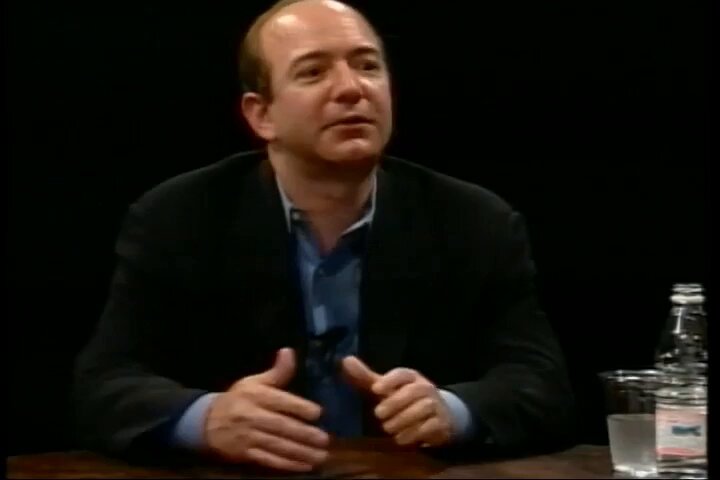
Jeff Bezos explains the heavy-eater test behind Amazon Prime. The finance model said the idea looked "horrifying." Amazon would offer "unlimited shipping." No minimum order threshold. A customer could buy "a single $20 item" or "a single $10 item" and still get "free two-day shipping." Then Bezos names the...

337,382 просмотров • 21 дней назад •via X (Twitter)

Комментарии: 0

Нет доступных комментариев

Здесь появятся комментарии из оригинального поста
Похожие видео

Jeff Bezos just compressed the entire AI race into one sentence. It has nothing to do with technology. Bezos: “Think about the things that are not going to change over 10 years and those are probably the big things.” Not a word about models. Not a word about compute. Just the oldest truth in commerce, dressed in the quietest language possible. The whole industry is sprinting to predict the next disruption. Bezos is pointing at what has never been disrupted. Bezos: “10 years from now customers are still gonna want low prices. I know they’re still gonna want fast delivery, and I just know they’re still gonna want big selection.” Cheaper. Faster. More. Those are not preferences. Those are instincts. Hardwired before we had fire, let alone software. Bezos: “It’s impossible to imagine a scenario where 10 years from now a customer says, ‘I love Amazon, I just wish the prices were a little higher.’” That sentence has never been spoken in the entire history of human commerce. Now pull every headline and every hype cycle out of AI. Look at what remains. Intelligence approaching free. Labor approaching free. Delivery approaching instant. The most advanced technology in human history is not chasing the future. It is chasing the oldest demands the species has ever had. Bezos: “When you identify the big things, you can tell they’re worth putting energy into because they’re stable in time.” You do not need to outrun the market. You do not need to outpredict it. You need to see the thing it has always wanted and build into it until nothing on earth can move you. The future was never a mystery. It was always just the past, moving faster.

Dustin

26,566 просмотров • 2 месяцев назад

Jeff Bezos explains to Alexandria Ocasio-Cortez how billionaires are created: providing at least a billion dollars in value to society -- the opposite of exploitation. Bezos: "Let me give you a simple example. Let’s say you start a burger joint, and you have 10 employees, and you make a little bit of money.” SORKIN: “Right.” Bezos: “Until you have — this is — this just one — one outlet. And by the way, these are the most delicious burgers in the world. People love your burgers, Andrew. And so then, you open a second outlet —” SORKIN: “Right.” Bezos: “— and now you’re making a little bit more money, and you have 20 employees. Nd you open a third outlet. By the time you’ve opened a thousand outlets, you are a billionaire.” SORKIN: “Right.” Bezos: “And by the way, this is a real life story, it happens all the time, it’s In-N-Out Burger, it’s Raising Cane’s Chicken. At what point did that money all of a sudden become unethical, or it didn’t? There was one outlet, and then there were two, and then there were three. What you’re doing — the way — the way you make a billion dollars, or a hundred million dollars, or 10 million dollars, or anything, is you create a service that people love. And if millions of people choose your service, you’re going to end up with a billion dollars.” SORKIN: “Right.” Bezos: “And you can, you know, just try it with a chicken franchise.” SORKIN: “Do you think though —” Bezos: “But your chicken has to be good.”

Tom Elliott

1,005,571 просмотров • 3 месяцев назад

Jeff Bezos just delivered the clearest definition of what artificial intelligence actually is. The market is still debating which department should own the AI budget. They’re asking the wrong question entirely. Bezos: “AI, modern AI is a horizontal enabling layer. It can be used to improve everything. It will be in everything. This is most like electricity.” This isn’t a software product. It’s the new utility grid of the global economy. Don’t treat it like a feature update. Treat it like the invention of alternating current. When a horizontal layer hits the board, it doesn’t improve a single vertical. It violently rewrites the baseline physics of every industry it touches. The companies that survive this decade won’t be the ones that bought a new AI tool. They’ll be the ones that ripped out their entire infrastructure and rewired the execution engine to run on the new grid. Bezos: “Because we are literally working on a thousand applications internally. I guarantee you there is not a single application that you can think of that is not going to be made better by AI.” The standard enterprise strategy is to launch one or two safe, isolated AI pilots and test the waters. You don’t pilot a horizontal enabling layer. You saturate the board immediately. Amazon isn’t building a single monolithic chatbot. It’s deploying a thousand specialized execution loops across every friction point in the empire. If your deployment strategy isn’t total saturation, you’re already bleeding margin to someone whose is. Interviewer: “What is it that you’re doing at Amazon?” Bezos: “AI. It’s 95% AI.” The standard CEO delegates automation strategy to a mid-level committee while focusing on quarterly earnings. The operator commanding a trillion-dollar supply chain is spending 95 percent of his personal bandwidth on a single vector. That is the market signal. If the leader of your organization isn’t driving algorithmic integration from the top down with everything they have, the company is already dead. It just hasn’t received the memo yet.

Dustin

404,830 просмотров • 5 месяцев назад

Jeff Bezos explains the “releasing the work” framework he used to build Amazon In the early days of Amazon, Jeff Bezos had too many ideas. Then Jeff Wilke, a new Amazon executive at the time, told his boss, “Jeff, you have enough ideas to destroy Amazon.” “This was just a shocking idea for me,” Bezos recalls. “As a founder, I had the great luxury of always being able to hire my tutors. I would hire these experienced, senior executives . . . And I would listen to them and they would teach me.” When Bezos asked Wilke what he meant by this, Wilke responded, “You have to release the work at the right rate so that the organization can accept it.” Bezos reflects on this point: “Every time I released an idea, I was creating a backlog of work in process. And because it was just stacking up, it was adding no value. In fact, it was creating distraction . . . This sounds so obvious, but it was not obvious to me at the time. And this was a profound insight for me. So I started prioritizing the ideas better, keeping lists of them, and keeping ideas to myself until the organization was ready for the ideas.” He continues: “I also started figuring out how to build an organization that can be ready for more ideas. That’s about having the right senior team and leadership and giving those people the executive bandwidth so they could do more ideas per unit of time. And that is what we built. We built a company that’s very good at inventing and doing more than one thing at a time. And as the company gets bigger, you do want to be able to do more than one thing at a time. But that idea of ‘releasing the work’ was very profound for me. It made us operationally more effective while still being inventive.” Video source: Reuters (2025)

Startup Archive

675,343 просмотров • 10 месяцев назад

Jeff Bezos on why too many ideas can destroy a company, and the discipline that built Amazon's inventive edge: "Jeff, you have enough ideas to destroy Amazon." That's what senior executive Jeff Wilke told Bezos after just one year of working together. Bezos was confused. He pushed back: "What do you mean?" Wilke was a manufacturing expert. He explained it simply: Every new idea Bezos released created a backlog. Work piling up, adding no value, creating distraction instead. The fix wasn't to stop having ideas. It was to control when they came out: "You have to release the work at the right rate that the organisation can accept it." So Jeff Bezos changed how he operated. He started keeping lists, holding ideas back, and waiting until the organisation had the bandwidth to absorb them. But then he flipped the problem entirely. He asked: "How do I build an organisation that's ready for more ideas?" His answer was structural: get the right senior team, give leaders real executive bandwidth, and build a company capable of running multiple bets at once. And there's a benefit he didn't expect. Slowing down made the ideas themselves better: "If you are releasing the ideas through time, it forces you to prioritise them better. You end up sharpening the ideas better." The constraint becomes a filter. The ideas that survive the wait are the ones worth acting on. The result? Faster execution, less distraction, and better ideas.

Big Brain Business

814,416 просмотров • 5 месяцев назад

Jeff Bezos on why stress is almost always a sign that you're avoiding action: When times are rough, Bezos doesn't talk about willpower or pushing through. He reframes where stress actually comes from. "I find if I'm stressed about something, it's usually because I'm not doing anything about it," he says. For Bezos, stress is information. He treats it as a physical signal worth paying attention to: "If I'm stressed about something, I'm trying to figure out why am I stressed? I'm listening to my body as a signal that something is awry." And the relief comes from simply starting to move on it: "The stress goes away the second I take the first step of identifying the source of the stress. Why am I stressed about this? What's going on?" The next step is to stop carrying it alone. Bezos talks to someone, and more specifically, he looks for allies: "If you can find friends who are interested in similar things or want to help you solve a problem, problem solving is inspiring for me all by itself." This is where the shift happens. Once Jeff Bezos has people around him, the same situation that once felt heavy becomes something he enjoys: "There's nothing more fun than getting in a room with a group of inventors and saying, 'Look, here's the problem. Let's invent a solution to it.' And as soon as you start doing that, I find that it turns from something that might create stress into something that creates fun."

Big Brain Business

43,146 просмотров • 2 месяцев назад

Jeff Bezos just told you where all of Earth’s factories are going. Off the planet. Bezos: “If we want to keep growing our civilization and using more energy per person, we’re eventually going to have to move all of our heavy industry off Earth.” Not a thought experiment. An engineering conclusion. One he has held since childhood. Decades on the same problem. The same answer every time. Earth is too small. Not too small for today. Too small for what today becomes. Every year the species consumes more energy. More compute. More materials. More of everything. The curve does not flatten. It never has. It never will. The planet has a hard ceiling. Fixed energy. Fixed land. Fixed resources. A closed system with a growing appetite. You do not solve that by shrinking the appetite. You solve it by expanding the system. Bezos: “We have unlimited energy in space and unlimited material resources in space.” Unlimited. Not abundant. Not plentiful. Unlimited. The Sun outputs more energy in one second than humanity could burn in a million years. The asteroid belt holds more raw material than every mine ever dug on Earth. The Moon alone carries enough helium-3 and rare earth minerals to fuel industries that do not yet have names. All of it sitting there. Untouched. While nations bleed each other over the scraps. Bezos: “We can start to build factories in space. We can start to build data centers in space.” Factories that produce zero pollution on Earth. Data centers that draw zero power from the grid. Heavy industry that generates zero waste in the atmosphere. Not because the waste disappears. Because the waste happens somewhere it does not matter. Bezos: “This planet is so beautiful and so unusual. This is the one that we’re going to want to protect. There’s no planet B.” The environmentalists and the industrialists have been fighting the same war for fifty years. Grow or protect. Build or conserve. Economy or ecology. Bezos is telling you the war was always false. You do not choose between growth and preservation. You move the growth off-world and the preservation happens automatically. Earth becomes the residential zone. The garden. The one place where biology gets to breathe. Space becomes the factory floor. The power plant. The data center. The refinery. Every smokestack. Every cooling tower. Every server farm drawing gigawatts from the grid. All of it belongs in the vacuum where energy is free and there is no ecosystem to damage. Bezos: “I don’t know how soon it will happen. It’s a job that I won’t finish. Probably my children’s children won’t finish.” He is building something he will never see completed. That is not a business plan. That is a cathedral. The kind of project that takes generations. Where the person who lays the foundation never stands in the finished building. Most founders build for an exit. Bezos is building for a timeline that outlives his grandchildren. The interviewer called it fantastical. Bezos had one response. Bezos: “Go back in time a hundred years and show somebody your iPhone.” Everything that exists today was once fantastical. Flight. Satellites. The internet. A phone carrying the sum of human knowledge in your pocket. Every single one was impossible until the year it was not. Orbital factories sound like science fiction the same way video calls sounded like science fiction in 1950. The pattern never changes. Someone describes the future. Everyone calls it crazy. Then it ships. Then no one can explain what came before. Bezos is not guessing. He is reading the same pattern that has held every single time. And betting his life that this one is no different.

Dustin

30,154 просмотров • 5 месяцев назад