Video yükleniyor...

Video Yüklenemedi

Ana Sayfaya Dön

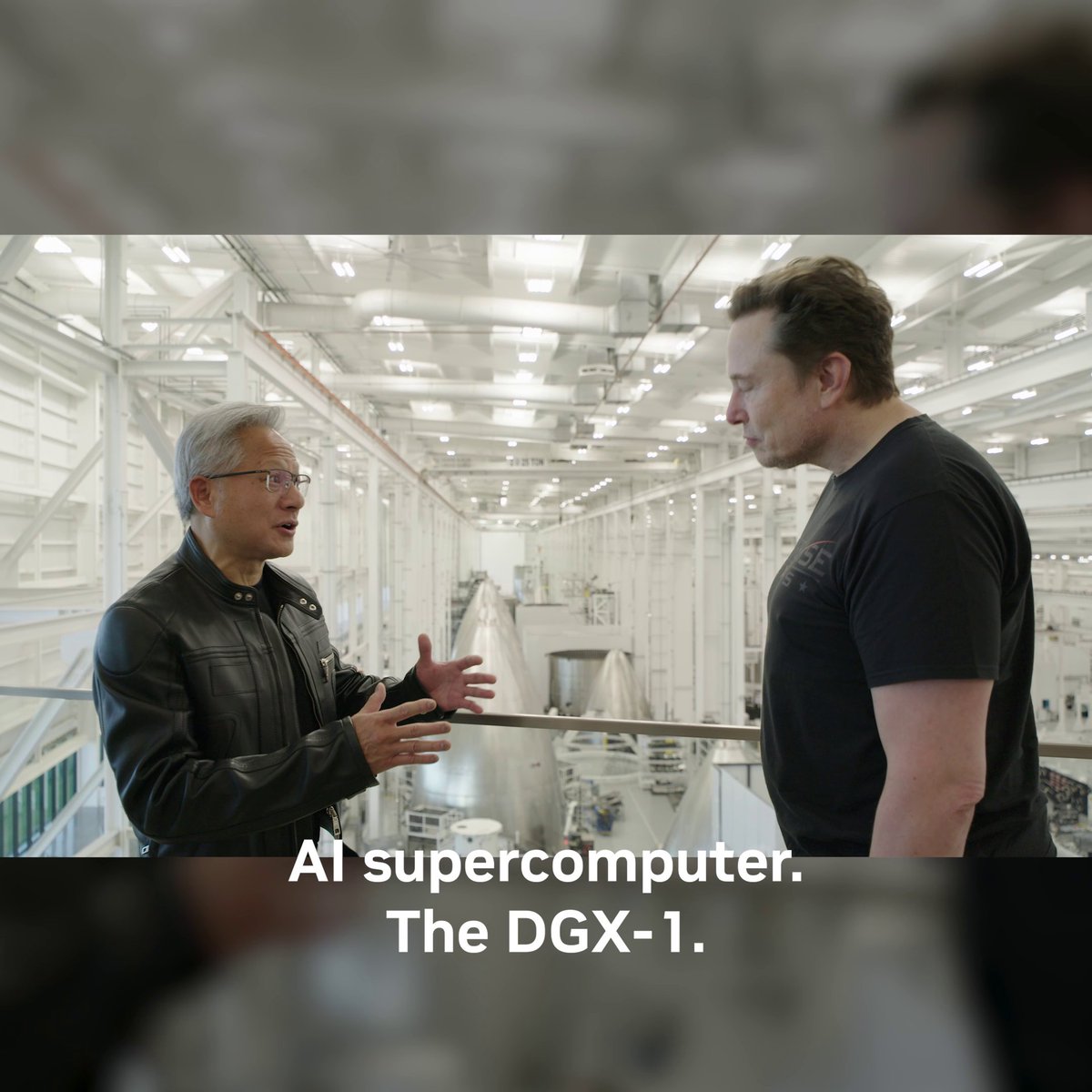
Jensen Huang said Grok 5 will be 7 Trillion parameter model. On time to train, with the training window fixed at 1 month, the new Vera-Rubin GPU system of Nvidia needs 1/4 the number of systems compared with Blackwell to train the same frontier model. “factory throughput” improves by...

165,770 görüntüleme • 6 ay önce •via X (Twitter)

0 Yorum

Yorum bulunmuyor

Orijinal gönderinin yorumları burada görünecek

Benzer Videolar

Jensen Huang just doubled NVIDIA's demand forecast to $1 Trillion through 2027 🤯 Then spent two hours explaining why that number is conservative… Here's everything today from GTC: - NemoClaw: NVIDIA's open-source enterprise AI agent stack built around OpenClaw. Jensen called OpenClaw "the operating system for personal AI" and said every company needs a strategy for it. - Space-1: NVIDIA is putting Vera Rubin data centers in orbit. Not a concept. An actual system being designed for space deployment right now. - DLSS 5: 3D-guided neural rendering that blends raw graphics with generative AI. Jensen called it the future of real-time rendering. - AWS: Deploying 1 million+ NVIDIA GPUs starting this year. Azure was the first hyperscaler to power up Vera Rubin. - Vera Rubin: NVIDIA's next-gen AI supercomputer. 10x more performance per watt than Blackwell, 700 million tokens per second, shipping later this year. - Groq 3 LPU: First chip from NVIDIA's $20B Groq acquisition. A purpose-built inference accelerator that ships Q3. NVIDIA now owns training AND inference. -Feynman: The architecture after Rubin, coming 2028. New GPU, new LPU, new CPU. NVIDIA is on a 12-month chip cadence and the treadmill never stops. - Autonomous driving: BYD, Hyundai, Nissan, and Geely building Level 4 vehicles on NVIDIA. Uber deploying NVIDIA-powered robotaxis across 28 cities by 2028. The man doubled his demand forecast to a trillion dollars, announced data centers in space, and closed the show with a robot singing country music. This is NVIDIA's world. Everyone else is just renting compute in it.

Josh Kale

45,875 görüntüleme • 4 ay önce

The most overlooked part of the SpaceX IPO thesis is the model and most people are completely missing it (Save this) Everyone has been focused on the Anthropic compute deal and the Colossus revenue because those are numbers you can put in a spreadsheet. Six months ago, xAI was competing reasonably well on model performance but was not clearly on the frontier. Then SpaceX exercised its option to acquire Cursor for $60 billion, the largest startup acquisition in history just days after completing the largest IPO in history at $75 billion. Cursor is a team of 700 to 800 people, was on track to exit 2026 at up to $10 billion in revenue, had millions of professional developers using it daily, and had already built a team with the genuine potential to compete at the frontier, the one thing holding them back was compute. SpaceX just gave them the largest GPU cluster in the world to work with. Grok 4.3, a 1.5 trillion parameter model, is currently training with Cursor's proprietary coding data being injected directly into pre-training, not just fine tuning which is a fundamentally more powerful integration than anything the market is currently modeling. The prior version, Grok 4, was already on the Pareto frontier as of 10 to 12 days ago, the most intelligent 500 billion parameter model in the world, sitting alongside Google Gemini, Anthropic, and OpenAI as one of only four systems at the true frontier. Composer 2.5, the previous Cursor model was Pareto dominant in coding tasks just before the acquisition closed, meaning SpaceX inherited a model that was already best-in-class in the highest-value AI use case in the market. The AWS parallel is the one everyone keeps missing. Bezos built data center capacity for Black Friday, sat on idle infrastructure the rest of the year, and monetized it into what was at the time the most profitable technology business in history and investors hated it in 2009 and 2010 because he was burning free cash flow on capacity that had no obvious revenue yet. SpaceX is in exactly that position, it built Colossus for xAI's own training needs, is monetizing excess capacity to Anthropic at $1.25 billion per month across 220,000 Nvidia GPUs, and has reportedly secured up to 20% of Nvidia's early Vera Rubin allocation, giving it the most powerful and scarcest GPU infrastructure in the world during the critical window when those chips are hardest to get. The $60 billion Cursor acquisition closed at a moment when SpaceX had essentially unlimited compute, a team already at the frontier, and a product with deep enterprise distribution, three things no other model lab had simultaneously when it was at this stage. The market is pricing the compute business conservatively and ignoring the model call option entirely, and coding is the fastest path to AGI, once you are on the Pareto frontier with that compute, revenue scales fast. Anthropic went from negligible revenue to $30 billion annualized in under 18 months and that is the existence proof. Bullish on SpaceXAI and Elon Musk

Milk Road AI

69,446 görüntüleme • 1 ay önce

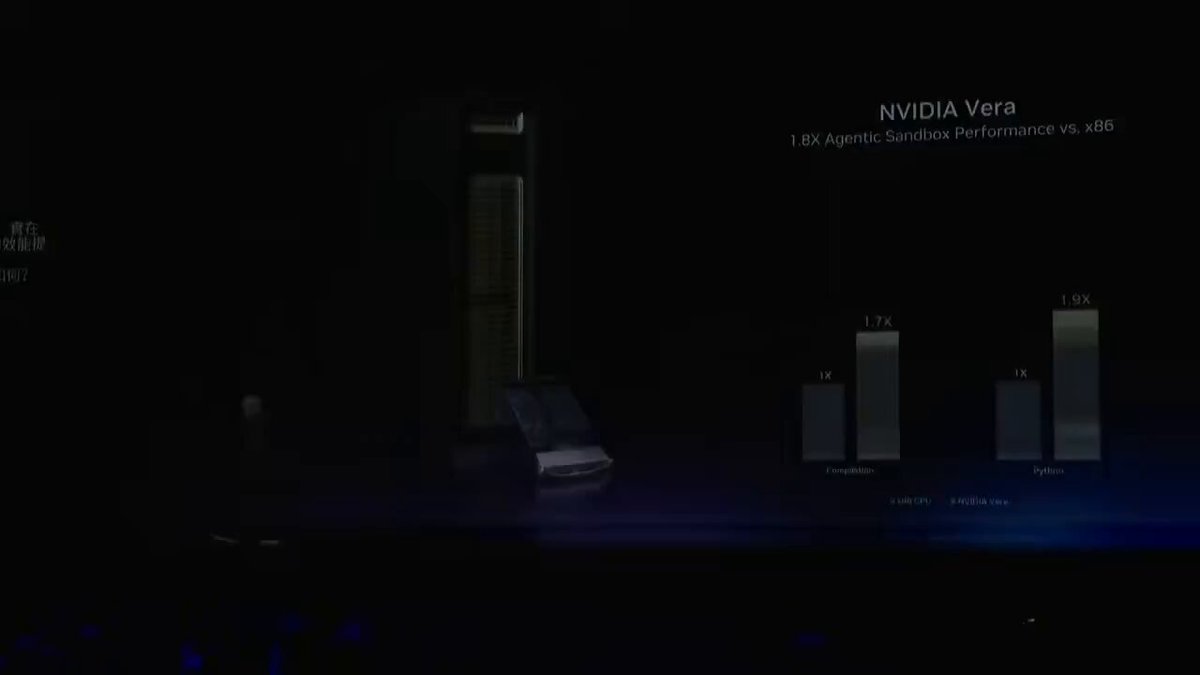
Jensen Huang just identified the next $200 billion market (Save this). The shift starts with a observation about agentic AI that changes everything about infrastructure. In the era of training and inference, the GPU was everything while CPU was a traffic cop, scheduling work, managing memory, dispatching tasks while the GPU did the heavy lifting. Agentic AI breaks that model entirely. An AI agent does not just run a single inference pass but rather it plans, calls tools, executes code in sandboxes, retrieves data from multiple sources and loops through complex multi-step reasoning sequences often thousands of times per second at scale. Every one of those operations runs through the CPU and the GPU sits idle waiting for the CPU to prepare the next task, supply the right context and execute the retrieval and tool calling logic fast enough to keep the accelerators fed. The CPU is now the conductor and the GPU is the orchestra and the bottleneck is the conductor falling behind. This is showing up in production AI factory utilization right now, which is exactly why Jensen built Vera from scratch rather than licensing x86. Vera achieves 40% lower peak memory latency than x86, 50% faster core to core communication, and 1.8 times the agentic sandbox performance of current x86 processors on a purpose-built architecture designed around the agentic loop. Now here is where the investment thesis gets interesting. The obvious beneficiary is Nvidia itself, and that thesis is real. Nvidia's CFO has guided for nearly $20 billion in Vera CPU revenue this fiscal year alone, a market Nvidia had zero presence in just three years ago. Intel held 60% of server CPU market share as recently as Q4 2025 and that transition is now happening at a pace Intel structurally cannot respond to. But the deeper question is, what architecture is Vera actually built on? Vera's Olympus cores are ARM compatible and every single Vera CPU deployed in every Vera Rubin rack in every data center in the world runs on ARM architecture. And ARM Holdings collects a royalty on every one of them. ARM does not make chips but rather licenses the instruction set architecture and CPU core designs that others build on top of. Every time Nvidia ships a Vera CPU, every time a hyperscaler deploys a Vera Rubin rack, every time an enterprise qualifies Vera for their AI factory, ARM earns a royalty. The secular tailwind here is almost perfectly constructed for ARM's business model. Amazon's Graviton, Microsoft's Cobalt, Google's Axion, Apple's silicon stack, and Qualcomm's data center push all run on ARM. And now Nvidia's Vera, which is projected to displace Intel as the largest server CPU supplier by revenue in a single fiscal year, is ARM. ARM's royalty rate on high end server chips is estimated at roughly 1 to 2% of chip selling price. At $5,000 per Vera CPU and 4 million units projected for FY2027, that is a royalty line growing from near zero to potentially $400 million to $800 million annually from Nvidia's data center CPU business alone before counting Amazon, Microsoft, Google, Apple, and Qualcomm. The total ARM addressable royalty base across all the silicon it already licenses is compounding at a rate that the current $130 billion market cap does not fully reflect. Jensen's CPU thesis is the most underappreciated catalyst in ARM's fundamental story, and the royalty compounding has barely started. Come join Milk Road Pro and get our full ARM royalty model and our entire AI trade thesis. Link below!

Milk Road AI

11,819 görüntüleme • 1 ay önce

Nvidia just spent $4 billion on a technology 99% of people have never heard of. But in 3 years, every AI data center on Earth will need it. And Nvidia just LOCKED UP the supply. Here's what happened: Nvidia invested $2 billion in Coherent and $2 billion in Lumentum. You probably never heard of these companies. They make photonics technology. Systems that transmit data using LIGHT instead of electricity. Sounds like sci-fi. But this is the most important infrastructure bet in AI right now. Here's the problem Nvidia just solved for itself: AI data centers are hitting a wall that has nothing to do with chips, energy, or money... Copper wiring is dying. Every data center on Earth moves data between GPUs using copper cables. But at the speeds AI now demands, copper physically cannot keep up. Signal degrades. Heat explodes. Power consumption skyrockets. Right now, 30% of the electricity in an AI data center is wasted just MOVING data from point A to point B. An MIT researcher said: "Copper's not going to cut it. It gets too hot. Too much power consumption and loss." Jensen Huang admitted it himself too: "We use copper as far as we can, about a meter or two. But where data centers are the size of a stadium, we need something else." That something else is photonics. Replacing copper with laser-powered fiber optics built directly into the chip. The numbers are insane: - 3.5x more power efficient - 10x better network reliability - Data moving at 102 terabits per second Wells Fargo estimates the photonics market will hit $10-12 billion by 2030. And Nvidia just bought privileged access to the two companies that make the advanced lasers every single one of these systems will need. This is the Nvidia playbook on repeat. They did this with CoreWeave. Invested $2 billion, locked up GPU capacity, created a dependent customer. They did this with memory suppliers. Secured HBM allocations years in advance while competitors scrambled. Now they're doing it with photonics. Invest early. Lock up supply. Make the entire ecosystem dependent on companies that are dependent on Nvidia. By the time competitors realize photonics is the bottleneck, Nvidia already OWNS the supply chain. Every data center, AI factory, and GPU cluster will need this technology to function at scale. Nvidia will become even more important.

Ricardo

640,623 görüntüleme • 4 ay önce

Karpathy told Dwarkesh that a 1 billion parameter model, trained on clean data, could hit the intelligence of today's 1.8 trillion parameter frontier. That is a 1,800x compression claim. The math behind it is more defensible than it sounds. When researchers at frontier labs look at random samples from their training corpus, they see stock ticker symbols, broken HTML, forum spam, autogenerated gibberish. Not Wikipedia. Not the Wall Street Journal. The actual pretraining dataset is mostly noise, and the model is burning parameters to vaguely remember all of it. One estimate pegs Llama 3's information compression at 0.07 bits per token. Well-structured English carries around 1.5 bits per token of real information. The trillion-parameter model is holding a roughly 5% resolution image of the internet it trained on. So when a lab ships a 1.8 trillion parameter model, the overwhelming majority of those weights are handling rough memorization. They are compression overhead for a noisy training set, taking up capacity that could be doing reasoning instead. Karpathy's proposal is to separate the two. Build a cognitive core: a small model that contains only the algorithms for reasoning and problem-solving, stripped of encyclopedic memorization. Pair it with external memory the model queries when it needs a fact. A 1 billion parameter reasoner plus retrieval beats a 1.8 trillion parameter model trying to do both. The data already supports this direction. GPT-4o runs at roughly 200 billion parameters and outperforms the original 1.8 trillion GPT-4. Inference costs for GPT-3.5 level performance fell 280x between 2022 and 2024, driven almost entirely by smaller, cleaner, better-architected models. The trend line is pointing where Karpathy says it should. The real implication for anyone tracking the AI trade: data quality is the actual constraint. The companies winning the next phase will be the ones who figured out what to train on, and what to throw away.

Aakash Gupta

508,078 görüntüleme • 3 ay önce