Загрузка видео...

Не удалось загрузить видео

На главную

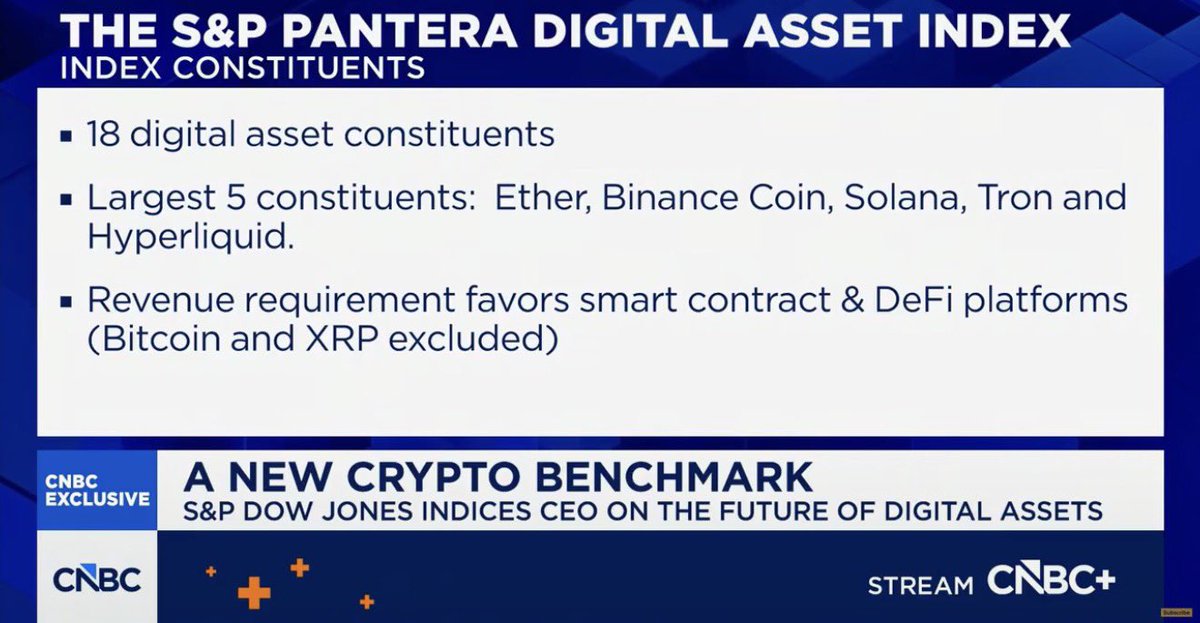
JUST IN: S&P just launched its first ever crypto index and Bitcoin isn't in it. CEO Kathy Clay says $BTC was excluded because "it's really not one of those revenue generating protocols" The index holds 18 tokens led by $ETH, $BNB, $SOL, $TRX, and Hyperliquid.

771,670 просмотров • 4 дней назад •via X (Twitter)

Комментарии: 0

Нет доступных комментариев

Здесь появятся комментарии из оригинального поста

Похожие видео

Tomorrow a company that holds close to 5% of all ethereum is set to join the russell 1000. Once done, index funds that have never had an opinion on crypto will be forced to buy it. Nobody in those funds chose this, a benchmark rule did it for them 👇 ◢ How index inclusion actually works Getting added to a major index is one of the strongest demand events in markets, and it has nothing to do with whether the company is good. Funds that track the russell 1000 have to hold what the russell 1000 holds, or they stop tracking it. So, when a stock joins, every passive fund benchmarked to that index becomes a forced buyer, at whatever the price is, on the schedule the index sets. Passive vehicles tend to hold something like 20 to 25% of a large-cap stock, which for this one points to roughly $2B of buying that arrives because a rule says it must. ◢ The part that makes it crypto Bitmine is not a normal company that happens to get indexed, it's an ethereum treasury, sitting on millions of $ETH as its core balance sheet. So the chain runs like this: the index adds the stock, passive funds are forced to buy the stock, and the stock is essentially a wrapper around a giant pile of ETH. The result is that ordinary equity index money ends up with ethereum exposure without a single person deciding they wanted it. No ETF approval, allocation vote or opinion required. ◢ A side door, not a front door Everyone in crypto watches the spot ETF as the official entrance for institutional money, the thing that needs sign-off and gets headlines. Index inclusion is the entrance nobody guards. strategy walked a bitcoin treasury into the nasdaq 100. Coinbase took a crypto exchange into the s&p 500. now an ethereum treasury is stepping into the russell 1000. Each time, the underlying business didn't change. what changed is who was suddenly required to own it. ◢ Why front-running it is harder than it looks The mechanism is concrete, but the easy trade around it usually isn't. The inclusion isn't final until the reconstitution actually closes, so the flow is conditional, not guaranteed. The stock is already down around 50% on the year, which is a reminder that a one-time wave of buying doesn't repair something tied to ETH's price and to confidence in the treasury model. And there's a quieter problem: "diversified" index funds are now obligated to hold a leveraged, single-asset crypto bet that most of their investors would never have picked on purpose. What it means that the biggest new buyer of a crypto-linked company is a rule, not a person, and that millions of people now hold a slice of ethereum because an index told their fund to?

Onur 🍌🦍

14,337 просмотров • 1 месяц назад