Loading video...

Video Failed to Load

Go Home

🚀Just launched: Amazon Q, the most capable GenAI-powered assistant is generally available today: Customers are using Q to transform how their teams get work done. When employees chat with Amazon Q, it provides immediate, relevant information and advice to help streamline tasks, speedup decision-making, and help spark creativity and...

25,216 views • 2 years ago •via X (Twitter)

0 Comments

No comments available

Comments from the original post will appear here

Related Videos

Remember when we as football fans had to rely solely on paper draft guides, sports radio rumors, and gut feelings to predict draft day decisions? Excited that fans now have access to the NFL's Draft IQ powered by Amazon Web Services ( – the most sophisticated tool yet for following the NFL draft and your favorite team's strategy. Draft IQ is built on Amazon QuickSight, our cloud business intelligence service that makes it easy to analyze and visualize massive amounts of data. QuickSight processes real-time data to give fans unprecedented insight into team decision-making, updating the entire draft landscape every five minutes. You can explore team needs, draft capital, and front office tendencies through personalized team dashboards, plus get AWS-powered machine learning predictions about potential trades and picks. During draft week, fans can track picks, prospects, and Next Gen Stats in real-time. We're also introducing Amazon Q Business integration, our generative AI-powered assistant. Q Business leverages large language models to understand and respond to natural language queries, allowing fans to ask detailed questions about draft prospects, team strategies, and historical draft data. It can provide AI-generated insights based on the same historical Next Gen Stats research data that powers Draft IQ, giving fans a new way to engage with the draft experience (check out the example below). Can't wait to see what stories the data tells us as teams make their selections and excited to dig into the Giants' data myself :)

Andy Jassy

102,869 views • 1 year ago

Today marks General Availability of AgentCore, a set of infrastructure building blocks for developers and companies to build secure, scalable agents. When we first started AWS, the vast majority of developers were spending most of their time on the undifferentiated heavy lifting of infrastructure instead of what differentiated their feature. So, we solved that problem by building primitive building blocks like compute and storage and database that would allow teammates and customers to quickly build and deploy new experiences without having to reinvent the wheel each time. We realized the same thing was happening with AI agents. It's too difficult and it's slowing customers down. That's why we created AgentCore, a set of services to build, deploy, and operate highly capable agents using any framework or model, with enterprise-grade security and scalability. These building blocks (like serverless secure runtime, memory, observability, a gateway that does MCP translation, etc) help customers tackle some of the biggest challenges of going from prototype to production, much more quickly, securely, and scalably. AgentCore has been in preview for several weeks, and customers have been quite excited about it. The AgentCore SDK has already been downloaded over a million times and we're seeing transformative results, such as Cohere Health expecting to reduce medical review times by 30-40% in highly regulated healthcare, and teams at Cox Automotive and Experian are embracing its flexibility to deploy and operate agents at scale. Inside Amazon, our Amazon Devices Operations & Supply Chain team is using AgentCore to develop an agentic manufacturing approach where AI agents work together to automate manual processes – turning what used to be days of engineering time into processes that take under an hour with high precision. Just like AWS changed how companies build and scale applications, we believe AgentCore will do the same for AI agents, enabling the next generation of innovation.

Andy Jassy

24,990 views • 9 months ago

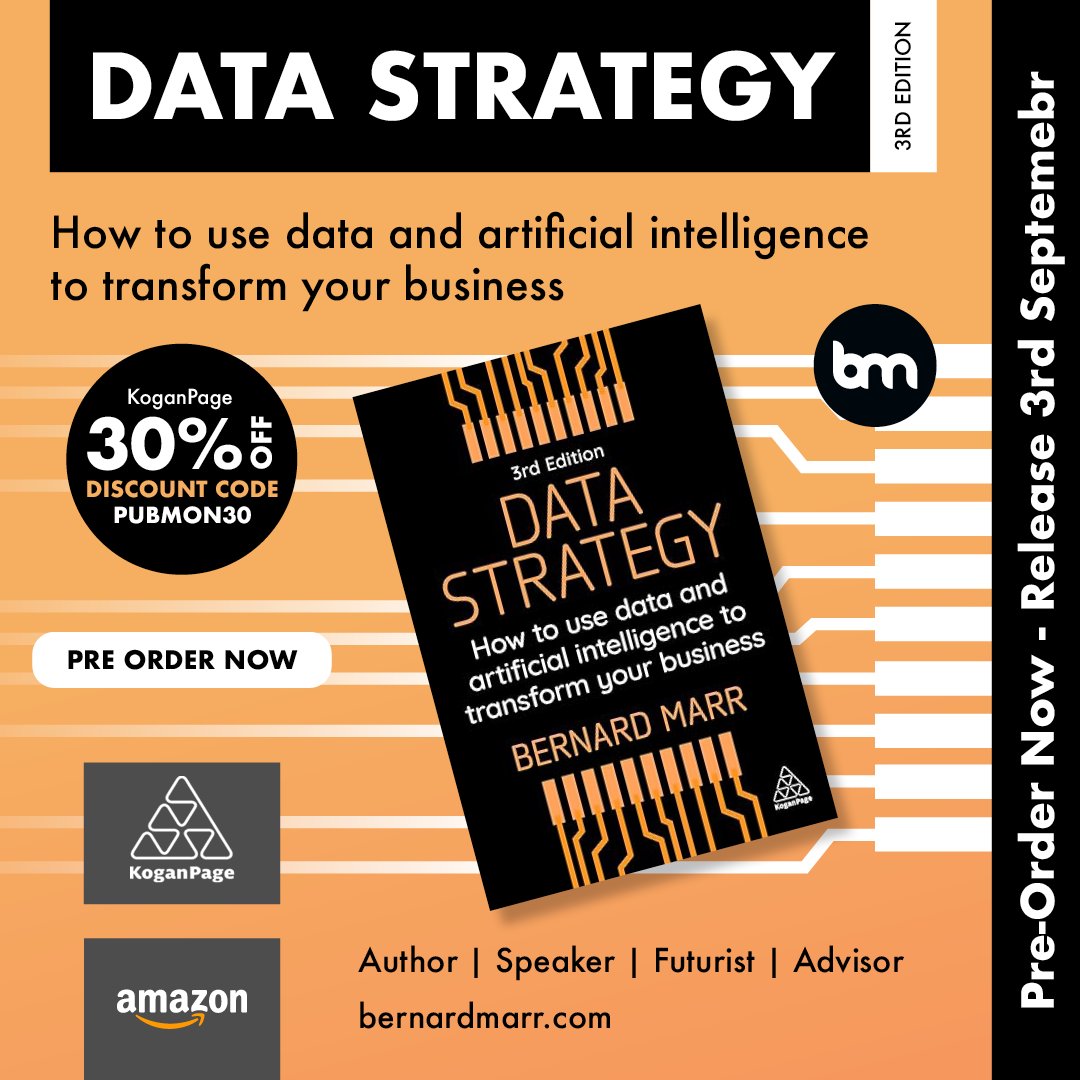
🚀 My New Book is Here: Data Strategy (3rd Edition) 🚀 I’m thrilled to share the release of my latest bestselling book, Data Strategy: How to Use Data and Artificial Intelligence to Transform Your Business. Every business today needs data to survive - but simply having data is not enough. What matters is how you use it. A well-designed data strategy is the key to unlocking value, driving insights, and giving your organisation the competitive edge it needs to thrive in the digital economy. From small organisations to global enterprises, I’ve seen first-hand how a data-driven approach can transform operations, improve decision-making, and unlock entirely new opportunities. That’s why I’ve poured my experience into this book — to help leaders and teams build strategies that don’t just talk about data, but actually deliver measurable impact. 🔍 In this third edition, I’ve expanded the book to reflect the latest developments in data and AI, including: ✅ Generative AI and its role in shaping business innovation. ✅ Synthetic data and how it can accelerate AI adoption. ✅ The potential of quantum computing and what it means for the future of data. ✅ Expanded guidance on cybersecurity, regulations, and ethics in a data-driven world. This isn’t just a theoretical framework - it’s a practical guide to collecting, managing, and using data effectively in order to drive growth, innovation, and long-term success. Whether you’re leading a start-up or a multinational, Data Strategy will equip you with the tools you need to stay ahead in a rapidly evolving landscape. 📖 Pre-order your copy today: 👉 Amazon - 👉 Kogan Page - I can’t wait to hear how this book helps you craft your own data-driven strategy and transform your business for the future.

Bernard Marr

10,980 views • 10 months ago

Microsoft presents Windows Agent Arena Evaluating Multi-Modal OS Agents at Scale discuss: Large language models (LLMs) show remarkable potential to act as computer agents, enhancing human productivity and software accessibility in multi-modal tasks that require planning and reasoning. However, measuring agent performance in realistic environments remains a challenge since: (i) most benchmarks are limited to specific modalities or domains (e.g. text-only, web navigation, Q&A, coding) and (ii) full benchmark evaluations are slow (on order of magnitude of days) given the multi-step sequential nature of tasks. To address these challenges, we introduce the Windows Agent Arena: a reproducible, general environment focusing exclusively on the Windows operating system (OS) where agents can operate freely within a real Windows OS and use the same wide range of applications, tools, and web browsers available to human users when solving tasks. We adapt the OSWorld framework (Xie et al., 2024) to create 150+ diverse Windows tasks across representative domains that require agent abilities in planning, screen understanding, and tool usage. Our benchmark is scalable and can be seamlessly parallelized in Azure for a full benchmark evaluation in as little as 20 minutes. To demonstrate Windows Agent Arena's capabilities, we also introduce a new multi-modal agent, Navi. Our agent achieves a success rate of 19.5% in the Windows domain, compared to 74.5% performance of an unassisted human. Navi also demonstrates strong performance on another popular web-based benchmark, Mind2Web. We offer extensive quantitative and qualitative analysis of Navi's performance, and provide insights into the opportunities for future research in agent development and data generation using Windows Agent Arena.

AK

19,684 views • 1 year ago

‼️IRREFUTABLE FACTS ABOUT Q • ANONS • JFK JR • AND "THE STORM"‼️ ---------- 🎯 "The storm is upon us" tweet Q told us to look for came directly from the OG John F. Kennedy Jr. account [Patriot1776🇺🇸] - which at the time was the most popular OG anon account. 🎯 [Patriot1776🇺🇸] used Trump's official POTUS seal as its avatar and an original photograph - uncirculated at the time - as it's header/background. this account was nuanced, trusted and was "Q'd" more than once. 🎯 according to Q - "THE TWEET" was to be posted when "The Storm" began. 🎯 ALL ANONS were purged from the internet on January 6, 2021 - this was "The Storm". 🎯 Patriot1776🇺🇸's last TWEET before being purged was sent at 7:17 PM • Jan 6, 2021 [timestamp] - and was EXACTLY what "The Storm" tweet was meant to be - down to the dots. ‼️THE STORM TWEET WAS A DECLARATION - A MOST IMPORTANT MARKER TO THE PLAN THAT MOST MISSED‼️ 🎯 WE [ANONS] WERE SUPPOSED TO LOOK - AND WE DID - BUT ALL OG's WERE PURGED THAT DAY - SO WE WERE UNABLE TO CONFIRM FOR ALL PUBLICLY. WE WERE GONE. 🎯 Q said exactly, "Look to Twitter: Exactly this: "My fellow "Americans, the Storm is upon us......." 🎯 Q NEVER said, "Look to X..." 🎯 Q NEVER said, "Look to Trump's Twitter account..." 🎯 on 12/12/2018 - Q conducted a Q&A session with anons where 2 different anons asked Q the same question, "is JFK Jr alive?". initially, Q answered no - the same question was asked five minutes later, but the word ALIVE was in all caps; Q answered yes. the links and responses below are still there today - and there's nothing anyone can do about it. you have a YES and a NO - and you just have to choose for yourself. 🎯 on November 2, 2021 - George Soros hired & paid a few hundred LARPS to gather at Dealey Plaza in Dallas where they posed as MAGA/Anons and held a fake rally for JFK Jr. that had nothing to do with MAGA, Q or anons. this was designed to make anons look unhinged, knowing we could not defend ourselves publicly - while simultaneously conflating Q with MAGA who were also infiltrated on January 6 - BUT were NOT purged from the internet. they infiltrated MAGA to turn them against Q - knowing that we had woken up the world. 🎯 REMEMBER - at this time anons were disappeared from the internet completely - we had no way to respond or reply to anyone anywhere as we were ALL deplatformed - not until almost a year later in February 2022 when Trump launched TruthSocial did we have a chance to post again publicly. it didn't matter, the damage was done, and was permanent - to this day. ----------

The Rubber Duck ™

16,095 views • 9 months ago

I'm proud to share that Glean has surpassed $300M ARR, just five months after crossing $200M and growing ~3x over the past 15 months. This is an exciting milestone for Glean, and it's a signal about where the enterprise AI market is heading. We’ve long believed the real challenge in enterprise AI is not access to models. It is grounding AI in how a company actually works: its people, knowledge, workflows, permissions, and systems. That’s even clearer now. The companies creating real value with AI are not just adopting better models. They are building systems that understand their business well enough to deliver reliable outcomes at scale. That is the real moat, and it is what we’ve been building at Glean: an unrivaled context layer for enterprise AI. That context has to work across the business, not just inside a single team or use case. We see that in how customers adopt Glean: more than 85% use it across five or more job functions. It also has to meet the security and governance demands of complex enterprises. We see that in who is choosing Glean: our Fortune 500 customer count nearly doubled year over year. And it has to make economic sense as usage grows. In our recent benchmark with Claude Cowork, Glean was preferred roughly 2.5x as often as off-the-shelf MCP tools and used 30% fewer tokens on average. Better context improves both quality and efficiency. I enjoyed talking with CNBC's Deirdre Bosa about this broader shift. In enterprise AI, the winners will not be defined by better models alone. They will be defined by who builds the strongest foundation for enterprise context. Thank you to our customers, partners, and team for helping us build the future of enterprise AI.

Arvind Jain

280,065 views • 1 month ago

Boom! Grok Tasks Make It One Of The Most POWERFUL Real-Time AI Systems In The World. — My How to Use Grok Tasks With Hidden Tools For Powerful Daily Output. Grok Tasks are customizable AI workflows that integrate a variety of tools to streamline daily activities, from research and analysis to creative planning and problem-solving. I have been using them for quite sometime and because of the vital heartbeat of news and first person data on X, it is the most powerful AI platform available. By combining Tasks with tools like web searches, X platform interactions, code execution, and media viewers, you can build efficient, automated processes. These tasks work by prompting Grok with a clear description of what you want to achieve, and Grok will intelligently call the necessary tools in sequence or parallel to deliver results. Here's a step-by-step guide to creating and using Grok Tasks: Step 1: Define Your Task Start by clearly outlining the daily activity or goal. Consider what inputs you have (e.g., a URL, a query, or an attachment) and what output you need (e.g., a summary, calculation, or visual analysis). Break it down into subtasks to identify tool needs. For example, if your task involves researching current events, note that you'll need search and browsing capabilities. Step 2: Review Available Tools Familiarize yourself with the tools Grok can access. Here's a quick overview: - Code Execution: Run Python code for calculations, data processing, or simulations using libraries like numpy, pandas, or sympy. - Browse Page: Fetch and summarize content from any website URL with custom instructions. - Web Search: Perform general internet searches, returning results with optional operators like site:. - Web Search With Snippets: Get quick, detailed excerpts from search results for fact-checking. - X Keyword Search: Advanced search for X posts using operators like from:, since:, or filter:. - X Semantic Search: Find semantically related X posts based on a query, with filters for dates or users. - X User Search: Locate X users by name or handle. - X Thread Fetch: Retrieve a full X post thread, including context like replies and parents. - View Image: Analyze an image from a URL or conversation ID. - View X Video: Extract frames and subtitles from an X-hosted video. - Search PDF Attachment: Query a PDF file for relevant pages using keyword or regex modes. - Browse PDF Attachment: View specific pages of a PDF with text and screenshots. Select tools that align with your task. Aim for a mix to handle data gathering, processing, and visualization. Step 3: Craft Your Prompt Write a detailed prompt to Grok describing the task. Include: - The overall goal. - Specific steps or subtasks. - References to tools if you want to guide the process (e.g., "Use web_search to find sources, then code_execution to analyze data"). - Any constraints, like dates or limits. Example prompt: "Create a Grok Task for my morning routine: Search recent X posts about tech news using x_keyword_search, fetch a key thread with x_thread_fetch, and summarize with browse_page on linked articles." Step 4: Submit and Interact Send your prompt to Grok. It will process the task by calling tools as needed, often in parallel for efficiency. Review the output and refine with follow-up prompts if required (e.g., "Expand on that using view_image for visuals"). Iterate to fine-tune the workflow for reuse. Step 5: Save and Reuse Once refined, note the prompt as a template for future use. You can adapt it for similar tasks, making Grok Tasks a habitual part of your day. Finding Grok Tasks To discover existing Grok Tasks or inspiration for new ones, use X searches with tools like x_keyword_search or x_semantic_search (e.g., query: "Grok Tasks examples" with mode: Latest). Browse community-shared threads via x_thread_fetch, or web_search for tutorials on xAI features. Prompt Grok directly: "Show me popular Grok Tasks for productivity." 1 of 3

Brian Roemmele

152,242 views • 6 months ago

HTML Artifacts are a big part of how I work with agents now. Artifacts can be more than just static files. When combined with agents, they can take action or help you take action. This unlocks all kinds of interesting ways to work with agents. This is clearly the future. Check out this writing and scheduler artifact I built in a few minutes. It uses a bit of HTML and JS. All the data is in markdown (Obsidian vaults), so the agent can access and modify it at any time. No DB needed. No sophisticated functionalities. The agent decides all that for me based on the skills, context, and memory it has access to. The best part about this simple stack is that all the important information stays with me. This has allowed me to build a recursive self-improving system and automations that can better tap into coding agents like Codex or Claude Code. I could have paid or built an entire app for scheduling posts, and there are so many of them out there. But I don't need to. I've realized a simple artifact does the job. And the simplicity of it is actually an advantage. Very little maintenance for very high returns on personalization, time, and efficiency. The other benefit of this is that I can add features as I please. That level of personalization feels magical, and we should all be pursuing more of it. All of this just keeps compounding. Of course, this example is just about writing. But I have similar artifacts for research, design, experimentation, evaluation, and so much more. And no, I didn't actually publish the post example I shared in the clip. It was just for demonstration purposes. I actually spend more time than this when writing together with agents. Lastly, having built my own agent orchestrator tool has made me realize that simplifying the tool stack is a superpower. If you are curious about how all this works, I will do a live session next week:

elvis

18,374 views • 2 months ago