Загрузка видео...

Не удалось загрузить видео

На главную

Kimi K2.7 Code just made Kimi K2.6 painfully outdated we tested Kimi K2.7 Code against Kimi K2.6, GPT 5.5, and Claude Opus 4.8 across Lorenz attractors, solar systems, and water waves in our previous comparison, Kimi K2.6 struggles with physical motion, now K2.7 gave the most realistic rendering of...

87,301 просмотров • 3 месяцев назад •via X (Twitter)

Комментарии: 0

Нет доступных комментариев

Здесь появятся комментарии из оригинального поста

Похожие видео

a moonshot engineer leaked the benchmark anthropic, openai and xai all buried the same week: kimi k3 beat opus 5, gpt-5.6 and grok 4.6 at $0.94 a task. stop paying anthropic $200 a month for opus 5 and openai $200 for gpt-5.6 when kimi does the same work for $8 the leak showed kimi k3 winning 9 of 12 categories against opus 5, gpt-5.6 and grok 4.6. within 48 hours all three labs quietly pushed pricing pages and one very specific comparison chart off their sites. nobody announced anything. they just deleted, which tells you everything the four numbers they scrubbed: cost per task · $0.94 vs $1.80 -> opus 5 charges $1.80 to finish one task. gpt-5.6 $1.04. grok 4.6 $0.61. kimi k3 $0.94 and it landed 487 of 500 clean -> anthropic is billing you double for a model that lost the benchmark it paid to promote the weights · free, sitting on huggingface right now -> the entire model is a public download. pull it, keep it, run it forever, nobody can switch it off -> a model you can hold cannot be rented at $200 a month. that single fact is what three labs deleted a chart over the switch · one line of bash -> moonshot ships an anthropic-compatible endpoint. one env variable and claude code points at kimi -> same cli, same keybindings, same /model. you change a url, opus 5 never knows it lost the seat the bill · $400 down to $8 -> opus 5 max plus gpt-5.6 pro is $400 a month. kimi runs the same daily work for $8 metered -> that is a 98% cut for output that beat both of them 9 categories to 3 here is the part they will fight me on: the frontier tax died the week this leaked and all three labs know it. once the weights are public the price has a ceiling, because anyone can serve the same model. anthropic, openai and xai are charging 2025 prices on a lead that ended in a benchmark they deleted instead of answered drop your $400/mo ai stack to $8. the run above is kimi k3 finishing the task opus 5 bills $1.80 for. the full breakdown is in the article below

starmex

32,547 просмотров • 25 дней назад

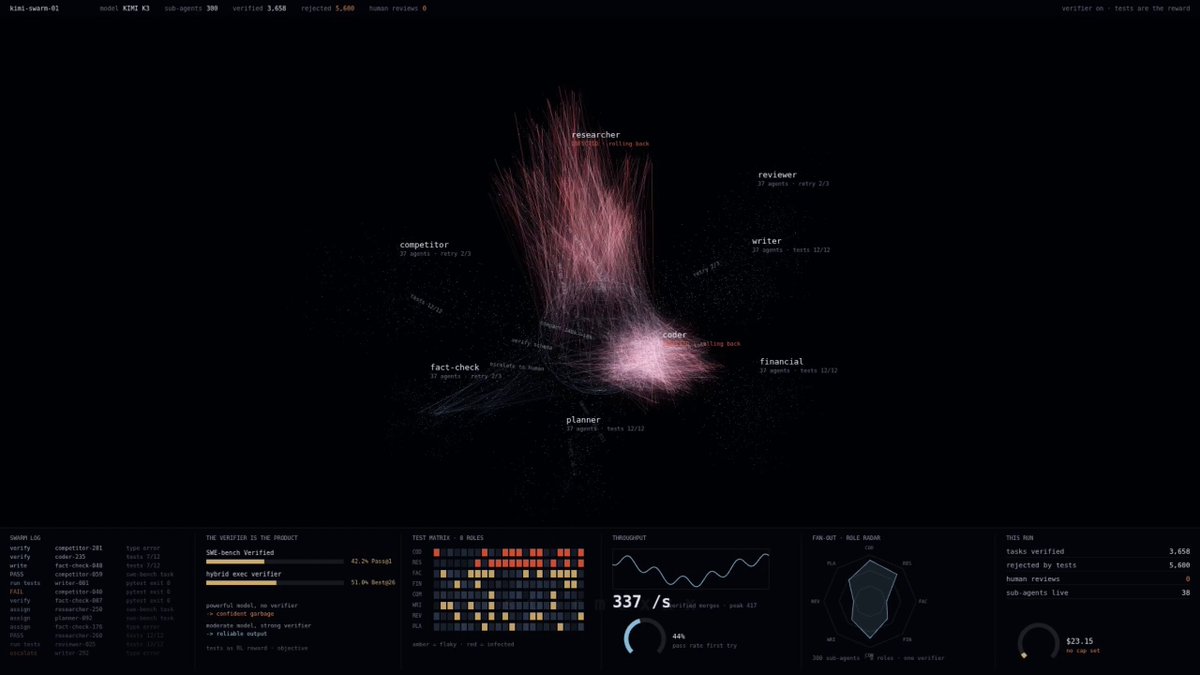
anthropic will sell you opus 5 at $200 a month. openai will sell you gpt-5.6 at $200 a month. neither will tell you stanford and berkeley published the 5 principles to build a $100k/mo ai company on kimi k3 for $10 stanford and berkeley spent years figuring out what actually separates ai systems that work in production from ai systems that die in demos. they published the findings. anthropic and openai priced their frontier subs like nobody would read the papers. the papers are free this is dspy plus verifiers plus decomposition plus skills plus mcp. five principles from stanford, berkeley and moonshot that turn a $10/mo kimi k3 sub into an ai analyst that runs unattended. the model is public. the system is the moat five moves that turn kimi k3 into the $100k/mo company: P1 don't prompt, program (stanford dspy) -> stanford proved hand-tuned prompts don't scale. define a pipeline as modules, let the optimizer tune them -> the compiled pipeline beat expert few-shot on multi-step tasks. one line of dspy replaces a month of prompt engineering P2 don't trust the model, build verifiers (berkeley 2026) -> a compiler either accepts or rejects. a test either passes or fails. that is a verifier -> berkeley: test-suite reward hit 42.2% pass@1 on swe-bench. hybrid verifiers hit 51.0% best@26. no bigger model, just a real check P3 don't scale agents, decompose them (stanford ai index 2026) -> stanford found multi-agent gains only 2-4 percentage points. two coding agents sometimes did worse than one -> the win is role decomposition, not count. researcher, writer, reviewer, verifier, clear input, clear output, no overlap P4 don't repeat expertise, encode it as skills (kimi code) -> every session starting from zero is institutional knowledge you lost. a skill.md file makes kimi activate the workflow automatically -> week one you write the skill. month six it encodes more institutional memory than most junior employees carry P5 don't keep ai in chat, connect it to tools (mcp) -> a model that only sees what you paste is a consultant working blindfolded. mcp connects kimi to your crm, db, github, linear, slack -> the model is public. the data is yours. the connections are your moat my position, and it is the arguable one: the next $100k/mo ai company will not win because it got early access to a frontier model. it will win because it followed 5 papers that anthropic and openai are quietly hoping you never read drop your $200/mo ai sub to $10. the swarm above is what 300 kimi k3 agents look like running those 5 principles. the full playbook is in the article below

starmex

31,358 просмотров • 29 дней назад

New open-source agent harness just landed! I got early access to TrueForge by TrueFoundry and have been running it locally for the past few days. The harness layer deserves as much attention as the model, and open source matters here because you can inspect the loop, run it on your own infrastructure, and swap to the latest or cheaper models. TrueForge handles the runtime work that makes an agent reliable. It drives the tool-calling loop, manages context, coordinates subagents, and executes code in a sandbox, with any model you choose. Every tool call re-sends the growing context to the model, so in practice the harness controls most of what an agent costs to run. A few things stood out from my testing and their published benchmarks. Vendor-Neutral by design. It runs OpenAI, Anthropic, and Google models alongside open-weight models like Kimi, GLM, and DeepSeek. Model routing is a setting, and you can send each task to the model that fits it. On a 14-task enterprise agent benchmark, it matched the accuracy of Claude Managed Agents running the same Opus 4.8 model at roughly 30% lower cost per run (3.8M tokens vs 10M for the same answers). Routing the same tasks to GLM-5.2 held accuracy and brought cost down by about 75%, around $3 per run instead of $12. Fully self-hosted and Open Source (MIT License). I had it running locally with one command, with sandboxed code execution working out of the box. It's time to own your agent harness. Thanks to TrueFoundry for partnering on this post.

elvis

11,303 просмотров • 27 дней назад

Made with Seedance 2.5 Prompt: Style: Luxury Korean skincare, minimal, clean, soft ivory and blush-pink palette, premium CGI, glossy liquid physics, elegant editorial beauty commercial, photorealistic, slow-motion. Product: Use the exact attached Anua Rice 70+ Glow Milky Toner bottle as the hero product. Preserve the bottle shape, proportions, cap, label, typography, colors, and all packaging details exactly. No redesign or altered text. ⸻ Scene 1 — Hero Introduction The exact Anua Rice 70+ Glow Milky Toner bottle slowly descends from above against a pristine ivory-white background with subtle warm pink gradients. Fine water droplets gently float around the bottle, catching soft light. Camera: Slow cinematic push-in. Lighting: Soft diffused studio lighting, delicate glossy reflections, premium beauty-commercial look. Scene 2 — Milky Water Splash The bottle gracefully settles into a pool of crystal-clear water. A perfectly balanced, elegant splash rises around the base in slow motion, while subtle blush-pink reflections shimmer through the liquid. Camera: 120fps macro cinematic shot. Details: Realistic water physics, fine droplets, glass-like refractions, soft highlights. Scene 3 — Rotating Beauty Shot The bottle slowly rotates 360° while suspended just above reflective water. Tiny water droplets orbit naturally around it as the background transitions from ivory white into an ultra-soft blush-pink gradient. Camera: Smooth luxury product turntable movement. Details: Sharp product focus, shallow depth of field, realistic reflections. Scene 4 — Milky Toner Texture Extreme macro shot of the toner dispensing from the bottle. A silky, translucent milky-white drop forms and slowly falls downward. Camera: Macro lens tracking the falling drop. Details: Ultra-realistic liquid simulation, smooth viscosity, glossy surface tension, soft pink reflections. Scene 5 — Ripple & Hydration The milky toner drop lands gently on a perfectly calm water surface, creating elegant concentric ripples. Tiny micro-bubbles rise through the water as light softly reflects across the surface. Camera: Slow-motion macro shot from water level. Mood: Calm, fresh, luxurious, hydrating. Scene 6 — Ingredient & Benefit Reveal The exact bottle remains perfectly centered above a glossy reflective surface. Minimal elegant typography appears around the product. Left Side ✓ Rice Water 70+ ✓ Nourishing Glow Right Side ✓ Hydrated, Radiant Skin ✓ Smooth Milky Finish Typography is refined, minimal, and premium, with generous spacing. Do not obstruct the product. Scene 7 — Milky Texture Beauty Shot Extreme macro shot of the Anua milky toner spreading smoothly across a pristine glass surface. The texture looks silky, lightweight, and luminous, forming delicate waves with tiny air bubbles. Lighting: Soft Korean beauty editorial lighting with glossy highlights. Camera: Slow macro tracking shot. Scene 8 — Product in Hand An elegant feminine hand gently picks up the exact toner bottle. Natural soft sunlight enters from the side, creating subtle highlights along the bottle and cap. Camera: Slow graceful rotation around the hand and product. Background: Minimal warm-white studio environment with a faint blush-pink gradient. Scene 9 — Final Hero Shot The exact Anua Rice 70+ Glow Milky Toner bottle stands perfectly centered on a glossy reflective water surface. Soft blush-pink mist gently fills the background. A few water droplets float around the bottle while subtle sparkles create a premium finishing touch. Camera: Very slow push-in toward the label. Lighting: Soft diffused luxury studio lighting, realistic reflections, cinematic depth of field. Final look: High-end Korean skincare campaign, photorealistic product CGI, elegant, minimal, luxurious, soft pink-and-ivory aesthetic, realistic water and liquid physics, no distortion, no extra products, no altered packaging, 3:4

H A J R A

18,104 просмотров • 5 дней назад

How a 22-year-old developer built a full 3D Jet Ski racing game in just 40 minutes with zero manual coding He used Claude Opus 5 to generate physics, WebGL 3D graphics, HUD, and audio in a single prompt and turned single-prompt gamedev into a high-margin income stream. Costs: $423 He launched a single-prompt generation workflow that built the entire HTML5 project from scratch: Top layer: A Three.js and WebGL rendering pipeline dynamically creates 3D water physics, real-time wave dynamics, dynamic lighting, and jet ski fluid mechanics, all written autonomously inside one output file without external frameworks. Bottom layer: The Claude Opus 5 engine processed a massive 690-million-token context window to generate the complete gameplay logic, collision handling, dynamic sound generation, controls, and UI layout directly from a detailed initial system prompt. The trend of single-prompt 3D game creation is rapidly exploding across media and indie development. The author monetizes this tech stack through three main channels: 1. Viral Content & Media Systems: Short-form breakdown videos driving massive reach, monetized via promo placements, prompt-pack access, and private developer communities. 2. Rapid Hypercasual Prototyping: Testing 10+ WebGL mechanics per day, flipping fully functional browser games on itch io or CodeCanyon, and licensing prototypes directly to casual game portals. 3. Interactive WebGL Client Solutions: Delivering custom 3D promotional browser games and interactive brand experiences for clients in 48 hours instead of weeks. First month results: > WebGL games generated: 24 > Viral impressions generated: 3.8M+ > Total revenue across licensing & content: $21,400 The AI completely automated the core development lifecycle: Claude Opus 5 built the physics engine, rendered 3D graphics in WebGL, hooked up audio controllers, and generated interactive browser logic with zero manual line-by-line coding. Bookmark it and check article 👇

Ridark

11,592 просмотров • 1 месяц назад