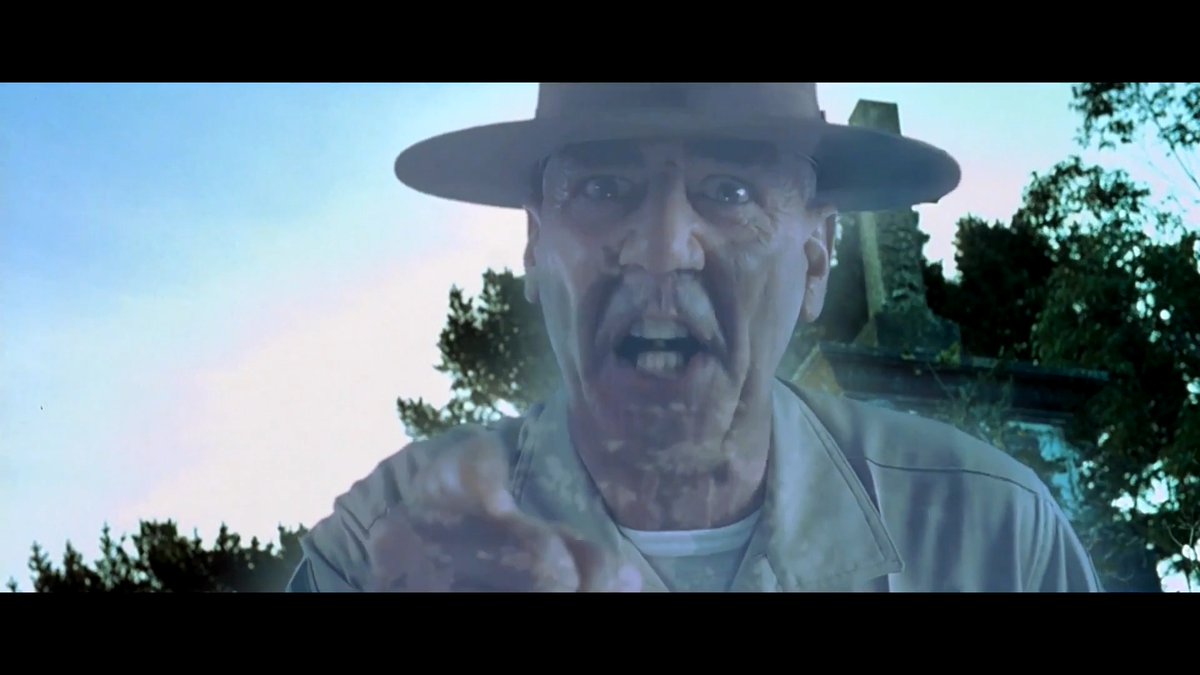
Video wird geladen...

Video konnte nicht geladen werden

Zur Startseite

Kubrick rarely allowed improvisation—except ‘FULL METAL JACKET’ The actor R. Lee Ermey’s ad-libs were so perfect, Kubrick barely needed 2–3 takes. Ermey later said Vincent D’Onofrio’s performance wasn’t just great—it was best part of the entire film.
339,278 Aufrufe • vor 11 Monaten •via X (Twitter)

0 Kommentare

Keine Kommentare verfügbar

Kommentare vom Original-Post werden hier angezeigt

Ähnliche Videos

Incredibly, R. Lee Ermey wasn't the first choice to parody himself in The Frighteners, which is 30 years old today. In one of the best callbacks in cinema, R. Lee Ermey playfully parodies his legendary Gunnery Sergeant Hartman from Full Metal Jacket. But it only happened because Peter Jackson couldn't find anyone good enough to emulate the role Ermey created. Jackson held auditions to find someone who could imitate Ermey’s raw intensity, but no one could. Realising he'd never find anyone good enough, Jackson went to the source and contacted Ermey directly, who immediately agreed to fly out to New Zealand. Jackson made the smart move and allowed Ermey to improvise around the basic plot points and deliver his signature Full Metal Jacket vibe, adding dialogue like, "Get back in the goddamn ground, you unorganised grab-asstic gob of teleplasmic shit!". At the same time, Jackson mirrored Kubrick's framing, giving the audience an up-close-and-personal nostalgia hit. What makes it so amazing is that it weaponises the psychological abuse, which was genuinely terrifying in Kubrick's war movie, abuse that drives a man to end his own life, and transforms it into a full-on comedic performance. Yet it's delivered in exactly the same fashion. The Frighteners was released nine years after Full Metal Jacket, but Ermey's unforgettable performance was so iconic that the parody is instantly recognisable the second he appears on screen. There is absolutely nothing subtle about it, and it hit the perfect note. What this story proves more than anything is that there was no one quite like R. Lee Ermey.

The Sting

851,561 Aufrufe • vor 28 Tagen

Steven Spielberg saw Stanley Kubrick for the first time in 1980 while he was building sets for "The Shining" (1980). After the movie was released, Spielberg went to Kubrick's house for dinner. Kubrick asked him if he liked the movie. Spielberg, who didn't like the movie in the first viewing, started to tell Kubrick all the things he liked about the movie, rather than telling that he didn't like the movie. Kubrick saw right through him and said, "Steven, you obviously didn't like my picture very much". Spielberg replied, "There is a lot of things that I like about the picture". Kubrick stopped him and said, "But there is a lot of things you didn't love about the picture, probably a lot more that you didn't than did. So tell me what you didn't like about it." Spielberg pinpointed Jack Nicholson's performance. He called him a "great actor" and a "great performance", but a "Great Kabuki Performance", almost like Kabuki theater. Kubrick then asked, "You mean you think Jack went over the top?". Spielberg replied affirmatively. Kubrick then asked Spielberg to name his top 5 favourite actors of all time without thinking much. Spielberg listed Spencer Tracy, Henry Fonda, James Stewart, Cary Grant and Clark Gable. Kubrick said, "Stop" & questioned, "Where was James Cagney on that list?" Spielberg said that he is up there high, Kubrick then said, "But not in the top 5". Finally Kubrick said," You don't consider James Cagney as one of the 5 best actors around, but I do. This is why Jack Nicholson's performance is a great one." Since then, Spielberg has caw "The Shining" more than 25 times & considers it one of his favourite pictures. P.S: Remembering the legendary American actor James Cagney on his 127th birthday! Clip from: One, Two, Three (1961) Director: Billy Wilder

DepressedBergman

396,766 Aufrufe • vor 1 Monat

Despite "Spartacus" (1960) being a box-office success & winning four Oscars, Stanley Kubrick disowned the movie as he had no creative control & constant disagreements with Kirk Douglas, Dalton Trumbo & producer Edward Lewis. Kubrick considered the script to be "Pretty dumb". Kubrick believed he achieved only limited success in making the movie visually interesting as a way of counteracting Trumbo's "Pedestrian" dialogue. Kubrick and Douglas never were reconciled. “He’ll be a fine director some day,” Douglas said afterward, “If he falls on his face just once. It might teach him how to compromise.” In one interview, Douglas added that some directors are talented, some directors are bastards, and that Stanley Kubrick was a talented bastard. Stanley Kubrick on his experience directing "Spartacus" (1960): "'Spartacus' is the only film over which I did not have absolute control. When Kirk offered me the job of directing 'Spartacus', I thought that I might be able to make some thing of it if the script could be changed. But my experience proved that if it is not explicitly stipulated in the contract that your decisions will be respected, there’s a very good chance that they won't be. The script could have been improved in the course of shooting, but it wasn’t. Kirk was executive producer; he and Dalton Trumbo, the script writer, and Edward Lewis, the producer, had it their way.” ("The Stanley Kubrick Archives", Edited by Alison Castle, 2005)

DepressedBergman

135,116 Aufrufe • vor 27 Tagen

WATCH: Stanley Kubrick's Eyes Wide Shut had a lot of secret truths hidden in it. Eyes Wide Shut was not the movie Kubrick intended audiences to see. The studio cut 24 minutes from the film, and just a few days later, the legendary filmmaker was dead... What was in those 24 minutes? And what happens at the real masked parties? The director was found dead on March 7th, 1999, at his home in Harpenden, Hertfordshire, just six days after screening the final cut of Eyes Wide Shut to Warner Brothers executives. As a result, he was unable to control the release of what was to be his final film... Considering the theme of Eyes Wide Shut, the fact Stanley Kubrick had first thought of casting actor Woody Allen as the lead actor in the movie only hyperbolizes the so-called conspiracy theories about the film. The director also considered Dustin Hoffman, Warren Beatty, Alan Alda, Alec Baldwin, Albert Brooks, Bill Murray, Sam Shepherd, and Tom Hanks for the leading role. What was Stanley Kubrick trying to tell us in this movie from 1999? #LolitaExpress #JeffreyEpstein #GhislaineMaxwell #Adrenochrome #EpsteinClientList #EpsteinFlightLogs #EpsteinIsland #SexTrafficking #HumanTrafficking #ChildTrafficking #Hollywood #Disney #pedophile #pedowood #pizzagate #pedogate #sexslave #CrimesAgainstHumanity #mkultra #TunnelJews #SATANIC #Rothschild #illuminati Alex Jones Illuminati Coin $NATI 👁️ #IlluminatiCoin 🦉 IlluminatiCoin 𝕏 🕵️‍♂️ Join us:

Illuminati Coin

470,428 Aufrufe • vor 2 Jahren

Stanley Kubrick on why he doesn't like to explain about his movies: "Interviewer: All the books, most of the articles I read about you—It’s all conceptualizing. Kubrick: Yeah, but not by me. I thought I had to ask those kinds of questions. No. Hell, no. That’s my... [He shudders.] It’s the thing I hate the worst. Interviewer: Really? I’ve got all these questions written down in a form I thought you might require. They all sound like essay questions for the finals in a graduate philosophy seminar. Kubrick: The truth is that I’ve always felt trapped and pinned down and harried by those questions. Questions like [reading from notes] “Your first feature, 'Fear and Desire', in 1953, concerned a group of soldiers lost behind enemy lines in an unnamed war; 'Spartacus' contained some battle scenes; 'Paths of Glory' was an indictment of war and, more specifically, of the generals who wage it; and 'Dr. Strangelove' was the blackest of comedies about accidental nuclear war. How does 'Full Metal Jacket' complete your examination of the subject of war? Or does it?” Those kinds of questions. Interviewer: You feel the real question lurking behind all the verbiage is “What does this new movie mean?” Kubrick: Exactly. And that’s almost impossible to answer, especially when you’ve been so deeply inside the film for so long. Some people demand a five-line capsule summary. Something you’d read in a magazine. They want you to say, “This is the story of the duality of man and the duplicity of governments.” [A pretty good description of the subtext that informs Full Metal Jacket, actually.] I hear people try to do it— give the five-line summary — but if a film has any substance or subtlety, whatever you say is never complete, it’s usually wrong, and it’s necessarily simplistic: truth is too multifaceted to be contained in a five-line summary. If the work is good, what you say about it is usually irrelevant. I don’t know. Perhaps it’s vanity, this idea that the work is bigger than one’s capacity to describe it. Some people can do interviews. They’re very slick, and they neatly evade this hateful conceptualizing. Fellini is good; his interviews are very amusing. He just makes jokes and says preposterous things that you know he can’t possibly mean. I mean, I’m doing interviews to help the film, and I think they do help the film, so I can’t complain. But it isn’t... it’s... it’s difficult." (Stanley Kubrick's interview with Tim Cahill, 1987) Clip from: Full Metal Jacket (1987) Director: Stanley Kubrick

DepressedBergman

58,791 Aufrufe • vor 8 Monaten