Loading video...

Video Failed to Load

Go Home

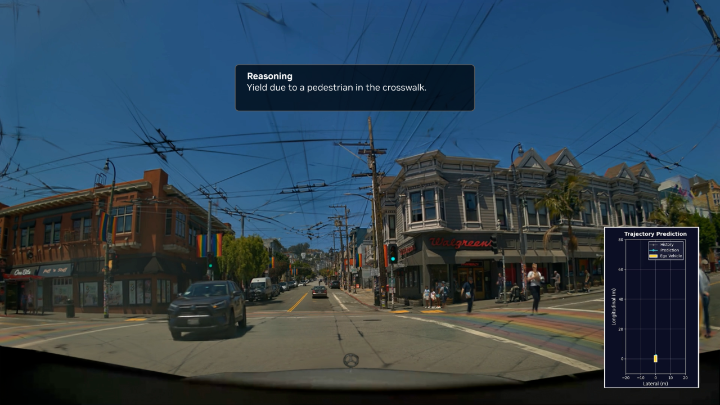
Large language models reason through text. Vision‑language‑action models reason through the real world. By fusing perception, context, and action from live video, VLAs deliver the awareness physical AI needs for next‑gen robotics and edge systems.

15,931 views • 3 months ago •via X (Twitter)

0 Comments

No comments available

Comments from the original post will appear here

Related Videos

NEWS: NVIDIA just announced Alpamayo, what CEO Jensen Huang calls the world’s first thinking, reasoning autonomous vehicle AI, launching on U.S. roads later this year, starting with the Mercedes CLA. Jensen: "It's trained end-to-end. Literally from camera in to actuation out; It reasons what action it is about to take, the reason by which is came about that action, and the trajectory." Alpamayo introduces Vision-Language-Action (VLA) models, which enable self-driving systems to interpret what they see, reason about complex driving scenarios, and generate driving actions. The platform includes large reasoning models, simulation tools for testing rare and edge-case scenarios, and open datasets for training and validation. NVIDIA says the approach improves transparency, safety, and robustness in autonomous systems, particularly in complex real-world environments, and supports progress toward higher levels of vehicle autonomy: "With a 10-billion-parameter architecture, Alpamayo 1 uses video input to generate trajectories alongside reasoning traces, showing the logic behind each decision. Developers can adapt Alpamayo 1 into smaller runtime models for vehicle development, or use it as a foundation for AV development tools such as reasoning-based evaluators and auto-labeling systems. Alpamayo 1 provides open model weights and open-source inferencing scripts. Future models in the family will feature larger parameter counts, more detailed reasoning capabilities, more input and output flexibility, and options for commercial usage."

Sawyer Merritt

1,602,706 views • 5 months ago