Loading video...

Video Failed to Load

Go Home

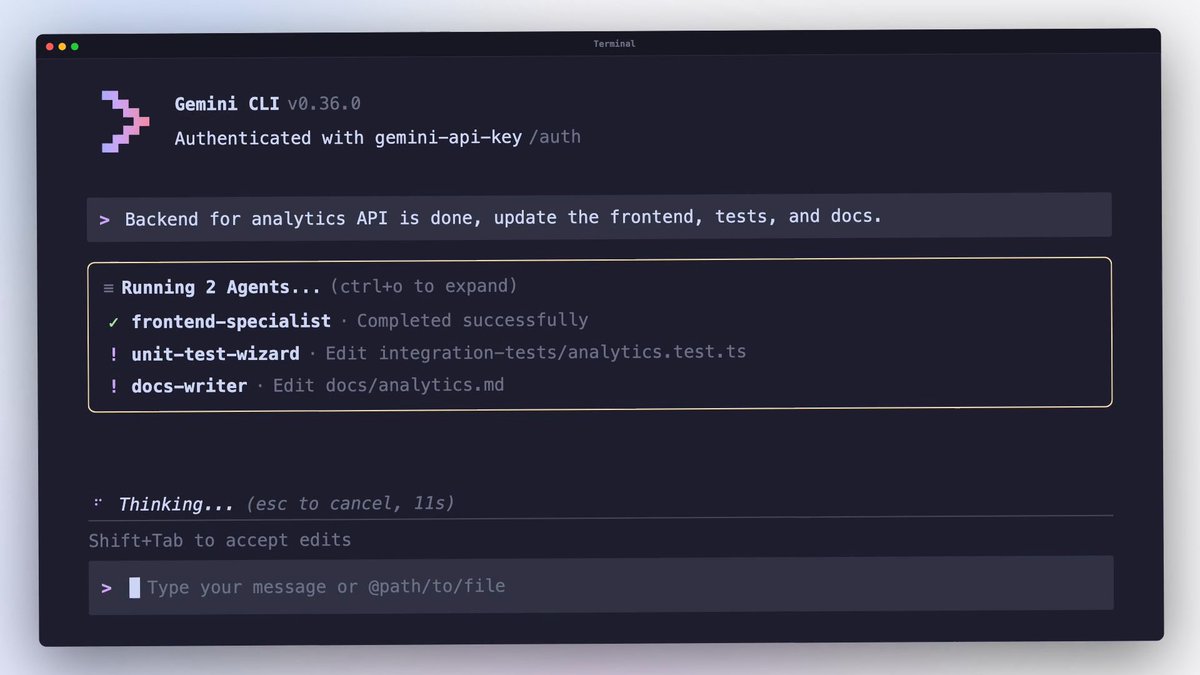
Learn how to build a Gemini 3 Deep Agents with this video from LangChain. These agents can reason through complex, long horizon tasks by: > Breaking goals into actionable steps > Delegating specific work for specialized models > Leveraging file systems and code execution

19,484 views • 7 months ago •via X (Twitter)

0 Comments

No comments available

Comments from the original post will appear here

Related Videos

New short course: Building Code Agents with Hugging Face smolagents! Learn how to build code agents in this course, created in collaboration with Hugging Face, and taught by Thomas Wolf, its co-founder and CSO, and m_ric, Hugging Face’s Project Lead on Agents. Tool-calling agents use LLMs to generate multiple function calls sequentially to complete a complex sequence of tasks. They generate one function call, execute it, observe, reason, and decide what to do next. Code agents take a different approach. They consolidate all these calls into a single block of code, letting the LLM lay out an entire action plan at once, which can be executed efficiently to provide more reliable results. You’ll learn how to code agents using smolagents, a lightweight agentic framework from Hugging Face. Along the way, you’ll learn how to run LLM-generated code safely and develop an evaluation system to optimize your code agent for production. In detail, you’ll learn: - How agentic systems have evolved, gaining greater levels of agency over time—and why code agents are a next step. - How code agents write their actions in code. - When code agents outperform function-calling agents. - How to run code agents safely in your system using a constrained Python interpreter and sandboxing using E2B. - To trace, debug, and assess the code agent to optimize its behaviours for complex requests. - How to build a research multi-agent system that can find information online and organize it into an interactive report. By the end of this course, you’ll know how to build and run code agents using smolagents, and deploy them safely with a structured evaluation system in your projects. Please sign up here!

Andrew Ng

124,382 views • 1 year ago

New Short Course: Building AI Browser Agents! Learn how to build AI agents that interact and take actions on websites in this course, created in partnership with and taught by and @namangarg0, Co-founders of AGI Inc. AI browser agents can log into websites, fill out forms, click through web pages, or even place orders online for you. They use both visual information, like screenshots, and structural data, like the HTML or Document Object Model (DOM) of a web page, to reason and take action. With the complexity of webpages and multiple possible actions at each step, it can be challenging for an AI browser agent to complete an assigned task. Because these agents run long action sequences, a single error—like clicking the wrong button or misreading a field—can lead to unexpected outcomes or errors that compound over time. In this course, you'll understand how autonomous web agents work, their current limitations, and how AgentQ enables them to improve through self-correction. In detail, you'll: - Learn what web agents are, how they automate tasks online, their architecture, key components, limitations, and an overview of their decision-making strategies. - Build a web agent that can scrape website and return course recommendations in a structured output format. - Build an autonomous web agent that can execute multiple tasks, such as finding and summarizing webpages, filling out a form, and signing up for a newsletter. - Explore AgentQ, a framework that enables agents to self-correct by combining Monte Carlo Tree Search (MCTS), a self-critique mechanism for continuous improvement, and Direct Preference Optimization (DPO). - Deep dive into MCTS, learn how it finds an effective path, illustrated by an example of Gridworld animation, and use AgentQ to complete web tasks. - Understand AI agents' current state and future directions—including key factors shaping their evolution, such as hardware, algorithm innovation, and data availability. By the end of this course, you will have hands-on experience building browser agents and a deeper understanding of how to make them more robust and reliable. Please sign up here:

Andrew Ng

186,031 views • 1 year ago