正在加载视频...

视频加载失败

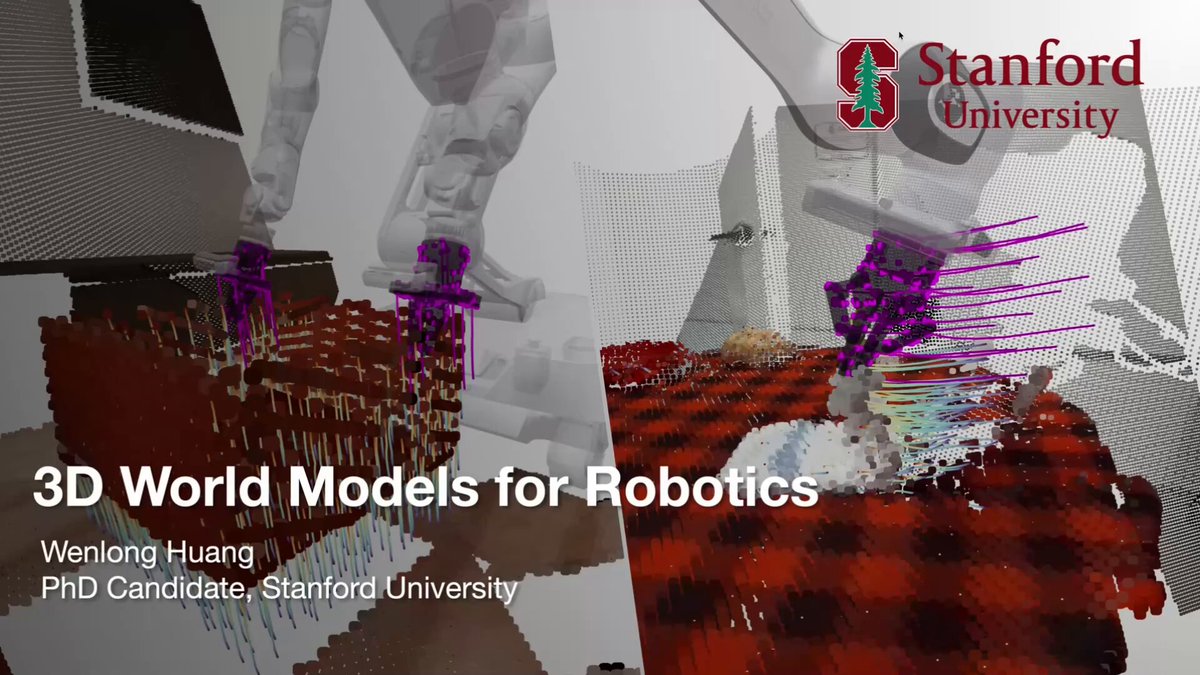
Learning robust, general-purpose reward functions for robotics unlocks many potential applications, like on-robot reinforcement learning or dataset validation. However, there’s a question of how to actually train such reward functions. Training success/failure prediction leads to ambiguous signals partway through a demonstration — it’s hard to measure progress — making...

14,363 次观看 • 1 个月前 •via X (Twitter)

0 条评论

暂无评论

原始帖子的评论将显示在这里

相关视频

New Course: Reinforcement Fine-Tuning LLMs with GRPO! Learn to use reinforcement learning to improve your LLM performance in this short course, built in collaboration with Predibase by Rubrik, and taught by Travis Addair, its Co-Founder and CTO, and Arnav Garg, its Senior Engineer and Machine Learning Lead. Reasoning models have been one of the most important developments in LLMs. Reinforcement Fine-Tuning (RFT) uses rewards to encourage LLMs to find solutions to multi-step reasoning tasks such as solving math problems and debugging code - without needing pre-existing training examples like in traditional supervised fine-tuning. Group Relative Policy Optimization (GRPO) is a reinforcement fine-tuning algorithm gaining rapid adoption. Developed by the DeepSeek team and used to train the R1 reasoning model, GRPO uses reward functions that you can write in Python to assign rewards to model responses. It’s beneficial for tasks with verifiable outcomes and can work well even with fewer than 100 training examples. It can also significantly improve the reasoning ability of smaller LLMs, making applications faster and more cost effective. In this course, you’ll take a technical deep dive into RFT with GRPO. You’ll learn to build reward functions that you can use in the GRPO training process to guide an LLM toward better performance on multi-step reasoning tasks. In detail, you’ll: - Learn when reinforcement fine-tuning is a better fit than supervised fine-tuning, especially for tasks involving multi-step reasoning or limited labeled data. - Understand how GRPO uses programmable reward functions as a more scalable alternative to the human feedback required for other reinforcement learning algorithms, such as RLHF and DPO. - Frame the Wordle game as a reinforcement fine-tuning problem and see how an LLM can learn to plan, analyze feedback, and improve its strategy over time. - Design reward functions that power the reinforcement fine-tuning process. - Learn techniques for evaluating more subjective tasks, such as rating the quality of a text summary, using an LLM as a judge. - Understand why reward hacking happens and how to avoid it by adding penalty functions to discourage undesirable behaviors. - Learn the four key components of the loss calculation in the GRPO algorithm: token probability distribution ratios, advantages, clipping, and KL-divergence. - Launch reinforcement fine-tuning jobs using Predibase’s hosted training services. By the end of this course, you’ll be able to build and fine-tune LLMs using reinforcement learning to improve reasoning without relying on large labeled datasets or subjective human feedback. Please sign up here:

Andrew Ng

86,457 次观看 • 1 年前

Today, we're joined by Nikita Rudin, co-founder and CEO of Flexion to discuss the gap between current robotic capabilities and what’s required to deploy fully autonomous robots in the real world. Nikita explains how reinforcement learning and simulation have driven rapid progress in robot locomotion—and why locomotion is still far from “solved.” We dig into the sim2real gap, and how adding visual inputs introduces noise and significantly complicates sim-to-real transfer. We also explore the debate between end-to-end models and modular approaches, and why separating locomotion, planning, and semantics remains a pragmatic approach today. Nikita also introduces the concept of "real-to-sim", which uses real-world data to refine simulation parameters for higher fidelity training, discusses how reinforcement learning, imitation learning, and teleoperation data are combined to train robust policies for both quadruped and humanoid robots, and introduces Flexion's hierarchical approach that utilizes pre-trained Vision-Language Models (VLMs) for high-level task orchestration with Vision-Language-Action (VLA) models and low-level whole-body trackers. Finally, Nikita shares the behind-the-scenes in humanoid robot demos, his take on reinforcement learning in simulation versus the real world, the nuances of reward tuning, and offers practical advice for researchers and practitioners looking to get started in robotics today. 🗒️ For the full list of resources for this episode, visit the show notes page: 📖 CHAPTERS =============================== 00:00 - Introduction 04:07 - Is robot locomotion solved? 06:04 - Sim-to-real gap 08:58 - Adding semantics to policies 09:42 - Modular vs end-to-end architectures 10:29 - Planner model 12:21 - Adapting RL techniques from quadrupeds to humanoids 15:39 - Behind robot demos 18:09 - Humanoid robots in home environments 22:03 - Training approach 23:56 - VLA models 27:59 - Closing the sim-to-real gap 32:55 - Task orchestration using VLMs 36:38 - Tool use 38:10 - Model hierarchy 43:37 - Simulator versus simulation environment 44:57 - Combining imitation learning and reinforcement learning 46:42 - RL in real world versus RL in simulation 52:58 - Reward tuning and value functions in robotics 56:38 - Predictions 1:00:10 - Humanoids, quadropeds, and wheeled platforms 1:02:45 - Advice, recommended robot kits, and community pla

The TWIML AI Podcast

22,533 次观看 • 6 个月前