Video wird geladen...

Video konnte nicht geladen werden

Zur Startseite

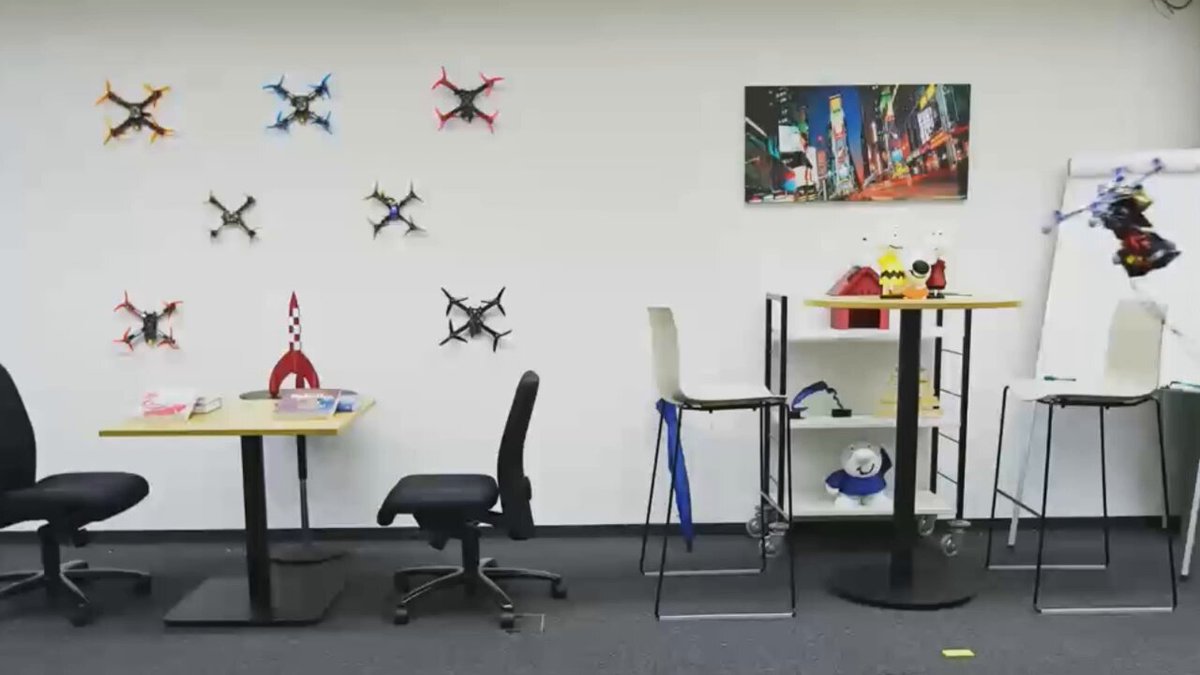
🤩 Look at that radiance field and mesh! 🤩 My initial thoughts on 2DGS for Geometrically Accurate Radiance Fields. I am still learning that not ALL scenes work well, but it LOVES drone flights. Tutorial is coming, I promise. #3d #Computervision

25,949 Aufrufe • vor 2 Jahren •via X (Twitter)

0 Kommentare

Keine Kommentare verfügbar

Kommentare vom Original-Post werden hier angezeigt

Ähnliche Videos

We are excited to share our work “Event-Aided Sharp Radiance Field Reconstruction for Fast-Flying Drones” published in IEEE Transactions on Robotics IEEE Transactions on Robotics (T-RO), which tackles sharp radiance field reconstruction under agile drone motion, where RGB frames are heavily motion-blurred and pose priors become unreliable! 4 years in the making! Code & dataset released! PDF: Code & Dataset: Full Narrated Video: High-speed flight is essential for time- and battery-constrained missions (e.g., inspection, exploration, search & rescue). However, fast motion corrupts visual data with severe motion blur and introduces drift/noise in visual-inertial odometry, making NeRF-based 3D reconstruction particularly brittle. We propose a unified framework that leverages asynchronous #EventCamera streams together with motion-blurred frames to reconstruct high-fidelity radiance fields from agile drone flights. Our key idea is to embed event-image fusion directly into radiance field optimization while jointly refining a shared, continuous-time camera trajectory initialized from event-based VIO. This enables us to recover sharp radiance fields and accurate trajectories without ground-truth supervision during training. We validate our method on synthetic data and on real sequences captured by a drone flying up to 2 m/s. Despite severe blur and noisy pose priors, our method preserves fine scene details and achieves a performance gain of over 50% on real-world data compared to state-of-the-art methods. Kudos to Rong Zou and Marco Cannici! Marco Cannici Reference: Rong Zou*, Marco Cannici*, Davide Scaramuzza Event-Aided Sharp Radiance Field Reconstruction for Fast-Flying Drones IEEE Transactions on Robotics (T-RO), 2026 NCCR Robotics European Research Council (ERC) AUTOASSESS UZH IfI University of Zurich UZH Science Prophesee SynSense UZH Space Hub

Davide Scaramuzza

12,028 Aufrufe • vor 5 Monaten

VideoRF: Rendering Dynamic Radiance Fields as 2D Feature Video Streams paper page: Neural Radiance Fields (NeRFs) excel in photorealistically rendering static scenes. However, rendering dynamic, long-duration radiance fields on ubiquitous devices remains challenging, due to data storage and computational constraints. In this paper, we introduce VideoRF, the first approach to enable real-time streaming and rendering of dynamic radiance fields on mobile platforms. At the core is a serialized 2D feature image stream representing the 4D radiance field all in one. We introduce a tailored training scheme directly applied to this 2D domain to impose the temporal and spatial redundancy of the feature image stream. By leveraging the redundancy, we show that the feature image stream can be efficiently compressed by 2D video codecs, which allows us to exploit video hardware accelerators to achieve real-time decoding. On the other hand, based on the feature image stream, we propose a novel rendering pipeline for VideoRF, which has specialized space mappings to query radiance properties efficiently. Paired with a deferred shading model, VideoRF has the capability of real-time rendering on mobile devices thanks to its efficiency. We have developed a real-time interactive player that enables online streaming and rendering of dynamic scenes, offering a seamless and immersive free-viewpoint experience across a range of devices, from desktops to mobile phones.

AK

38,686 Aufrufe • vor 2 Jahren