Video yükleniyor...

Video Yüklenemedi

Ana Sayfaya Dön

Low-cost autonomous GPS-free navigation (closed-loop): Pixhawk mission flight mode with Spectacular AI VIO as “fake GPS”, running real-time on #raspberrypi CM 4. Extra sensor & compute weight < 100g

46,815 görüntüleme • 10 ay önce •via X (Twitter)

0 Yorum

Yorum bulunmuyor

Orijinal gönderinin yorumları burada görünecek

Benzer Videolar

🚨$OSS is not an AI company. → It is the hardware that lets AI exist where the cloud cannot. Most investors don’t understand $OSS because they think AI = software. $OSS builds the physical “brains” that run AI in extreme environments where cloud computing fails. Jets. Ships. Tanks. Drones. Space. Hospitals. That’s the game. 1) What $OSS actually is $OSS (One Stop Systems) designs rugged high-performance computers and storage systems for AI at the edge. Meaning: They bring data-center-level computing power into harsh environments. Their products include rugged servers, GPU accelerators, storage arrays, and expansion systems used for AI, sensor processing, and autonomous systems. In simple terms: Cloud AI = brain in a safe building. $OSS AI = brain inside machines operating in chaos. 2) Why this is crucial Most AI today runs in data centers. But the future of AI is not in the cloud. It’s on: • autonomous vehicles • military systems • drones • ships • industrial machines • medical devices These systems cannot wait for the cloud. Latency, connectivity, security, and survival demand local AI. $OSS delivers “data-center performance at the edge” across land, sea, and air. Without companies like OSS, autonomous systems simply don’t work. 3) What OSS actually does: Think of OSS as building AI engines that survive reality. 🌊 SEA example: naval surveillance aircraft and ships. $OSS supplies rugged storage and compute systems for U.S. Navy reconnaissance aircraft to collect and process massive sensor data in real time. Translation: Instead of sending raw data back to base, the aircraft analyzes threats instantly onboard. $OSS = the onboard AI brain. 🪖 LAND example: military vehicles and tactical operations. $OSS delivers high-performance servers and FPGA systems for mobile military intelligence platforms used by the U.S. Department of Defense. Translation: Tanks and vehicles detect threats, process sensor data, and make decisions locally. $OSS = the battlefield computer. ✈️ AIR example: airborne AI. $OSS builds GPU-accelerated servers designed for aircraft, described as a “datacenter in the sky.” Translation: Jets and drones run AI models mid-flight. $OSS = flying supercomputers. 🚀 SPACE example: $OSS hardware is designed for extreme environments and autonomous systems across aerospace and defense. Translation: Future satellites, space drones, and autonomous spacecraft need onboard AI. $OSS = the computing core of autonomous space systems. BONUS: CIVILIAN & COMMERCIAL $OSS systems are used in: • autonomous trucking and farming • industrial automation • healthcare imaging • energy and mining • telecom and 5G Example:A medical imaging company uses $OSS hardware to run real-time AI diagnostics in next-gen breast cancer scanners. $OSS = AI where milliseconds matter. 4) Who their customers are (pattern, not names) $OSS sells to: • defense primes • government programs • industrial OEMs • AI infrastructure companies • medical device manufacturers These customers share one trait: They cannot rely on the cloud. That’s why $OSS exists. 5) The mental model that makes $OSS obvious $NVDA = AI chips $PLTR = AI software $OSS = AI hardware in the real world If AI is electricity, $OSS builds the generators that work in storms. Most investors understand AI software. Few understand AI infrastructure at the edge. That gap is the opportunity. 6) The real thesis The world is moving toward: • autonomous warfare • autonomous vehicles • real-time AI systems • distributed intelligence All of that requires rugged edge computing. $OSS is positioned exactly there. Infrastructure. The hardest layer to build. And often the most valuable.

Black Panther Capital

30,138 görüntüleme • 6 ay önce

🚨 Civilian aircraft are now MASSIVELY vulnerable. Anyone can build a functional MANPADS missile launcher for under $100 full designs, 3D-print files, firmware, and AI targeting all open-sourced on GitHub right now. Shoulder-fired. Guided rocket. Built to lock onto and take down planes. What used to require nation-state factories, military supply chains, and millions in R&D… now anyone with a garage and a printer can make it. Our commercial airliners have zero defense against this new reality. The democratization of weapons just turned every flight into a potential target. The launcher and rocket use ESP32 microcontrollers along with sensors including an MPU6050 IMU, NEO-6M GPS, QMC5883L compass, and BMP180 barometric sensor. Flight stabilization is handled through a proportional-derivative control loop that adjusts canard control surfaces during flight. The mechanical structure was designed in Fusion 360 and analyzed in OpenRocket to evaluate aerodynamic stability. Most structural components were produced using consumer-grade 3D printing and assembled with threaded inserts, machine screws, and custom springs. Total build cost: approximately $96. $6 Esp32 (2) $17 MG996r Servos (4) $3 SG90 Servos (2) $4 Switches (4) $15 ABS pipe (1) $20 Urgenex 1100mAh Battery (2) $1 BMP180 (1) $1 MPU6050 (1) $5 NEO-6M (1) $2 QMC5883l (1) $1 Active Buzzer(1) $17 PLA Plastic (1.5 kg) $2 PVC Pipe (9 in) $2 Rocket Propellant (170g) Wires / Capacitors / etc Negligible Future development explores integration with distributed camera-node tracking networks capable of generating real-time XYZ coordinates of airborne objects.

Dagnum P.I.

436,868 görüntüleme • 4 ay önce

Orbit AI Satellite Successfully Achieve World’s First Orbital AI Deployment and Launching Digital AI Sovereignty Decentralized Orbital AI Network Orbit AI Orbit AI🛰️ today announced that the first satellite, “OAI Genesis-1,” has successfully launched and entered Low Earth Orbit (LEO). Amidst fierce competition from tech giants (e.g., Starlink Starlink Elon Musk , Google AI Project Suncatcher) in space AI computing, this launch signifies Orbit AI’s position as the first to achieve real-world AI deployment, formally inaugurating its "Orbit AI Cloud Platform." Genesis-1 is equipped with NVIDIA NVIDIA AI Compute Cores, running a 2.6B parameter AI model for real-time analysis of infrared remote sensing data in space. By processing data on orbit, Genesis-1 drastically reduces critical information retrieval time (e.g., disaster alerts, maritime monitoring) from hours to mere seconds, while cutting transmission bandwidth costs by over 90%. Furthermore, Orbit AI has partnered with from energy company Powerbank (NASDAQ: SUUN) ( utilizing infinite solar power to achieve carbon-neutral computing and projecting a reduction in overall energy operational costs by 60%. Following its triumph at the BNB Chain Hackathon ( Orbit AI protocol is committed to creating an ultimate censorship-resistant deployment environment: Developers can deploy AI models, privacy applications, financial algorithms, and even blockchain nodes on the satellite network. This ensures that code and data operate in a physically isolated, neutral environment beyond the jurisdiction of major nations, guaranteeing extreme digital sovereignty and service resilience. Orbit AI will also leverage the RWA (Real World Assets) mechanism to allow community users to purchase satellite NFT shares, becoming co-owners of this space infrastructure and sharing in its compute revenues, thus building a community-owned orbital AI economy.

Orbit AI🛰️

24,839 görüntüleme • 7 ay önce

Robotics has a massive, silent bottleneck. It isn’t just data collection—it’s the brutal 1x speed of the physical world. Genesis AI Genesis AI just unveiled Genesis World 1.0, and they are attempting to turn the notorious Sim2Real gap into a pure compute problem. Evaluating a robotics foundation model across edge cases usually means hundreds of hours of physical lab testing. With Genesis World 1.0, what traditionally takes nearly a week of continuous, real-world operation is being compressed into 30 minutes in simulation. What makes this different from just dropping a robot model into an off-the-shelf game engine? 1️⃣ Nyx Renderer: A custom, real-time path-traced engine rendering noise-free 1080p frames in under 4ms. Game engines use rasterization tricks that confuse AI; Nyx uses physically accurate multi-bounce lighting so the model's "eyes" see exactly what real sensors see. 2️⃣ Quadrants Compiler: A custom Python-to-GPU compiler to run heavily parallelized multi-physics simulations (rigid bodies, fluids, deformables) natively across architectures. 3️⃣ Evaluation First: They aren't rushing to train on synthetic data. They are using this purely for closed-loop evaluation to perfect the physics first, currently claiming an impressive 89% correlation with real-world hardware tests. If the industry can accurately evaluate models in simulation without the physical world bottleneck, humanoid development stops moving at wall-clock time and starts scaling with compute.

Humanoids daily

17,240 görüntüleme • 2 ay önce

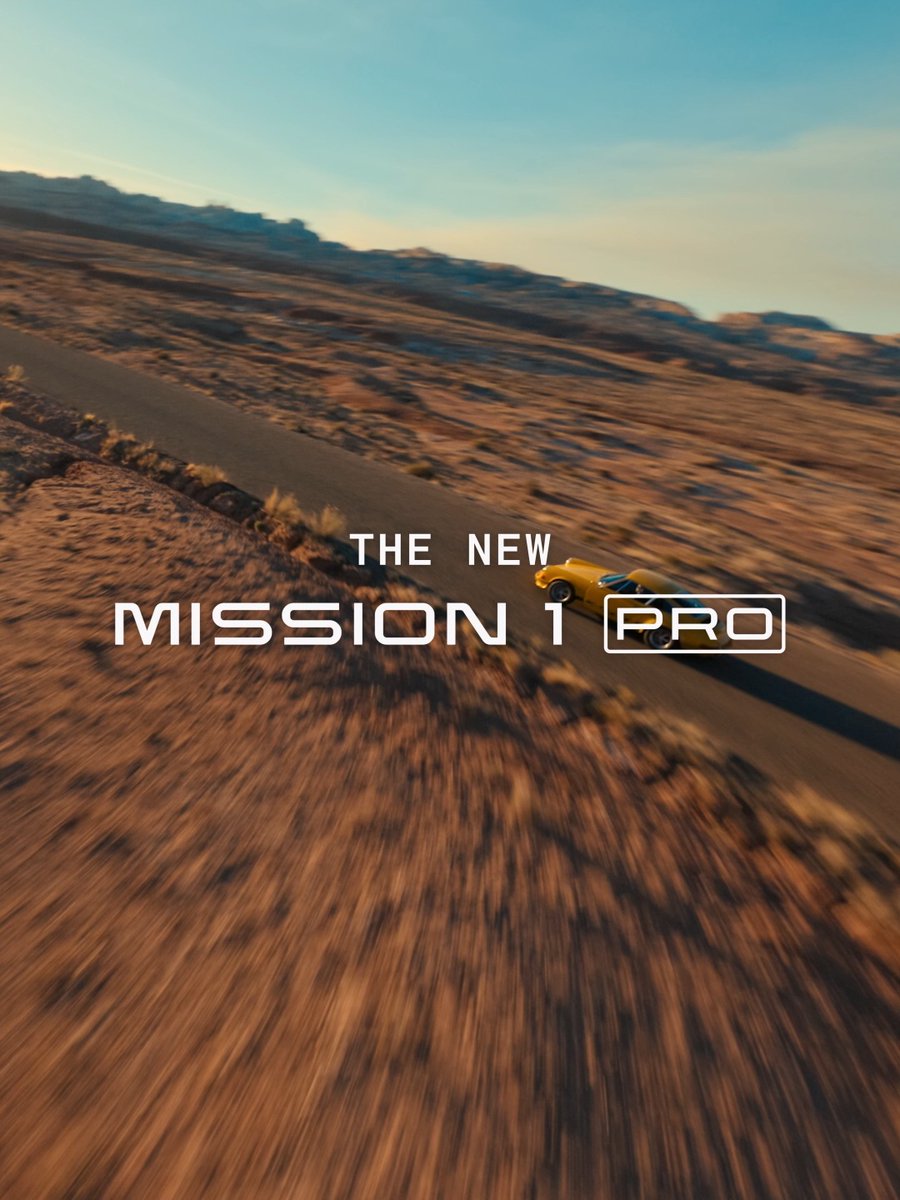
This is #GoProMISSION1 PRO 🎥 The only 8K60 camera with a 1-inch sensor. Our compact, cinema-grade camera features a proprietary GP3 processor and 50MP sensor that enable intelligent low-light capture, industry-leading frame rates and resolutions, and groundbreaking thermal performance. ✔️ 1-inch Quad-Bayer sensor with up to 14-stops of dynamic range at the sensor for low-light capture ✔️ Longest continuous runtimes + most dependable thermal performance of any GoPro ever—over 5 hours in 1080p + over 3 hours in 4K at 100°F ✔️ Industry-leading 8K60—300% more pixels than 4K ✔️ 4K240 + 1080p960 ultra slo-mo with real frames—not AI-interpolated ✔️ 8K30 + 4K120 Open Gate capture ✔️ Gallery-ready 50MP photos + 44MP frame grabs ✔️ Up to 240 Mbps bit rate out of the box + 300 Mbps with GoPro Labs ✔️ 10-Bit color + GP-Log2 with LUTs for Rec.709 + Rec.2020 outputs ✔️ HLG HDR with Simultaneous Dual-Gain Readout—the industry standard for pros ✔️ New intelligent capture modes: Dive, Vlog, Low-Light, Sport POV, + Subject Tracking ✔️ 13% higher capacity Enduro 2 battery in the same form factor with new fast charging ✔️ Rugged + waterproof, now to 66ft (20m) without a housing ✔️ Emmy® Award Winning #HyperSmooth in-camera video stabilization ✔️ New 4-microphone array, 32-bit float audio, multi-track recording, + manual audio controls ✔️ Timecode Sync to streamline multi-camera editing + GPS with telemetry data ✔️ New Point-and-Shoot Grip compatibility for elite handheld control ✔️ Removable Lens Hood included to reduce glare + flares ✔️ Bluetooth® 5.3 Super Wideband connectivity + USB-C port for external audio capture ✔️ A cinema-grade camera that anybody can use Enhanced by a GoPro Subscription: ✔️ Unlimited cloud backup at 100% quality ✔️ Camera replacement guarantee ✔️ Up to 50% off select accessories Order your MISSION 1 Series camera now to get a free Point-and-Shoot Grip ($100 value) + free shipping at Pro-tip: Existing GoPro Subscribers save $100 with the annual camera discount.

GoPro

21,307 görüntüleme • 2 ay önce

Mark Zuckerberg is explaining one of the most misunderstood dynamics in AI and it has direct investment implications (Save this). The concept he's describing is model distillation, and it's one of the most important techniques to emerge in AI over the past year. Here's how it works. You train a massive, enormously expensive model, in Meta's case, Llama 4 Behemoth, a 2 trillion parameter teacher model and then you use that model to teach a much smaller, cheaper model. The smaller model inherits roughly 90 to 95% of the intelligence of the giant while running at 10% of the cost and on a fraction of the compute. Meta already did this with the Llama 4 family and Behemoth serves as the teacher. Llama 4 Scout and Maverick, the publicly released open-source models were distilled from it. Scout runs on a single H100 GPU with a 10 million token context window and outperforms models that cost far more to operate. Maverick, at 17 billion active parameters, rivals DeepSeek V3 in coding at half the parameter count and beats GPT-4o on multimodal benchmarks. Both are completely free for commercial use. What Zuckerberg is pointing at is a structural shift in how AI gets deployed in the real world. Companies aren't taking a frontier model off the shelf and running it as-is but rather taking open-source models, fine-tuning them on their own proprietary data, distilling them into even smaller custom models tailored to their specific use case, and running them on infrastructure they control at a fraction of the cost of a closed frontier API. The investment implication of this is significant and runs in two directions. For Meta specifically, this is a strategic masterstroke. Every company that builds on Llama, fine-tunes it, distills it, or deploys it through their infrastructure is pulling into Meta's orbit while Meta builds the most powerful open teacher model. The ecosystem of companies using it grows and that ecosystem generates commercial activity across Meta's platforms and data services. Meta's AI research benefits from billions of real world deployment signals and it's a flywheel that closed model providers cannot replicate because their strategy requires charging per token, which is now a 65x cost disadvantage against the open-source alternative. For the broader market, distillation changes the economics of inference in a way that has barely been priced in. As intelligence becomes extractable into smaller and cheaper models, the absolute demand for compute doesn't decline but rather it explodes, because now the number of applications that are economically viable expands by orders of magnitude. Every task that was previously too expensive to automate at $3.25 per call becomes viable at $0.05 that means more total token usage, more total GPU utilization, and more demand for the infrastructure companies, the Nebiuses, the GE Vernovas, the Constellation Energies that supply the underlying compute and power.

Milk Road AI

27,869 görüntüleme • 28 gün önce

Demis Hassabis just explained why the real AI bottleneck has nothing to do with training runs. Most people picture the AI arms race as who can build the biggest model. GPT-4 or Gemini Ultra style training runs, a few hundred million in compute, fired once or twice a year. The constraint sits somewhere else. Every time a researcher has a new algorithmic idea, a new architecture, a new training technique, they can't just test it on a laptop. They have to run it at the scale where it would actually be deployed, because ideas that look promising at small scale fall apart completely when you put them into a real system. Every research hypothesis burns significant compute before a single line of production code gets written. At a lab like DeepMind, hundreds of researchers are running hundreds of ideas simultaneously. The demand for experimental compute is continuous. It never stops. Now layer the hardware reality on top. GPU lead times are currently 36 to 52 weeks for data center hardware. Global AI data centers are already drawing 29.6 gigawatts, equivalent to the peak power demand of the entire state of New York, and they still can't meet demand. Companies willing to pay any price can't just buy more compute. They wait in line. The speed of scientific discovery in AI is now gated by hardware availability. The next breakthrough is sitting in a researcher's head right now. Whether it gets validated fast enough to matter depends entirely on whether the compute is there when they need it. The AI race gets won by whoever can run the most experiments per month.

Aakash Gupta

32,150 görüntüleme • 3 ay önce