Video wird geladen...

Video konnte nicht geladen werden

Zur Startseite

๐Ÿš€ Major Update for ML-Sharp WebUI on Pinokio! ๐ŸŒŸ Native Mac Video Export (Zero CUDA) ๐ŸŽฅ 10 New Camera Trajectories ๐Ÿ’พ Low VRAM Mode (8GB GPU Support) โšก๏ธ Real-Time Previews Create stunning 3D gaussian splats from a single image.

22,860 Aufrufe โ€ข vor 8 Monaten โ€ขvia X (Twitter)

0 Kommentare

Keine Kommentare verfรผgbar

Kommentare vom Original-Post werden hier angezeigt

ร„hnliche Videos

six months ago this wasn't happening on 8gb vram. running unsloth's Q4_K_XL quant of gemma 4 26b-a4b-it-qat, a sparse MoE model with only 4b active params on a single rtx 4060 laptop gpu, 8gb vram, 20+ tok/s decode. no cloud, no api, no offload hacks. just a gaming laptop on battery. what makes it fit: google's QAT (quantization aware training), plus MTP (multi token prediction) support in the latest llama.cpp builds. that combo is the single biggest unlock for local inference on low vram. rtx 3060, rtx 3070, gtx 1070, gtx 1080, rtx 4050, rtx 4060, rtx 5050, rtx 5060 โ€” any 6-8gb consumer gpu, old or new โ€” this model runs on it. world cup season, so i told it to build a soccer themed flappy bird clone. one shot, zero iteration, fully playable. six months ago an 8gb model could barely clone vanilla flappy bird. now it's shipping a themed game from a sparse MoE model running locally on a laptop battery. inference benchmarks: - decode throughput: 30 tok/s - context: 64k. this is the real unlock. 64k ctx is what makes a hermes agent loop viable locally on this model, not just single-turn chat. llama.cpp flags: -m gemma-4-26B-A4B-it-qat-UD-Q4_K_XL.gguf -c 64000 -cmoe --port 8080 game's deployed on my own site, built and shipped end to end with open source llm, zero closed source api dependency in the pipeline. link in the description. gguf weights on huggingface, link in the comments. pull it down, run it on whatever 8gb card is sitting in your rig. try the game and tell me your score and what you want in v2. local llms on consumer gpus stopped being a meme.

Alok

61,660 Aufrufe โ€ข vor 2 Monaten

Want to create an avatar from a single image? FlexAvatar is a transformer model that creates full 360ยฐ, high-quality, and expressive 3D head avatar from just a single portrait image in minutes. Real-time Demo: FlexAvatar's lightweight architecture allows both animation and rendering in real-time, enabling interactive user experiences. To create a new 3D head avatar, only one image is required, e.g., from a webcam. The final avatar is ready after 2 minutes. Architecture: Under the hood, FlexAvatar adopts a transformer-based encoder-decoder design. The encoder maps the input image onto a latent avatar space, while the decoder produces 3D Gaussian attribute maps by incorporating the animation signal via cross-attention. The model learns all facial animations directly from the data without relying on pre-built 3D face models. This equips the avatars with realistic facial expressions. The internal avatar latent space can be conveniently used to integrate additional observations of a person via fitting. This enables use-cases where more than one image of a person is available, e.g., from a phone scan of the person. We train jointly on 2D monocular videos and multi-view data. However, in monocular videos, the animation signal leaks the target viewpoint, causing the model to produce incomplete 3D heads. We call this phenomenon entanglement of driving signal and target viewpoint. To prevent entanglement, we introduce bias sinks. These are learnable tokens that indicate whether a training sample stems from a monocular or a multi-view dataset. During training, the model learns to produce incomplete 3D heads only when the monocular token is present. During inference, FlexAvatar then always uses the multi-view token for which the model has learned to produce complete 3D heads. This simple design allows to combine the generalizability from monocular data with the quality of multi-view data. FlexAvatar summary: - Input: Single-image, phone scan, or monocular video - Output: Full 360ยฐ head avatar - Expressive animations - Real-time rendering and animation - Generalization to any portrait - Create a new avatar in 2 minutes - Use bias sinks to combine 2D and 3D data ๐Ÿ  ๐ŸŒ ๐ŸŽฅ Great work by Tobias Kirschstein and Simon Giebenhain!

Matthias Niessner

96,334 Aufrufe โ€ข vor 9 Monaten

๐Ÿš€ Announcing Echo โ€” our new frontier model for 3D world generation. Echo turns a simple text prompt or image into a fully explorable, 3D-consistent world. Instead of disconnected views, the result is a single, coherent spatial representation you can move through freely. This is part of a bigger shift in AI: from generating pixels and tokens to generating spaces. Echo predicts a geometry-grounded 3D scene at metric scale, meaning every novel view, depth map, and interaction comes from the same underlying world โ€” not independent hallucinations. Once generated, the world is interactive in real time. You control the camera, explore from any angle, and render instantly โ€” even on low-end hardware, directly in the browser. High-quality 3D world exploration is no longer gated by expensive equipment. Under the hood, Echo infers a physically grounded 3D representation and converts it into a renderable format. For our web demo, we use 3D Gaussian Splatting (3DGS) for fast, GPU-friendly rendering โ€” but the representation itself is flexible and can be easily adapted. Why this matters: consistent 3D worlds unlock real workflows โ€” digital twins, 3D design, game environments, robotics simulation, and more. From a single photo or a line of text, Echo builds worlds that are reliable, editable, and spatially faithful. Echo also enables scene editing and restyling. Change materials, remove or add objects, explore design variations โ€” all while preserving global 3D consistency. Editing no longer breaks the world. This is only the beginning. Echo is the foundation for future world models with dynamics, physical reasoning, and richer interaction โ€” environments that donโ€™t just look right, but behave right. Explore the generated worlds on our website and sign up for the closed beta. The era of spatial intelligence starts here. ๐ŸŒ #Echo #WorldModels #SpatialAI #3DFoundationModels Check it out:

SpAItial AI

176,903 Aufrufe โ€ข vor 9 Monaten

3D scanning and rendering is moving so fast - got my splats up and running and I'm mind blown getting ~100fps for this complex 3D scene โฌ‡๏ธ ๐Ÿคฏ 1. WAY faster than NeRF: For comparison, NeRFs would takes around 10 seconds per frame (!) Instead I'm zipping around with FPV controls without breaking a sweat - though I do crash a few times towards the end of the video lol 2. Old Meets New: Gaussian Splatting is cool in that it fuses classical graphics and deep learning techniques. Like NeRFs, this is still a radiance field - just without the slower (ne)ural rendering part. 3. Explicit Representation: Instead you represent a 3D scene as a collection of ellipsoidal "splats" called gaussians. Each gaussian has a position, size, and color. Rendering in real-time is done by projecting into the image plane and alpha blending. 4. Photorealistic Effects: Gaussian splatting use spherical harmonics to represent the view-dependent effects and lighting - allowing surfaces to change color when viewed from different angles, enabling greater photorealism. It doesn't use a neural network, but the training loop is similar to deep learning. 5. Enables Direct Editing: But it's not just speed - with Gaussian Splatting you also get 3D editing support! So you can select, move, and delete stuff, even relight stuff. This type of editing has been more tedious to do with NeRFs and their implicit black box representations. ๐Ÿ“ฒ More tests cooking! Much more to unpack here including simpler explanations. If you enjoyed this post, you might enjoy my feed: Bilawal Sidhu

Bilawal Sidhu

337,090 Aufrufe โ€ข vor 3 Jahren

๐Ÿ“ข๐Ÿ“ข ๐€๐ฏ๐š๐ญ๐Ÿ‘๐ซ ๐Ÿ“ข๐Ÿ“ข Avat3r creates high-quality 3D head avatars from just a few input images in a single forward pass with a new dynamic 3DGS reconstruction model. Video: Project: Our core idea is to make Gaussian Reconstruction Models animatable. We find that a simple cross-attention to an expression code sequence is already sufficient to model complex facial expressions. We then incorporate position maps from DUSt3R and feature maps from Sapiens to facilitate the prediction task. While DUSt3R's position maps act as a pixel-aligned initialization for the Gaussians' positions, the Sapiens feature maps help the cross-view transformer to match corresponding image tokens in the 4 input images. One major challenge in creating a 3D head avatar from smartphone images comes from inconsistent facial expressions when the subject could not remain perfectly static during the capture. We eliminate this static requirement by simply showing our model input images with different facial expressions during training. This technique makes our model robust to inconsistent input images later on. Finally, we show that despite the model has been trained with 4 input images, one can even create a 3D head avatar when only a single image is available. To achieve this, we employ a pre-trained 3D GAN to lift the single image to 3D and then render the 4 input images for our model. This allows us to create 3D head avatars from single images and even highly out-of-distribution examples like AI generated faces, paintings or statues. Great work by Tobias Kirschstein from his internship at Meta with Javier Romero, Artem Sevastopolsky, and Shunsuke Saito

Matthias Niessner

74,818 Aufrufe โ€ข vor 1 Jahr

GeoLibre v3.0.0 is here! GeoLibre is a free and open-source, lightweight, cloud-native GIS platform for visualizing, exploring, and analyzing geospatial data. It runs everywhere you do, in the web browser, on the desktop, on mobile, and inside Jupyter notebooks, all while keeping your data local and private. This release landed 95 pull requests from 11 contributors, and 5 people made their first contribution to GeoLibre. Thank you to everyone who filed an issue, reviewed a change, or sent a patch. Our first major release makes the Cesium 3D globe a full rendering engine for the whole workspace, brings time-dynamic CZML scenes and native KML to the globe, and lets you save your edits straight back to ArcGIS Feature Services. What's new in v3.0.0 - Cesium as your main map: switch the entire workspace between MapLibre 2D and Cesium 3D from the View menu, and the choice is saved with your project. - Nearly every layer on the globe: COGs, PMTiles, MBTiles, vector tiles, ArcGIS services, I3S scene layers, LiDAR point clouds, and Gaussian splats all render in 3D, with extruded polygons and true elevation for 3D vectors. - Dynamic 3D scenes: load CZML for orbits, trajectories, and moving objects that play along the globe clock, open KML and KMZ with their original styling, and add Cesium Ion assets such as OSM Buildings by id. - Your tools work in 3D too: screenshots, print layouts, video and camera tours, the Elevation Profile, and the Sun, Atmosphere, Flight Simulator, and weather plugins. - ArcGIS write-back: edit a Feature Service layer in GeoLibre and save additions, changes, and deletions back to the service. - Editable SVG print layouts: export a layout and fine-tune the title, legend, and scale bar in Inkscape or Illustrator. - Smarter rasters and new data sources: viewport-based raster stretch, persistent layer filters from Select by Expression, a Portolan catalog browser, OGC CSW catalog search, and a USGS NLDI panel for tracing river networks. Try it out - Launch GeoLibre Web: - GitHub: - Documentation: - Release notes: #GIS #Geospatial #OpenSource #CesiumJS #3DMapping #MapLibre #GeoLibre

Qiusheng Wu

60,897 Aufrufe โ€ข vor 2 Tagen

๐——๐—ผ๐—ฟ๐—บ๐—ฎ๐—ป๐˜ ๐— ๐—ฒ๐—บ๐—ผ๐—ฟ๐˜† ๐—ฉ๐—ถ๐—ฒ๐˜„๐—ฒ๐—ฟ: Because I almost always have some gear with meโ€”a drone, a mirrorless camera, or at least a phoneโ€”I can capture scenes on the spur of the moment. Here I am freely flying through 3D Gaussian Splats scenes trained from these impromptu captures. It has been several years now since I've developed a real passion for 3D scanning, photogrammetry, andโ€”for the last two and a half yearsโ€”radiance fields. We actively use these technologies on a professional level at Dpt. , but this is also a personal passion of mine. I love capturing scenes, places, people, moments in timeโ€”memories. I enjoy the process of doing it; yes, capturing several hundreds of photos at a time, going in circles around a 'subject' for 15 minutesโ€”all of which can drive my family nuts when they're with me. I have fun pre-processing, aligning, and using datasets to finally see those memories form and then be able to explore them freely in real-time. This week, Meta announced Hyperscape during this year's Meta Connect eventโ€ฆ "๐˜ˆ๐˜ฏ๐˜ฅ ๐˜ด๐˜ฑ๐˜ฆ๐˜ข๐˜ฌ๐˜ช๐˜ฏ๐˜จ ๐˜ฐ๐˜ง ๐˜ฑ๐˜ณ๐˜ฆ๐˜ด๐˜ฆ๐˜ฏ๐˜ค๐˜ฆ, ๐˜ธ๐˜ฆโ€™๐˜ณ๐˜ฆ ๐˜ช๐˜ฎ๐˜ฑ๐˜ณ๐˜ฐ๐˜ท๐˜ช๐˜ฏ๐˜จ ๐˜ต๐˜ฉ๐˜ข๐˜ต, ๐˜ต๐˜ฐ๐˜ฐ. ๐˜ž๐˜ฆโ€™๐˜ณ๐˜ฆ ๐˜ธ๐˜ฐ๐˜ณ๐˜ฌ๐˜ช๐˜ฏ๐˜จ ๐˜ต๐˜ฐ ๐˜ฃ๐˜ณ๐˜ช๐˜ฏ๐˜จ ๐˜ฑ๐˜ฉ๐˜ฐ๐˜ต๐˜ฐ๐˜ณ๐˜ฆ๐˜ข๐˜ญ๐˜ช๐˜ด๐˜ต๐˜ช๐˜ค ๐˜ด๐˜ฑ๐˜ข๐˜ค๐˜ฆ๐˜ด ๐˜ช๐˜ฏ๐˜ต๐˜ฐ ๐˜ต๐˜ฉ๐˜ฆ ๐˜ฎ๐˜ฆ๐˜ต๐˜ข๐˜ท๐˜ฆ๐˜ณ๐˜ด๐˜ฆ, ๐˜ฆ๐˜ฏ๐˜ข๐˜ฃ๐˜ญ๐˜ช๐˜ฏ๐˜จ ๐˜ข ๐˜ฑ๐˜ณ๐˜ฐ๐˜ง๐˜ฐ๐˜ถ๐˜ฏ๐˜ฅ ๐˜ฏ๐˜ฆ๐˜ธ ๐˜ธ๐˜ข๐˜บ ๐˜ต๐˜ฐ ๐˜ฃ๐˜ฆ ๐˜ต๐˜ฐ๐˜จ๐˜ฆ๐˜ต๐˜ฉ๐˜ฆ๐˜ณ ๐˜ช๐˜ฏ ๐˜ด๐˜ฑ๐˜ข๐˜ค๐˜ฆ๐˜ด ๐˜ต๐˜ฉ๐˜ข๐˜ต ๐˜ญ๐˜ฐ๐˜ฐ๐˜ฌ ๐˜ข๐˜ฏ๐˜ฅ ๐˜ง๐˜ฆ๐˜ฆ๐˜ญ ๐˜ญ๐˜ช๐˜ฌ๐˜ฆ ๐˜บ๐˜ฐ๐˜ถโ€™๐˜ณ๐˜ฆ ๐˜ฑ๐˜ฉ๐˜บ๐˜ด๐˜ช๐˜ค๐˜ข๐˜ญ๐˜ญ๐˜บ ๐˜ต๐˜ฉ๐˜ฆ๐˜ณ๐˜ฆโ€”๐˜ธ๐˜ฆ ๐˜ค๐˜ข๐˜ญ๐˜ญ ๐˜ช๐˜ต ๐˜๐˜บ๐˜ฑ๐˜ฆ๐˜ณ๐˜ด๐˜ค๐˜ข๐˜ฑ๐˜ฆ." โ€ฆit's exciting to see major players like Meta pushing the boundaries of immersive experiences. Their announcement of Hyperscape resonates deeply with the work I've been doing and my passion for capturing and recreating photorealistic environments and memories. It feels like we're all moving toward a future where the lines between the physical and digital worlds blur, allowing us to share spaces and moments in unprecedented ways. I'm thrilled to be contributing my own explorations to this ever-evolving field. The attached video is a screen recording of myself exploring and flying through volumetric capturesโ€”dormant memoriesโ€”in real-time using an app I crafted for this purpose. The first part shows me moving from one memory to another (btw, this works in tethered VR), and in the second part of the video at , I explore two memories simultaneously, rendering two 3D Gaussian Splats of the same location onto two monitors. #gaussiansplatting #radiancefield #digitaltwin #hyperscape #memories

Hugues Bruyรจre

16,333 Aufrufe โ€ข vor 1 Jahr

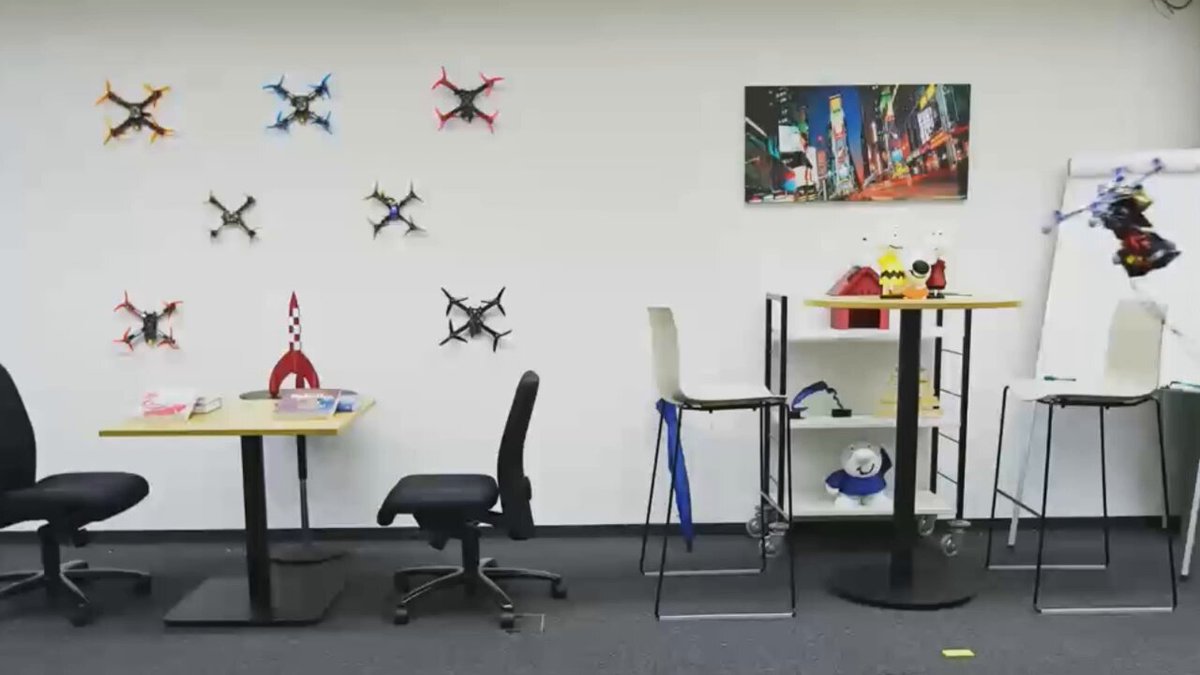
We are excited to share our work โ€œEvent-Aided Sharp Radiance Field Reconstruction for Fast-Flying Dronesโ€ published in IEEE Transactions on Robotics IEEE Transactions on Robotics (T-RO), which tackles sharp radiance field reconstruction under agile drone motion, where RGB frames are heavily motion-blurred and pose priors become unreliable! 4 years in the making! Code & dataset released! PDF: Code & Dataset: Full Narrated Video: High-speed flight is essential for time- and battery-constrained missions (e.g., inspection, exploration, search & rescue). However, fast motion corrupts visual data with severe motion blur and introduces drift/noise in visual-inertial odometry, making NeRF-based 3D reconstruction particularly brittle. We propose a unified framework that leverages asynchronous #EventCamera streams together with motion-blurred frames to reconstruct high-fidelity radiance fields from agile drone flights. Our key idea is to embed event-image fusion directly into radiance field optimization while jointly refining a shared, continuous-time camera trajectory initialized from event-based VIO. This enables us to recover sharp radiance fields and accurate trajectories without ground-truth supervision during training. We validate our method on synthetic data and on real sequences captured by a drone flying up to 2 m/s. Despite severe blur and noisy pose priors, our method preserves fine scene details and achieves a performance gain of over 50% on real-world data compared to state-of-the-art methods. Kudos to Rong Zou and Marco Cannici! Marco Cannici Reference: Rong Zou*, Marco Cannici*, Davide Scaramuzza Event-Aided Sharp Radiance Field Reconstruction for Fast-Flying Drones IEEE Transactions on Robotics (T-RO), 2026 NCCR Robotics European Research Council (ERC) AUTOASSESS UZH IfI University of Zurich UZH Science Prophesee SynSense UZH Space Hub

Davide Scaramuzza

12,028 Aufrufe โ€ข vor 6 Monaten

VoxCPM 2 just dropped by OpenBMB Only 2B-param open-source TTS (Text-to-Speech) model built for production-grade multilingual voice work. Apache-2.0 license, Can run on only 8GB VRAM. โ€ข Eliminates the "robotic" feel of traditional TTS, delivering prosody and emotional depth suitable for high-stakes professional environments like filmmaking, gaming, animation, and audiobooks. โ€ข 30-language multilingual: no language tag needed, just type in a supported language and generate directly. โ€ข Voice design: create a brand-new voice from a text description alone, like age, tone, pace, or emotion. No reference audio required. Describe the desired voice characteristics (gender, age, tone, emotion, pace โ€ฆ) in Control Instruction, and VoxCPM2 will craft a unique voice from your description alone. โ€ข Controllable cloning: clone from a short clip, then steer delivery style without losing the speakerโ€™s core voice. โ€ข Ultimate cloning: use reference audio + transcript for continuation-style cloning that keeps the tiny vocal details. โ€ข 48kHz output: takes 16kHz reference audio and produces studio-quality speech without an external upsampler. โ€ข Real-time ready: around 0.3 RTF on RTX 4090, even lower with Nano-VLLM. โ€ข Commercial use: Apache-2.0 licensed. Developer-Friendly Infrastructure: - Native Torch Inference: Direct support for PyTorch-based workflows. - Training Flexibility: Supports both full-parameter and LoRA fine-tuning for specific domain adaptation. - Production Readiness: Compatible with voxcpm-nanovllm for large-scale, high-concurrency deployment.

Rohan Paul

13,541 Aufrufe โ€ข vor 5 Monaten