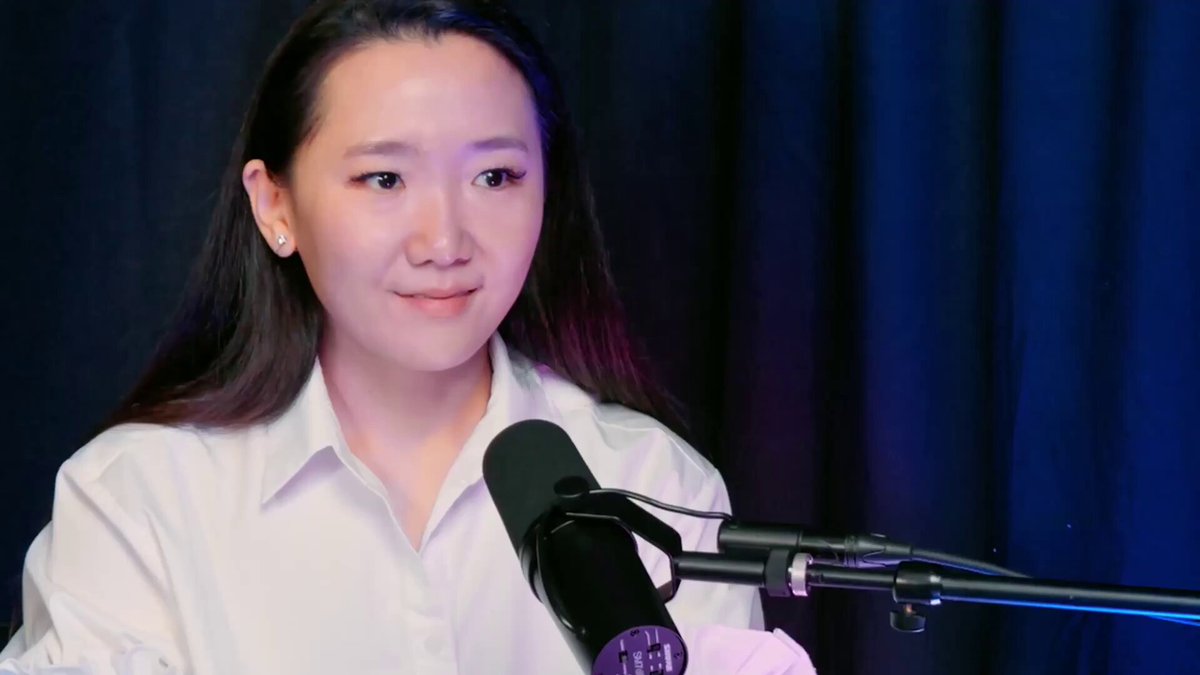
Loading video...

Video Failed to Load

Go Home

Markets don't move on data alone — they move on stories. The question is not just whether a narrative is right, but where it is in its lifecycle: just beginning to spread, already fully priced in, or somewhere in between. Most investors sense this intuitively, but lack a systematic...

15,480 views • 1 month ago •via X (Twitter)

0 Comments

No comments available

Comments from the original post will appear here

Related Videos

When I was 8 years old, growing up in Taipei, I called my aunt in San Francisco and asked: What is the best science and technology school in the world? She said MIT. I went on the internet, found it, and decided that was where I was going. All because of a Steven Spielberg movie about a little robot boy who wanted to find his mom. I grew up as an only child. What stayed with me from that movie was not just the technology. It was the possibility that one day, an artificial companion could understand how I felt. That was the first time I remember being moved by a technology that could change how humans experience reality. Years later, I did get to MIT. I studied AI before it became obvious. I became a machine learning engineer, built my first company, joined a $3.5B VC fund, left to build again, failed, started again, moved to New York alone, and built through one of the hardest crypto markets as a solo founder after the collapse of FTX. I kept going because I have always been drawn to technologies that change how humans understand the world. AI was the first version of that. Crypto and prediction markets are the next. I believe the future I am building toward is inevitable. The only question is whether I get to be one of the people who helps realize it. That future is a world where markets become information-first. The old model of trading was asset-first. It rewarded people with capital, financial education, institutional access, and better tools. But the next generation of markets will be shaped by information flow, narrative, attention, politics, culture, sentiment, and collective belief. Prediction markets make this shift obvious. They are one of the first asset classes where the value is informational, not purely financial in the traditional sense. Your edge does not have to come from technical analysis or a traditional finance background. Your edge can come from knowing something before it becomes consensus. From seeing reality shift before the market prices it in. Someone with firsthand knowledge of an unfolding event can have more alpha than an institution with a much bigger balance sheet. They turn belief into price. But price alone is not enough. Polymarket shows what the market thinks will happen. ARES is built to understand why the market is changing. We are building an information-first trading platform for prediction markets and other narrative-driven assets. One that does not just show traders what is moving, but helps them understand why odds are shifting, why narratives are forming, and why the future is moving in a certain direction. But the bigger vision is not just a better trading terminal. We want to turn every trade into an information object. Every position can become a piece of content. Every market view can become a signal. Every trader can build a reputation around conviction and accuracy. Most feeds rank information by engagement. Who got the most likes. Who already has the biggest audience. Markets allow us to rank information differently. How much are you willing to stake on what you believe? How often have you been right? That creates a fundamentally different kind of media feed. One powered by conviction, track record, and market incentives. One that becomes harder to fake. One that can help people understand not just what the market thinks will happen, but why reality is changing. I also believe prediction markets are one of the few markets where humans can still have a real edge over AI. AI knows what is already on the internet. But humans experience reality before it becomes data. We see things before they become headlines. We hear things before they become reports. We feel shifts before they become consensus. If those signals can be priced, organized, and made legible, then more people can gain access to financial opportunity, information agency, and power. That is what Ares is building toward. I spent years watching founders from the VC side of the table, always thinking: I wish that was me. Now it is. I talked about this journey and the thesis behind Ares in my conversation with Dmitry on Predict Time If you are building, trading, investing, or thinking deeply about prediction markets and information markets, I would love for you to watch it. And if you want to collaborate on what we are building, contribute to the vision, or join the team, we are always open to exceptional people across functions. DMs are open.

Morgan Lai

302,663 views • 2 months ago

🚨 SOMETHING VERY STRANGE IS HAPPENING SpaceX will go public tomorrow at a $1.75T valuation. The biggest IPO in market history. And Wall Street just changed the rules right before it happens. I've been trading for more than 15 years and have never seen them rewrite the rules so urgently: IPO access now lowered from $500,000 to $2,000 (-99.6% cut). That means millions of investors can suddenly enter a deal and buy shares tomorrow. One day before the most expensive IPO in history. And suddenly... SpaceX reserved up to 30% of the deal for regular investors. Three times the normal share. Why? Because retail investors need to buy what insiders sell. And here is the part most people are missing: SpaceX does not just create demand for SpaceX. It pulls liquidity out of everything else: - Retail sells stocks to chase the IPO. - Funds sell stocks to prepare for forced buying. - Brokers open access to generate demand. - Everyone needs cash at the same time. That is why the market is selling now. First, insiders create the hype. Then brokers open the gates. Then regular investors rush in. And by the time the crowd realizes what happened, the exit door is already closed. We’ve seen this before. 2000: Dotcom IPOs became the symbol of the bubble. Then Nasdaq collapsed 80%. 2021: SPACs, Coinbase, Robinhood, Rivian. Retail thought they were buying the future. They were buying the exit. Now the same playbook is back. Only this time, it is much bigger. When Wall Street cuts the entry ticket from $500K to $2K right before a $1.75T IPO, they are not giving retail a gift. They are creating buyers. Remember: Insiders need liquidity. Funds need allocation. The market needs a dream. And Wall Street needs someone to hold the bag. That is what tomorrow is really about. Reminder: I’ve called all the market tops and bottoms for the last 15 years, including the Bitcoin bottom at $16,000 and the top at $126,000. The next call will be even more important. When I exit the markets completely, I’ll post it here publicly like I always do. Turn notifications on. If you’re not following yet, you’ll understand why that was a mistake later.

Alex Mason 👁△

1,748,183 views • 1 month ago

This narrative that Palantir $PLTR and Robinhood $HOOD are meme stocks is absolute nonsense and needs to stop. Memestocks are companies that are being hyped up by investors that have zero fundamental reason to gain their appreciation in value. While it can be subjective over how to think of what constitutes a meme, the idea of comparing the company that deploys software on the battlefield to defend the warfighter or the company that has increased their assets under custody to 1/4th of a TRILLION in less than a year is just ridiculous. Palantir and Robinhood are led by two exceptional founders. Both have executed at a level that has realistically not been seen in the public markets EVER and cultivated an audience of retail investors that saw the potential, believed in them when the world didn't, and continue to see their growth trajectories as exponential. Now, you can absolutely disagree with the market's valuation of these two companies. I think that is a reasonable debate. However, to categorize their aggressive premiums as just filled with memes COMPLETELY discounts why the street is willing to pay a multiple and if you're best argument is valuation, please tell me why $COST Costco deserves a 50 P/E or why $NFLX Netflix, as incredible as it is, deserves to have a premium that is more than triple of $GOOGLon a P/E basis. The point is valuations are debatable but what is not debatable is the level of focus, dedication, and execution $PLTR and $HOOD have shown the public markets. Discounting them as memestocks just makes it seem like you'd rather ignore their execution vs. understand why the markets have given them their multiples.

amit

134,791 views • 1 year ago

Most $TAO holders are flying blind. They bought the token. They watched the price. They read the threads. But they have never opened the one tool that shows them everything happening inside the Bittensor network in real time. It is called Taostats. It is free. And after reading this, you will never look at $TAO the same way again. Here is exactly how to use it. Step 1: Start at the Subnets page. This is the heartbeat of the entire network. Every subnet running on Bittensor is listed here with: - its current emission rate - the number of active miners and validators - real-time performance data The emission rate is the most important number on this page. It tells you exactly how much TAO is flowing into each subnet every block. High emission means the network is directing significant resources toward that subnet's commodity. Low emission means the market has not yet recognised its value, or the subnet has not yet proven itself. Watch which subnets are gaining emission share over time. That movement tells you where the network believes the most valuable work is being done, before any headline announces it. Step 2: Use the Subnet pages to go deeper. Click any subnet, and you enter a complete dashboard for that individual market. - The TradingView chart shows you the alpha token price history for that subnet. Alpha tokens are the subnet-specific tokens that sit inside TAO's broader economy. Their price relative to TAO tells you how the market is valuing that subnet's specific commodity. - The Metagraph is the full list of every miner and validator currently active in the subnet: their UID, their stake, their trust score, their emission share. This is the raw intelligence layer. The miners consistently earning the most emissions are producing the work the validators collectively agree is the most valuable. - The Sentiment Index gives you a real-time community temperature reading on each subnet. Not price sentiment. Ecosystem sentiment. Whether the participants building inside the subnet believe it is healthy and improving. Step 3: Check Validators before you stake anything. This is the step most people skip and regret. The Validators page on Taostats shows you the performance history of every validator on the network: their VTrust score, their emission consistency, and their weight-setting behaviour across subnets. VTrust is the metric that matters most. It measures how closely a validator's judgments align with the honest stake-weighted majority across the network. High VTrust means the validator is doing genuine work and being rewarded for it. Low VTrust means the validator is either lazy, copying other validators' weights, or attempting to manipulate the system. When you delegate your TAO to a validator, you are trusting them with your emissions. Taostats shows you exactly which validators have earned that trust over time, and which ones have not. Never stake blind again. Step 4: Use the Blockchain explorer to track real movement. The Blockchain section of Taostats logs every transfer, every staking transaction, and every extrinsic called on the Bittensor chain in real time. This is where you track what wallets are actually doing: - Large staking transactions from unknown addresses - Subnet registration events that signal a new market is about to go live - Neuron registration burns that show demand for participation in a specific subnet is accelerating The people who read on-chain data before the narrative catches up to it are the ones who position correctly before the crowd notices the move. Step 5: Track your own portfolio inside the Dashboard. Connect your coldkey address, and Taostats builds you a complete portfolio view: - Your TAO balance - Your staking positions - Your delegation returns - Your yield over time The yield calculator is particularly useful. It shows you the actual return you are generating from your staking position in real TAO terms, not in percentage estimates that assume conditions that may not hold. If your yield is lower than the network average for your validator tier, Taostats shows you that too. Switching validators takes one transaction. The data to make that decision intelligently is right in front of you. The bigger picture. Most people holding $TAO are making decisions based on price charts and social media sentiment. Both of those inputs are downstream of what is actually happening inside the network. Subnet emission shifts. Validator VTrust changes. On-chain registration events. Neuron burn rates. Alpha token price movements relative to TAO. All of it is live on Taostats right now. All of it is free. All of it tells you something the price chart cannot. The investors who understand Bittensor at the data layer will always be positioned ahead of the investors who understand it at the narrative layer. Taostats is the data layer. Bookmark it. Open it daily. The network is telling you exactly what it is doing if you know where to look.

2xnmore

137,182 views • 2 months ago

Someone just stole from 37,000 $TAO holders and walked away clean. Not because they broke a rule. Because no rule existed to stop them. That changes today. Here is what happened. Covenant AI ran one of the most watched subnets on Bittensor. On April 10, the founder sold their entire position and disappeared. No warning. No announcement. No on-chain signal. By the time holders found out, the price had already moved against them. This was not a hack. This was not a bug. This was a founder legally exiting into their own community with zero accountability. Bittensor just closed that door permanently. The Conviction upgrade is live on mainnet today. Every emission a subnet owner earns now locks automatically the moment it arrives. They cannot touch it immediately. If they want to exit they must submit a public unlock transaction on-chain. Visible to every single person on the network the second it is submitted. Then the clock starts. 30 days before 63% of their position becomes spendable. 90 days before 95% is accessible. You now have a month of warning before the first dollar of sell pressure hits. A silent exit is no longer possible. The founder has to tell you they are leaving before they can leave. And it goes further. Any holder can now lock their tokens toward a different address they believe would run the subnet better. The address with the most locked support behind it becomes eligible to take over entirely. Bad owners can be replaced by the community before they do damage. Before today, subnet investing had one risk nobody could price. The person running it could vanish overnight, and you would never see it coming. That risk has been removed from the equation. Skin in the game used to be a promise. Now, it is a number on a block explorer that every holder can verify in real time. The people who understand what accountable infrastructure means for the value of $TAO will not need to explain themselves later. This is still early.

2xnmore

19,513 views • 2 months ago

$ONDO is not a token waiting for adoption. It is already running two products with real money inside them right now. USDY: $2.14 billion in TVL. 3.55% APY. Deployed across Ethereum, Solana, Sui, Aptos, Mantle, Near, and six other chains. A yield-bearing stablecoin that outperforms a standard US Treasury Bill return every single day it runs. OUSG: $539 million in TVL. 3.43% APY. Built specifically for institutional investors who need 24/7 instant access to short-term US Treasuries without touching a bank or waiting for settlement windows. Combined TVL across both products: $2.68 billion. $ONDO's current market cap: $1.7 billion. Read that again. The protocol has $2.68 billion of real capital sitting inside its products right now and the market is valuing the entire protocol at $1.7 billion. TVL is 157% of market cap. Most DeFi protocols would celebrate a TVL equal to their market cap. $ONDO already has more real capital deployed in its products than the market thinks the entire protocol is worth. That is not a narrative. That is a balance sheet. USDY price accrues daily. OUSG beats the T-Bill rate consistently. Both are growing. Both are live. Both have institutional counterparties on the other side of every single transaction. The SEC confidential filing is active. The DTCC consortium seat is confirmed. Over 200 tokenised US stocks are preparing to launch on Solana. The product is built. The capital is inside it. The institutional pipeline is forming. The people who understood this before the repricing will not need to explain their positioning later

2xnmore

22,273 views • 1 month ago

.David Deutsch: "What's currently called AI and AGI are not only different from each other, they are very close to being the exact opposites of each other. The reason is that an AI, current AI is like an AI that diagnoses diseases or an AI that plays chess or an AI that controls a huge factory. Those things have objective functions, that is they have a function that they are designed to maximize and that is why they are used in those particular applications. Or in military terms, you could say the objective is to hit the target. You might say the objective is to hit the target unless some thing specified, but it's a specified thing comes up in which case don't hit the target and so on. This is, as I said, almost the opposite of what humans do when humans think. For a start, the AI has to be obedient, that is it has to actually do the things it is programmed to do, whereas a human is fundamentally disobedient, especially when being creative. When a human plays chess, they are performing a completely different kind of computation. They don't do the same things, they don't investigate the same possibilities that the artificial chess playing machine does, because the artificial one is capable of looking at billions and billions of possibilities, whereas the human can only look at hundreds or something. They are doing something completely different. Another difference is that the human can explain, can write a book later, having become world champion, can write a book saying how I did it, as the computer program that beats the world champion can write no such book, because it has no idea how it did it. It was just following a program. I was doing this and that and that and none of that is illuminating. Also, third thing, the chess player can decide I don't want to play chess anymore, from now on I will play Go or from now on I will play tennis. If commanded to play chess, the functionality will deteriorate completely. Those things are different. What we want in an AGI is that it behaves in a way that cannot be specified in advance, because if you specified it, you would already have the answer. The AGI program has to give unexpected answers, answers to questions we didn't even know how to ask."

Deutsch Explains

72,455 views • 1 year ago