Video yükleniyor...

Video Yüklenemedi

Ana Sayfaya Dön

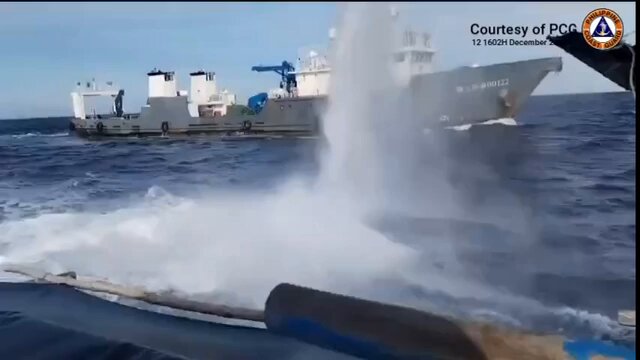
Mayor Baste Duterte's recent statements misrepresent the Philippines' balanced approach to China and the root causes of tensions in the West Philippine Sea. His two key claims—that using Chinese products implies support for economic cooperation over military confrontation, and that tensions in the WPS stem solely from U.S.-China great...

309,713 görüntüleme • 8 ay önce •via X (Twitter)

0 Yorum

Yorum bulunmuyor

Orijinal gönderinin yorumları burada görünecek

Benzer Videolar

Senator Robin Padilla's statement that confrontation with China yields no benefits for the Philippines and that continued contestation over the WPS is futile. Such position undermines the plight of Filipino fishermen who, just weeks ago, were injured and had their boats damaged by China Cost Guard water cannons near Escoda Shoal—incidents that highlight ongoing aggression despite diplomatic efforts. This statement is also a profound disservice to the PCG personnel who are courageously and selflessly patrolling the West Philippine Sea and who are constantly subjected to China’s bullying and dangerous actions. Our presence in these waters is not the cause of escalating tensions. We are there to prevent China from normalizing its illegal presence in the WPS while, at the same time, providing safety and security to our ordinary fishermen. As part of the senate, Sen. Padilla should recognize that the Philippines has never initiated or escalated tensions in the WPS. Instead, we have consistently been on the receiving end of China's barbaric, illegal, coercive, aggressive, and deceptive actions, which violate the 2016 Arbitral Award and international law. While Sen. Padilla emphasizes for diplomatic dialogue, he perhaps forgot that the current administration under President Ferdinand Marcos Jr. has actively pursued diplomacy. President Marcos has repeatedly emphasized maintaining open communication channels with Beijing while asserting that the WPS issue does not define the entirety of Philippines-China relations. As a matter of fact, bilateral trade remains robust: China is the Philippines' top import partner and a major export destination, with trade volumes reaching billions annually despite WPS issue. On Sen. Padilla’s discussion of territorial sea and exclusive economic zones, the Philippine government broadly understands the distinction under the United Nations Convention on the Law of the Sea (UNCLOS). It is only China that refuses to accept the invalidity of its "nine-dash line," as ruled by the 2016 Arbitral Award. Sen. Padilla's vision—that Filipino fishermen fish freely in the WPS, that Philippine Coast Guard vessels no longer subjected to water cannon by the China Coast Guard, and that resources like oil and gas at Recto Bank be extracted—can only materialize if China ceases its aggression. Suggesting that the Philippines should halt its defense of rights reveals a misunderstanding: we are not "fighting" in an offensive sense but steadfastly upholding sovereign rights against bullying. It is our fishermen who truly "fight" daily—not with arms, but by pursuing their livelihood in the WPS which is now endangered daily by China’s maritime forces. The good senator must remember: standing firm is not provocation; it is patriotism and it is our obligation for the next generation of Filipinos. By the way, Vietnam is not a founding member of ASEAN; it only joined in 1995.

Jay Tarriela

232,246 görüntüleme • 5 ay önce

I am compelled to respond to the misleading and inflammatory remarks made by Cong. Kiko Barzaga in a circulating video, which grossly misrepresent the Philippine Coast Guard’s mandate, operations, and the very essence of our service to the Filipino people. Cong. Barzaga’s statements not only distort facts but also disrespect the brave men and women of the PCG who risk their lives daily to safeguard our sovereignty and sovereign rights, ensure maritime safety, and uphold the rule of law. We urge the public to discern facts from fiction and to stand with those truly committed to the defense of our national interests. Cong. Barzaga’s assertion that the PCG’s actions in the West Philippine Sea could “cause World War III” and have “nothing to do with the lives of the Filipino people” is alarmist, inaccurate, and deeply irresponsible. The WPS is not an abstract geopolitical issue—it is part of our national patrimony. It encompasses vital fishing grounds, trade routes, and marine resources that sustain millions of Filipino families. The PCG’s presence there is not an act of provocation. PCG’s absence would be a blatant dereliction of duty. We are mandated to uphold and protect our sovereign rights under international law, including the UNCLOS and the 2016 Arbitral Award. Our patrols and operations prevent the normalization of China’s illegal activities, protect our fishermen from harassment, and expose violations of international norms. The PCG stands resolute: our operations in the WPS are acts of patriotism and public service, carried out with professionalism, transparency, adherence to law and restraint. Equally troubling is his baseless accusation that the PCG is a “corrupt organization” that confers “high ranks” on political figures. This claim is factually wrong and legally unfounded. Republic Act No. 9993, or the Philippine Coast Guard Law of 2009, clearly defines our organizational structure and the role of the PCG Auxiliary—a civilian volunteer under the direct supervision of the PCG Commandant. The honorary ranks they receive are symbolic of recognition, not authority. They hold no command positions and exercise no operational control over the PCG. Most concerning, however, is Cong. Barzaga’s claim that “the Philippines has no future with the PCG holding power in the military.” This reflects either a fundamental misunderstanding or a deliberate distortion of fact. The PCG is not part of the Armed Forces of the Philippines. We are armed and uniformed service, but not a military organization that is attached to the Department of Transportation, mandated to promote maritime safety, maritime security, and marine environmental protection. To portray the PCG as a military is not only inaccurate—it undermines the principles upon which civilian maritime governance is built. As a member of House of Representatives of the Philippines, to call for the abolition of the PCG and dismiss our existence as a “waste of government funds” is both reckless and deeply insulting to the 36,000 strong of the PCG who serve this nation with honor and courage. Our men and women operate in the harshest conditions—rescuing those in distress at sea, enforcing maritime laws, protecting our environment, and standing firm against coercion in the WPS. Many have sacrificed their lives in the line of duty. To trivialize their service as wasteful betrays not only a lack of understanding but also a lack of empathy. We will remain steadfast in our commitment to uphold our mandate with professionalism, integrity, and loyalty to the Filipino people. We will not be distracted by disinformation or political grandstanding. Instead, we will continue to fulfill our duties—calmly, lawfully, and resolutely—guided by the rule of law and love of country. I respectfully urge Cong. Barzaga to retract his statements and recommend that he consult with a doctor or a lawyer for a clearer understanding of the Philippine Coast Guard.

Jay Tarriela

50,949 görüntüleme • 8 ay önce

STATEMENT OF THE NATIONAL TASK FORCE FOR THE WEST PHILIPPINE SEA 9 December 2023 Manila, Philippines The National Task Force West Philippine Sea (NTFWPS) vehemently condemns the illegal and aggressive actions carried out by the Chinese Coast Guard and Chinese Maritime Militia against the civilian Bureau of Fisheries and Aquatic Resources (BFAR) vessels Datu Sanday, Datu Bankaw, and Datu Tamblot today during a regular BFAR humanitarian and support mission of providing oil subsidy and grocery packs to over 30 Filipino fishing vessels near Bajo De Masinloc in the West Philippine Sea. As of this reporting the mission is on-going. Based on the reports received, as the BFAR vessels approached 1.4 to 1.9 nautical miles from Bajo de Masinloc, the Chinese Coast Guard ships utilized water cannons to obstruct and prevent BFAR vessels from approaching the Filipino fishing vessels eagerly awaiting the oil subsidy and grocery packs. The water cannons had been used at least eight (8) times at the time of reporting. Additionally, the Chinese Maritime Militia vessels are reported to have engaged in dangerous maneuvers and deployed what is understood to be a Long-Range Acoustic Device (LRAD) against the BFAR vessels - causing severe temporary discomfort and incapacitation to some Filipino crew. Water cannon action have resulted in significant damage to BFAR vessel Datu Tamblot's communication and navigation equipment, as it was directly and deliberately targeted by the China Coast Guard. The Task Force likewise denounces the deployment of Rigid Hull Inflatable Boats (RHIBs) to disperse and drive away Filipino fishing vessels eagerly awaiting the distribution of fuel subsidies and food supplies from the BFAR ships. To prevent the distribution of humanitarian support is not only illegal but also inhumane. Moreover, Filipino fishermen have reported and documented the Chinese Coast Guard launching a small boat early this morning to illegally install a floating barrier at the southeast entrance of Bajo De Masinloc. The actions of Chinese Coast Guard and Chinese Maritime Militia hindered the BFAR vessel from accessing the entrance of the shoal. We stress that Bajo de Masinloc is a high-tide feature with territorial sea, per the 2016 Arbitral Award. It forms an integral part of the Philippine national territory under the Constitution. The Philippines exercises sovereignty and jurisdiction over the shoal and its territorial sea. The 2016 Arbitral Award has also clarified that Filipinos have traditional fishing rights in the water of Bajo de Masinloc protected by international law. China's illegal exercise of maritime law enforcement powers, interference with Philippine vessels, harassment and intimidation of Filipino fisherfolk, or any other activity that infringes upon the Philippines' sovereignty and jurisdiction in Bajo de Masinloc are violations of international law, particularly UNCLOS and the Arbitral Award. We firmly insist that these Chinese vessels leave Bajo de Masinloc immediately. We demand that the Chinese government take immediate action to halt these aggressive activities and uphold the principles of international law and desist from actions that would infringe on Philippine Sovereignty and endanger the lives and livelihood of Filipino fishermen who have traditionally fished in the area. The NTF-WPS remains committed to protecting the sovereignty and territorial integrity of the Philippines in the West Philippine Sea.

Jay Tarriela

1,298,944 görüntüleme • 2 yıl önce

PCG and BFAR Stand Firm Against Chinese Bullying and Aggressive Actions in Pag-asa The Philippine Coast Guard (PCG) and the Bureau of Fisheries and Aquatic Resources (BFAR) have reaffirmed their strong commitment to protecting Filipino fishermen in the Kalayaan Island Group, vowing to remain undeterred despite aggressive harassment and direct threats from Chinese vessels in the territorial waters of Pag-asa Island. This morning, while three BFAR vessels, including the BRP Datu Pagbuaya, were safely anchored in the territorial waters of Pag-asa Island to provide protection for Filipino fishermen as part of the “Kadiwa para sa Bagong Bayaning Mangingisda” (KBBM), they faced dangerous and provocative maneuvers from the China Coast Guard (CCG) and Chinese Maritime Militia vessels. Around 8:15 a.m., the Chinese maritime forces approached dangerously close, activating their water cannons as a clear threat against the BFAR vessels. The situation escalated at approximately 9:15 a.m. when CCG vessel with bow number 21559 fired its water cannon directly at the BRP Datu Pagbuaya, hitting the vessel. Just three minutes later, at 9:18 a.m., the same CCG vessel deliberately rammed the stern of the BRP Datu Pagbuaya, causing minor structural damage but no injuries to the crew. Despite these bullying tactics and aggressive actions, the PCG and BFAR remain resolute. We will not be intimidated or driven away, as our presence in the Kalayaan Island Group is crucial for protecting the rights and livelihoods of Filipino fishermen. PCG Commandant Admiral Ronnie Gil Gavan echoed this determination, stating, "The harassment we faced today only strengthens our resolve. Filipino fisherfolk depend on these waters, and neither water cannons nor ramming will deter us from fulfilling our commitment to President Ferdinand Marcos to not surrender a square inch of our territory to any foreign power."

Jay Tarriela

158,581 görüntüleme • 8 ay önce

PCG and BFAR Deploy Assets to Support Filipino Fishermen in BDM and Escoda Shoal The Philippine Coast Guard (PCG), in collaboration with the Bureau of Fisheries and Aquatic Resources (BFAR), has been actively deployed in Bajo de Masinloc and Escoda Shoal since yesterday. The primary objective is to ensure the safety and security of Filipino fishermen in these areas while distributing fuel, ice, and food packs to extend their fishing operations as part of the Kadiwa para sa Bagong Bayaning Mangingisda (KBBM) Program. Yesterday morning, the PCG monitored a group of fishermen being harassed and prevented from fishing near Bajo de Masinloc by Chinese Maritime Militia vessels and Chinese Coast Guard vessels 3103 and 3303. In response, the PCG vessel BRP Cabra, along with ten (10) BFAR vessels, were immediately dispatched to rendezvous with more than 30 Filipino fishing vessels. Upon arrival, the Filipino fishing boats received fuel subsidies and expressed gratitude to the national government for the support. Notably, the fishermen also reported an unidentified drone flying overhead, seemingly documenting their activities. Additionally, both the PCG and BFAR confirmed that Starlink connections are disconnected upon entering within 12 nautical miles of Bajo de Masinloc. In Escoda Shoal, Filipino fishing boats contacted the PCG vessel to report harassment by Chinese Maritime Militia and Chinese Coast Guard vessels 4203 and 5303, which prevented them from continuing their fishing activities. The PCG vessel BRP Cape Engaño proceeded to their location to provide security. As of this update, the PCG vessel remains in the vicinity to ensure the Filipino fishing boats are not harassed and are safely protected. PCG Commandant Admiral Ronnie Gil Gavan reiterated his commitment that the primary priority of PCG vessels deployed in these areas is to promote peace, stability and rule of law, while fulfilling the goverment’s responsibility to safeguard Filipino fishermen. This is in furtherance of the standing guidance of President Ferdinand Marcos, Jr., to assert the nation's rights firmly without provocation, while prioritizing the protection of our fishermen.

Jay Tarriela

43,116 görüntüleme • 3 ay önce

Philippine Coast Guard Continues Vigilant Patrols in Zambales Against Illegal Patrols of China Coast Guard Today, the Philippine Coast Guard vessel, BRP Cabra, under the command of LCDR Hanna Yanez, a female skipper, is actively patrolling off the coast of Zambales to thwart attempts by the China Coast Guard to normalize their illegal patrols within the Philippines' Exclusive Economic Zone (EEZ). Despite the BRP Cabra being smaller in length compared to the Chinese Coast Guard vessels, PCG Commandant Admiral Ronnie Gil Gavan asserts that international law empowers our vessel to operate without intimidation. This confidence allows the BRP Cabra to challenge the China Coast Guard, thereby exposing their unruly behavior and bullying tactics to the international community. The Philippine Coast Guard conducts its maritime patrols in accordance with the United Nations Convention on the Law of the Sea (UNCLOS), the 2016 Arbitral Award, and the Philippine Maritime Zones Act. Yesterday, during an engagement with CCG-21612 in the vicinity of 132.97 WSW off Capon Grande, Zambales, or approximately 36.35 S off BDM, the Chinese Coast Guard increased its speed and maneuvered past the port side of the BRP Cabra, dangerously blocking its navigation route. This incident highlights the CCG's non-compliance with the International Regulations for Preventing Collisions at Sea (COLREGS) and reflects a blatant disregard for safety at sea. While coast guards are typically recognized as enforcers of maritime safety and humanitarian organizations, the actions of the People's Republic of China diverge from these norms. Their illegal patrols jeopardize the lives of fishermen and legitimate law enforcement agencies alike. The Philippine Coast Guard remains committed to supporting the policy direction of President Ferdinand R. Marcos, Jr. that is to assert our rights and jurisdiction while ensuring that we do not act as an agent of escalation in the West Philippine Sea.

Jay Tarriela

14,624 görüntüleme • 1 yıl önce

Despite the United States being the Philippines' oldest treaty ally, it never interfered in the maritime disputes in the South China Sea. The US calling out the People's Republic of China's barbaric, illegal, coercive, aggressive, and deceptive actions in the West Philippine Sea is a principled move. Every law abiding nation is expected to stand for what is right and lawful. It strains logic to suggest that ordinary Filipino fishermen on wooden boats are somehow "organized and orchestrated" and can be provocative vis-a-vis the massive, armed and steel-hulled China Coast Guard vessels. Common sense alone debunks this narrative: how could unarmed fishermen realistically threaten or provoke such heavily equipped forces? Moreover, claims that Filipino fishermen were carrying knives are contradicted by evidence showing CCG vessels firing water cannons at close range, injuring three fishermen, damaging boats, and deliberately cutting the anchor lines of Philippine fishing vessels—endangering lives and livelihoods. The international community is well aware of these facts and will not be misled by propaganda portraying the Philippines as the aggressor. On China's assertion of "indisputable sovereignty" over Escoda Shoal, one must question the accuracy of Beijing's nautical charts: the feature is a low-tide elevation that is well within the Philippines' EEZ, approximately 75-95 nautical miles from Palawan. It is over 600 nautical miles—or up to 1,200 km—from China's nearest landmass. If China refuses to recognize the 2016 Arbitral Award invalidating its expansive claims, it should at least honor its commitments under the United Nations Convention on the Law of the Sea—a treaty it has ratified—that says LTE’s are not subject to territorial sovereignty. By the way, here is your Chinese Maritime Militia pretending to be a civilian fishing vessel also using water cannon against a Filipino wooden fishing boat as they escape the China Coast Guard vessels dangerous harassment last weekend. Finally, thank you for admitting committing illegal actions branding it as “necessary control measures.” ✌🏻

Jay Tarriela

94,203 görüntüleme • 6 ay önce

Since yesterday and continuing until now, the China Coast Guard vessel 5303 has persistently engaged in provocative actions and illegal monitoring of our ongoing hydrographic survey, which is situated 110.46 nautical miles northwest off Bolinao, Pangasinan. Although they have not directly obstructed or interfered with our survey activities, this relentless behavior serves as undeniable evidence that the People's Republic of China (PRC) is unhesitant in deploying its vessels within our Exclusive Economic Zone to intimidate and impede our legitimate operations, specifically in the field of marine scientific research. This blatant disregard for our jurisdiction and sovereign rights directly refutes the false narratives that are being propagated by Pro-China trolls. These individuals falsely claim that our actions are intended to provoke China or that we deliberately seek to present ourselves as oppressed. Per the UN Convention on the Law of the Sea’s (UNCLOS) Part XIII, the Philippines has the exclusive right to regulate, authorize, and conduct marine scientific research in its own EEZ and Continental Shelf. It is crucial to emphasize that our ongoing hydrographic survey in the northern region fully aligns with this provision. As a nation, we have every right to conduct this survey without facing impediments from any other states. Furthermore, it is noteworthy that despite the provocative presence of the China Coast Guard vessel, we have chosen not to respond with violence or aggression. Nevertheless, the government remains committed to advancing the rule of law in the West Philippine Sea and peace in the broader Indo-Pacific Region. The Philippines will not yield!

Jay Tarriela

195,065 görüntüleme • 2 yıl önce

China Coast Guard Harasses BFAR Vessels While Distributing Supplies to Filipino Fishermen in Panatag Shoal In support of the “Bagong Pilipinas” vision for food security and national development, the Bureau of Fisheries and Aquatic Resources (BFAR) deployed four vessels—BRP Datu Tamblot, BRP Datu Taradapit, BRP Datu Bankaya, and BRP Datu Daya—along with personnel from the Philippine Coast Guard (PCG) to Panatag Shoal this morning. The mission aimed to protect the rights and safety of Filipino fishermen in the area. Upon arrival, BFAR distributed fuel subsidies to over 20 local fishing boats, highlighting the national government's commitment to the Filipino fishing community. However, at approximately 10:00 AM, BRP Datu Taradapit faced aggressive maneuvers from the Chinese Coast Guard vessel CCG-4203, which approached within 600 yards and fired a water cannon from 15.6 nautical miles southwest of Panatag Shoal. Despite these aggressive actions, including blocking maneuvers and a water cannon attack that briefly struck the port quarter of BRP Datu Taradapit, the vessel adeptly maneuvered away to avoid significant damage. At 10:30 AM, CCG-3105 targeted BRP Datu Tamblot with a water cannon from a distance of 18.1 nautical miles southeast of the shoal, but the attack missed its mark. Throughout the operation, six China Coast Guard vessels, two PLA Navy warships, and multiple Chinese maritime militia vessels were monitored, all of which aimed to obstruct BFAR’s efforts to provide support and subsidies to Filipino fishermen. It is crucial to emphasize that the operations conducted by BFAR vessels are within the Exclusive Economic Zone of the Philippines. Filipino fishermen have sovereign rights to exploit resources in these waters, particularly for fishing. The presence of BFAR and PCG vessels is fully aligned with the Philippine Maritime Zones Act, the United Nations Convention on the Law of the Sea (UNCLOS), and the 2016 Arbitral Award. Despite the unprofessional and illegal actions of the Chinese Coast Guard, which endangered Filipino crew members and fishermen, BFAR vessels remained resolute in their mission to protect local fishing boats. The BFAR and PCG reaffirm their commitment to safeguarding the rights and livelihoods of Filipino fishermen and will continue legitimate operations in Panatag Shoal.

Jay Tarriela

65,187 görüntüleme • 1 yıl önce

PCG DEPLOYS VESSELS AND AIRCRAFT TO BAJO DE MASINLOC IN RESPONSE TO CHINESE HARASSMENT Following reports of harassment by Chinese Coast Guard vessels and the Chinese Maritime Militia against Filipino fishermen on March 17, the Philippine Coast Guard (PCG), in close coordination with the Bureau of Fisheries and Aquatic Resources (BFAR), has immediately deployed surface vessels to Bajo de Masinloc (BDM). The mission is to ensure the safety and security of Filipino fishermen and to deliver essential support, including fuel subsidies, ice, and food packs. Fishermen who witnessed the incidents have documented dangerous maneuvers by Chinese Coast Guard vessels 21605, 3107, and 3103, as well as Chinese Maritime Militia vessels. These actions included the repeated use of sirens and the launching of Rigid Hull Inflatable Boats (RHIB) specifically intended to drive Filipino fishermen away and prevent them from exercising their legitimate right to fish in Bajo de Masinloc. This morning, PCG Commandant Admiral Ronnie Gil Gavan directed the deployment of a PCG aircraft for a Maritime Domain Awareness flight over BDM. The flight confirmed a significant presence of both Filipino fishermen and Chinese maritime forces in the area. The aircraft documented the five (5) Chinese Coast Guard vessels, three (3) People’s Liberation Army Navy (PLAN) vessels, and two (2) Chinese Maritime Militia vessels. It also verified the presence of more than twenty (20) Filipino fishing boats operating in the vicinity of BDM, along with the continued presence of yellow buoys installed by China since last year. During the flight, the PCG aircraft actively challenged the illegal presence of CCG and PLAN vessels in Philippine waters. Notably, this was the first time a People’s Liberation Army Air Force asset challenged a PCG aircraft. The aircraft further documented the PCG and BFAR surface vessels currently en route to respond to the ongoing Chinese aggression. The Philippine Coast Guard remains steadfast in upholding President Ferdinand Marcos Jr.'s commitment to ensuring the safety and welfare of Filipino fishermen. Despite the challenges posed by China’s numerous larger vessels, the dedicated men and women of the PCG stand resolute in their mission to safeguard our sovereignty, sovereign rights, and jurisdiction in the West Philippine Sea peacefully in accordance with national and international law including the Philippine Maritime Zones Act, UNCLOS and the 2016 Arbitral Award.

Jay Tarriela

13,138 görüntüleme • 3 ay önce

For context, Bajo de Masinloc is a triangular coral reef/atoll located approximately 124 nautical miles west of Luzon in the Philippines and 448 nautical miles from mainland China. Under the 2016 arbitral award, it is classified as a rock that generates only a 12-nautical-mile territorial sea, with no entitlement to an exclusive economic zone or continental shelf. Its surrounding waters thus lie within the Philippines' EEZ, extending 200 nautical miles from its baselines, granting the Philippines sovereign rights over living and non-living resources. The tribunal explicitly rejected China's "nine-dash line" claims as incompatible with UNCLOS, finding no valid basis for historic rights extending beyond the Convention's framework. China's Coast Guard presence, along with its maritime militia vessels, at Bajo de Masinloc is therefore unlawful and constitutes not legitimate maritime law enforcement but aggressive harassment of Filipino fishermen who hold full rights to fish and access these resources. PRC must abandon the illusion of territorial waters there—consult your charts and revisit UNCLOS. Furthermore, Deputy Spokesperson Guo Wei's account contradicts China Daily's own narrative that the "CCG drove away Philippine vessels that illegally intruded into China's territorial waters," essentially admitting to the bullying of Filipino fishing boats not only by CCG vessels but also by the Chinese maritime militia, whose existence Beijing continues to deny despite evidence of its role in these operations.

Jay Tarriela

27,414 görüntüleme • 3 ay önce

PCG Takes Action Against Illegal Swarming by Chinese Maritime Militia In response to reports of illegal swarming by Chinese Maritime Militia (CMM) in Rozul Reef, the Commandant of the Philippine Coast Guard (PCG) deployed two PCG vessels and an aircraft yesterday to investigate the situation. Upon arrival at Rozul Reef, the PCG confirmed the presence of over 50 CMM vessels, both scattered and clustered together. The PCG vessels and aircraft promptly challenged these vessels via radio, notifying them that they were operating within the Philippines' Exclusive Economic Zone (EEZ), approximately 130 nautical miles off the coast of Palawan. The PCG emphasized that the irregular patterns of movement, along with their anchoring and swarming activities, violate the principles of freedom of navigation and infringe upon the sovereign rights of the Philippines in its EEZ. The Chinese Maritime Militia vessels were directed to clarify their intentions, cease their swarming behaviors, and navigate in accordance with the Philippine Maritime Zones Act, the United Nations Convention on the Law of the Sea (UNCLOS), and the 2016 Arbitral Award. Unfortunately, no response was received from the CMM vessels. To ensure accurate documentation of the situation, the PCG deployed their RHIBs (Rigid Hull Inflatable Boats) to approach the CMM vessels in the shallow waters of Rozul Reef and record their bow numbers. The Philippine Coast Guard remains committed to safeguarding the country's maritime jurisdiction in the West Philippine Sea. It continues to monitor and address any unauthorized activities within our Exclusive Economic Zone in accordance with the policy direction of President Ferdinand Marcos, Jr. of not surrendering a square inch of our territory to any foreign power through resolute but non-escalatory actions based on international law.

Jay Tarriela

13,693 görüntüleme • 1 yıl önce