正在加载视频...

视频加载失败

Meet SO-101, next-gen robot arm for all, by Hugging Face 🤗 Enables smooth takeover to boost AI capabilities, faster assembly (20mn), same affordable price ($100 per arm) 🤯 Get yours today! Links in thread below 👇

139,846 次观看 • 1 年前 •via X (Twitter)

11 条评论

Remi Cadene 的头像
Remi Cadene1 年前

1/5 Order your SO-101 with Wowrobo

Remi Cadene 的头像
Remi Cadene1 年前

2/5 Order your SO-101 with Seedstudio

Remi Cadene 的头像
Remi Cadene1 年前

3/5 Order your SO-101 with Partabot

Remi Cadene 的头像
Remi Cadene1 年前

4/5 Then follow our new tutorial with @LeRobotHF

Remi Cadene 的头像
Remi Cadene1 年前

5/5 Stay tuned, we will release another tutorial specifically designed for this arm. It will be about finetuning your policy with Reinforcement Learning in the real world.... 🤯

The Rundown AI 的头像
The Rundown AI2 年前

AI won't replace you, but a person using AI will. Join 500,000+ readers and learn how to use AI in just 5 minutes a day (for free).

gijs 的头像
gijs1 年前

@huggingface what’s different compared to the SO-100 in terms of 3D printed parts?

Remi Cadene 的头像
Remi Cadene1 年前

@huggingface No significant changes besides faster assembly and better capable management. We kept the same cinematic chain for backward compatibility.

LECCA Intern (Ø,G) 🍜 的头像
LECCA Intern (Ø,G) 🍜1 年前

@huggingface $100 to start building with real AI hardware. Let’s go!

Marine Caous 的头像
Marine Caous1 年前

@huggingface 🚀🚀🚀

Philip Fung 的头像
Philip Fung1 年前

@huggingface Nice!!! Big congrats @RemiCadene @pepijn2233 !!!

相关视频

China unveils humanoid robot worker with brain that runs 275 trillion ops/sec | Jijo Malayil, Interesting Engineering In tests, SUYUAN used vision and joint control to sort and move crates of various sizes, greatly improving warehouse productivity. Chinese manufacturing firm Shanghai Electric has unveiled its first self-developed industrial humanoid robot, “SUYUAN,” marking a major milestone in its robotics journey. Debuting at the World Artificial Intelligence Conference (WAIC 2025) on July 26 in Shanghai, SUYUAN boasts 38 degrees of freedom and 275 TOPS of on-device computing power, enabling precise operations and fluid movements. According to the firm, designed for diverse industrial use, the robot showcases Shanghai Electric’s end-to-end capabilities—from core tech to integrated solutions—and reinforces its commitment to next-gen industrial automation through a full industry chain strategy. At WAIC 2025, Shanghai Electric also unveiled a new joint venture with Johnson Electric for next-gen humanoid robotics and showcased its “LINGKE” dual-arm robot. Recently, Hangzhou-based Unitree Robotics launched the R1 humanoid with 26 joints for $5,900, showcasing athletic feats like cartwheels, running, and quick recovery. Smart factory assistant Shanghai Electric claims SUYUAN, equipped with 38 degrees of freedom (DoF) and a powerful 275 TOPS on-device computing processor, delivers fluid, human-like movements and high-precision operations across various industrial scenarios. Its advanced articulation and real-time processing capabilities make it highly adaptable, enabling smooth execution of complex tasks in dynamic work environments. SUYUAN, who weighs 110 pounds (50 kilograms) and is 5 feet 6 inches (167 cm) tall, was designed to have human-like proportions. Its 38-DoF articulation offers dexterity, allowing for both wide-range motion and sensitive manipulation. With a single arm, the robot can lift objects up to 4.4 pounds (2 kilograms) in weight and carry a total payload of up to 22 pounds (10 kilograms). With a walking pace of 3.1 miles per hour (5 km/h), SUYUAN is ideal for environments including assembly lines, warehousing, and logistics, according to a statement. To navigate complex industrial settings, SUYUAN combines LiDAR and binocular vision for self-guided mobility. Its 275-TOPS AI processor enables rapid data analysis and integration with large language models, allowing it to understand tasks in natural language and handle objects adaptively, reports Fox 44 News. In pilot demonstrations, the robot successfully identified, picked, and relocated crates of varying sizes using advanced computer vision and coordinated joint control—delivering measurable gains in warehouse efficiency. The company claims that SUYUAN’s launch represents a major turning point in Shanghai Electric’s foray into humanoid robotics and strengthens its vertically integrated approach to industrial automation solutions. Intelligent task handling Shanghai Electric also demonstrated its most recent developments in intelligent manufacturing at WAIC 2025, introducing a new joint venture with Johnson Electric centered on next-generation humanoid robotics and showcasing the “LINGKE” dual-arm robot. With its high-precision operations, adaptive teamwork, and closed-loop data capabilities, the LINGKE robot demonstrated live talents in handling complicated production jobs. LINGKE is made to do more than just replace human labor; it uses compliant force control and bimanual coordination to relieve workers of high-intensity, repetitive jobs. According to the company, the robot enhances operational efficiency by up to five times. Its core strength lies in a Data-Model-Deployment closed-loop system that starts with operational data, followed by data cleansing, model training, live deployment, and feedback-driven optimization—enabling autonomous learning and workflow improvement. Also at the event, Shanghai Electric and Johnson Electric introduced advanced hardware modules for humanoid robots, including rotary joints, linear joints, and dexterous finger joints. These components are designed to support smooth, precise, and quiet motion performance across robotics systems, reports Stock Titan. The joint venture announced two strategic agreements: a first-unit supply deal with the National and Local Co-Built Humanoid Robotics Innovation Center (Qinglong Project) and a cooperation memorandum with Fourier Robotics. Read more:

Owen Gregorian

51,638 次观看 • 1 年前

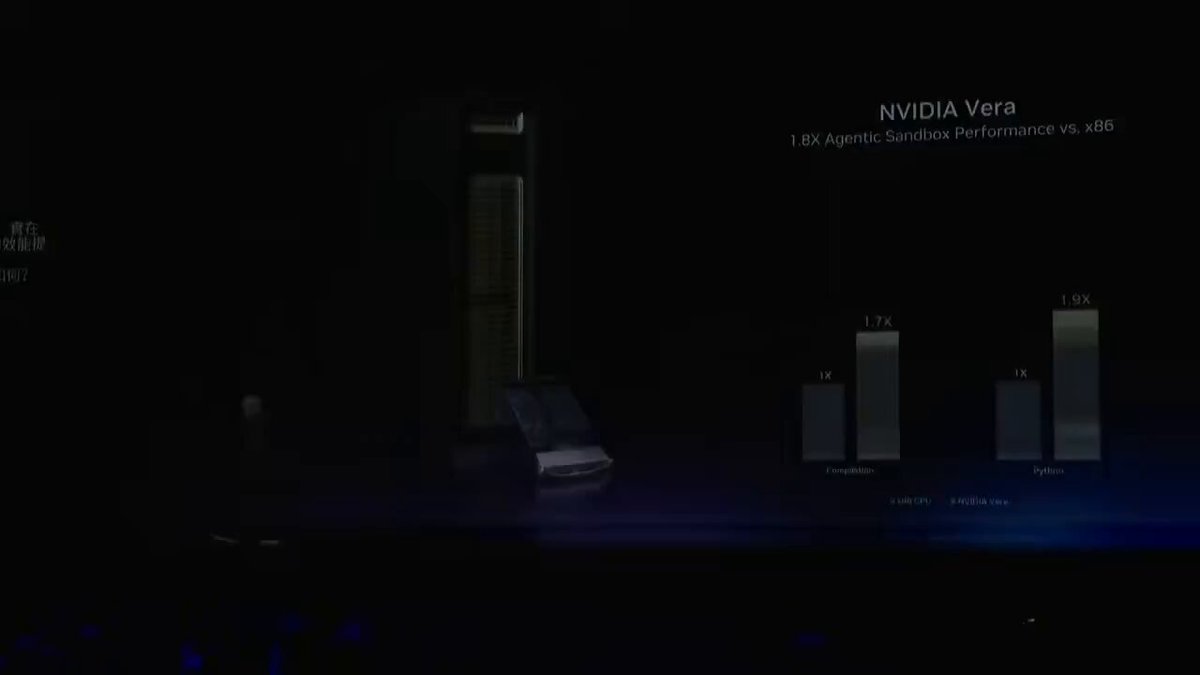
Jensen Huang just identified the next $200 billion market (Save this). The shift starts with a observation about agentic AI that changes everything about infrastructure. In the era of training and inference, the GPU was everything while CPU was a traffic cop, scheduling work, managing memory, dispatching tasks while the GPU did the heavy lifting. Agentic AI breaks that model entirely. An AI agent does not just run a single inference pass but rather it plans, calls tools, executes code in sandboxes, retrieves data from multiple sources and loops through complex multi-step reasoning sequences often thousands of times per second at scale. Every one of those operations runs through the CPU and the GPU sits idle waiting for the CPU to prepare the next task, supply the right context and execute the retrieval and tool calling logic fast enough to keep the accelerators fed. The CPU is now the conductor and the GPU is the orchestra and the bottleneck is the conductor falling behind. This is showing up in production AI factory utilization right now, which is exactly why Jensen built Vera from scratch rather than licensing x86. Vera achieves 40% lower peak memory latency than x86, 50% faster core to core communication, and 1.8 times the agentic sandbox performance of current x86 processors on a purpose-built architecture designed around the agentic loop. Now here is where the investment thesis gets interesting. The obvious beneficiary is Nvidia itself, and that thesis is real. Nvidia's CFO has guided for nearly $20 billion in Vera CPU revenue this fiscal year alone, a market Nvidia had zero presence in just three years ago. Intel held 60% of server CPU market share as recently as Q4 2025 and that transition is now happening at a pace Intel structurally cannot respond to. But the deeper question is, what architecture is Vera actually built on? Vera's Olympus cores are ARM compatible and every single Vera CPU deployed in every Vera Rubin rack in every data center in the world runs on ARM architecture. And ARM Holdings collects a royalty on every one of them. ARM does not make chips but rather licenses the instruction set architecture and CPU core designs that others build on top of. Every time Nvidia ships a Vera CPU, every time a hyperscaler deploys a Vera Rubin rack, every time an enterprise qualifies Vera for their AI factory, ARM earns a royalty. The secular tailwind here is almost perfectly constructed for ARM's business model. Amazon's Graviton, Microsoft's Cobalt, Google's Axion, Apple's silicon stack, and Qualcomm's data center push all run on ARM. And now Nvidia's Vera, which is projected to displace Intel as the largest server CPU supplier by revenue in a single fiscal year, is ARM. ARM's royalty rate on high end server chips is estimated at roughly 1 to 2% of chip selling price. At $5,000 per Vera CPU and 4 million units projected for FY2027, that is a royalty line growing from near zero to potentially $400 million to $800 million annually from Nvidia's data center CPU business alone before counting Amazon, Microsoft, Google, Apple, and Qualcomm. The total ARM addressable royalty base across all the silicon it already licenses is compounding at a rate that the current $130 billion market cap does not fully reflect. Jensen's CPU thesis is the most underappreciated catalyst in ARM's fundamental story, and the royalty compounding has barely started. Come join Milk Road Pro and get our full ARM royalty model and our entire AI trade thesis. Link below!

Milk Road AI

11,819 次观看 • 2 个月前

This guy spent several days teaching a tabletop robot arm to roll a burrito and when one could not do it he did not rewrite the controller he printed 2 more and launched a 3-arm setup for about $1,000. He does not rewrite the software, does not wait for a smarter model, does not update the imitation weights, he just prints another arm and connects it to the existing leader-follower through LeRobot, nonstop. And it got more interesting: the hardware of one arm is a DIY kit SO-101 for about $300 to $400 on STS3215 bus servos, coordination between the arms goes through leader-follower teleoperation in Hugging Face LeRobot, and replication goes through a Bambu Lab A1 for $399 that prints a copy in a day. It knows the position of the tortilla by the leader-arm coordinates at the start, knows the handoff moment between the arms by the fold phase, and knows the final rolling from the sequence of demonstrations from teleop sessions. And it even distributes the work between the arms, one does the initial folds, the second holds the tortilla still, the third performs the final rolling, depending on which phase the burrito is currently in. In one 57-second demonstration 3 arms rolled a burrito for the first time without human involvement, and the total stack cost less than $1,000 in hardware versus a UR5 at $25,000 or an industrial burrito machine Solbern BR-1500 that costs about $50,000. The viewer is not watching 3 robots rolling a burrito. The viewer is watching permission to believe in a future where a kitchen task on $1,000 of hardware is done by the same loop as an industrial one at $50,000. Here is what happens when the bottleneck stops being the intelligence of the controller and the quality of the imitation model, and becomes the number of arms in the setup, and for a maker with a 3D printer the number of arms is limited only by print time. 3 arms do not get tired between sessions, do not require retraining when a new one is added, do not degrade from repetition, and every next burrito goes through the same teleop pipeline at the same quality as the first. Imagine that multi-arm DIY setups are no longer built for one kitchen task, but printed for each one, burritos, sushi, tacos, pizza dough, pour-over coffee. We just watched hobby robotics shift from "retrain the controller" to "print 2 more": when one robot can not handle it, you do not make it smarter, you print 2 more. The viewer thinks they are watching a DIY experiment. They are watching a multi-agent robotics stack that in one 57-second demonstration rolled a burrito for the first time without human hands, and whose filling partially falls out on the final rolling. What will improve the final rolling, a softer silicone gripper, a 4th follower arm in the setup, or a different filling composition and a more moist tortilla?

Blaze

61,030 次观看 • 2 个月前

Excited to announce GR00T N1, the world’s first open foundation model for humanoid robots! We are on a mission to democratize Physical AI. The power of general robot brain, in the palm of your hand - with only 2B parameters, N1 learns from the most diverse physical action dataset ever compiled and punches above its weight: - Real humanoid teleoperation data. - Large-scale simulation data: we are open-sourcing 300K+ trajectories! - Neural trajectories: we apply SOTA video generation models to “hallucinate” new synthetic data that features accurate physics in pixels. Using Jensen’s words, “systematically infinite data”! - Latent actions: we develop novel algorithms to extract action tokens from in-the-wild human videos and neural generated videos. GR00T N1 is a single end-to-end neural net, from photons to actions: - Vision-Language Model (System 2) that interprets the physical world through vision and language instructions, enabling robots to reason about their environment and instructions, and plan the right actions. - Diffusion Transformer (System 1) that “renders” smooth and precise motor actions at 120 Hz, executing the latent plan made by System 2. We deploy N1 on GR1 robot, 1X Neo robot, and a large collection of simulation benchmarks. N1 achieves up to +30% boost in diverse manipulation tasks for household and industrial settings. While humanoid robots are the main focus of N1, our model also supports cross-embodiment. We finetune it to work on the $110 HuggingFace LeRobot SO100 robot arm! Open robot brain runs on open hardware. Sounds just right. Let’s solve robotics, together, one token at a time. Links to our Whitepaper, Github repo, HuggingFace model, and open dataset page in the thread: 🧵

Jim Fan

466,333 次观看 • 1 年前