Sensitive content

This media may contain sensitive content.

正在加载视频...

视频加载失败

Mei Gets Filled Animator -justausernamesfm (Comms closed) Audio -HentAudio 🇺🇦 🟢COMMS OPEN🟢 VA - vivi🎙️🔞 Away Jul 27 ➡️ Aug 20 This is a preview, You can check it out in full VR on our Patreon #rule34 #Overwatch #VR #vrporn #hentaivids #hentai #futa #futanari_hentai

112,947 次观看 • 3 年前 •via X (Twitter)

0 条评论

暂无评论

原始帖子的评论将显示在这里

相关视频

CORNUCOPIA is now available to watch on demand on Apple Music Apple Music and AppleTV+ Apple TV !! Watch it here : i am so thrilled to share an hour excerpt of the Cornucopia concert film here with you online . the full version will be played later in theatres . this has been a long journey with hundreds of people helping out . i am so beyond enormously grateful to every single one of them . i feel the modern concert film is a matriarchially friendly construct , welcomed in the current climate . where female musicians can share their worlds uncorrupted . in cornucopia , i was joined by musical director and multi instrumentalist bergur þórisson , percussionist manu delago , flute septet Viibra , harpist katie buckley and the hamrahlid choir . i spent last decade working with 360-degree sound and visual software in virtual reality and animation, creating Biophilia and later Vulnicura as a VR album. i was deeply inspired by the idea of a fully-immersive experience spreading Utopia and Fossora into fully surround speakers. my intention was to bring what we had created for 21st-century VR into a 19th-century theatre - taking it from the headset to the stage. this vision was realised with 27 moving curtains that captured projections on different textures and LED screens, creating a digitally animated show : a "modern lanterna magica" for live music. i also wanted to feature bespoke instruments: a magnetic harp, an aluphone, a circular flute, and a reverb chamber, specially built with an audio architect to enhance the most intimate version of a performance—in a personal chapel. throughout this tale, there is a subplot woven in: a second story of an avatar—a modern marionette who alchemically mutates, from puppet to puppet, from the injury of a heart wound to a fully healed state. i hope you enjoy it. warmthness, björk

björk

120,806 次观看 • 1 年前

CORNUCOPIA on Apple Music Apple Music and AppleTV+ Apple TV !! This Friday, 24th of January at 7pm PT. #AppleMusicLive i am so thrilled to share an hour excerpt of the Cornucopia concert film here with you online . the full version will be played later in theatres . this has been a long journey with hundreds of people helping out . i am so beyond enormously grateful to every single one of them . i feel the modern concert film is a matriarchially friendly construct , welcomed in the current climate . where female musicians can share their worlds uncorrupted . in cornucopia , i was joined by musical director and multi instrumentalist bergur þórisson , percussionist manu delago , flute septet Viibra , harpist katie buckley and the hamrahlid choir . i spent last decade working with 360-degree sound and visual software in virtual reality and animation, creating Biophilia and later Vulnicura as a VR album. i was deeply inspired by the idea of a fully-immersive experience spreading Utopia and Fossora into fully surround speakers. my intention was to bring what we had created for 21st-century VR into a 19th-century theatre - taking it from the headset to the stage. this vision was realised with 27 moving curtains that captured projections on different textures and LED screens, creating a digitally animated show : a "modern lanterna magica" for live music. i also wanted to feature bespoke instruments: a magnetic harp, an aluphone, a circular flute, and a reverb chamber, specially built with an audio architect to enhance the most intimate version of a performance—in a personal chapel. throughout this tale, there is a subplot woven in: a second story of an avatar—a modern marionette who alchemically mutates, from puppet to puppet, from the injury of a heart wound to a fully healed state. i hope you enjoy it. warmthness, björk

björk

159,262 次观看 • 1 年前

🚨THE ULTIMATE DATE PHAGGING ALERT‼️🚨 il Donaldo Trumpo post on 7/5 at 11:02 EST (twice Eleven Eleven): «MY REAL PATRIOTS» = ANONS 🔥🐸🔥 The White Hat Meme Team are talking directly to us‼️😘🤓🥳 We’re getting real close to THE END 🎬🍿now so let’s unlock what they are telling us: ✴️ «November rain» sounds like a word play on «April showers»…. ☔️ ✅NOVEMBER SHOWERS (2135 Jewish 👉🏼9/11 and 201 Simple ) ➡️Christmas In July 🎁🎅🏼🥳🔥 🎁They are giving us a YUUUGE hint here‼️ ✅ NOVEMBER (👉🏼912) ➡️ Unlocking All My Code 👀 ➡️ XRP Phoenix 9-1-2 🔁 9-2-1 👉🏼 9/11-2026‼️ 2 is 11 (1+1) 2026 is 2+0+2+6 =10 is 1 🔥THE ⚽️ FINALS is on 19th of July 2026. 7/19-2026 November 🟰 July 11/19 👉🏼 9/11-1 👉🏼 Nine Eleven‼️⚽️ Look at the «April showers» Q drop. It has number 1127 👉🏼 119 🔁 911 👉🏼 9/11 👈🏼 👀 «Our comms must be this way» 👈🏼 👀 «Trust the plan.» 📑👀 ✴️ Now let’s go back to «April showers»: (perhaps April is not a month but a comm….? 🤔) ✅APRIL (170/56) 170👉🏼17 and 5+6=11 (Seven Eleven) ➡️ Moon (170👉🏼17) 🚀 ➡️ The End (56👉🏼11) 🎬 ✅SHOWERS (107 simple) ➡️Twenty April showers = April Twenty ✅APRIL TWENTY (1715/163) ➡️Jeffrey Epstein 💥 ➡️Twenty Three (🟰Pain! 💀) Is 1715 a date? 7/15-1 ? 🤔 Remember the yuuuge comms in the Q drops for April 20‼️ Here: «Signal» «Canary» 👉🏼 Epstein singing like a canary Łitecoin Bull | The News Before The News! 🌴🐤 It’s all coming together! 🔥🔥🔥 ✴️ And finally this one that we have been waiting for: ✅ RED OCTOBER = (379 jewish 👉🏼 19 and 105 simple 👉🏼 1 and 5. 👉🏼 5 is 11 🕰️ As Above So Below, so total date if we add 19 and 11 and 1 is 11/19-2026 👉🏼 7/19-2026 👉🏼⚽️) ➡️Purim (remember the colors 🟣🟡🟢) Decode here: ➡️Internet (shut down?) ➡️It is Finished ➡️Disaster 💥👀 ➡️Nine Eleven ‼️💥⚽️👀 ➡️Green Light ➡️Blood Moon Do you get it yet? 🤓 Next week looks real interesting… 🔥🔥🔥
0:57

Sensitive content

🚨THE ULTIMATE DATE PHAGGING ALERT‼️🚨 il Donaldo Trumpo post on 7/5 at 11:02 EST (twice Eleven Eleven): «MY REAL PATRIOTS» = ANONS 🔥🐸🔥 The White Hat Meme Team are talking directly to us‼️😘🤓🥳 We’re getting real close to THE END 🎬🍿now so let’s unlock what they are telling us: ✴️ «November rain» sounds like a word play on «April showers»…. ☔️ ✅NOVEMBER SHOWERS (2135 Jewish 👉🏼9/11 and 201 Simple ) ➡️Christmas In July 🎁🎅🏼🥳🔥 🎁They are giving us a YUUUGE hint here‼️ ✅ NOVEMBER (👉🏼912) ➡️ Unlocking All My Code 👀 ➡️ XRP Phoenix 9-1-2 🔁 9-2-1 👉🏼 9/11-2026‼️ 2 is 11 (1+1) 2026 is 2+0+2+6 =10 is 1 🔥THE ⚽️ FINALS is on 19th of July 2026. 7/19-2026 November 🟰 July 11/19 👉🏼 9/11-1 👉🏼 Nine Eleven‼️⚽️ Look at the «April showers» Q drop. It has number 1127 👉🏼 119 🔁 911 👉🏼 9/11 👈🏼 👀 «Our comms must be this way» 👈🏼 👀 «Trust the plan.» 📑👀 ✴️ Now let’s go back to «April showers»: (perhaps April is not a month but a comm….? 🤔) ✅APRIL (170/56) 170👉🏼17 and 5+6=11 (Seven Eleven) ➡️ Moon (170👉🏼17) 🚀 ➡️ The End (56👉🏼11) 🎬 ✅SHOWERS (107 simple) ➡️Twenty April showers = April Twenty ✅APRIL TWENTY (1715/163) ➡️Jeffrey Epstein 💥 ➡️Twenty Three (🟰Pain! 💀) Is 1715 a date? 7/15-1 ? 🤔 Remember the yuuuge comms in the Q drops for April 20‼️ Here: «Signal» «Canary» 👉🏼 Epstein singing like a canary Łitecoin Bull | The News Before The News! 🌴🐤 It’s all coming together! 🔥🔥🔥 ✴️ And finally this one that we have been waiting for: ✅ RED OCTOBER = (379 jewish 👉🏼 19 and 105 simple 👉🏼 1 and 5. 👉🏼 5 is 11 🕰️ As Above So Below, so total date if we add 19 and 11 and 1 is 11/19-2026 👉🏼 7/19-2026 👉🏼⚽️) ➡️Purim (remember the colors 🟣🟡🟢) Decode here: ➡️Internet (shut down?) ➡️It is Finished ➡️Disaster 💥👀 ➡️Nine Eleven ‼️💥⚽️👀 ➡️Green Light ➡️Blood Moon Do you get it yet? 🤓 Next week looks real interesting… 🔥🔥🔥

Bendleruschka

46,898 次观看 • 20 天前

COACHES: If we want to develop better hockey players, we need to talk more about work AWAY FROM THE PUCK. Here are two clips to show your players on this concept. 1. GIVE-AND-GO: One of my favorite youth coaches was from Russia and Tarasov's school of hockey...and his biggest pet peeve was passing and then not moving. He would literally stop practice and make us do a somersault if we passed and stood still. Our team won a national championship, we had half our team play college hockey, and his emphasis on this I think was a huge part of our development. Why is a give-and-go big? When a defender is on you and you pass it, that split second is when they're most vulnerable. They have to look at where the puck goes but also pay attention to you. By moving right away after passing, their attention shifts, even so briefly, which allows you to get open to get it back. Check out this AMAZING give-and-go between McDavid and Draisaitl. These guys are on another level and McDavid is truly superhuman at working away from the puck. 2. WORK TO SUPPORT THE PUCK: On the second clip, watch how hard Tarasenko speeds through the neutral zone to get to a spot of support. If he doesn't, this play ends in a dump in and an easy breakout. But he hightails it, like he's shot out of a cannon, and even though he doesn't get the puck, his speed without the puck allows him to get pressure on the forecheck. 3. WORK TO GET THE PUCK BACK: Then you have Kaprizov, one of the most skilled players in the world, working to track back on the forecheck. His effort helps create the turnover and he gets rewarded with the goal. If you want to play offense, the harder you work away from the puck defensively, the more you'll benefit offensively by getting possession back. Even the best players in the world only have the puck on their stick for maybe one minute during a game. As coaches and in player development, the more we can emphasize play without the puck, the more we'll develop smarter and better players.

Topher Scott

14,893 次观看 • 4 个月前

This is probably the most complex workflow I’ve ever built, only with open-source tools. It took my 4 days. It takes four inputs: author, title, and style; and generates a full visual animated story in one click in ComfyUI . I worked on it for four days. There are still some bugs, but here’s the first preview. Here’s a quick breakdown: - The four inputs are sent to LLMs with precise instructions to generate: first, prompts for images and image modifications; second, prompts for animations; third, prompts for generating music. - All voices are generated from the text and timed precisely, as they determine the length of each animation segment. - The first image and video are generated to serve as the title, but also as the guide for all other images created for the video. - Titles and subtitles are also added automatically in Comfy. - I also developed a lot of custom nodes for minor frame calculations, mostly to match audio and video. - The full system is a large loop that, for each line of text, generates an image and then a video from that image. The loop was the hardest part to build in this workflow, so it can process either a 20-second video or a 2-minute video with the same input. - There are multiple combinations of LLMs that try to understand the text in the best way to provide the best prompts for images and video. - The final video is assembled entirely within ComfyUI. - The music is generated based on the LLM output and matches the exact timing of the full animation. - Done! For reference, this workflow uses a lot of models and only works on an RTX 6000 Pro with plenty of RAM. My goal is not to replace humans, as I’ll try to explain later, this workflow is highly controlled and can be adapted or reworked at any point by real artists! My aim was to create a tool that can animate text in one go, allowing the AI some freedom while keeping a strict flow. I don’t know yet how I’ll share this workflow with people, I still need to polish it properly, but maybe through Patreon. Anyway, I hope you enjoy my research, and let’s always keep pushing further! :)

Lovis Odin

58,769 次观看 • 10 个月前

I’m thrilled to announce the launch of Spatial Film—an immersive 180° and 360° film app we’ve built: After months of self-teaching Swift and app development, I finally turned my dream of having a platform dedicated to showcasing the highest-quality immersive films into reality. I’m not a developer by trade—I’m an immersive filmmaker—but I wanted a space where our original 3D 180 and 360 films could shine, free from the heavy compression of typical platforms. So, four months ago, I dove into coding, and here we are with version 1! This journey has been both challenging and incredibly rewarding, and I couldn’t have done it alone. My gratitude goes out to the immersive and VR community, our loyal Patreon members, and developers around the world who generously offered advice and encouragement along the way. What makes Spatial Film unique? It’s 100% original content, from immersive films to 360° environments, all crafted to provide an unparalleled experience. Some of you might recognize us as immersive filmmakers and educators on YouTube, where we’ve shared tutorials and inspired countless creators on Meta, Apple, Pico, HTC, and even back in the early YouTube VR days. Now, we’re taking advantage of Vision Pro’s stunning display to bring our work to you in the best quality possible. Our journey with immersive content goes way back—we’ve worked with 12K camera rigs like Jaunt, Google Jump, and Yi Halo, creating wild experiences for brands. But despite our efforts, our films were often stuck on platforms with heavy compression, which limits the quality. Vision Pro changed that for us, but it’s taken a lot of work to adapt. We’re still learning, refining, and working hard to optimize this new pipeline. Our hope with Spatial Film is to champion immersive storytelling on our own terms, without big corporations that might restrict artistic freedom. We’re here to bring you genuine, immersive stories—not influenced by financial projections. This platform is small, just me and a Shiba Inu sidekick named Kimchi, and we plan to keep it that way. No outside investment, no mission drift—just pure, immersive storytelling. And the best part? We’re releasing free films every other week, so you can explore and download our latest releases without a paywall. Every film also comes with its own immersive environment, free of charge. If you’d like to support us, you can subscribe to access the full library for a super affordable price, helping us keep this going as a true “mom-and-pop” shop on VisionOS. Feedback is more than welcome as we continue learning, optimizing, and improving the experience for all of you. Thank you for being part of this journey with us!

Hugh Hou

17,540 次观看 • 1 年前

“Tariffs Built America. Free Trade Hollowed It Out.” It's time to stop apologizing for putting our people first. Most people today have no idea what a tariff really is—or what role it played in building this country. The word has been twisted, smeared, and thrown around by globalists as if it’s a sin against “free markets.” But let me ask you this: 🔹 Did America rise to greatness by importing everything from China? 🔹 Did our ancestors cross oceans, carve out cities, build factories, raise barns, and fight wars just to become dependent on foreign labor and cheap junk? No. America was built on strength, sovereignty, and yes—tariffs. Before 1916, we had no income tax. The federal government was funded almost entirely through tariffs on imported goods. Our founding fathers—Hamilton, Lincoln—understood something we’ve forgotten: ➤ Tariffs didn’t just generate revenue. They protected our industries. ➤ They made it costly for foreign nations to dump cheap products here and destroy local competition. We weren’t protectionist—we were pragmatic. But over the past 50 years, something changed. Washington elites sold us a lie: "Free trade is always good. Let the market decide." While they got rich, America got gutted. 🔻 70,000+ factories closed 🔻 Entire towns decimated across the Rust Belt 🔻 Our youth pushed away from trades into debt traps called universities 🔻 “Learn to code” replaced “learn to build” Meanwhile, China, India, and Mexico kept massive tariffs on us—and we let them. They subsidized production, devalued labor, and shipped it all into America… with our permission. That’s not “free trade.” That’s economic surrender. President Donald J. Trump Trump understands this. His plan isn’t extreme—it’s common sense: ➤ Parity. Reciprocity. Fairness. We don’t want a global trade war. We want an even playing field. 🎙️ In this 🔥 clip, Charlie Kirk sits down with Victor Davis Hanson to explain what’s really at stake. ▶️ In the clip here, Victor Davis Hanson lays it out plain: “We’re not waging a trade war… we’re ending the one they’ve been winning for decades.” This isn’t just about economics—it’s about survival.• A nation that can’t build is a nation that can’t defend itself. • A nation that can’t feed itself is a nation that’s one shipment away from collapse. • A nation that can’t employ its men will watch them lose purpose, pride, and family. We can bring industry back. We can make Made in America mean something again. But first, we must stop apologizing for wanting to protect our own. I believe God gave us this land not to exploit it, but to steward it—to build something worth passing down. It's time to stop listening to the experts who sold us out. And start listening to the wisdom of our ancestors. 💬 What do YOU think? Should we return to fair trade and national production? Drop your thoughts. Let’s talk. 📺 Full Interview in the First Comment 🎙️ Featuring: Charlie Kirk & Victor Davis Hanson

Francois Leclerc

10,803 次观看 • 1 年前

NEW PRODUCT ALERT: I am beyond thrilled to Unveil Chipper ID - Chipper Cash's Latest Product Offering. In case you missed our Chipper AI Day Showcase from this morning, you can watch it here. After 18 meticulous months, our team has crafted Chipper ID—a game-changing onboarding & verification platform that has already delivered remarkable results for us: 🛡️ Slashed fraudulent sign-ups by 90% ⚡ Expedited verification by 300% 💵 Decreased Customer Acquisition Cost (CAC) by over 50% Our verification platform harnesses the power of foundation models to additionally include Screen GPT—an LLM-based compliance screening bot. This tool speeds up user onboarding by 25% without compromising on accuracy/hit rate, which remains above 95%. 🤝 We're fortunate to collaborate with pioneering early partners such as Payday, Yellow Card App, Invest with Hisa, Cadana, Sudo Africa, Creditchek and more. Please visit to get started with Chipper ID for your business and start seeing the results right away. Heartfelt thanks to our uber-talented teams of engineers, designers, PM's, content creators, comms, AI/ML experts, and everyone who worked tirelessly over the past year and a half to bring this revolutionary product to life. The Road Ahead: Our future plans are ambitious. We’re rolling out features such as Visual Q&A over documents—be it utility bills or ID cards. Moreover, we aim to enrich our data payloads with enhanced risk indicators, including location/address mismatches and user risk scores. Plus, look out for a drag-and-drop verification flow builder in our back-office suite. 🔒 Your Data, Your Control: All the while, we prioritize user autonomy, giving our users full control over their data and who gets to see it.

Ham Serunjogi

18,408 次观看 • 2 年前

Alright, this one’s worth your attention if you’re building or deploying agents. Future AGI just open-sourced their entire platform and i don’t mean a trimmed-down version. this is the full stack: UI, backend, simulation engine, evals, optimization loop, observability, guardrails, gateway, docs. all in one repo. Apache 2.0. I’ve been putting it through its paces on production agents, and what stands out isn’t just the breadth it’s the architecture. Most of the current “agent reliability” stack is fragmented. tracing lives in one tool, evals in another, guardrails somewhere else. you end up manually connecting dots, and the agent itself doesn’t really improve you just keep patching prompts and hoping for the best. This flips that model. It’s built as a closed feedback loop: simulate failures → evaluate in real time → detect production issues → learn from them → generate fixes → validate against real traffic → check regressions → redeploy → monitor again And when something new breaks, the loop just runs again. no manual glue. The simulation piece is especially strong. instead of static test cases, it generates adversarial, multi-turn conversations based on how your agent actually behaves basically hunting for the exact scenarios where your system fails confidently. ran a few thousand simulations on our side… caught things we definitely would’ve missed. Evals run fast (sub-50ms) across modalities. not LLM-as-judge trained classifiers. guardrails are built-in, not layered on top. observability gives you step-level visibility into reasoning, cost, latency, quality. But the real shift is the optimization loop. Most tools tell you *what* broke. this system actually fixes it, validates the fix, and ensures nothing else regresses. That’s the missing layer. It’s clearly built with production in mind not a research demo. and the fact that it’s self-hostable makes it even more relevant if you’re running serious workloads. If you’ve been duct-taping together infra around your agents, this is probably the closest thing to a unified system i’ve seen so far. Worth checking out. If you're serious about deploying reliable AI agents, this is worth a look: 👉 You can also try it instantly (no setup) via their cloud version:

Aakash Verma

22,910 次观看 • 3 个月前

LayerEdge LayerEdge Closed 🛠️ Testnet - 🗓️3 days remaining. Easy to keep in the background and earn points 👇 🌐 1⃣Connect EVM wallet (MM or Keplr) 2⃣Use code: NgAMgDAG 3⃣Click "Start Node" - You may need to try a few times, but on a 3rd-4th try it launches for me 4⃣Keep tab open and earn points (can be in the background). 1 Point per second while mining 5⃣Check back every 24 hours and grab extra points (click "Claim Reward" at the top nav) The more tab stays open = more points 🛠️Testnet Roll-out Structure ➡️Phase 1: Closed Testnet (Jan 22–28, 2025) 🔸Stress-testing with browser-based light nodes and limited access 🔸*this may be extend by a few days🔸 ➡️Phase 2: Public Beta Testnet (Jan 28, 2025) 🔸Full launch with browser-based and system-based light nodes, more protocol integrations and more What is LayerEdge? LayerEdge makes Bitcoin more useful by solving two main problems: 1. It makes complex computations cheaper and faster by doing them off the Bitcoin network while still maintaining Bitcoin’s security. 2. It bundles multiple verifications into one, reducing costs by up to 95%, which makes it much more affordable for apps and services to use Bitcoin’s security. Think of LayerEdge like a smart assistant for Bitcoin - it handles the complicated work elsewhere but checks back with Bitcoin to make sure everything is correct and secure. This approach allows Bitcoin to support more advanced applications like gaming and IoT devices without becoming slow or expensive. The key benefit is that instead of paying $900+ for each verification on Bitcoin, protocols using LayerEdge might pay less than $20 when sharing costs with others. Source: 🫡

Grey Ledger

17,675 次观看 • 1 年前

Just in $AMD Anush "Speed is the moat"|ROCm🎙️ In the race to define the future of AI, what's the one advantage that truly lasts? It's not proprietary tech, argues Anush Elangovan Elangovan, VP of AI Software at AMD , but the sustainable speed of innovation. He explains why AMD is rejecting the "walled garden" model for its open source ROCm stack, betting that an open community flywheel is the key to victory. Listen to understand how this open strategy is designed to out-innovate closed systems by empowering developers to solve everything from frontier-model challenges to the mundane, everyday problems that define the "last mile" of AI. AMD ROCm Software: Part 1 Transcript [00:00:00] Andrew Zigler: Joining me is Anush Elangovan, VP of AI software at AMD. And when people talk about AI compute, the conversation often stops at hardware specs, but it's more than just physical chips that win the game. It's also the software ecosystems supporting them. [00:00:18] Andrew Zigler: The prevailing strategy in the industry has been to build something like a walled garden. You know, something closed, proprietary locks, developers in. But AMD is betting on an entirely different play, open source acceleration, and with rock, their open source AI software stack. AMD is building not just hardware parity, but an innovation flywheel that's powered by the community with interoperability and the freedom to scale without all of that pesky lockin. [00:00:48] Andrew Zigler: And in this world, speed is your moat and how fast you can innovate while your platform remains open, flexible, and standardize across all of its applications. That's what we're gonna explore [00:01:00] today. So Anush, I'm really excited to have you here. Welcome to Dev Interrupted. [00:01:04] Anush Elangovan: Thanks for having me. Uh, super excited to chat about it. [00:01:07] Andrew Zigler: Amazing. Well, let's go ahead and dive right in with kind of what I laid it out with in the beginning, the idea of the moat and it being about speed. I wanna unpack that a bit because that came from you when you and I first spoke. And I, and I want to know, you know, how do you define speed inside of AMD beyond just things like hardware, benchmarks. [00:01:27] Anush Elangovan: Yeah, that's a very good question. So when we typically talk about speed, everyone's like, Hey, hardware benchmark specs, right? Like, uh, memory bandwidth or, or flops. And that is one important part of it, uh, AMD does very well. With that, we do have, a, a very good history of executing on that axis. [00:01:47] Anush Elangovan: But when I say speed is the moat, it is about, uh, how we prepare, how we build the muscle to run the race for a long time and run it fast. And it is [00:02:00] not about a single point in time that you've, you've beat some you know, benchmark and, and you declare victory. It's about building the ability to consistently develop and deliver. [00:02:13] Anush Elangovan: Both hardware and software innovation at scale and do it fast, right? Like, you know, we we're increasingly getting to a point where models come out and they're, uh, you know, a year or two ago it was like, Hey, they work on AMD on day zero, which is great, but now they are performing on AMD the day it releases, right? [00:02:32] Anush Elangovan: So, what does it take to Prefetch where the industry is going? Be prepared to intercept. At that point is what you know, I, I refer to as you know, the, the speed factor in, in creating this mode, right? And the mode is just shed all things that hold you back and run as fast as you can. [00:02:53] Anush Elangovan: Uh, because the pace of innovation that is, uh, being seen in, in AI [00:03:00] industries is just. Amazing. Right? And it's like, it's transformational at at how you generate electricity. It's transformational as at how you build data centers. It's transformational at how you deploy compute, networking. It's transformational at what kind of use cases you, you know, uh, use AI for. [00:03:17] Anush Elangovan: Uh, and for that, you need to be prepared to, see what comes tomorrow and be prepared to run the race tomorrow. [00:03:23] Andrew Zigler: Yeah, it's a really great perspective because it highlights that it's not just like a checkpoint that you run through. I like how you called out, like it's not just hitting that benchmark or being the best in class at that moment, in that snapshot, it's about having a. The throughput and about having that dedication to the idea and continuing to deliver on it. [00:03:43] Andrew Zigler: It's not just crossing the threshold, but it's also being the engine. And that's what, that's what protects a business. That is the moat, because the moat is that innovation layer, the faster and more, uh, future forward. That you can work and think, [00:04:00] you know, the better. Uh, we, we talk a lot about like future forward work styles. [00:04:04] Andrew Zigler: Like what are the things I could be doing right now today that are gonna be like, way more useful tomorrow? Let, let's abandon those, workflows that are older and that kind of like, that translates into. An advantage when you work that way. You know, what kind of things have you learned working with, uh, like across all spectrums of people who would use ROCm, right? [00:04:23] Andrew Zigler: You have like the developers, but then you also have the enterprises and you have this large span of adoptees, right? So what is the, what does that look like that you learn? [00:04:32] Anush Elangovan: Yeah, so, so the way I look at it is there are gonna be pockets of different, uh, you know, cadences, right? Like, so people who are deploying in enterprises, for example, right? The validation and how long it takes for them to deploy an LLM that's secure. It's, with guardrails, et cetera, maybe longer. [00:04:52] Anush Elangovan: but you still have to go through the process and you have to be prepared to like, walk that walk to deploy an enterprises. That doesn't mean it's [00:05:00] not fast, that's as fast as you can do for that industry, right? And if you are deploying AI in healthcare, right, it's, it's got its own, uh, cycle. [00:05:07] Anush Elangovan: but in each one of these, you want to see how, like, go down to the essence of what is it that you actually have to do. And, you know, I, I, I like how you framed it. It's like it's, you shed your prior assumptions of how things are done, right. And, and you kind of build up from a, uh, first principles, uh, approach to say, this is how I could use AI to unlock, whatever I'm doing. [00:05:33] Anush Elangovan: And, and, some of it, you know, it's good to really step back and look at. Just question every part of it, right? Like right now you're getting chat GPT and, Gemini competing for like, math, olympiads and, and, uh, college, uh, reasoning, uh, tests. Right? And, and those are like that, that is amazing and increasingly like complex tasks that they're trying to do. [00:05:58] Anush Elangovan: But there may also be like. [00:06:00] More mundane things that AI could, could get applied to. Right? And, and so when we think about shedding old ways, you wanna shed it not just in like the tip of the spear. It's like, you know, I'm gonna see what's the frontier model. It's also, it could be something as simple as. [00:06:18] Anush Elangovan: How do you choose a, a movie, uh, you know, like a recommendation system, right? Or, or, uh, an automated, uh, flight, uh, rebooking system. So the moment, you know, your flight is late, uh, right now it's a notification, right? It's like, oh, you got a text message saying your flight's late. And I got that like three times this week. [00:06:38] Anush Elangovan: But anyway, uh, and, and, and, and, I was just like, okay, so if I were to rethink this. All this MCPs that we have that should be hooked up into an MCP that says, your flight's delayed. Here are your options. If you want, you know, these are the paid options. Yeah. Here are the free options. This will get you back into your you know, Toronto airport [00:07:00] tonight. [00:07:00] Anush Elangovan: Or if you stay, here's a hotel plus this, plus this, plus. It's just like, go ahead is all I should say. Versus now I'm like, okay, can someone, you know, can I call a travel agent? Can I do this? Can I go online and log into And you know, so we gotta fundamentally rethink even those like small, nuances of, things that we do that can be automated out and AI is really, really good at doing something like this, right? Maybe I just explained an AI startup idea right now. Somebody should just start that. [00:07:29] Andrew Zigler: I think you did. Yeah, you definitely did. Someone, one of our listeners is definitely going to lift that off of you. I, I, I, you know, I hate being on the receiving end of those. You feel a little helpless and then you have to like, follow the whole flow. So I know what you mean. Like I, I like how you called out that the build and this like. [00:07:45] Andrew Zigler: Where speed is your moat and the innovation layer is protecting you, is what makes you better than your competitors. How you scale that and you bring that to market. So by understanding the problems that you're solving, uh, throwing away those older assumptions, but also [00:08:00] recognizing that like. We're building every single day, new things and new ways of using stuff that we're still figuring out the implications of. [00:08:08] Andrew Zigler: And so when you have a lot of velocity and you're introducing a lot of new ideas, and maybe you have that workflow now that automatically rebook your flight off of your late flight text message, and uh, I know I would certainly use it, but you know, what kind of philosophies guide the way that y'all think about building this ecosystem to manage that stability while letting folks. [00:08:29] Andrew Zigler: Play with the speed and the assumptions and the airplane re bookings. [00:08:34] Anush Elangovan: so, so I think, you know, we need to peel one layer down, right? and the philosophy is, Hey, we, we just discovered electricity, right? And you know what we're gonna do? We are gonna make motors, uh, or dynamos, right? Like engines. Uh, sure. We don't know if it's gonna be a Ferrari that you're gonna make, or it's a a a a dump truck. [00:08:57] Anush Elangovan: That's good for doing this. But let's [00:09:00] let, which is also required, right? You need a dump truck. You need a garbage truck. And, [00:09:04] Andrew Zigler: Yeah. You need the [00:09:04] Anush Elangovan: course you need, uh, a Ferrari for a midlife crisis, right? So, [00:09:09] Andrew Zigler: precisely. [00:09:10] Anush Elangovan: But, but my, uh, point is what do we build next? And, uh, and this is what I meant by like, okay, let's, let's take those baby steps to build the. [00:09:20] Anush Elangovan: Infrastructure that's required that we know we'll have to use, right? So, so if I just discovered electricity, okay, great. Now one, how do I save this electricity and how do I use it? So there's battery technology, so you need to do something like that, right? Like so. But then you also want to make it into an actionable thing. [00:09:37] Anush Elangovan: You want to make it for like automobiles, or you wanna use it for, you know, powering, uh, entire cities. So it is that transformational. So, uh, AI is that transformational. So, if you distill down, it'll, it'll come down to how do we think about, what we can do with this this fundamental technology that, We may not be aware of what it [00:10:00] is gonna unlock next, but at least you know the next step is clear, right? It's like a dense fog, you know, it's gonna be like, it, it's the right path. You see the light, but it's kind of like out there and, and the steps you're taking are concrete and you're like, okay, this is good. [00:10:16] Anush Elangovan: I, this is better than where I was or where we were. So we are moving forward. So you can build with the. Intuition from what you see in the short term and a tactical view, but towards what you think the future is gonna be. [00:10:28] Andrew Zigler: Right. You almost like we're all in this like fog of war, right? And like you said, you're reaching out and you're trying to step through it. You could think of it too, as like you're in the dark and your hands are up in front of you and you know that. You're, you're not gonna run your face into a wall because your hands are out in front of you, but you're not gonna maybe do much better than that. [00:10:45] Andrew Zigler: So that's kind of like, I think the eco, the, the industry, the world that we find ourselves in, uh, and we all have to, then this becomes the power of an ecosystem, of a group of people working together to create that layer of, [00:11:00] uh, of establishing the [00:11:01] Anush Elangovan: exactly. And I, I, I just, instead of, you know, saying fog of war I describe it as like, you're in this. Beautiful valley with like a morning, uh, fog that's in. You can smell the flowers. You, you hear the birds. You are like, okay, it's, we are in like, uh, utopian paradise and yes, I just need to like, continue the walk, right? [00:11:24] Anush Elangovan: and then move forward with that, conviction that you're in the right spot. [00:11:27] Andrew Zigler: Yeah. So let's talk about that ecosystem world. This nice, I love how you describe it, this grassy side of a hill in the morning that's covered in some mist and maybe we can't see 30 feet in one direction, but it sure is a beautiful hill and it smells nice. And so we're all here. And why is, in that world, why is. [00:11:44] Andrew Zigler: You know, open source, their strategic advantage that y'all are going for in the AI hardware market. And, and then how does like ROCm turn that into wins for people within that ecosystem? [00:11:56] Anush Elangovan: you know, the, the way we look at it is this, is kind of like how I view [00:12:00] AI and the ecosystem, right? But, but it is for everyone to enjoy. Uh, and so we do want to make sure that. You know, it is, uh, beneficial for everyone. [00:12:09] Anush Elangovan: The ecosystem can come in and, and innovate. It's an open innovation engine. and uh, it is very different from, you know, having a walled garden with, Hey, only I know how to do this and I'm gonna do it and throw it over the fence and you can use it or keep walking, right? So we'd like to be good citizens that way, but also. [00:12:30] Anush Elangovan: Uh, it is self-fulfilling in a way, right? Like it, the, the pace at which we innovate with open source is unmatched. Like, you know, our serving engines are like VLLM and, and sg l. Those things, uh, those frameworks are like super, super aggressive in terms of how fast they come out with features and how fast they can you know, get performant models out. [00:12:52] Anush Elangovan: And that compared with what, uh, you'd get from, you know, the likes of like T-R-T-L-L-M or something is always lagging, right? Because you [00:13:00] just can't keep up with you know, 200 commits a week just on one particular model to get that model really performant [00:13:06] Andrew Zigler: And, and, and in that world where, you know, everyone can enjoy the winds of this, what kind of customer stories or innovation stories have really stood out to you and excite you about building and creating this place for developers? [00:13:19] Anush Elangovan: Yeah. So I think the parts that are super exciting for me are when when we get to see a customer that is first skeptical. Then they start a little like, okay, fine, we'll give you a chance. Uh, we do a simple, uh, POC and then they're like, huh, this seems to work. Yeah, we told you it works. [00:13:42] Anush Elangovan: You don't have to change one line of code. Really? Yes, no need to change one line of code. Okay, let's try a production workload. So then they try it. Oh, you're more performant than the competition. Yes. We're more performant than, than the competition. So how much does it cost? And we're like, oh, it's your TCO is better with, uh, [00:14:00] AMD. [00:14:00] Anush Elangovan: So again, they're like, wow, okay, good. So now how do we deploy at scale? And then we go deploy it at scale. And when they give a thumbs up on that and they say, this is good, right? That's when you know, you, you see it go full circle from like, oh, we, we've never heard about AMD to like actually deploy to tens of thousands of GPUs In the order of a few months, right? It, it, it really is fascinating to see and very exciting and invigorating to [00:14:28] Andrew Zigler: Yeah. At like a great exposure to a lot of interesting problems. And, and then people using the infrastructure, the, the technology available to solve those problems. Really specific problems by the way, that's often why they're bringing their data and AI to it, uh, is because it is really specific and important for them. [00:14:45] Andrew Zigler: And there's a, a lot I think that other engineering orgs can learn and even emulate from AMD's success and, and having this open source ecosystem and it causing this acceleration within. You [00:15:00] know, uh, customers and enterprises that use and adopt the tools and, and, and that creates an advantage. And that goes back to why we're talking and like the real thesis of our conversation today. [00:15:10] Andrew Zigler: So how do you think engineering leaders that are listening to this and obviously tapping into this great success AMD has from an open source flywheel, how do you think other, other folks building in the same space can foster that open, first, that open source oriented culture in order to, you know, accelerate their innovation goals? [00:15:29] Anush Elangovan: Yeah, that's a very good question. So the startup that um, was acquired by AMD we, we built, I mean, we started off doing iot stuff and you know, smart ring and all that, right? But in the, the end of like, uh, and not the end, the last six years of the company was building ML compilers. [00:15:47] Anush Elangovan: And ml, ML compilers are like super, uh, complicated, sophisticated, advanced algorithms, dah, dah, dah. but it was all open source, right? So our VCs were like, wait, what do you mean your core [00:16:00] IP is open source? And um, the speed is the moat applied even then, right? It was just like, yes, if you have an idea that. [00:16:08] Anush Elangovan: Because someone saw this idea that you are, they're gonna be able to catch up, then you probably have the wrong idea anyway. But if they are, you know, you execute and they're gonna catch up, that you should assume they're gonna catch up. Right? So you gotta move forward. So keeping it open source is super important. [00:16:25] Anush Elangovan: But also to your question on like, you know, the learnings from an AMD standpoint, right? If there are, hard problems, I'd say dig in and work through it, right? Like there's no way but through it, right? That should be the simple mentality. And more, uh, frequently than not. you'll see that you'll just make it through in a, in, in good form. [00:16:52] Anush Elangovan: But if you doubt it and you're like, oh, I don't know if I should commit, if I'm, I, you know, what should just commit to do the right thing [00:17:00] every step, right? Every step, and just keep taking one step in front of the other. And in no time you'll see that you'll be running. Right. And, and yes, the first few steps will be like, yeah, everyone's complaining about your software quality. [00:17:15] Anush Elangovan: Everyone's complaining about this and that, and it doesn't work. And, and a few steps in, you know, you get, you get the hang of all the complaints that are coming in. You get the feedback loop. You're like, okay, what, what are you prioritizing again? One step in front of the other, right? You just keep knocking that out and then you get to a point where you're, it just becomes second nature, right? To do the, to do the right thing. And, and then yes, if someone gives you two options, you'll be like, fine. This is, uh, you know, there's always the resource trade off. There's always a human capital trade off, but what's the right thing to do? of course, I, I'm pragmatic about what we choose, but, but if the right thing for your long-term success is dig in, go first, principles, make it [00:18:00] happen. [00:18:00] Anush Elangovan: Well. Then just go for that. There's, there is no shortcut to [00:18:04] Andrew Zigler: acknowledging, you know, how it aligns with your mission, your core company goals, and what you're looking to achieve. And, and I, I love how you rightfully called out that in the open source world and you know, you have your technology that you've built, what you think is your moat upon, right? [00:18:22] Andrew Zigler: It's your code and, and to open source that, or to just make it where anyone could peer in is, you know. Scary in one regard, but two, it just kind of feels like you're handing away your throne room in some kind of sense, a very direct feeling sense. But the ultimately, you were really right to call out, and this is something I think about all the time, that the real power there is still the speed This the speed. [00:18:42] Andrew Zigler: That was the moat at the beginning of our conversation. It's the speed in combination with your. Very specific domain understanding of what you're building and what you're creating, and your new role as the steward of that world and how people plug into it, which [00:19:00] has frankly, a lot more influence and power than lording over a closed. [00:19:04] Andrew Zigler: You know, repository or an ecosystem, and like you said, like throwing things over the wall. Sure. There, there might be people always on the other side of that wall, but you're not gonna have a great connection with them. You're not gonna be able to really clearly understand them. I, I like your metaphor of the side of the field of the mountain a lot more. [00:19:23] Andrew Zigler: But, but in the, in this world, you know, where. That speed is, is the power and, and open source is just one way that you can harness that speed to get really far ahead and to innovate. , There's other parts of this equation that you can be experimenting with too, and I'd love to pick your brain about them as a software leader and, and, and one of them is about looking forward and kind of understanding that future that we're all building towards and beyond today's models and hardware. [00:19:48] Andrew Zigler: You know, what do you see as the next major bottleneck or opportunity in the AI compute space? As, as you know, enterprises and folks start to get a little more mature about what's available to [00:20:00] them. [00:20:00] Anush Elangovan: Yeah, I think, the bottleneck and opportunity is, uh, what I'd call, call walking the last mile of ai. Right. Uh, and like I I, I gave you an example, uh, previously, but, but it's similar to that. It's like there are cases where Humans have so many, uh, things to do in your day. You know, like the, if we sit down and actually had a customer focus like, okay, these customers lives, I'm gonna save four hours of this customer's life. And if you actually sit down and look at all of that, it'll be. Easily automatable, easily you know, uh, applicable, uh, for ai, right? [00:20:39] Anush Elangovan: Like, but then making it happen is gonna take a little bit, right? It's like maybe it's, uh, paying your utility bill, right? Or something like that, right? Or, or, your healthcare explanation of benefits. Uh, like, I'm sure you get an explanation of benefits, and I'm like, I, I don't even know what that thing is. [00:20:55] Anush Elangovan: It's just like EOB and like. [00:20:57] Andrew Zigler: it's a big, a big old PDF. Yeah, [00:21:00] exactly. [00:21:01] Anush Elangovan: Like, like, I'm like great straight to the, uh, shredder, right? And but that could be, you know, automated with the ai, right? It, it, it'd be like, Hey, the summary of this thing is you went and visited this day. Everything is okay. Everything is paid for, so don't worry, it's not a bill. [00:21:17] Anush Elangovan: That again, the same, uh, thing, but the sense of what that information overload is could be. Digested by ai, uh, accumulated over time and retrieved when you need it. Like, I don't, I actually don't even need to know this EOB right now, unless of course, whenever I need to know it, that maybe, you know, like for some benefits I need to figure out what do, what did I do over the past year and how do I apply it? Source:

Mike

14,195 次观看 • 8 个月前

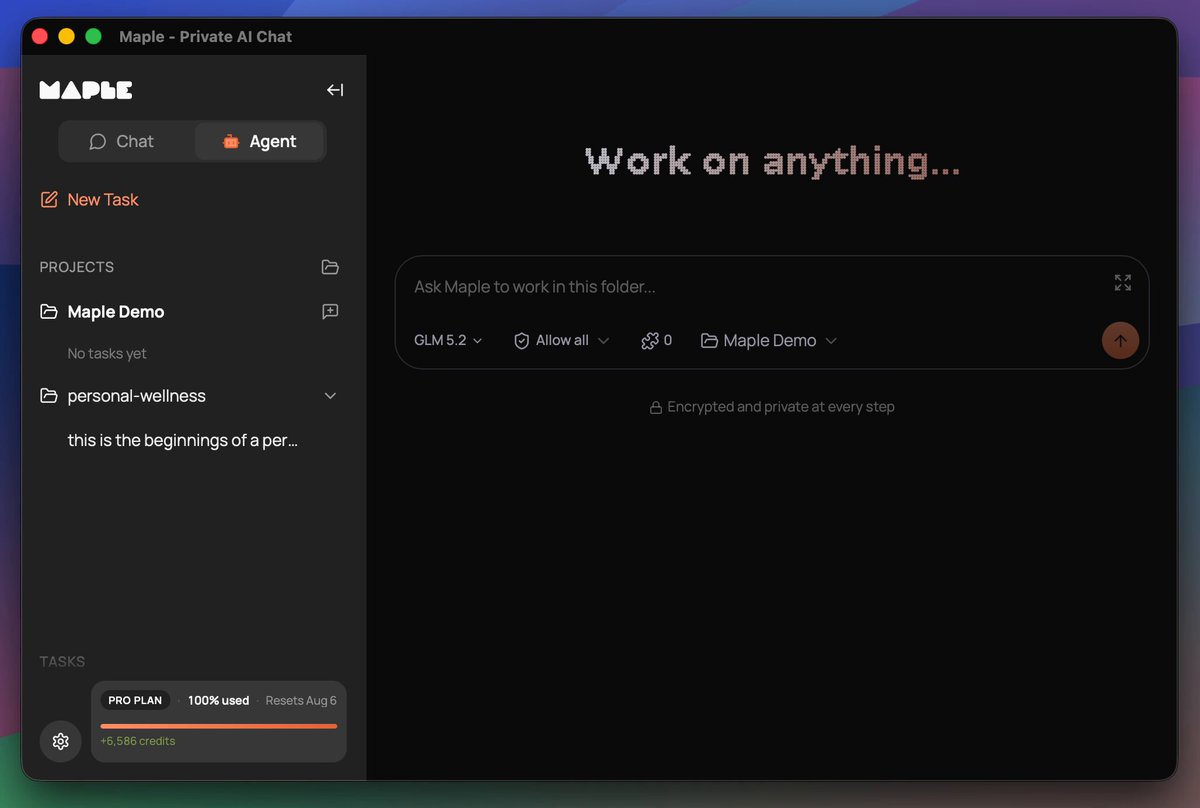
Maple is preparing for the release of a co-working agent. You install it locally and it works with your files, whether it's office work or building websites and apps. It's a turnkey solution, as easy as Claude Code, that keeps your data secure and private, no data sharing with closed AI labs. This is THE sovereign AI app for individuals and businesses who want powerful AI while retaining ownership of their information. Why build an agent into the Maple app when other agents already exist? Easy, we want to give you control over your work. We don't have a business plan that incorporates making money off our users' data. In the age of AI, your information, whether it's personal or company trade secrets, is the single thing that differentiates you from everyone else. We all have access to AI that can build a professional website for selling shoes. But your strategy and network for how you sell shoes should not be shared with your competitors. Sovereignty is the path to protecting what makes you, you. Maple sits at the intersection of Usability and Sovereignty. Maple gives you the best tools that are both easy to use and maintain your data sovereignty. Sovereign for one, sovereign for all. It has been a journey to get here. We brought to market the very first personal chatbot with end-to-end encryption using TEEs in late 2024. Prior to that there were proofs of concept but no full product offerings. Every other AI chat product on the market handled your data in plain text, either selling you a service to get your data or asking you to trust that they won't snoop on you. Quickly people found Maple and latched onto its open-source code and verifiable encryption. We didn't stop there. You may remember earlier this year we teased a product called "Maple Agent" and opened up a waiting list. That product is a mobile app that acts as your AI "friend", maintaining one long continuous chat, and getting to know you over time. I dislike using the word "friend" there, but it's the best way to convey the UX in a few words. AI is a tool, always has been, always will be. Any kind of friendly personality on top is just synthetic. In our testing, the UX of Maple Agent is really powerful for what it does. Think about the many short AI chats you have in your favorite app, whether it's looking up a historical fact or asking advice about a topic. With Maple Agent, those all go away in favor of the long-running chat with the friendly agent. It's like you have your own personal assistant who knows you so well and can look up anything for you. When I ask AI certain questions, I want to ask an expert who already understands my situation so I'm not repeating myself for the 100th time. That's the amazing value the personal agent brings to the table. We still see great utility for a personal agent like the "Maple Agent". Thousands of people on the waiting list, hoping to get their hands on it, agree that the concept is worth exploring and trying out. We were constrained in launching it due to a few circumstances, one of them being access to the scale of compute needed to power it. We have a clear path laid out for how to get there, but today is not the day to execute on that. It will be in the near future. Instead we have a different agent ready to go that we think is also incredible. We now have an agentic harness inside of the Maple Research app. This thing is a powerhouse. It even builds and publishes its own software releases. The agent in Maple Research works with your local filesystem, speaks to the largest open models running in TEEs, utilizes local models for certain tasks, is compatible with MCP tools, has an API for connecting to anything you need, and also supports the ACP protocol, which means it can be extended in the future to speak to other tools like Claude Code, Codex, and local models running on your own hardware. A big unlock for us was the Goose Development Kit, which powers the core of our agent harness. More on that to come as we publish articles and documentation later about the agent. The agent inside Maple Research doesn't have a name. At least not yet, not sure if it ever will. For now we call it "Chat Mode" and "Agent Mode". Think of this as the workhorse, the truck, the heavy lifter. Our other "Agent", the phone app, is your sidekick in your pocket, ready to help with quick things and ongoing conversations about life. I am incredibly excited about the Maple Research Agent. While I'm already seeing great results using it for internal work items, I'm especially thrilled about the personal health and wellness work it's doing for me. I know there are plenty of apps out there for compiling wellness data, but I'm having it build a tool tailored specifically for what I need, without the extra fluff. And none of my health data is being donated to the closed AI labs or sent to advertisers. I know that the AI logic is not being silently adjusted to fit the whims of a large corporation that has paid for product placement. It's me, state of the art AI, and my data. That's how I want it. Maple's new agent makes that possible. We can't wait for you to try it out. If you want early access, comment here, email us, reach out in some way. To those on the other agent waitlist, you're already in the queue. Thanks for reading this lengthy update. :)

Mark

29,135 次观看 • 6 天前

This was the Channel at 5:30 this morning. A boat full of men, pointed at Dover. The crew laughing, throwing SHOES at the British man filming them. And 20 metres away, the French police we pay just WATCHING. "Where are you from?" "England." "Well, you're invading." That's the door. Now look who's walking through it. The Telegraph reports Iran is using this exact route, these exact boats, to move suspected intelligence operatives into Britain. Tehran's own officials boasting they OWN the crossing and can do what they like with it. That they have revolutionary people already in London, waiting to be told what to do. More useful than missiles, they said. We cannot even see them coming. Over 4,000 Iranians arrived by small boat last year. Most are ordinary people fleeing a brutal regime. But they land with no verifiable identity, and our own system admits it cannot pick out the dangerous few from the desperate many. The head of MI5 has tracked more than 20 potentially lethal Iran-backed plots on British soil in a single year. This week the President of the United States was forced to switch aircraft leaving Turkey. Why? US officials identified a credible threat that Iranian proxies were targeting him and Air Force One. The Secret Service moved him to a different plane. The same regime. The same threat. Iran even vowed to attack RAF Fairford after Burnham renewed US strike permissions there. So hold these two pictures side by side. America took the Iranian threat so seriously it moved its President onto another plane. Britain is paying France up to £892 MILLION to stand on a beach and watch the boats that regime is using leave in broad daylight. Our wannabe Prime Minister, 'Andy Brent,' spent the week filming a DJ set. One country locked the cockpit. The other is dancing while the front door swings open. Brave, important work by The Nowhere Photographer

BanksyCat

11,724 次观看 • 3 天前

🚨 BREAKING: Leftist mobs get nipped in the bud at Delaney Hall Detention Center, radical protesters torch themselves attacking ICE while Tom Homan and ICE stand strong! After days of violent clashes and chaos outside New Jersey’s Delaney Hall ICE facility, Monday night was noticeably calmer after the Governor’s temper tantrum and paid agitators were put in check. Border Czar Tom Homan showed up and made it crystal clear: This facility isn’t going anywhere. A lot of the detainees inside can’t even be released due to federal law. The radical left can scream all they want, America is done putting criminal invaders first. Protesters who threw projectiles, assaulted officers, and threatened to kill ICE agents and their families were arrested. One Brooklyn man now faces serious charges. Good. As law enforcement officials said: Verbally assault our agents or threaten their families and we will track you down using facial recognition and hold you accountable. Zero tolerance. Retired Supervisory Agent James Gagliano nailed it: This is the same disgusting treatment the radical left gave our Vietnam vets, spitting on heroes and smearing law enforcement. These protests aren’t “organic.” They’re funded by extremist groups and deep-pocketed leftists designed to create havoc and shut down detention centers. Meanwhile, Cory Booker and radical Democrats are crying about “out-of-control ICE” and demanding the facility be closed. The same people who want open borders are now defending visits while rioters barricade the place. Pathetic. The food is better than most American prisons, the facility gets high health ratings, and detainees even play soccer, but facts don’t matter to the open-borders left. President Trump and this administration are finally enforcing our laws. No more sanctuary madness. No more coddling illegals while American communities suffer.

Gunther Eagleman™

26,339 次观看 • 1 个月前

California's Next Governor? | Sheriff Chad Bianco | ep 87 Sheriff Chad Bianco Returns to the Hot Seat! We are just months away from the critical June 2026 California Governor primary and the Republican race just got a lot more intense. In this hard-hitting second interview on The Britt Mayer Show, Riverside County Sheriff Chad Bianco is back in the hot seat. I asked him the tough questions on the biggest issues facing California right now. We dive into: -President Trump’s full endorsement of Steve Hilton -California Republican Party decides NOT to endorse either Bianco or Hilton -His seizure of over 650,000 ballots, the AG lawsuits, and the Supreme Court pause -The 2020 BLM knee controversy — how he responds to critics who say he "bent the knee to BLM" -Sanctuary policies, mass deportations, and his position on a path to citizenship -Second Amendment rights -Taxes, cost of living, exploding insurance rates & medical freedom This is the kind of honest conversation California voters need right now. Who are you voting for? Drop your comments below. Follow Sheriff Bianco: ⁠ Sheriff Chad Bianco Subscribe to The Britt Mayer Show here, share this episode and please leave a good review. On⁠ ⁠⁠Spotify⁠⁠⁠,⁠ ⁠⁠Apple Podcasts,⁠⁠⁠⁠ ⁠⁠X⁠⁠⁠ &⁠ ⁠⁠YouTube⁠⁠⁠. All linked here: ⁠⁠⁠⁠⁠⁠⁠⁠⁠⁠⁠ ⁠⁠ This Episode is Brought to You By: Operation Love Global. On mission to end sex trafficking and the exploitation of women and children. ⁠ Raising ROCK - One of my favorite brands for intentional parenting is Raising Rock. Their resources are SO GORGEOUS and help moms raise kids of character rooted in Scripture. ROCK = Respect, Obedience, Courage, & Kindness. Check out our conversation with co-founder Elise Orozco ⁠(episode 82)⁠ + I open some of her goodies toward the end of the convo! Exclusive Rooted Wings community 20% discount off purchase with code ROOTEDWINGS20: ⁠ Check out Britt’s fave things with exclusive community discounts. This helps fund the independent journalism of Rooted Wings so we can keep bringing you news and analysis that is not bought and is faithfully, consistently independent: ⁠ If this episode encouraged you, please like, subscribe, and share with someone who needs to hear it. New episodes every week exploring culture, politics, faith and health through a biblical lens. The Britt Mayer Show on ⁠Spotify⁠, ⁠Apple Podcasts,⁠ ⁠X⁠ & ⁠YouTube⁠. Producer/PR Inquiries: ⁠[email protected]

rooted.wings

28,572 次观看 • 3 个月前