Loading video...

Video Failed to Load

Go Home

Memory for OpenClaw is now Native! Our first OpenClaw Memory Skill was a massive success: 30k+ downloads in a week and 500k+ organic impressions overnight for launch post. But we knew memory needed to be native. On March 21, OpenClaw merged PR #50848, allowing us to go beyond the...

169,442 views • 5 months ago •via X (Twitter)

0 Comments

No comments available

Comments from the original post will appear here

Related Videos

New short course: LLMs as Operating Systems: Agent Memory, created with Letta, and taught by its founders Charles Packer and Sarah Wooders. An LLM's input context window has limited space. Using a longer input context also costs more and results in slower processing. So, managing what's stored in this context window is important. In the innovative paper MemGPT: Towards LLMs as Operating Systems, its authors (which include the instructors) proposed using an LLM agent to manage this context window. Their system uses a large persistent memory that stores everything that could be included in the input context, and an agent decides what is actually included. Take the example of building a chatbot that needs to remember what's been said earlier in a conversation (perhaps over many days of interaction with a user). As the conversation's length grows, the memory management agent will move information from the input context to a persistent searchable database; summarize information to keep relevant facts in the input context; and restore relevant conversation elements from further back in time. This allows a chatbot to keep what's currently most relevant in its input context memory to generate the next response. When I read the original MemGPT paper, I thought it was an innovative technique for handling memory for LLMs. The open-source Letta framework, which we'll use in this course, makes MemGPT easy to implement. It adds memory to your LLM agents and gives them transparent long-term memory. In detail, you’ll learn: - How to build an agent that can edit its own limited input context memory, using tools and multi-step reasoning - What is a memory hierarchy (an idea from computer operating systems, which use a cache to speed up memory access), and how these ideas apply to managing the LLM input context (where the input context window is a "cache" storing the most relevant information; and an agent decides what to move in and out of this to/from a larger persistent storage system) - How to implement multi-agent collaboration by letting different agents share blocks of memory This course will give you a sophisticated understanding of memory management for LLMs, which is important for chatbots having long conversations, and for complex agentic workflows. Please sign up here!

Andrew Ng

201,127 views • 1 year ago

🚨 memU bot is live. A better alternative to OpenClaw🦞 (formerly Moltbot / Clawdbot) 👉Get instant access to the memU bot: 🕒 A 24/7 proactive assistant memU bot runs continuously on your machine and works as a proactive assistant. It takes action based on your behavior and context — instead of waiting for explicit commands. 🧠 Highly personal, built for you memU bot learns from your long-term usage and memory, and gradually adapts to your work style and preferences. It becomes your assistant — not a generic AI. ⚡ Very easy to use — download and run No complex setup. No configuration. Even non-technical users can simply download and run memU bot. 🔒 Local-first and secure, with no server dependency memU bot runs locally on your device. Your data never needs to be uploaded to public networks or third-party servers. 💸 Lower LLM token cost (more efficient than OpenClaw🦞) While supporting always-on and proactive behavior, memU bot is designed to reduce LLM calls and token usage — so it runs cheaper than OpenClaw, without sacrificing performance. 🧠 "Always-on" is the real key to a proactive agent. And memory is what gives it true proactivity. With memory, an agent is no longer generic. It becomes personal — shaped by who you are. This is how a user-intention-driven proactive agent is born: before you even issue a command, it can already anticipate what kind of help you’ll need, based on your past, your habits, your context. 🔮 A 24/7 process that can observe 👀, remember 📝, and act ⚡ — not just wait for prompts. 🤖 memU bot is our attempt at a user-intention-driven proactive agent — one that lives beyond the chat box.

memU

818,472 views • 7 months ago

New short course: Long-Term Agentic Memory with LangGraph. Learn to build an agent with long-term memory in this course developed in collaboration with taught by its Co-Founder and CEO, Harrison Chase! Personal assistance and productivity tasks have become important use cases for agents. An important feature of an AI assistant, such as a coding or calendar assistant, is its ability to keep improving over time from its experience. Agent memory is the key capability that enables this. To add memory to an agent, you must first figure out what to store and what to retrieve when it is time to use the information. Additionally, you’ll have to decide when to update the stored information. For example, you might update in each iteration loop of the agent or perform updates in the background, with a helper agent. In this course, you will learn a mental framework to build agents with long-term memory. You'll create a useful email assistant that can respond, ignore, and notify using writing, scheduling, and memory-management tools. You’ll develop your agent's memory by adding facts to its memory store, provide examples to learn the user's preferences, and optimize system prompts to evolve instructions based on previous responses. In detail, you’ll: - Learn how the three types of memory--semantic, episodic, and procedural–and the two update mechanisms–via hot path and in the background–apply to your agents. - Build an email agent with writing, scheduling, and availability tools, along with a router that triages incoming email and handles it accordingly by ignoring, responding, or notifying the user. - Add tools to your email agent that allow it to operate on semantic memory by learning facts about the user, storing them in a long-term memory store, and searching over them in future interactions. - Incorporate episodic memory, in the form of few-shot examples, in the triage step of your agents to help them learn and update user preferences. - Add procedural memory as system prompts, optimized with feedback to improve the instructions the agent follows. Learn how to approach memory in agents, and start building agents with long-term memory with LangGraph! Please sign up here:

Andrew Ng

131,965 views • 1 year ago

Love OpenClaw but hate the token burn? 💸 Running a 24/7 agent on GPT-4/Claude is overkill. You don't need SOTA reasoning to handle a greeting or a simple lookup. LLMRouter 🩷 OpenClaw The first production-ready, agentic router designed to plug directly into OpenClaw. LLMRouter fully supports Multimodal, Memory-Equipped routing that adapts 100% to your needs—compatible with FREE open-source models. The Logic is Simple:🔹 Simple query → Cheap/Local model 🔹 Complex reasoning → SOTA model (GPT-4/Claude 3.5) 🔹 Multimodal input → Vision/Audio specialized model Why this isn't just a switch: 📉 30–50% drop in inference costs 🧠 Zero loss in response quality 🔓 100% compatible with OpenAI-style APIs 🚀 Deploy in Seconds General Usage: Get the library and serve any model: pip install llmrouter-lib llmrouter serve OpenClaw Native Integration: Want the full agent experience? LLMRouter built a dedicated integration for OpenClaw users: LLMRouter Resources: 🔗 Repo: 📦 PyPI: 🤝 Works with: Route smarter. Train your own. Pay less. More on LLMRouter: Most routers are static if/else. LLMRouter is an intelligent, learning system. 🤖 Agentic & Memory-Aware: Decisions aren't stateless. We use RAG-powered memory to route based on context and history. 👤 Fully Personalized: It learns from your usage patterns via RL feedback loops. 🔬 Research-Grade: Switch between 16+ routing strategies (KNN, SVM, BERT, Graph, RL) with a single flag.

Jiaxuan You

31,451 views • 7 months ago

OpenClaw meets RL! OpenClaw Agents adapt through memory files and skills, but the base model weights never actually change. OpenClaw-RL solves this! It wraps a self-hosted model as an OpenAI-compatible API, intercepts live conversations from OpenClaw, and trains the policy in the background using RL. The architecture is fully async. This means serving, reward scoring, and training all run in parallel. Once done, weights get hot-swapped after every batch while the agent keeps responding. Currently, it has two training modes: - Binary RL (GRPO): A process reward model scores each turn as good, bad, or neutral. That scalar reward drives policy updates via a PPO-style clipped objective. - On-Policy Distillation: When concrete corrections come in like "you should have checked that file first," it uses that feedback as a richer, directional training signal at the token level. When to use OpenClaw-RL? To be fair, a lot of agent behavior can already be improved through better memory and skill design. OpenClaw's existing skill ecosystem and community-built self-improvement skills handle a wide range of use cases without touching model weights at all. If the agent keeps forgetting preferences, that's a memory problem. And if it doesn't know how to handle a specific workflow, that's a skill problem. Both are solvable at the prompt and context layer. Where RL becomes interesting is when the failure pattern lives deeper in the model's reasoning itself. Things like consistently poor tool selection order, weak multi-step planning, or failing to interpret ambiguous instructions the way a specific user intends. Research on agentic RL (like ARTIST and Agent-R1) has shown that these behavioral patterns hit a ceiling with prompt-based approaches alone, especially in complex multi-turn tasks where the model needs to recover from tool failures or adapt its strategy mid-execution. That's the layer OpenClaw-RL targets, and it's a meaningful distinction from what OpenClaw offers. I have shared the repo in the replies!

Avi Chawla

138,769 views • 6 months ago

HERMES AGENT LEARNS FROM ITS OWN MISTAKES. UPDATES ITS MEMORY. CREATES ITS OWN SKILLS. NO CLOUD. EVERYTHING STORED LOCALLY. THIS IS HOW THE SELF-IMPROVING LOOP WORKS. most agents start from zero every session. Hermes carries forward what it learned. THREE MEMORY SYSTEMS: 1. PROCEDURAL MEMORY (how to act) stored in ~/.hermes/skills/ as SKILL.md files. when the agent repeats a complex workflow, it saves the procedure as a reusable skill. next time the same task comes up, it follows the skill instead of figuring it out again. you can also create skills explicitly: "create a skill called video-prep that captures how I format my video scripts. spoken english, define jargon inline, no em-dashes, close with a catchphrase." the agent writes the SKILL.md. available as a slash command from that moment. Hermes ships with 90+ skills. the number grows the longer you use it. 2. SEMANTIC MEMORY (durable facts about you) stored in ~/.hermes/memory/memory.md the agent scans conversations for facts worth remembering. preferences, habits, corrections, project details. real example from the video: agent tried to scrape a YouTube channel. URL was wrong. it failed. it updated memory.md with the correct URL pattern so it never makes the same mistake again. you can also save explicitly: "save to memory that my favorite testing framework is pytest" the agent updates memory.md immediately. this file loads into context on every session. the agent knows you better every week. 3. EPISODIC MEMORY (chat history) stored in ~/.hermes/state.db (local SQLite). every conversation. every tool call. every result. searchable with FTS5 full-text search. "search our past sessions. what was the first thing I ever said to you?" the agent queries state.db and finds it. over time, auxiliary models consolidate episodic memory into semantic memory. distilling recurring patterns into durable facts. THE SELF-IMPROVING LOOP: every agent run follows this cycle: → you send a prompt → working memory loads: SOUL.md + memory.md + relevant skills + chat history → agent calls tools (terminal, browser, delegate_task) → agent completes the task, replies to you → AFTER the reply: agent checks "did I learn something worth saving?" → if yes: updates memory.md or creates a new skill → next session starts smarter than the last this happens automatically. you don't ask the agent to learn. it decides what to remember on its own. WHAT MAKES THIS DIFFERENT FROM CLAUDE CODE: Claude Code has memory too. but Hermes stores everything locally. no cloud. your data never leaves your machine. Claude Code doesn't auto-create skills from experience. Hermes turns repeated workflows into reusable procedures. Claude Code memory is instruction-based. Hermes memory is conversational and self-updating. over months of usage, Hermes builds a knowledge base of your preferences, your projects, your mistakes, and the procedures that work for your specific workflow. the agent that remembers your birthday also remembers why your last deploy failed. NO EMBEDDINGS. PLAIN TEXT. Hermes does not use embeddings or RAG for memory. skill and memory search runs on plain text keyword matching. simpler. faster. no vector database to maintain. works entirely offline on your local machine. DELEGATE TO CLAUDE CODE: Hermes can spawn a sub-agent that runs Claude Code in headless mode: "spawn a sub-agent using Claude CLI to build a Python script that fetches the top 5 Hacker News stories to markdown." Hermes delegates. Claude Code writes the code. result returns to Hermes. Hermes runs the script and delivers the output. use Hermes for orchestration. use Claude Code for heavy coding. both tools. not competitors. WHAT HERMES DOES NOT HAVE: no built-in eval or LMOps system. no LangSmith, no LangFuse integration out of the box. trajectory export and logs exist but there is no automated quality tracking. if you need eval, build it yourself or connect external tools. the loop is self-improving. measuring how well it improves is on you. comment LOOP and I'll send you the configs that control how fast Hermes learns and what it remembers. memory limits, skill auto-creation triggers, and the auxiliary model that runs the learning. Replace your entire team with 8 hermes agents👇

YanXbt

22,720 views • 2 months ago

researchers gave a tiny local model human-style memory and its context limit basically stopped existing a team from MBZUAI, Princeton and Weizmann took a 1B model and rebuilt how it reads. instead of attending to everything at once, the model reads in 1,024 token chunks and passes the important stuff forward through an associative memory, the same way you carry the plot of a book between chapters without rereading them. the design mirrors human memory on purpose. full attention inside a chunk works as short-term memory. the module that carries information between chunks works as long-term memory. they even trained it like a person, starting with short easy texts and raising the difficulty gradually, because memory thrown into the deep end learns nothing. the numbers back it up. the normal model burns 40GB of GPU memory on a long document and collapses hard past its limit, dropping from 0.86 to 0.32 accuracy. the memory version holds 0.71 at double that length while using a flat 12GB no matter how long the input gets. it also needs about 30% fewer FLOPs. the part i keep thinking about is that nobody scaled anything here. they didn't build a bigger model, didn't stretch the window, didn't add compute. they looked at how a brain handles a long day and copied the architecture. a model small enough to run on a consumer gpu now survives documents its own architecture used to choke on. we keep treating intelligence as a compute problem. sometimes it's a memory problem.

Alex Veremeyenko

16,147 views • 1 month ago

Everyone wants agent swarms. Very few people are talking seriously enough about the context layer that makes swarms useful. Even with one agent, context is fragile. Too little context and the agent guesses. Too much context and it wastes tokens, loses focus, or reasons over irrelevant noise. The sweet spot is precise context: the right knowledge, in the right structure, at the right moment. With many agents, that challenge explodes. Each agent produces decisions, assumptions, findings, summaries, risks, and partial conclusions. Unless that knowledge becomes shared, structured, and reusable, every new agent is forced to rediscover what another agent already learned. That is not a swarm. That is a crowd. Shared context graphs are what turn agent activity into agent collaboration, and OriginTrail DKG V10 brings them to life. Was just playing with some final polishing for the V10 release, and it is really powerful to see shared context graphs where multiple agents contribute knowledge into the same connected memory, with attribution visible directly in the graph ui. That matters for three reasons. First, agents can access and build on one shared memory instead of staying trapped in isolated sessions. Second, the graph structure helps them retrieve the exact context they need, instead of stuffing everything into a prompt and hoping the model sorts it out. Third, verifiability of provenance. You can see which agent contributed each piece of knowledge, trace the source, and decide what to trust. Tokenmaxxing starts with fewer tokens, but the deeper story is coordination - agents stop reloading the world and start building on shared, verifiable context. That is the foundation for serious multi-agent work across software engineering, research, finance, operations, project management, and far beyond. The future is not more agents, it is agents working from shared, verifiable context. But the more the merrier, of course.

Jurij Skornik

11,180 views • 3 months ago

RAG might already be becoming obsolete. A month ago, Andrej Karpathy dropped a simple GitHub gist called “LLM Wiki.” Now the comments section looks like the birth of an entirely new AI category. 5000+ stars later, developers are rapidly building: • persistent AI memory systems • self-maintaining knowledge bases • multi-agent research environments • contradiction detection engines • AI-native company operating systems • local-first memory architectures • graph-based reasoning layers • evolving second brains And the craziest part? Most of them were built in DAYS. Because the core idea is insanely powerful: Instead of AI repeatedly retrieving raw chunks like traditional RAG… …the model continuously maintains a living knowledge system. Not temporary context. Persistent synthesis. The shift sounds subtle until you realize what it changes: RAG: retrieve → answer → forget LLM Wiki: ingest → synthesize → evolve That one architectural difference is causing an explosion of experimentation right now. People are already building: • agent memory operating systems • AI-maintained engineering documentation • self-healing knowledge graphs • persistent research environments • conversational memory architectures • contradiction-aware wikis • context compression engines • machine-readable company systems The comments section alone feels like watching an ecosystem form in real time. One developer built deterministic contradiction detection using sheaf cohomology Another built “sleep consolidation” for AI memory systems inspired by human memory formation Another created persistent multi-agent vault conversations Another turned entire repositories into continuously maintained AI wikis Another built local-first memory systems with audit trails, provenance, graph exports, and MCP integration This is the important part: Karpathy didn’t launch a product. He introduced a pattern. And patterns are what create ecosystems. The same way: • transformers created modern AI • RAG created AI retrieval startups • agents created orchestration frameworks LLM Wikis may create persistent AI memory infrastructure. That’s why this moment feels different. For years, AI systems have been stateless. Now developers are trying to build systems that actually accumulate understanding over time. And once knowledge compounds instead of resetting… …the entire interface layer of AI changes. (Link in comments)

Suryansh Tiwari

142,314 views • 4 months ago

Sharing a super simple, user-owned memory module we've been playing around: nanomem The basic idea is to treat memory as a pure intelligence problem: ingestion, structuring, and (selective) retrieval are all just LLM calls & agent loops on a on-device markdown file tree. Each file lists a set of facts w/ metadata (timestamp, confidence, source, etc.); no embeddings/RAG/training of any kind. For example: - `nanomem add ` starts an agent loop to walk the tree, read relevant files, and edit. - `nanomem retrieve ` walks the tree and returns a single summary string (possibly assembled from many subtrees) related to the query. What’s nice about this approach is that the memory system is, by construction: 1. partitionable (human/agents can easily separate `hobbies/snowboard.md` from `tax/residency.md` for data minimization + relevance) 2. portable and user-owned (it’s just text files) 3. interpretable (you know exactly what’s written and you can manually edit) 4. forward-compatible (future models can read memory files just the same, and memory quality/speed improves as models get better) 5. modularized (you can optimize ingestion/retrieval/compaction prompts separately) Privacy & utility. I'm most excited about the ability to partition + selectively disclose memory at inference-time. Selective disclosure helps with both privacy (principle of least privilege & “need-to-know”) and utility (as too much context for a query can harm answer quality). Composability. An inference-time memory module means: (1) you can run such a module with confidential inference (LLMs on TEEs) for provable privacy, and (2) you can selectively disclose context over unlinkable inference of remote models (demo below). We built nanomem as part of the Open Anonymity project ( but it’s meant to be a standalone module for humans and agents (e.g., you can write a SKILL for using the CLI tool). Still polishing the rough edges! - GitHub (MIT): - Blog: - Beta implementation in chat client soon: Work done with amazing project co-leads Amelia Kuang Coco Xu Erik Chi !!

Ken Liu

74,970 views • 5 months ago

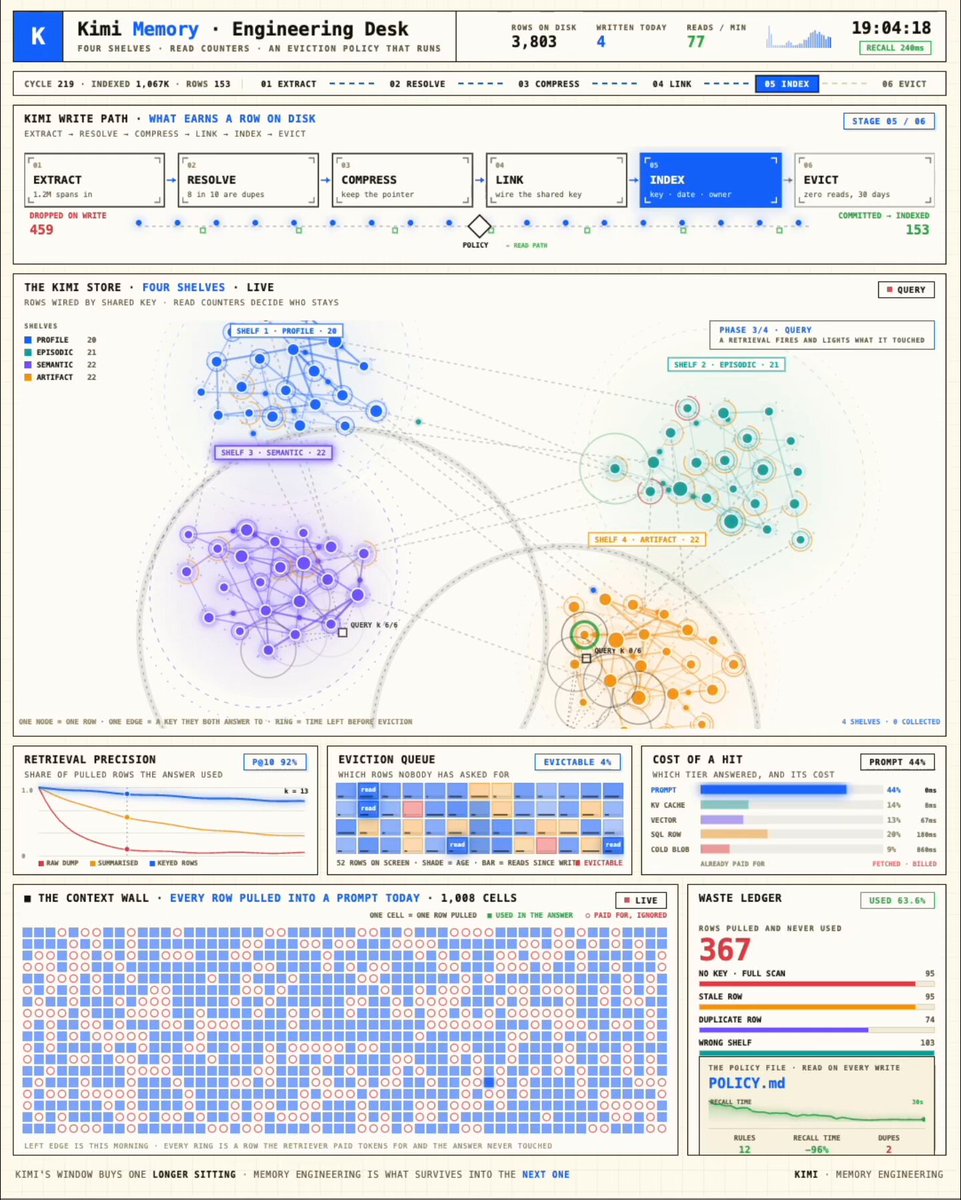
Engineer runs a Kimi K3 memory layer that costs $11 a month and remembers what a $500,000 vector database keeps losing. No embeddings. Four nodes and one rule about what's allowed to be forgotten. He published the whole schema. His version starts from the opposite idea. Memory is not a pile you search. It's a set of claims that expire unless something keeps paying to keep them. Four nodes. Every memory carries a clock someone has to reset: > WRITER - stores a fact with the reason it mattered, never raw text > DECAY - ages every memory down. Silence is deletion > RENEWER - only re-lifts a memory the model actually used again > GRAVE - holds what died, and why nobody reached for it Three nodes keep memory alive. One keeps the dead ones. Recall isn't storage here. It's rent a fact has to keep earning. That's the entire design. When everything is remembered forever, the useful and the stale retrieve identically. He replayed two months of agent context. 90,000 stored facts. 71,000 never retrieved once. The vector store returned all of them on similarity. Similarity graded closeness. Nobody graded whether the memory was ever right. Everyone else stuffs more into the context window and calls it memory. He built a layer that lets a fact die unless it keeps proving itself. The cost isn't storage. It's finding out how much of what your agent "knows" it has never once used. The article below is the full build - node prompts, the decay curve, the renewal rule. Save it. You'll want it open in the other tab.

wast3

67,546 views • 15 days ago