Video wird geladen...

Video konnte nicht geladen werden

Zur Startseite

10,642 Aufrufe • vor 1 Jahr •via X (Twitter)

0 Kommentare

Keine Kommentare verfügbar

Kommentare vom Original-Post werden hier angezeigt

Ähnliche Videos

Here's something I'm seeing more and more in "woke" research papers: ritualized, emotion-filled confessionals about the authors' "positionality" designed to signal academic rigor. These aren't actual research methods, although they're often in the Methods section. In this paper, the section is called "Reflexivity and Rigor." One author's "experience as a Black, genderfluid, queer clinician and academic" apparently shaped the research questions, while the other authors are described as "white, heterosexual, cisgender women." Then we get this: "These ongoing dialogues created intentional spaces to question ideas and examine how each author's social location informed their meaning-making." They also "shared excerpts from analytic memos...which captured the first and second authors' emotional reactions to the transcripts and their analytic insights." All of this apprently "deepened the authors' understanding of the data and helped to manage bias; thus, ensuring a thoughtfully interrogated analysis." This is bizarre. Academic publishing is supposed to minimize bias. That's the whole point of blinded peer review. But instead of concealing the authors' immutable characteristics, these papers foreground the authors' skin color, sexuality, and gender identity. The authors claim this helps "manage bias," but I suspect it does the opposite. Instead, it signals to reviewers: We are good, progressive, emotionally empathetic people doing The Work. Please treat us accordingly.

Colin Wright

68,006 Aufrufe • vor 3 Monaten

Bear Paw - the 'Status' symbol of Chinese Culinary Heritage... Bear paw has long been entrenched in the saga of Chinese culinary traditions, revered not just for its flavor but as a symbol of prestige and opulence. Dating back as far as Shang dynasty, roughly spanning from 1600-1046 BC, bear paw was a delicacy enjoyed by nobility and upper echelons of society. It was particularly famed during the time of King Zhou, last ruler of Shang dynasty, known for his fondness for this exotic dish. Consumption of bear paw, alongside other rare and exotic ingredients, was seen as a statement of power and wealth. In traditional Chinese cuisine, bear paw is considered to embody a combination of gastronomic luxury and medicinal value. It was prepared with meticulous care, combining various ingredients such as honey, ginger, and grain alcohol to enhance its distinct flavor. Traditional methods of preparation emphasized the tenderness of the meat, a result of the bear's natural pawing actions. Esteemed as a delicacy in historic banquets, bear paw has been a part of dishes symbolizing unity and national pride at various points in Chinese history. Over time, bear paw soup and similar dishes ascended as prized delicacies in finer dining establishments in China, Hong Kong and Taiwan. The rarity of the ingredient and the complexity of its preparation rendered it a dish associated with status. As historically valued as bear paw is in Chinese food culture, its role has evolved, and it has become a point of contention in modern times due to conservation efforts and animal rights considerations. Bear paw has been a significant element in Chinese culinary heritage, symbolizing power and status from ancient times through various dynasties. This section explores its historical roots and the meanings associated with this delicacy. Bear paw is deeply entrenched in Chinese history, with specific mentions tracing back to Shang dynasty. Renowned figures such as King Zhou are noted for their affinity for this dish. It was a distinctive aspect of Chinese food culture that persisted into Han dynasty (206 BC - 220 AD), highlighting its longstanding significance. As a component of Chinese cuisine, bear paw was not merely nourishment but a symbol of grandeur in gastronomy. It was often prepared using intricate methods, showcasing the skill and sophistication of chefs. This luxurious dish was believed to convey strength to those who consumed it, reflecting its perceived potency. Consumption of bear paw historically symbolized affluence and elite social standing. Due to the rarity of bears and elaborate preparation required, only the wealthy had access to this dish. It represented luxury and power on the tables of the nobility, serving as a tangible indicator of their elevated position in society. Bear paw, a delicacy with ancient origins, has held place of prestige in Chinese culinary history. It requires meticulous preparation methods that spotlight its texture and taste. Historically, the bear paw was prepared with traditional cooking methods that were as elaborate as the status the dish held. A typical recipe would call for one bear paw to be carefully peeled and cleaned of sinew. Once prepped, the paw might be combined with 2 ounces of honey, 1 teaspoon of salt, 20 ounces of chicken broth, 1/3 ounce of ginger, and 7 ounces of grain alcohol for flavor and tenderness. Initial Preparation: Peel the bear paw; Remove sinew and clean thoroughly. Cooking Process: Marinate the paw in a blend of honey, salt, and ginger; Simmer the paw in chicken broth mixed with grain alcohol. This process makes the bear claw remarkably tender, allowing it to soak in the flavors of the added ingredients. Such intricate techniques are testimony to the importance placed on this particular dish in the realm of Chinese food. 🎥 : Credit to the Owner #archaeohistories

Archaeo - Histories

11,690 Aufrufe • vor 1 Monat

*** SOTA RETROCON S.O.T.A UPDATE *** Whilst the Versao LTDA team is busy at Retrocon showing off our latest Sega Genesis SOTA update, here is a small snippet of how the game is progressing. This video has 3 parts, our menu screen, rain - wind sub section of level 1, then the boss. Everything is still wip including my gameplay skill lol ( and i thought the controller would help .. ) Some challenges overcome : The Menu screen uses shadow and highlight transparency modes in two ways, the background mode for the light rays and then the sprite mode for the mist - it has a nice overlapping effect too, due to using the forground plane for the light rays (s & h background mode) the entire forground is made up of sprites - all the words are sprites . SaviorMarks sent me a screenshot of an issue with boss leftover Mist sprites affecting the menu screen and I thought that looks really cool - lets do that haha . Sometimes bugs are keepers !! The rain section uses more than 80 sprites, a sprite multiplexor handles the rain whilst normal non plexed sprites make up the moon / clouds in the far background , the lamp posts and lamp light in the mid forground and Fences in the front forground . Without the multiplexor there was too much drop out on the rain at times. The rain is still blinked in alternating X positions due to the pixels per line limit , but it gives a great result still. The lamp lights use Shaded Active Dither as S&H here would not overlap the enemies / player . The Boss was a challenge with its size and full frame updates, up to 650 tiles are changed per animation frame into vram. Custom Dual priority DMA routines and extended DMA timings are used (still NTSC 224 pixels tall screen size but most of the vblank was used for updating tiles ) . These methods were used to update the bosses dual display buffers. I needed to have dual priority DMA buffers as the player / waterfall etc had to update their frames whilst the boss is constantly streaming tiles. There are also S&H transparent Mist sprites used for the boss sequence. It seems if you want everything to break at once target a demo for a retrocon event haha, we had lots of issues mainly with vram getting stomped and as all animating sprites need to be DMA streamed to fit into VRAM as the forgrounds and backgrounds take up a lot of tiles. Some new tools which show the VRAM allocation for the sprite engine on a frame by frame basis helped and a self defragging VRAM system helped quite a bit also. Thankfully things are in a good state now apart from a couple of small bugs that persist. Thanks to SaviorMarks and @MichelinFabio for putting up with and testing all the bugged updates haha !! #SegaGenesis #SGDK @MichelinFabio SaviorMarks #VersaoLTDA

Shannon Birt

10,319 Aufrufe • vor 1 Jahr

#ZimElection2023 ZAMBIA-LED SADC ELECTION OBSERVATION MISSION OUT OF ORDER AS IT, AU AND COMMONWEALTH COUNTERPARTS RELEASE PRELIMINARY REPORTS ON ZIM ELECTION It is a good thing that three major international election observer missions have submitted their preliminary reports: The Commonwealth Election Observation Mission, the African Union (AU) Observation Mission and the Sadc Election Observation mission. The links to the three reports are indicated below: The Commonwealth Zim Election Observation Mission Report AU Zim Election Observation Mission Report Sadc Election Observation Preliminary Report Notably, and significantly so, the three preliminary reports echo an important sentiment expressed by CITE's Zenzele Ndebele (Zenzele) a few weeks ago on Newzroom Afrika – for which he was vilified and demonised by the usual quarters among self-proclaimed champions of democracy – that Zimbabwe’s 2023 harmonised general election “has been largely peaceful”, compared to previous editions characterised by widespread violence. A peaceful harmonised general election in Zimbabwe is no mean achievement. It is big ns, and a huge social and political relief. And to say the election has been largely peaceful is not to say there have been no skirmishes or worse, any loss of life even if it was of one person, as Ndebele pointed out to Newzroom Afrika on the attached video clip. Meanwhile, there are no matters arising from the preliminary reports by the Commonwealth and the AU election observers, pending the release of their final reports in two or so months. Otherwise, election observation mission reports are precisely that, namely, reports on what the relevant missions actually observed on the conduct of an election in question. But not so for the Sadc Election Mission Preliminary Statement on Zimbabwe’s 2023 harmonised general election. Led by former Zambian Vice President Nevers Mumba, appointed by Zambian President Hakainde Hichilema, who recently assumed the chairmanship of the Sadc Organ on Politics, Defence and Security. Unlike its African Union and Commonwealth counterparts, the Mumba Mission clearly, intentionally and scandalously wrote its report on the basis of what it heard, and not what it observed. Rather than making news about the election it ostensibly observed, the news is on the Sadc Election Observation for coming to Zimbabwe with an axe to grind, wielding it recklessly and shamelessly. It would be irresponsible to let the preliminary report of the Sadc Election Observation Mission go scot-free, unchallenged. The Mumba report is premised on this far reaching conclusion, which it is not competent to make: The Mission noted that some aspects of the Harmonised Elections, fell short of the requirements of the Constitution of Zimbabwe, the Electoral Act, and the SADC Principles and Guidelines Governing Democratic Elections. Writing under the rubric, “Constitutional and Legal Framework for the Elections,” Mumba and his colleagues make sweeping and opinionated statements and conclusions that are all based not on the direct observation of the election by the Mission but on hearsay with not a single thread of even desktop evidence. The sweeping statements and conclusions include an array of gratuitous comments based on hearsay about the voters roll; freedom of assembly in general and the Maintenance of Peace and Order Act (MOPA); freedom of expression in relation to the Criminal Law (Codification and Reform) Act; the nomination of candidates; participation of women as candidates; alleged intimidation of voters; postal voting controversy; and coverage of the election by the state media. In the result, the main thrust of the report is pure and naked hearsay. In this connection, the report’s treatment of two key issues is telling: one is the delimitation of constituencies and the other is on the so-called Patriotic Act. Regarding the so-called Patriotic Act, the report makes the following conclusion based on untested hearsay submissions: The Mission noted that the Patriot Act is incompatible with the spirit of section 61(1) of the Constitution, and paragraph 4.1.2 of the SADC Principles and Guidelines Governing Democratic Elections which requires Member States to uphold, amongst others, the freedom of expression. This is utterly shocking. What jurisdiction, power and legal competence do Nevers Mumba and his colleagues in the Sadc Election Observation Mission on the Zimbabwean 2023 harmonised general election have to make such a judicial pronouncement? The pronouncement is manifest and gross interference with the rule of law in Zimbabwe under which such judicial findings are made by competent courts of law and, even worse, the pronouncement is an unacceptable violation of Zimbabwe’s sovereignty. Then there’s the report’s treatment of the delimitation of constituencies, about which it says: “The mission WAS INFORMED that the delimitation exercise that was conducted in 2022 by the ZEC was marred with controversy”. Without saying who informed it, the Sadc Observation Mission preliminary report makes the following scandalous statements and partisan conclusions on Zimbabwe’s delimitation exercise conducted by the Zimbabwe Electoral Commission in 202, which it is not entitled to make – as it lacks the jurisdiction, authority and competence to do so – and which statements and conclusions demonstrate beyond reasonable doubt that its preliminary report is heavily opinionated hearsay that smacks of a malicious and predetermined hatchet job: "(i) In its Delimitation Report of 2022, the ZEC rightly states that, “the Constitution recognisesthe impracticability of having equal number of voters in each constituency by allowing the Commission to depart from this requirement within a stipulated margin. In this case the Constitution in section 161(6) stipulates that …“no constituency may have more than 20% more or fewer registered voters than other such constituencies”. The constitution in section 161(6)a-f also lists factors that need to be considered when delimiting since they are important during the exercise.” However, the ZEC goes on to also state that, “Based on the provision of section 161(6) the Zimbabwe Electoral Commission then calculated the 20% deviation from the national average voter registration expected in each constituency which was 27 640. This yielded a deviation of 5,528 voters. Since the average number of registered voters was regarded as a stable benchmark against which delimitation of constituencies was conducted, the deviation figure was added to the national average to determine the maximum number of registered voters that a constituency delimited would contain i.e., 33 168.” (ii) The Mission noted that the use of the average number voters per constituency is not consistent with the provision of section 161(6) of the newConstitution that was adopted in 2013. The word “average” appears in section 61A(6) of the old Constitution of Zimbabwe under which it was permissible to calculate the minimum and maximum permissible number of voter per constituency by using the national average as the baseline. That word “average” does not exist in section 161(6) of the new Constitution which deals with the same subject matter. The difference between section 61A(6) and section 161(6) of the old and the new constitutions respectively is far from being merely technical. (iii) In the new Constitution, and in the context of section 161(6), the maximum deviation is 20% of the voters registered in the constituencies. The new Constitution uses actual constituency by constituency registered voter population, not the national average number of constituency voter population to calculate the permissible deviation from the requirement that constituencies must have an equal number of voters. Mathematically, the two methods produce very different results and affect the equality of the vote with respect to the elections to parliament. On the other hand, since the country votes as a single constituency in the presidential election, the difference in the methods has no particular impact on the equality of the vote in that election. It was therefore not unexpected that ZEC would receive substantial criticism on this aspect of its latest Delimitation Report. (iv) The Mission noted that the use of the average number of voters per constituency is not consistent with the provision of section 161(6) of the new Constitution that was adopted in 2013. The word “average” appears in section 61A(6) of the old Constitution of Zimbabwe under which it was permissible to calculate the minimum and maximum permissible number of voter per constituency by using the national average as the baseline. That word “average” does not exist in section 161(6) of the new Constitution which deals with the same subject matter. The difference between section 61A(6) and section 161(6) of the old and the new constitutions respectively is far from being merely technical. (v) In the new Constitution, and in the context of section 161(6), the maximum deviation is 20% of the voters registered in the constituencies. The new Constitution uses actual constituency by constituency registered voter population, not the national average number of constituency voter population to calculate the permissible deviation from the requirement that constituencies must have an equal number of voters. Mathematically, the two methods produce very different results and affect the equality of the vote with respect to the elections to parliament. On the other hand, since the country votes as a single constituency in the presidential election, the difference in the methods has no particular impact on the equality of the vote in that election. It was therefore not unexpected that ZEC would receive substantial criticism on this aspect of its latest Delimitation Report." There are three things to highlight about what Mumba and his team say regarding the delimitation of constituencies. Firstly, everything they say is very familiar to Zimbabweans because the delimitation issue was widely, hotly and robustly debated. More specifically, the words used in the Mumba narrative about the delimitation report are familiar words that were used during the debate. It is disappointing that the familiar words have found their way, verbatim, into the Sadc Election Observation preliminary report. This alone is sad, and the less said about it, the better for everyone concerned. Secondly, ZEC’s delimitation exercise was challenged at the High Court of Zimbabwe and in the country’s apex court, the Constitutional Court. The views that the Sadc Election Observation Mission regurgitates as its own, when in fact they’re not, were argued in Zimbabwe’s courts, but no pronouncement or finding of the kind that the Mumba team goes to town about was made by any court of the land. What makes this even more egregious is the following statement in the Sadc Election Observer Mission’s report: In view of their significance in the event of legal challenges in the context of the electoral process, some stakeholders expressed the view that the judiciary is compromised by the Government. A key justification for this perception was information received from these stakeholders that the judiciary recently received large financial and material incentives which the stakeholders viewed as an attempt by the Government to buy the loyalty and allegiance of the judiciary. So, the Sadc Election Observation Mission on the 2023 harmonised general election in Zimbabwe “received information from…stakeholders that the judiciary recently received large financial and material incentives which the stakeholders viewed as an attempt by the Government to buy the loyalty and allegiance of the judiciary”. Why is the Sadc Election Observation Mission disrespecting Zimbabwe’s judiciary in this manner? The is outrageous, and for it to find expression in this report is shameless and unacceptable. In the interest of fairness, the Sadc Mission must be required by Sadc to share this information with everyone, particularly the Government of Zimbabwe which represents the Zimbabwean State, a member of Sadc. As already pointed out, the Sadc Observer Mission has no jurisdiction or competence to make any judicial pronouncements on Zimbabwean elections, not least because it is not a judicial inquiry; it is just and only an observation mission. This needs to be rectified by the Mission in its final report. That’s why it has been both important and necessary to engage the preliminary report at this stage. Thirdly, and last but not least, it is important to recall the Mission’s conclusion that is making news everywhere in order to show that it is politically opportunistic, and arguably is self-evident malice aforethought. The Sadc Election Observation Mission’s preliminary report has this running thread that ties everything in the report together, and which is effectively the essence of the report’s conclusion: The Mission noted that some aspects of the Harmonised Elections, fell short of the requirements of the Constitution of Zimbabwe, the Electoral Act, and the SADC Principles and Guidelines Governing Democratic Elections. Is this conclusion in any way linked to or an outcome of the observations that the preliminary report lists as the observations that were actually made by the Sadc Mission? The best way to unpack the question is by looking at the full list of the observations that the Mission says it made, and they are the following: "3. OBSERVATIONS ON ELECTION DAYS (23-24 AUGUST 2023) On the Election Days, the SADC Electoral Observation Mission observed the voting process in 10 Provinces of the Republic of Zimbabwe. The deployed observer teams covered 172 polling stations in their respective areas. The political contestants have continued to call for peace during this election period and after. The SEOM observed the following critical aspects at the 172 polling stations that we visited: (a) The environment at the polling stations was relatively calm and peaceful. (b) A number of voters expressed concern due to a lack of, or late arrival of ballot papers and poor administration at some polling stations. However, voters remained patient to exercise their constitutional right to vote. (c) Professional and attentive police presence enhanced the overall peace and secure environment in all the polling stations observed. (d) 64% of the voting stations observed opened on time, 36% did not open on time for the 07:00am stipulated opening time. Some polling stations opened more than 12 hours after the stipulated time. The reason provided by ZEC for this unprecedented development was the unavailability of ballot papers, particularly for the local authority elections, and also due to previous litigation. This challenge was, however specific to Harare and Bulawayo Provinces. Due to the delays, some voters left without casting their votes, while others opted to remain in the lengthy queues throughout the day and night. By 06:00am on 24 August 2023, some voters in these two provinces had still not voted. Consequently, these delays also had a knock-on effect as they dissuaded voters from voting in the first place. Against this observation we further note as follows: i. Section 52(1) of the Electoral Act provides that for any election, the ZEC shall ensure that every constituency elections officer is provided with polling booths or voting compartments and ballot boxes, and shall provide papers, including ballot papers. ii. Prior to election day, ZEC had assured our Mission and other stakeholders, that all necessary voting materials, including ballot papers, were available and ready for use before election day. This communication was made in the context of section 52A(2) of the Electoral Act which requires ZEC to provide information on the number of ballot papers and publication of details regarding them. On the basis of these two considerations, the subsequent information from ZEC that they did not have adequate ballot papers has the unfortunate effect of creating doubts about the credibility of this electoral process. (e) The voters roll was unavailable at 1% of the polling stations observed, and was therefore not displayed outside the polling stations for the convenience of the voters and verification by party/candidates agents. (f) During the voting period, and at 26% of the polling stations observed, not all voters who turned out could vote. The reasons advanced for this included: i. Voters were identified, but the names were not found on the voters’ roll; ii. It was not possible to establish the voter’s identity; iii. Voters were at the wrong polling station; and iv. Voters did not have a national identity card or passport, or due to the absence of an official witness confirming an elector’s identity. (g) 8% of the polling stations observed were not accessible to voters living with disabilities. (h) At 50% of the polling stations, voters living with disabilities, the elderly, and pregnant women were not given priority to vote. (i) In 3% of polling stations observed, indelible ink was not checked on the voters before allowing them to cast their vote. (j) At 97% of the polling stations observed, voting was free from irregularities. (k) Voting proceeded in an orderly manner at 95% of the polling stations observed. (l) Ballot boxes did not remain locked and/or sealed at 2% of the polling stations. (m) As a result of the excessive delays in the opening of polling stations in Harare and Bulawayo provinces, at least 36% of the voting stations observed did not close at the scheduled closing time of 1900hrs, while some had not even opened by that time. It was announced that voting would be extended to proceed into 24 August 2023 to compensate for the late opening. (n) In previous stakeholder consultations, a shadowy organisation referred to as Forever Associates Zimbabwe was accused of conducting a country-wide exercise of electoral intimidation. Our observers confirmed the existence of this group as its officials or agents were easily identifiable at some polling stations as they were dressed in regalia emblazoned with the FAZ name and were accredited local observers. These, and other unidentified persons who were not polling officials were also observed taking down the names of voters before they cast their votes. In some areas, voters were intimidated by actions of these individuals. (o) The Mission observed the closing and vote counting processes. A proper analysis of these two processes shall be provided as part of the final SEOM Report." CONCLUSION Three points to conclude: Firstly, it is notable that the actual observations made by the Sadc Election Observation Mission are given as a skeletal laundry list with little if any analysis. Yet the observations are at the core of how the actual polling or election was conducted on polling day. Secondly, there’s no connection between the preliminary report’s running theme that “the Mission noted that some aspects of the Harmonised Elections, fell short of the requirements of the Constitution of Zimbabwe, the Electoral Act, and the SADC Principles and Guidelines Governing Democratic Elections”. Surely, to sustain the theme, it has to be connected with the actual observations made by the Mission. But the preliminary report makes no connection, not least because the connection is contrived, based on hearsay and therefore has no factual foundation. Thirdly, one of the observations that proves malice in the preliminary report is the following [number “m” on the laundry list of observations]: As a result of the excessive delays in the opening of polling stations in Harare and Bulawayo provinces, at least 36% of the voting stations observed did not close at the scheduled closing time of 1900hrs, while some had not even opened by that time. It was announced that voting would be extended to proceed into 24 August 2023 to compensate for the late opening. It is an unfortunate falsehood that there is any polling station that had not opened by 1900hrs on polling day, 23 August 2023. It’s a shame that such a falsehood found itself in a report of this stature and implication. Otherwise, if the report was based on good faith, the name and location of polling stations that had not opened by 1900hrs on polling day should have been specified for purposes of verification and rectification. Fourthly, right upfront the preliminary report says: The Mission was informed that a further proclamation was issued rendering 24 August 2023 as a polling day in view of the delays experienced at certain polling stations. Furthermore, President Mnangagwa also proclaimed 2 October 2023 for the run-off election to the office of president if such a poll becomes necessary. Two points about this. One is that the mind boggles at why the Mission had to be “informed” about this, and why the Mission did not get a copy of the proclamation for itself. Was this out of laziness or what? The other point is why does the preliminary report fail to see and understand that “the further proclamation” was the specific solution to the litany of what the Mission lists in its preliminary report as its observations regarding the delayed opening of polling stations on polling day and the shortage of ballot papers and related issues? An impression, a false one at that, is created to the effect that the litany of observations of problems that beset polling stations that opened late or opened without some or all ballot papers for the three elections were left unattended to. If truth be told, the Sadc Election Observation Mission’s preliminary report leaves a distinct and disturbing impression that the Mission had a sinister and a not so hidden mission against the people of Zimbabwe and the Republic of Zimbabwe, abi nitio. That’s unfortunate because the impression is palpable!

Prof Jonathan Moyo

333,361 Aufrufe • vor 3 Jahren

Development Must Not Come at the Cost of the Himalayas and Its People In the quiet border village of Jelam near Joshimath, a story of loss has unfolded that captures what happens when development forgets its human face. Along the under-construction Jhelam–Malari road, a section of land suddenly sank during bridge work carried out by the General Reserve Engineer Force (GREF) and a private contractor. Among those most affected is Chanchari Devi, an apple farmer whose orchard once stood on the slopes above the road. As heavy machinery cut into the hillside, the ground beneath her trees began to crack. Within days, the land gave way. Her orchard, the result of years of care and labor, slid into ruin. Her voice, recorded in a video shared by locals, carries both sorrow and clarity. She explains how villagers had warned officials about unstable slopes and the dangers of unplanned excavation. Those warnings were ignored. No retaining walls were built, no scientific surveys were conducted, and no local advice was taken into account. What followed was predictable: roads collapsed, orchards were destroyed, and livelihoods were lost. Chanchari Devi’s experience is not an isolated case. Across Jelam, Malari, and Niti Valley, families who depend on farming and tourism are facing similar threats from unregulated construction. For months, they have asked for safer methods and community involvement, yet the response has been silence. People now ask simple but unanswered questions. When villagers foresaw the danger, why were they dismissed? Who will take responsibility for the damage? Will the government provide fair compensation to those whose lives have been uprooted? National security and border development are vital, but they cannot come by undermining the very people who protect and sustain these regions. True progress must safeguard both the land and the communities that belong to it. What is needed is a more balanced approach to development that •employs local expertise and labor, •follows scientific, environment-friendly construction practices, •holds agencies and contractors accountable for negligence, and •ensures timely compensation and rehabilitation for affected families. The Himalayan frontier deserves infrastructure that symbolizes care as much as strength. Development should protect, not destroy. It should connect, not divide. Chanchari Devi’s story reminds us what is at stake. She is not an obstacle to progress but its most authentic voice-a guardian of both livelihood and landscape, asking that growth be guided by respect for the mountains and the people who call them home. Narendra Modi Amit Shah Rajnath Singh #Uttarakhand

Kumaon Jagran

12,079 Aufrufe • vor 10 Monaten

RSI section from the AI documentary Machine God The next threshold is Recursive Self-Improvement: the moment when AI can improve itself without human assistance. For decades this sounded like science fiction. Intelligence explosion scenarios imagined a system rewriting its own code, becoming smarter, then using that new intelligence to make still better versions of itself. But the idea looks less remote now that AI contributes directly to frontier science. In mathematics, recent systems have moved beyond solving contest problems to producing serious new arguments on long-standing open problems. AI is used to build physics world models and propose candidate theories or computational methods. These are early signs that machine cognition is entering the creative loop of science itself. The crucial transition comes when that loop turns inward. AI research is, after all, a technical discipline made of code, mathematics, models of information flow. These are exactly the domains in which frontier models are improving fastest. A model that can solve hard mathematical problems, write production-quality code, design experiments, read the literature, and evaluate benchmark results is already participating in the work of building its successor. At first this will look prosaic. AI systems will write kernel optimizations, improve training infrastructure, discover better data filters, tune reinforcement-learning pipelines, design new benchmarks, and suggest architectural modifications. Human researchers will remain in the loop, approving changes and interpreting results. But the important point is that the search process accelerates. The model becomes not just the product of the lab, but part of the lab’s research machinery. The system being optimized helps optimize the next system. This is the core RSI feedback loop: better models make AI research faster; faster AI research produces still better models; those models, in turn, become better researchers. The danger is that once this loop becomes sufficiently autonomous, it may stop resembling ordinary technological progress. Human institutions are slow because humans are slow: we read papers, attend meetings, debug code, sleep, argue, and wait for funding cycles. Machines do not have to operate on that timescale. An AI research collective can run continuously across millions of processors. This is the runaway possibility. Not that an AI instantly wakes up and recursively rewrites itself into a god, but that the entire AI ecosystem becomes an autocatalytic process. Capital buys compute; compute trains models; models improve models; better models attract more capital. At some point the dominant input into AI progress may no longer be human insight, but machine-generated insight, machine-written code, and machine-run experiments. Then the Butler-Land analogy becomes sharper. Humanity is no longer merely building machines. We are building machines that help build better machines. Once intelligence itself becomes part of the production function, the old categories — tool, worker, inventor, firm, market — begin to blur. The question is whether recursive self-improvement remains a managed industrial process, or whether it becomes the first technological process in history whose natural endpoint lies beyond human comprehension.

steve hsu

13,008 Aufrufe • vor 1 Tag

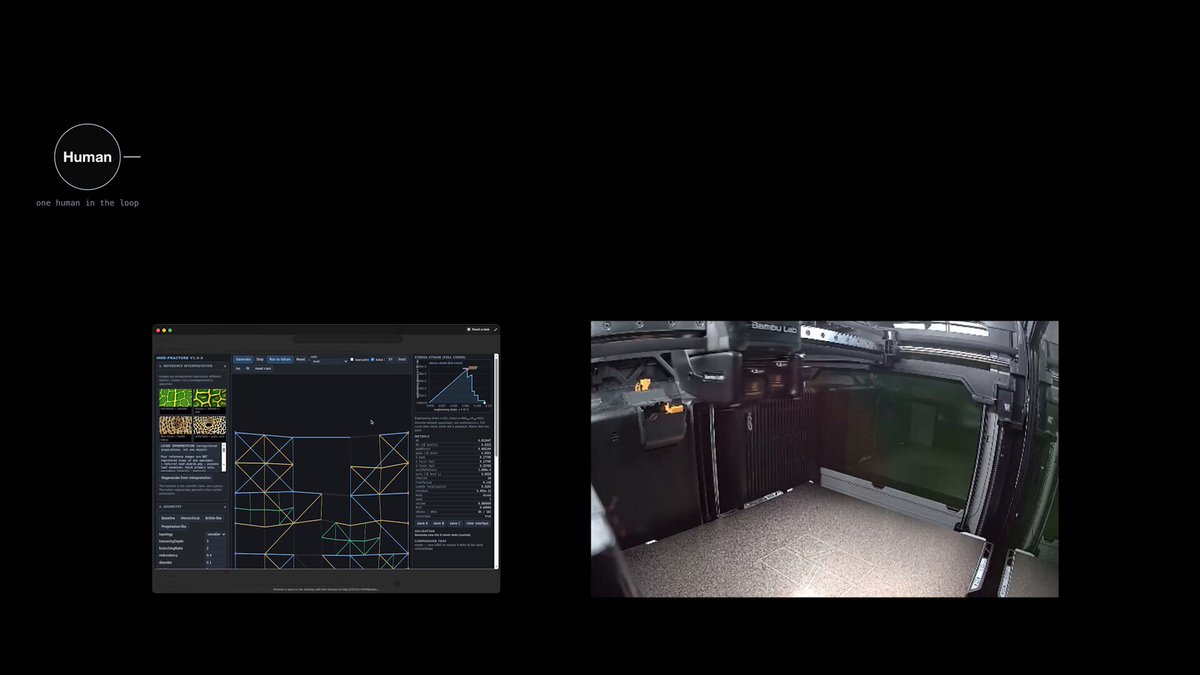
Grok Grok Bot is incredible - and they can even manufacture real physical objects! Here is a little experiment I did last night: I created a team of bots and asked them to solve a complex engineering problem end to end - starting from four images as design cues, inferring transferable structural principles from the pixels, synthesizing an executable interactive physics simulator, running and reasoning over experiments, optimizing the design & finally manufacturing the best designs. The entire loop worked remarkably well - and I was even able to communicate with the agents from my Apple Watch. (Do we live in the future yet?) Team of agents 1⃣ Chief of Staff coordinates the workflow: watches the other agents, pulls results into the main chat, transfers files between them, and keeps the job moving. 2⃣ Physics Experimenter is the scientist-coder. It interprets the design cues and images, writes the simulator, runs experiments, analyzes the results, and produces a detailed LaTeX scientific report. 3⃣ 3D Printing Bot operates the fabrication workflow: prepares and slices the models, generates manufacturing code, sends the job, and monitors the printer. The workflow I provided an initial task based on four unregistered reference photographs containing different objects at different scales (pinnate leaf venation, a Voronoi-like areole mesh, a stochastic fibrous lattice, and a radial/circumferential web). The prompt asked the agents to infer transferable design principles - hierarchy, branching, interfaces, redundancy, disorder, load paths - and use them to build an interactive laboratory for hierarchical materials and fracture. The scientific question was: at fixed material budget, how do hierarchy depth, redundancy, disorder, and interlevel strength change stiffness, peak load, energy absorption, and the brittle-to-progressive transition? In ~20 minutes, the Physics Experimenter produced a 2D hierarchical Euler–Bernoulli beam-network laboratory. Coarse veins persist and remain thicker; finer infill is added inside cells; members connecting levels are treated as interfaces with relative strength κ; and total material volume is conserved. The four source photographs remain visible in an editable interpretation panel. The app generates geometry, steps or runs the network to failure, compares A/B/C designs, and exports JSON, CSV, PNG, and STL geometry for fabrication. After validation the Physics Experimenter used the app and conducted 47 simulation experiments, including six holdouts. It found something scientifically interesting: extra hierarchy is not "free" toughness. At fixed volume, initial stiffness changed by only about 20%, while work-to-failure varied by several-fold. Infill steals cross-section from the main axial veins, so deeper and more redundant networks often absorbed less energy than a simple depth-1 grid. Weak interfaces behaved as distributed fuses, producing more progressive failure and reducing localization. The specific H2 hypothesis - that hierarchy becomes detrimental primarily because interfaces form a mechanical bottleneck - was rejected; the dominant effect instead came from redistribution of a fixed material budget across structural levels. The Physics Experimenter then assembled the methods, tests, results, hypothesis evaluation, and conclusions into a detailed scientific report. The best designs were passed to the 3D Printing Bot. It opened Bambu Studio and brought the Bambu Lab H2D online. Both STLs were placed on one build plate at the same 50x scale and sliced using a 0.20 mm PLA process. The prints completed within less than an hour. The loop images → structural abstraction → executable physics → autonomous experiments → hypothesis testing → design selection → STL → slicing/manufacturing code → physical object That last transition is what I find especially interesting: AI is beginning to operate across the entire scientific and physical workflow - converting observations into models, models into experiments, experimental evidence into revised designs, and those designs into manufactured matter by directly operating machines. This starts to blur the boundary between AI that reasons about the physical world and AI that can actually act on it. Shoutout to the Grok Bot team - you are building something very special here! The way these agents can move naturally from reasoning, to experiments, to operating machines in the physical world feels like an important step.

Markus J. Buehler

1,120,197 Aufrufe • vor 17 Tagen

👽 Dr. Eric Davis: I Saw Photos of a Dead Gray Alien 👽 🇷🇺 🔥 It Appears the Soviets Retrieved a Tic Tac UFO and Four Deceased Grays 🔥 🇷🇺 "[The Soviets] did recover four bodies of humanoid aliens." ~Davis Josh Golembeske (Josh Golembeske): "In the movie 'Moment of Contact,' directed by James Fox, 'New Revelations of Alien Encounters,' you made an incredible statement. You swore on your own life and your kids' life that you saw photos and reports of crash retrievals and non-human intelligent bodies." (Watch that clip of Dr. Davis...here. ⬇️⬇️⬇️ ) ~ Josh Golembeske (Josh): "That's an incredible statement - that you saw in a SCIF. Then a year earlier, you in 2025, at the UAP-Disclosure-Fund briefing to Congress, mentioned four types of ET races. You said that you know they are Nordics, Grays, Insectoids, and Reptilians." ~ (Here's an edited transcript of that exchange.) Rep. Eric Burlison: "Can you comment on whatever species have been piloting these craft? Davis: "They're typically the multiple species people are familiar with. The Greys, the Nordics. A humanoid, because they have...a hand, and four limbs, and a torso, so..." Burlison: "Large? Small?" Davis: "Human size, human scale." Burlison: "How many are in a crew?" Davis: "Well, the group, well, the Greys I'm familiar with from investigating the crash at Corona, which is misnamed the crash at Roswell. It's not the crash at Roswell, it's the crash at Corona, New Mexico. Those were Greys, those were four-foot tall. And the Nordics are typically human-sized, probably...I've heard five, six-feet tall. And same with the people who mislabel Reptilian and Insectoid. They're roughly that height, too. I haven't heard anything about anything seven or eight feet or nine-foot tall, of that nature." Full transcript here: ~~~ Josh: "And you mentioned that you know the public has low credibility evidence on that, and then the classified programs is high credible evidence potentially of this." (Watch that clip here. ⬇️⬇️⬇️ ) ~ Josh: "My question for you is...and I'm not trying to push you to break your NDAs here, but I know you can't say much. But in those photos and reports, were those species involved in those photos and reports that you saw?" Dr. Eric Davis: "Just one of them. And there's a minimum of four, and that was my slip up for not clarifying that. There's a minimum of four. The best example of the number of, you know, I don't know if you would say species versus morphology. You have to look at Bob Emenegger's companion book to his 1974 television documentary, 'UFOs: Past, Present, and Future.' "He's got a section in the middle of the book showing graphics of the taxonomy of different UAP craft that have been observed and investigated by Project Blue Book. And then there's one with the taxonomy of 'NHIs' or 'aliens.' And that section on the taxonomy of the different NHIs/aliens or ufonauts, as Jacques Vallée calls 'em, is an excellent example of the variety of different type of UAP beings or crew members that have been reported and investigated and encountered. "So there's a minimum of four. And as I qualified at the May 1st, 2025 House Oversight Committee, I clarified that the Reptilians and Insectoids are not a species, per [say]. Well, they are. It's just that they morphologically resemble what they're [we're] familiar with on Earth." (I would push back and say that we don't know if they're multiple species. Hell, they could be avatars created by a single, ultra-advanced intelligence that uses a type of super-duper 3D printing to make/create four different types of beings, infused with AI. In other words, robots. Or, maybe they're four different types of ETs from four different planets? We just don't know. And yes, witnesses have reported seeing lots of different craft and beings, which Dr. James Lacatski has pointed out. Could be a clue. I'll try to find and post the Emenegger taxonomies in the replies, in the morning.) Davis: "So, for example, the Insectoid is going to represent a type of NHI species that resembles or looks like, you know, it's got the face and body morphology of an insect..." Josh: "A praying mantis." Davis: "...or a praying mantis, yeah. But that's not what they are. They're not a praying mantis, by any means. They're not an insect by any means. It's just that that's how they appear. And so, the same with the Reptilian. It doesn't mean that they're reptiles, it just means that they resemble an Earth-type reptile." (How does he know that they're not actual intelligent praying mantises or reptiles or something similar? What is he basing that on?) Davis: "Remember these things, we don't know that they even come from Earth. But that doesn't mean that's exactly what they are. I'm not aware (laughs) that we've got any deceased ones. I'm aware that we've recovered deceased Grays. And the Grays are like the little ones you saw near the end of, 'Close Encounters of Third Kind.' The little guys, diminutive bodies and really large heads." Josh: "Is that the one you saw in the photos, the Grays?" Davis: "Yeah. Yeah." (Great question, and that's new information. I thought he may have seen Reptilian or Mantis bodies but a few other folks thought he was talking about Grays. You were right.) Josh: "Oh, okay, that's fascinating. Okay. And I don't know how much information you can give about these photos. Was it some of the famous crash sites that we've heard about over the years? Is it Roswell, is it Kecksburg?" Davis: "Ah no, this was foreign intelligence collected so this is a foreign crash, and that's classified, so I can't get into that. But the photos I saw came from the site of a foreign crash retrieval during the Cold War." (if you look up the end of the Cold War between the Soviet Union and the U.S., it will tell you that it ended in December of 1991 when the Soviet Union dissolved and ceased to exist. That date and timeframe will be important in a second.) Josh: "Got it. And like, how does that work, exactly, Dr. Davis? Because you're such a highly-credible person. And for you to say I saw photos of crash retrievals and ET bodies, is disclosure on some level to me and to some people. But you can't cross the line to saying more. Like, how does that work from a national-security situation? Like, who draws that line, you know?" Davis: "Well, this isn't a disclosure of American information. It's involving intelligence collection on a foreign adversary. So...you have to kind of walk a fine line here. That's all you can do. Now, whether the government agency that owns that intelligence is willing to disclose it? It's hard to say because there's a lot of sources and methods that are buried inside that intelligence, and that makes it very hard for them to want to reveal because the sources and methods are still being used today." (Okay. So which country was it, and when did the crash take place? And what type of craft? Let's go back to Davis in, "The Age of Disclosure.") Dr. Eric Davis: "We have seen highly-credible, U.S. government intelligence on the Soviet recovery of a crashed UAP in 1989." (Two years before the end of the Cold War with the Soviets, so the timeframe fits.) Davis: "They recovered a Tic Tac-shaped UAP that was twice as big as the Tic Tac that was encountered by the USS Nimitz Carrier Strike Group, and they did recover four bodies of humanoid aliens. The Soviet scientists took apart the recovered craft and discovered a very advanced directed energy weapon." (It certainly looks like this case fits what Davis said to Josh. Davis also said this in 2024 at the SOL conference.) Dr. Eric Davis: "Russia is one that had some crash retrievals, and that's been released when the Soviet Union fell, KGB opened up the files, George Knapp went there, other people went there, found the Thread 3 documents. And I had independent - and I can't get into this because it's still super classified - but through the AAWSAP program, I had a connection in with a three-letter agency that collected, not from the KGB open records, they collected it from their own asset. "And the asset was filtering out actual, legitimate documents, photos, reports, technical and operational and executive-summary type. " (Photos of four Grays? Again, this seems to fit with what he was talking about to James Fox, Josh, and elsewhere.) Davis: "There is enough evidence that I saw in a classified setting that convinced me that they have it. At least one crash retrieval, yeah. I can't say that and go back to the 40s, 50s or 60s or 70s. I know...it was at the end of the 80s was the one I was exposed to. So, they have had something and they've got hardware, but I don't see that they've been any successful with it."

Joe Murgia

77,684 Aufrufe • vor 1 Monat

Detailed Summary of “President Trump Addresses the Nation” on July 16th, 2026 President Trump begins the address by presenting an optimistic assessment of the country's condition under his administration. He argues that the United States has undergone a dramatic turnaround from what he describes as an inherited economic and social crisis characterized by high inflation, uncontrolled illegal immigration, rising crime, and declining international prestige. According to Trump, the nation is now experiencing renewed prosperity, stronger economic performance, increased foreign investment, lower inflation, record-breaking financial markets, and historically high employment. He also highlights several domestic policy achievements, including tax initiatives such as eliminating taxes on tips, overtime pay, and Social Security benefits, incentives for purchasing American-made vehicles, prescription drug pricing reforms, and the creation of "Trump Accounts," tax-advantaged investment accounts intended to help American children accumulate long-term wealth. Trump next turns to immigration and public safety, claiming that the southern border has become the most secure in American history. He asserts that illegal immigration has effectively been halted, that crime has fallen nationwide, and that the murder rate has reached historic lows. He also emphasizes continued military investment, describing the U.S. armed forces as the strongest in the world. Brief references are made to foreign policy, including cooperation with Venezuela on oil production and what he characterizes as favorable developments involving Iran, though he provides few specifics before transitioning to what he identifies as the central purpose of the speech. The primary focus of the address is election security. Trump argues that public trust in elections is indispensable to maintaining confidence in government and national unity. He announces the immediate declassification of intelligence documents that he says expose serious vulnerabilities in America's election infrastructure. According to Trump, the objective of releasing these materials is not to undermine confidence in elections but to strengthen it through transparency, public awareness, and corrective action. Trump organizes the newly released material into five principal areas. The first concerns alleged Chinese cyber operations targeting American voter data. Trump states that intelligence indicates the People's Republic of China conducted what he describes as one of the largest compromises of election-related data in history beginning around the 2020 election cycle. According to his description, Chinese actors allegedly acquired approximately 220 million U.S. voter records containing names, addresses, telephone numbers, political affiliations, and other registration information. He argues that this information could be used to facilitate election interference and claims Chinese intelligence established specialized units dedicated to exploiting the stolen data. Trump further alleges that senior officials within portions of the U.S. intelligence community deliberately suppressed information regarding the Chinese operation. According to his account, intelligence agencies became aware that voter registration information from numerous states had been compromised, yet failed to inform either the President or Congress. He contends that officials instead publicly emphasized that the 2020 election was secure while internally possessing information suggesting significant vulnerabilities. The speech then expands beyond cyber intrusions into broader allegations regarding Chinese influence efforts. Trump cites intelligence reports dating back to 2018 and 2019 that he says describe a Chinese government strategy aimed at weakening his presidency, influencing American public opinion, encouraging opposition among business leaders, and cultivating favorable media coverage through financial incentives. He argues these activities formed part of a comprehensive campaign to undermine his administration politically. Trump next discusses intelligence that he says was obtained by the FBI in 2020 alleging Chinese involvement in efforts to manufacture illegal ballots benefiting Joe Biden. He claims this intelligence was never presented in his daily presidential briefings because officials intentionally removed or minimized such reporting. He references internal communications that he says reveal analysts deliberately withheld information about Chinese election activities. Trump also alleges that one FBI official referred internally to operating a "shadow government" designed to prevent politically sensitive intelligence from reaching senior leadership or the public. The President then references recently discovered "burn bags," explaining that these bags reportedly contained government documents that had been scheduled for destruction during the Obama administration but instead remained intact due to what he characterizes as bureaucratic incompetence. He states that the recovered materials have produced significant findings and announces that he has directed the Department of Justice, FBI, CIA, and the Office of the Director of National Intelligence to investigate why information was withheld and whether criminal charges are warranted. The third category of declassified material concerns election technology itself. Trump argues that electronic voting machines, centralized voter registration databases, ballot-counting systems, and related election infrastructure have long been recognized within the intelligence community as vulnerable to cyber compromise. He states that classified assessments identified Russia, China, Iran, North Korea, and non-state actors as possessing the capability to penetrate or manipulate election systems. Trump says these assessments demonstrate that government officials were aware of these vulnerabilities for years while publicly assuring Americans that election systems were secure. He further references intelligence describing cyber methods that allegedly could digitally alter vote totals in ways that would evade traditional audits. Trump argues that these findings underscore the necessity of replacing or significantly reforming existing election technology to eliminate opportunities for manipulation. The fourth section of the address focuses on alleged domestic election fraud investigations. Trump describes an investigation in Michigan in which state police reportedly executed search warrants involving a voter registration organization. According to his description, investigators obtained admissions from canvassers who allegedly signed voter registration forms using false identities, submitted fraudulent registrations, and received financial incentives based on the number of applications collected. Trump states that FBI investigators believed crimes had occurred but that the Biden Justice Department terminated the investigation before prosecution. He directs the current FBI Director to reopen and fully investigate the matter. Trump also discusses findings from a Department of Homeland Security review that he says identified thousands of noncitizens registered to vote in federal elections. He argues that because some states declined to share voter registration data, the actual number may be significantly larger. He contends that outdated voter rolls containing noncitizens and deceased individuals represent additional vulnerabilities that undermine election integrity. Throughout the speech, Trump criticizes existing election administration practices, particularly extended ballot-counting periods and widespread mail-in voting. He cites California's lengthy vote-counting process as evidence that election administration has become inefficient and susceptible to public distrust. He argues that large-scale mail voting creates opportunities for fraud and should be significantly restricted. Trump also sharply criticizes major news organizations, specifically mentioning NBC and ABC, after stating that they declined to broadcast the address. He accuses portions of the media of deliberately minimizing election security concerns and participating in efforts to conceal vulnerabilities from the American public. He argues that media organizations have failed in their responsibility to provide objective reporting on matters of national importance. The President concludes by outlining several actions his administration intends to pursue immediately. He states that affected states will be notified if their voter registration data was compromised, and that DHS will brief state officials regarding cyber vulnerabilities affecting election infrastructure. Federal agencies, he says, will work with states to improve cybersecurity protections before upcoming elections. DHS will also notify states regarding individuals identified as noncitizens on voter rolls so that appropriate eligibility reviews can occur. Finally, Trump urges Congress to pass the SAVE America Act, which he presents as the legislative solution to many of the vulnerabilities described during the speech. As summarized by Trump, the proposal would require photo identification for voting, documentary proof of U.S. citizenship for voter registration, restrictions on mail-in voting except for specified circumstances such as military service, disability, illness, or travel, and measures intended to improve the accuracy of voter registration rolls. He calls on Americans to contact their elected representatives and encourage passage of the legislation, arguing that restoring confidence in elections is essential to preserving democratic institutions and strengthening national unity. The address closes with an appeal for bipartisan support for election integrity reforms, a call for national unity around free and fair elections, expressions of support for the U.S. military, and the traditional closing, "God Bless America." ### Summary in 30 Bullet Points President Trump opens by asserting that the United States is stronger, safer, and wealthier than when his administration took office. He characterizes the prior administration as leaving behind severe inflation, an unsecured southern border, rising crime, and declining international respect. He states that inflation has experienced its largest monthly decline in more than six years. He highlights tax initiatives including no tax on tips, no tax on overtime, and no tax on Social Security benefits, along with tax incentives for purchasing American-made vehicles. He says stock markets and retirement accounts have reached record highs. He claims his prescription drug pricing policies have reduced drug costs and lowered healthcare expenses. He promotes “Trump Accounts,” describing them as tax-advantaged investment accounts intended to help children build long-term savings. He states that America’s borders have become the most secure in U.S. history. He claims zero illegal immigrants have been admitted into the United States during the previous 14 months. He says national crime rates, including the murder rate, have fallen significantly. He emphasizes continued investment in the U.S. military, describing it as the world’s strongest armed force. He references energy cooperation with Venezuela and says positive developments regarding Iran will become apparent soon. He argues that trustworthy elections are essential to maintaining public confidence in government. The central announcement of the speech is the immediate declassification of intelligence documents concerning election security. He says the purpose of releasing the documents is to increase transparency by exposing and addressing vulnerabilities. Trump alleges the documents show that China conducted a massive operation to obtain U.S. voter registration data beginning around the 2020 election cycle. According to his remarks, the compromised data allegedly included voter names, addresses, phone numbers, party affiliations, and other registration information. He claims intelligence agencies knew about the alleged compromise but withheld the information from both the President and Congress. He further alleges that intelligence officials deliberately minimized or suppressed reporting regarding Chinese election-related activities. Trump says additional intelligence indicates China sought to influence U.S. politics through media, business leaders, and public opinion campaigns. He alleges the FBI received intelligence in 2020 concerning efforts related to manufacturing illegal ballots for Joe Biden but says the information was buried by officials. He claims internal communications show presidential intelligence briefings omitted significant information regarding Chinese election interference. Trump references recently discovered “burn bags,” suggesting they contained government records that were supposed to have been destroyed but instead were recovered. He announces that the Department of Justice, FBI, CIA, and Director of National Intelligence have been directed to investigate why intelligence was allegedly withheld and to pursue criminal charges where appropriate. Trump argues electronic voting machines, centralized voter databases, and ballot-counting systems are vulnerable to cyberattacks by foreign governments and non-state actors. He cites newly released intelligence spanning 2022–2026 that he says documents cyber vulnerabilities affecting U.S. election infrastructure. He discusses alleged election fraud investigations, including a Michigan voter registration case, asserting that evidence was not fully pursued by the prior Justice Department. He says DHS reviews identified noncitizens registered to vote and contends that outdated voter rolls contribute to election vulnerabilities. Trump criticizes lengthy ballot-counting processes, particularly citing California, and argues that major media organizations have avoided covering election security issues. He concludes by urging Congress to pass the SAVE America Act, which he says would require photo voter identification, proof of U.S. citizenship for federal voter registration, restrict most mail-in voting to specified exceptions, require states to remove ineligible voters from registration rolls, and strengthen election security measures. Election Integrity Documents The recently declassified documents from President Trump’s July 16, 2026 address are available here on the official White House site: Key Sections & Downloads (ZIP files): - Vulnerabilities in Electronic Voting & Ballot-Counting Systems - China’s Acquisition and Exploitation of American Voter Data (references ~220 million voter files) - Michigan Voter-Registration Investigation - Noncitizens on State Voter Rolls (references ~278,000 non-citizens) The page includes summaries from the administration and direct download links for the document packages.

Tony Seruga

29,607 Aufrufe • vor 1 Monat