Загрузка видео...

Не удалось загрузить видео

На главную

Metroid Prime VR Mod Released! nobbie has been hard on work on a full Metroid Prime VR mod. Includes: 🎮 Full directional movement + a modern VR control scheme 👁️ Visor head tracking with hand gesture input 🎯 Improved gun-based targeting & grapple 🔫 6DOF arm cannon tracking —...

296,894 просмотров • 2 месяцев назад •via X (Twitter)

Комментарии: 0

Нет доступных комментариев

Здесь появятся комментарии из оригинального поста

Похожие видео

Folks, here's another little design exercise that I spent the last few hours on 👍 This is based on a thesis I had for basically a decade now: Aiming in FPS games with the right analog stick is quite bad. Your thumb has maybe 1cm of travel on a tiny stick, fighting a spring, trying to make precise micro-adjustments AND fast 180-degree turns with the same input. If we're being honest, that's a terrible interface for the task. Your wrist, on the other hand, has roughly 180 degrees of rotational range, uses your entire forearm's muscle groups, and can make both ultra-precise micro-corrections and fast sweeping motions naturally. It's why mouse aiming destroys stick aiming: You're using your wrist and arm, not your thumb. So the thesis is simple: what if we just used wrist rotation directly as the aiming input? No VR headset, no special hardware. Just hold an old Switch1 Joy-Con in your right hand and rotate your wrist. Small rotations for precision tracking, larger rotations for fast turns. Recoil kicks the camera up and you instinctively tilt your hand back to compensate, etc. To me, it just feels right. I built a little prototype to test this. It has 4 weapons with some recoil, cover you can lean around, jump/crouch, lock-on targeting, ammo management, blablabla. The whole point is to see if this input method feels as good in practice as it does in theory. The aiming algorithm handles all the shitty stuff: Dead zones against shaky hands, auto-clutching when you unwind your wrist, asymmetric sensitivity because human wrists rotate further inward than outward, response curves for precision at low speed without sacrificing fast flicks, etc. I made a quick video to show the prototype in action. And if you wanna try it yourself, I put a small zip file up here that contains the executable:

thomasmahler

11,678 просмотров • 4 месяцев назад

Beta Blocker 3.6 is here and it introduces a BIG new feature. Here's everything that's new: 🖥️ UI Overhaul. The entire interface has been cleaned up to feel more premium, modern, and less boxed-in. 📐 Better Window Scaling. Wider windows now properly use the available space instead of stretching awkwardly or leaving everything floating in the center. 🎨 Live Preview. The Style tab now includes a real-time preview, so you can see exactly what your block will look like before you enable it. ⚙️ Cleaner Detection Settings. Detection settings have been reorganised and simplified so everything is easier to understand. 🧭 Reworked Help & Settings Layout. Important options are now easier to find with a cleaner settings and help structure. now for the big one… 🔄 REVERSE CENSOR REWORK This is the biggest part of the update. Reverse Censor has been completely rebuilt. Instead of blocking detected areas, it now applies your block across the screen while leaving detected parts visible. This also adds: ✨ New Reverse Censor settings tab 🌀 Blur or mosaic modes 🎚️ Strength controls 🖥️ Full monitor selection support ⚡ Live setting updates while blocking is active BUG FIXES & POLISH 🛠️ Fixed Reverse Censor sizing issues on second monitors, including Windows scaling modes like 125% 🖥️ Improved multi-monitor behaviour for effects and Popup Storm 🧹 Cleaned up the Help tab 🎯 Fixed Auto-Detect changing results after switching tabs 📷 Improved camera handling in virtual camera mode 🎮 Reduced cursor flicker while Beta Blocker is active for a smoother gaming experience 🖤 & lots more smaller QoL improvements throughout the app. sfw

Isla

336,544 просмотров • 3 месяцев назад

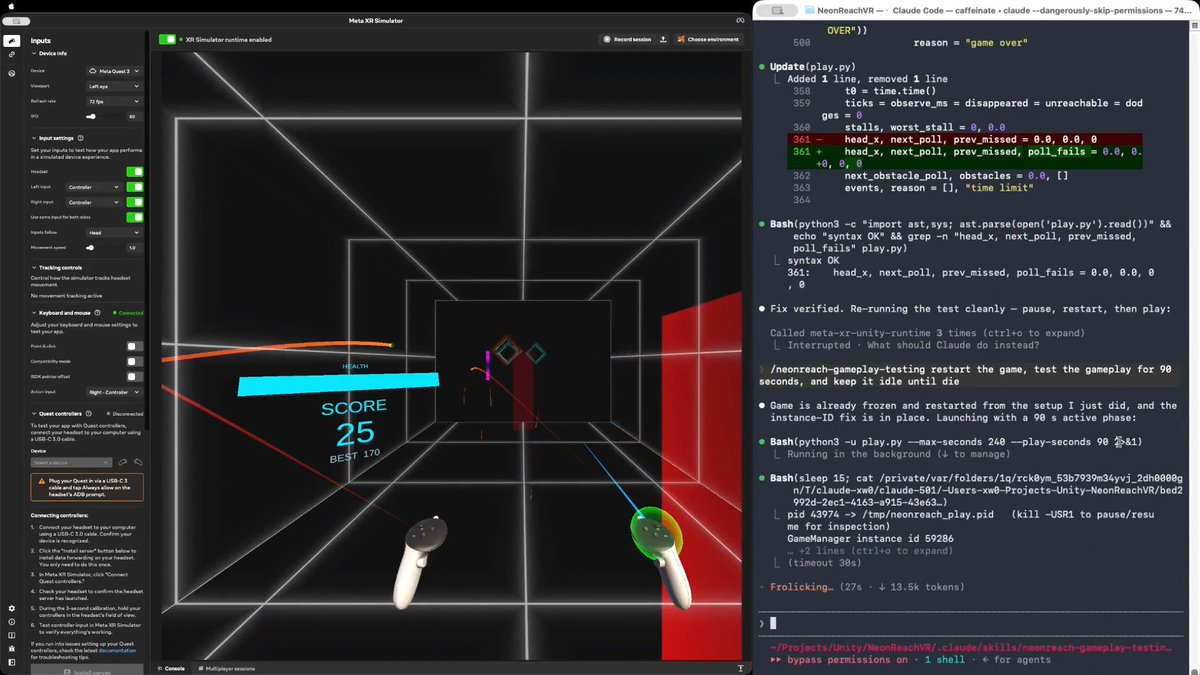
Would you believe an AI agent can test a real VR action game in real time, the way a person plays it? Meta XR Operator makes it possible. As far as I know, this is the first time. I am not talking about tapping a menu or replaying a recorded click path, but genuinely moving, shooting, and using the same game mechanics a human player does. In NeonReach VR, which is a real (and open source) action game, rings spawn 12m out and come at you somewhere between 1.5 and 5.5 m/s, getting faster over a 90 second ramp. There are three kinds: straight, weaving side to side, and spinning. Every shot is a full slingshot cycle, so you press, pull back, aim, then release. Obstacles arrive at head height and cost you a life if you don't get out of the way. You have ten lives. Here is why the game is hard for an AI agent. Even though Meta XR Operator gives the agent everything it needs to observe the app and act inside it, the agent still cannot play. One agent turn takes 10 to 15 seconds. One throw is four steps that have to happen in order, because the press has to latch before the pull, and they cannot be batched into a single call. So a throw costs about 45 seconds. A fast ring only exists for 2.3 seconds. One action takes 20x longer than the target is alive. Prompt tuning does not close a gap that size. What works is a three stage path: EXPLORATION, then SKILL, then SCRIPT. 1/ EXPLORATION. The agent drives the live app and works the game out on its own. It verified the coordinate mapping by setting a pose and reading it back, then derived the launch model. The more useful output was the traps it found. For example, the player's own body collider silently deflects a ball released inside it, with no error and no log line. That produced two confident wrong conclusions before anyone caught them. 2/ SKILL. All of that gets written down as a reusable SKILL.md plus an aim solver. There is a section that separates what was actually verified from what was assumed, so a wrong conclusion cannot quietly turn into doctrine. This stage also produced the trick that mattered. Set timeScale to 0 and a throw becomes atomic in game time, so however long the agent spends thinking never shows up in the shot. 3/ SCRIPT. The agent then compiles everything into a player script, a loop that observes, decides, and throws, calling the MCP servers directly from Python with no model in the hot path. Round trips drop from 10 to 15 seconds down to something between 1 and 16 milliseconds. The loop runs at 23 Hz, about 0.75 seconds per throw, roughly 60x faster than the agent doing it turn by turn. The result is that it plays like a person, which you can see from the attached video. It tracks the rings, works out where each one is going, throws with whichever hand is free, moves out of the way of the obstacles, and does not wait around to see whether the last throw landed. Shipping settings, no difficulty edits, no health locks, no slow motion. It plays until it actually loses. The takeaway generalizes beyond games: an agent does not have to be the player. Even following the same rules as a player, it has too much latency between moves. Having the agent write the thing that acts bypasses that constraint entirely. Try it yourself: or explore the agent-created skill and scripts: Based on NeonReach VR by Dilmer, with no code changes. I only upgraded its Meta XR Core SDK to v205, which ships Meta XR Operator. Our blog post, Introducing Meta XR Operator: Close the Build-Test-Verify Loop for VR: Disclosure: I work at Meta. And this represents my own opinion. #XR #VR #AI #MetaQuest #Unity #GameDev

Xiang Wei

52,421 просмотров • 14 дней назад

Milestone! We (robotic arms for gadgets assembly) finished the first commercial order, which brought the first revenue. Here are some learnings from this: The customer was a smart toy manufacturer. The task was to add a heatsink to Raspberry Pi. We received parts from them and returned the assembled modules back. Currently, it's done by teleoperation. Later it will be done by a remote employee via the Internet. Then it will be automated action by action, reducing the operator's time on this and making the task profitable. ps. If you have an assembly task that we can do for you asynchronically - leave a comment below. Learning 1. It's possible! This task which is usually done by the human arm with 5 fingers can be done with a two-finger gripper with the addition of a couple of simple tooling. The task was not simplified. We peeled off thin films from stickers, unpacked paper boxes, moved PCB boards full of components, etc. And no unsolvable problems have been encountered yet. Challenges: 1) The paper box shifted during the opening Solved with the plastic walls that you can lean against 2) Heat pad, stuck to the gripper instead of heat sync. Can be solved by gripper with a pump, but this time solved with the patience of the operator 3) The film on the pad is very thin. Turned out that sub-millimeter arm precision is enough to peel it off with just a regular gripper. 4) The working area has not enough space. You'll only know this by doing real tasks in bulk. This could be solved by an extra pair of long arms, but in this case, solved with the patience of the operator. I think that in the end, we will have 5-10 types of universal tooling and 5-10 types of grippers to solve almost all the problems in such assembly tasks. Learning 2. It's slow. It took 5 times more time, than doing it with human hands. But the good news is there's a lot of room for improvement. We now have specific “time for task” metrics, which we will decrease with iterations. The main reasons for slowness: 1) To rotate the gripper to a steep angle you are forced to control one robot arm with two hands instead of using both arms. We can fix this by just making more room for rotations. 2) Grabbing PCB board with two arms is hard. A slight difference in rotation can break the board, and it's hard to control these angles visually. To solve this, the best way is to use force feedback so you can feel the pressure applied to the item. 3) Accuracy and steadiness is still can be improved We will try a metal version and double the motors to do this. 4) It is physically difficult for the human hands to move with such precision To solve this, we will add a pad for the hands like in surgical robots Learning 3. It's a good business model The "Factory in the cloud" is a good business model for this stage. You send us parts and we send back assembled modules. Currently, it's more convenient than sending a robot to your place, as we can iterate/fix the robot quickly and utilize it 100% of the time. When we polish the set-up over time - we can send robots to your place. So if we can assemble something for you in the USA with Chinese prices by using modern automation - leave a comment below.

Igor Kulakov

37,266 просмотров • 1 год назад

Blades of Fire | Hands-On Gameplay Impressions ▪️Recap: New action-adventure IP from MercurySteam (Metroid Dread, Castlevania: Lords of Shadow) ▪️Coming to PS5, Xbox and PC on May 22 ▪️Around 60-70 hours long to complete ▪️You play as Aran de Lira, a forger and warrior who, after suffering a personal tragedy, "finds himself in possession of a magic hammer that lets him enter the forge of the gods to create the only weapons able to defeat Queen Nerea’s forces" ▪️The world is "squarely in fantasy territory", "rich, overabundant, lavish fantasy, as well as occasionally brutal and twisted" ▪️Magic courses through a land teeming with flowers and buzzing with wildlife, and creatures like trolls and elementals romp around ▪️Soldiers sort of look a bit like the Locust from Gears of War, chunky, loitering around. The whole game feels like it has a "chunkiness" to it, a bit like Blizzard games (hands and arms are oversized, buildings/walls are double thick). Combines to make a pleasing visual picture and give a sturdy, hefty feel ▪️"Wildly customizable weapons saves it from being just another action game", "combat is refreshingly different" ▪️Combat: Rooted in directional attacks that use every face button on a controller. On a DualSense for example, Δ aims for the head, X goes for the torso, while ⏹️ and ⭕️ swipe left and right respectively ▪️An enemy holding up a blade to protect their face for instance, can be overcome by aiming low and skewering through their gut ▪️Example: A troll boss can have a second health bar that can only be chipped away after dismembering it. If you use your right hand attacks, you can cut off its club-wielding left arm or cut off its entire face, leaving it blind and aimlessly flailing until it can regrow its eyes back ▪️Your attack and dodge stamina must be manually restored by holding the block button instead of automatically regenerating ▪️You can swap between 4 different weapons on the fly, wield your weapons via different stances, either slashing with the sharp edge or thrusting with the pointed tip; assess enemies to determine which methods are the most effective ▪️Rather than finding new weapons out in the game world, every weapon's life starts in the Forge ▪️You can create up to 7 different weapon types, from twin axes to polearms ▪️You start with your choice of a basic weapon template and tweak and modify and name, for example you can adjust the length of a spear's pole and the shape of its spear head which affects its stats ▪️A longer pole increases the spear's range, while its head shape dictates if its better at slashing or piercing ▪️Different materials also affect a weapon's weight which has an effect on your stamina pool ▪️You then physically hammer out the metal in-game on the anvil through a "remarkably involved minigame", where you control the length, force and angle of every hammer strike ▪️There is a curved line onscreen that represents the ideal weapon, you arrange a series of vertical bars to try and match the shape of that curved line with each hammer strike. Overworking results in a weaker weapon. You're rewarded with a star rating, the more stars you get, the more you can repair your weapon before it permanently breaks ▪️You can instantly remake weapons you've made before to save time ▪️Some found the weapon forging system to be "frustratingly obtuse", as there didn't seem to be a clear connection between the areas struck and the resulting shape of the metal; hoping for better tutorial or improvements before launch ▪️MercurySteam wants you to feel deeply attached to the weapons you create and carry them with you for the duration of your journey ▪️If you die, you lose your weapon upon respawning, but you can go back to where you died to retrieve them ▪️After playing for 3 hours, some hands-on impressions were unsure if the game can support a variety of a 60 hour game ("within 3 hours I’d fought the same gatekeeping miniboss 3 times") ▪️Others also felt there were uneven difficulty spikes, the game chucks multiple types of enemies at you, sometimes in confined areas. Can sometimes feel like you waste precious weapons, rest at an anvil to reforge and then enemies respawn again ▪️One previewer noted that when they started slowing down and nosing through the game's menus and built-in tips to see what they were doing wrong, they learned the game's nuances and it clicked Previews IGN: Full IGN Gameplay: Mirror: Eurogamer: #BladesofFire

Shinobi602

113,003 просмотров • 1 год назад

I’ve been using GPT-5.6 Sol internally for the past two months, I've spent probably 25+ billion tokens. Here’s my review and comparison to Fable 5: > Let's start with the analogy because everyone seems to be giving theirs - GPT-5.6 is likely the last version of the GPT-5 training run series. It's kind of like an athlete at their peak. Through years of experience in the game, they've become the most reliable player and has the highest game IQ. But, there's no more room to grow. Fable on the other hand, being essentially the first version of a new training run, is the first round draft pick rookie. Raw talent mixed with the energy only a young person would have results in some incredible plays we didn't think possible, but also mistakes due to lack of experience. But that rookie will only improve and likely will be better than the veteran ever was because it's a new game and a new era. > GPT-5.6 is genuinely better at long, sustained work. With /goal, I've had it running complex projects for days with almost no intervention. It built a Minecraft-style game, kept adding features and mobs after the core game worked, and only stopped because I stopped the run. I never felt as though I had to jump in and guide it back to the right path. > It keeps finding useful work when you give it a concrete finish line. I had it recreate Excel with a loop. It inspected the real desktop excel app with Computer Use, comparing that against its own build, and closing the gaps. I stopped it after six days after it had built an incredible amount of functionality. > It's faster than other models in two different ways. The raw generation speed is higher, something OpenAI has been putting effort into. But it also takes a shorter path to solutions. It wanders less, changes less code, and generally knows how to get things done directly. In daily use, it feels about 2-3x times faster than Fable. That's my impression, not a controlled benchmark. The difference is large enough that I notice it constantly. > It works well across a wide range of tasks. I use it for one-line edits, quick questions, browser chores, and multi-day builds without changing my prompting style. Speaking of browser control, its the best ever I've used. To the point where I actually use it often. If a task lives on a website, GPT-5.6 usually opens the browser and does it there instead of asking for an API key or forcing everything through the terminal. When I switched back to GPT-5.5, it went straight to the command line even when the browser was clearly the better tool. > And it can handle real browser work, not just toy demos. During a data import, I had it monitor Supabase and resize instances as the load changed. It stayed on the dashboard, adjusted capacity, and checked the result without an API or a custom script. > I also gave it a full Google Workspace migration. It moved Forward Future from to preserved the old aliases, and configured MX, SPF, and DKIM. Before a consequential save, it stopped, explained exactly what would change, and waited for confirmation. > The reasoning setting matters a lot. Light is good for questions and small edits. High and Extra High are the sweet spots for serious work. Ultra usually takes longer than the extra thinking is worth and burns tokens. > I love that 5.6 is split into 3 sizes. Not only can you control speed and cost that way, but you still also have the thinking effort setting for each of them. Very precise controls. I just wish Codex automatically routed my prompts for me. > Its personality is blunt and a little bland. Claude feels warmer and more natural to talk to. GPT-5.6 is more clinical, but I like that for work. It gives me enough explanation and rarely pads the answer. I usually have to ask Fable to explain things more simply and/or more concise. > Its front-end taste has improved, but the default is predictable. Left alone, it turns websites into PowerPoint decks with huge statements and hard section breaks. The good news is that it takes design direction well and can revise without destroying the parts that already work. > It still makes confident mistakes. I asked it to rebuild parts of a system, and it told me the job was finished. Later, I found out it wasn't. Bits of its internal process also leak into the answer occasionally. > Claude Fable is more naturally autonomous on large, open-ended projects. GPT-5.6 is easier to reach for. I don't need to invent a huge project to justify using it. It works just as well for a small edit or browser chore. > GPT-5.6 is also cheaper. Sol costs $5 per million input tokens and $30 per million output tokens. Fable costs $10 and $50. Cached input is cheaper too. Still, cost per finished task matters more than cost per token. > GPT-5.6 isn't the best at everything, and it still needs supervision. But it generates faster, wanders less, works at almost any scale, and wastes less of my time. It's the model I have the most confidence in to get the job done right the first time. I put together a full breakdown with all the tests, prompts, and examples on a site. You can read it here:

Matthew Berman

187,321 просмотров • 1 месяц назад

Wow. Classic Jensen style, he ended the Nvidia vs. custom ASIC competition for good. 🫡 The level of confidence with which he explains. 🎯 He was answering to UBS research analyst question on how custom ASICs will affect NVIDIA or how they are going to compete with custom ASIC. Basically he says - Your custom chip is a science project in a world where NVIDIA is building revenue-generating AI factories. While the competition is still desperately trying to copy Nvidia's last generation, their roadmap is already at the limits of physics. They don't just sell silicon; they deliver the entire, impossibly complex platform that the industry has already surrendered to and standardized on. When you must bet hundreds of billions on your company's future, there is no alternative—they are the only platform to build on, and everyone knows it. Full transcript below. Question by the Analyst - "Jensen, I wanted to ask about customer ASIC. And I ask because if, you know, we listen to some of the same CSPs that you put up on that slide, and we listen to some of the companies who are making custom ASICs, some of the deployment numbers sound pretty big. So, I wanted to just hear your position, how you're going to compete with custom ASICs, how they can possibly compete with you, and maybe how some of your conversations with these same customers would sort of form your view in terms of how competitive custom ASIC will be to you." Jensen's response "First of all, just because something gets built doesn't mean it's great. Number two, if it's not great, all of those companies are run by great CEOs who are really good at math. And because these are AI factories, it affects your revenues, not just your costs. It affects your revenues, not just your cost. It's a different calculus. Every company only has so much power. You just have to ask them. Every single company only has so much power, and within that power, you have to maximize your revenues, not just your cost. So this is a new game. This is not a data center game, this is an AI factory game. So when the time comes, that simple calculus, as I was using yesterday, that simple math that I was showing yesterday, still has to be done. Which is the reason why so many projects are started and so many are not taken into production. Because there's always another alternative. We are the other alternative, and that alternative is excellent. Not normal excellent, as you know. Everybody's still trying to catch up to Hopper. I haven't seen a competitor to Hopper yet. And here we're talking about 40x more. And so our roadmap is at the limits of what's possible. Not to mention we're really good at it and completely dedicated to it. A lot of people have a lot of businesses to do. I've got this one business to do. And we're all in on this. 35,000 people doing one job. Been doing it for a long time. The depth of capability, the scope of technology, as you saw yesterday, is pretty incredible. And it's not about building a chip; it's building an AI factory. We're talking about scale up, scale out. We're talking about networking and switches and software. We're talking about systems, and these system architectures are insane. Even the systems themselves. Notice, 100% of the computer industry, 100% of the computer industry has standardized on NVIDIA's system. Why? Because try to build an alternative. Building the alternative is not even thinkable because look at how much investment we put into building this one. And so even the system's hard. What people used to think, system is just sheet metal. Hardly sheet metal. 600,000 parts, it's hardly sheet metal. And so all of the technology is hard. We're pushing every single dimension to the limit because we're talking about so much money. The world is going to lay down hundreds of billions of dollars of investment in the next just a couple of two, three years. Let's do the thought experiment. Let's say you want to stand up a data center and you want it to be fully operational in two years' time. When do you have to place the PO on that? Today. So let's suppose you have to place a hundred billion dollar PO on something. What architecture would you place it on, literally based on everything you have today? There's only one. You can't reasonably build out giant infrastructures with hundreds of billions of dollars behind it, hoping to turn it back on and to get the ROIC on it, unless you have the confidence that we are able to provide you. And we can provide you complete confidence. And singularly so. We're the only technology company where if I had to go place a hundred billion dollars on an AI factory... Oh, that's interesting, I did. Literally the only company who's willing to place hundred billion dollar POs across the industry to go build it out. And you guys know, that's our, that's the depth of our supply chain. And we are, and we have. Give me another. Give me another one that has that depth and that length. And now to the point where we've got to go and work with the supply chain upstream and downstream to prepare the world for hundreds of billions of dollars working towards trillions of dollars of AI infrastructure build-out. Our partnerships with power companies and all of the cooling companies, the Vertivs, the Schneiders, our partnerships with BlackRock... The partnership network necessary to prepare the world to go build out trillions of dollars of AI infrastructure, that's undergoing as we speak. What architecture and what ASIC chip do you go select? That doesn't even make sense. It's a weird conversation even. And so, I think that one, the game is quite large. The investment level, therefore the risk level, is quite high. And so the certainty that you're selecting the best is quite important. And the certainty that you can execute, vital. We are the company you can build on top of. We're the company, we're the platform that you can build your AI infrastructure on. And we're the company that you can build your AI infrastructure strategy on. And so, I think it includes chips, but it's much, much more than that." --- From 'GTC Financial Analyst Q&A' session (full link in comment)

Rohan Paul

208,032 просмотров • 9 месяцев назад

New framework: Kick down your robot, it will get back up every time 🥋 Chinese startup RoboParty is a Beijing startup founded April 2025 by Huang Yi, originally shipping ROBOTO ORIGIN, the world's first full-stack open-source bipedal humanoid. They released UFO: Unsupervised Reinforcement Learning Framework for Humanoid Control. DEFINITIONS -> what differs is where the learning signal comes from: - SUPERVISED: humans supply the right answers (labels), the model imitates them. - UNSUPERVISED: no answer key, the model finds structure in raw data on its own. - REINFORCEMENT LEARNING: no answer key either, the model tries things and a reward scores each attempt. → UNSUPERVISED RL: trial and error where the agent invents its own rewards, instead of engineers hand-writing one per task. REPRESENTATION LEARNING: compress raw states into a useful internal map. TEMPORAL DISTANCE: distance on that map is "how many steps from A to B." CONTRASTIVE: trained by pulling together what's close in time, pushing apart what isn't. -> CONTRASTIVE TEMPORAL-DISTANCE REPRESENTATION LEARNING: the model builds an internal map of body states where distance means how many steps it takes to get from one to another. It is trained by contrast: states that occur close together in a movement get pulled together in the map, randomly paired states get pushed apart. UFO is an open-source training framework that teaches humanoid robots skills, like getting up, walking, goal-reaching, teleoperation, without reference motions -> no motion-capture or human-video demonstrations to imitate. Its core is TeCH, a contrastive temporal-distance representation-learning algorithm: the robot explores, builds pseudo-goals by temporal rolling, and learns goal-conditioned policies from a single unified progress reward. One framework trains five different robots (Unitree G1/H1, RoboParty RP0/RP1, AgiBot X2) with automatic config conversion in ~2–3 hours per robot! The real novelty here "no demonstrations at all". No data-collection arms race,the dominant humanoid-locomotion recipe is tracking: imitate mocap/retargeted-human reference trajectories. The robot self-generates goals from its own exploration and learns from a progress reward, needing zero reference motion data. Everybody else is fighting over data acquisition, while this team just teleports out of the race entirely (inb4 "competition is for losers 💀 ). This strategy reminds me of the DeepSeek playbook applied to robots: open-source the whole stack to become the global default and commoditize everyone else. RoboParty is giving away hardware and now control software (UFO) to be the Android of humanoids. Yet another reason for the US to ban Chinese open models perhaps 🥶 ? What I also really like about this approach is the cross-embodiment infrastructure, one framework trains Unitree G1/H1, RoboParty RP0/RP1, and AgiBot X2 with automatic configuration conversion. Just like Physical Intelligence, RoboParty seems to place itself as a neutral hardware agnostic middle man. Also woth mentioning: their ability ot perform stable skill injection, e.g. adding a cartwheel without forgetting how to walk. A common failure of RL humanoid policies is that teaching a new agile skill destabilizes the existing ones (catastrophic forgetting). UFO claims you can inject rare motions (cartwheel) without collapsing learned behavior. If it holds, that's a significant incremental/continual skill-learning! But again, I have to underline it: no arXiv, no external validation, no success-rate numbers. -> robotics badely needs an independent unbiased evaluator imho. Still, look at that cool demo: robot is getting kicked and pushed around (serious disturbance) during teleoperation (controlled the person at the back wearing the VR headset), and still managed to always get back up. This is some serious demonstration of stability and robustness!

Léo

35,855 просмотров • 1 месяц назад

👽 Did Grusch See Footage of Live Aliens? 👽 "Grusch has seen evidence that will leave you slack-jawed when you hear it." ~JF 😶 What Left Congress Speechless, and Staffers with Their Eyes Popping Out of Their Heads? 😱 ~ "Examine biological evidence of living or deceased non-human intelligence." ~Burlison Proposed Legislation (I'm gonna break all of this down and give you my speculation on what left Fox with his jaw on the floor, members of Congress speechless, and their senior staffers with their eyes popping out of their heads.) ~ James Fox: " Probably about two weeks ago (late May), we were having meetings on The Hill with members of Congress. We brought in a PR firm, 42 West, and we were having a meeting with staff members, bipartisan. We had Rep. Anna Paulina Luna, Rep. Tim Burchett Press Office, Rep. Eric Burlison. We had a representative from Congressman Jared Moskowitz's office. We had a number of Chiefs of Staff (top staffer for a specific member of Congress), like, present." (Don't really know why they needed a public relations firm in attendance, but if it helps them with advice on how to handle this, so be it. Just know: it appears like members of that PR firm know what Grusch said, and we don't.) Fox: "And, I can't reveal what was said. I thought it was gonna be said at the actual event that we had yesterday (June 9th) in DC with Mr. Grusch." (Don't be mad at Fox for keeping his word to Grusch and not sharing what was said in that private meeting. But I don't blame people for being annoyed that Grusch shared this information six or so weeks ago and we still don't know what he said in that room.) Fox: "Then, what Mr. Grusch revealed to all of us, what he had seen with his own eyes, left the room speechless. It drew the oxygen out of the room. I looked at everybody in that room, and their eyeballs were popping out. My jaw was on the floor. Like, I simply couldn't believe what he'd seen with his own eyes. Like, I can't wait for it to come out. "So I asked Mr. Grusch today, 'Can I talk about what I heard?' And he's like, 'No, but I will be addressing it very soon.'" (Like I said, it's almost been one month now (June 12) since Fox said this, so what does "very soon" mean? Was Grusch supposed to share this information on CNN with Jake Tapper last week but it didn't happen because that interview was, reportedly (Fox told us), postponed?) Fox: "So that's where we stand right now. But I can tell you, Mr. Grusch has seen evidence that will leave you slack-jawed when you hear it. It's coming, it's coming." (We heard that Gruch's Op/Ed was coming soon and that was 2.5 years ago. It never happened. So, I don't blame people for being skeptical about this. If Grusch hasn't told us by this time next week, I propose someone (a member of Congress) who was in that room just tell us. That's fair, right? Total transparency from our elected representatives?) ~ Fox: "Mr. Grusch is legitimately concerned about his personal safety. He's coming out with it, I promise you, this is coming out. He assured me today that he will address this issue to the general public very soon, in the near future." (I'm glad Grusch told a room full of people what he saw, as that may offer him some protection from people who allegedly want him to stop talking.) Fox: "So I can't speak to what he's gonna say, but I'm just telling you from what I heard out of his mouth, sitting in an office of a member of Congress? And everybody (Fox laughs) in the room, you could have heard a pin drop." Clayton Morris: "Could you give us a hint? Is it related to craft? Can you maybe dance around it a little bit? I want to say, 'You're killing me, Smalls (laughs).'" Fox: "Yeah, so if you can imagine, if you know about 'Moment of Contact,' that involves captured non-human intelligent beings. Think about that for a minute. Think about that case. I heard it out of his mouth, and I can tell you, I was in the room. And I looked around the room, and I'm looking at these young, like, guys in their 20s, you know, the staff guys? And their eyeballs were popping out of their head. My jaw was on the floor. I couldn't believe it." (There's a reason why I included that quote (living or deceased non-human intelligence) from the new Burlison/Carson/Crane legislation at the top of this tweet: At the very least, I'm confident Grusch told them that he saw photos of dead non-human beings. Bodies. But what about evidence of LIVING non-humans, aka aliens of unknown origin? More on that at the end. Fox: "My jaw was on the floor. I couldn't believe it." (Would Grusch saying he saw photos of craft and dead non-humans have that type of effect on Fox? Seems like that's something he would have expected to hear.) ~ Fox: "It was an [out of] body experience when I heard that. But I can tell you...the impression I got, was that he felt a little more protected to talk about this because of President Trump's directive to release the files, and that this... Again, this is my speculation, okay? This is not what Mr. Grusch said. "I got the impression that he was much more relaxed - even though he was still not fully relaxed - because of President Trump's directive to release these files. And that it was something that he had seen during his official investigations just within the last few years." (Imagine how much more relaxed Grusch (and others) would feel if we had an actual Executive Order from Trump with strong language to protect whistleblowers?) Fox: "And that it...I think it had an extremely profound impact on his life when he saw this evidence that he described. Again I'm leaving it right there. I've been talking with Republicans, and they said if Joe Rogan tweets about this, that the President will hear it, And I can't overstate the significance of that." (Why hasn't Rogan already done that? No excuse. Fox has been on Rogan and I'm sure he has Joe's contact information. Make it happen.) Fox: "We need people. We're not asking for money, we're not asking to get on your show, we're just asking, Mr. President, please, as many people as possible, release the files that should not be associated with national security. And that's the alien or non-human sentient beings. That's it." ~~~ (I'm going to speculate on what Grusch may have said in that room.) Fox: "I think it had an extremely profound impact on [Grusch's] life when he saw this evidence that he described." (Grusch has said he started out as a skeptic when he started looking into this. If he was shown what he felt were photos of non-human bodies, I think that might be enough to have an, "extremely profound impact on his life." Depending on exactly what those photos showed, of course.) In "Moment of Contact," Eric Davis had this exchange with Fox: James Fox: "Put me wherever you were when you got to see photographs of crash retrieval and documents. What did that feel like?" Dr. Eric Davis: "That was startling, when I actually see recorded evidence with my own eyes. Photographs, reports, and whatnot. That took it to a higher level, that kicked it up several notches of reality. And that made it very clear that this reality is very hard, very physical, very real. "And this type of evidence, you can't come by in the open literature, it's not public, it's classified. And I can't discuss what it was, but I can tell you, yeah, it's a crash retrieval, there's a craft, and there's alien bodies. That's all I can say about it." Fox: "You swear on your life that you saw those pictures?" Davis: "Oh, I swear on my life, and everybody's...my children's life, so (laughs). Yeah, I'm absolutely telling you the truth. I saw the evidence, and it's stark! I can't tell you the exact number, because it's classified, but I'll just say, there's a few dozen total retrievals." Full exchange with video... ~~~ As I said in my other post, I think Davis, Semivan, Puthoff, Kelleher, Grusch, Lacatski, Stratton, aka The AAWSAP Gang (I just made that up), may have seen the same evidence of photos and reports. Has Grusch seen more than that? I don't know. In 2025, Davis said this... Burlison: "Can you comment on whatever species have been piloting these craft? Are they largish? Are they multiple species? What was their size, and how many are usually on a craft?" Davis: "They're typically the multiple species people are familiar with. The Greys, the Nordics. People have talked about Reptilians and Insectoids. It's not that they're Reptilian or Insectoid, it's that they resemble, to the participant, a reptile, or insect type. A humanoid, because they have this...a hand, and four limbs, and a torso, so..." Burlison: "Large? Small?" Davis: "Human size, human scale." Burlison: "How many are in a crew?" Davis: "Well, the group, well, the Greys I'm familiar with from investigating the crash at Corona, which is misnamed the crash at Roswell. It's not the crash at Roswell, it's the crash at Corona, New Mexico. Those were Greys, those were four-foot tall. And the Nordics are typically human-sized, probably...I've heard five, six-feet tall. And same with the people who mislabel Reptilian and Insectoid. They're roughly that height, too. I haven't heard anything about anything seven or eight feet or nine-foot tall, of that nature." Full post with video... ~ And this past Sunday, Davis said this to The Good Trouble Show with Matt Ford... Davis: "I can say to you guys that there are a minimum of four different alien species. The credibility of that ranges on the spectrum from no credibility to high credibility. The high credibility is the classified part." Full post: My Final Thoughts (Based on everything Davis has shared, it seems he saw classified photos of what appeared to him to be non-human craft and photos that appeared to show dead non-humans (bodies) with enough detail that he could see that some resembled reptiles and others resembled insects. Were there also photos of Greys and beings that looked human (Nordic)? I don't know. These images of non-humans would fall into what Davis deemed "high credibility" and "the classified part.") Davis: "I saw the evidence, and it's stark!" (If Davis saw close-up photos that showed details of beings that looked like Reptilians and Mantids, I'd say that qualifies as stark!) Back to what Fox said... Fox: "Then, what Mr. Grusch revealed to all of us, what he had seen with his own eyes, left the room speechless. It drew the oxygen out of the room. I looked at everybody in that room, and their eyeballs were popping out. My jaw was on the floor. Like, I simply couldn't believe what he'd seen with his own eyes." (I think what caused that reaction was Grusch describing seeing close-up photos of different types of non-human beings. Maybe.) However, Fox also said this: "...if you can imagine, if you know about 'Moment of Contact,' that involves captured non-human intelligent beings (This is the Varginha, Brazil case. ~Joe). Think about that for a minute. Think about that case. I heard it out of his mouth, and I can tell you, I was in the room." (The biggest CLAIM in that film and from that case is that a live, non-human being was captured and that Dr. Italo saw video of it, and then stood next to it for a few minutes when it was in the hospital, in a bed, being cared for by another doctor. Did Grusch say he saw evidence (photos or videos) of a live being that appeared to be non-human? Joe Rogan asked him that in his November 2023 interview... Grusch: "Once you realize the phenomenon's real, then you realize we've recovered artifacts and, you know, biologics or, you know, dead pilots, if you will, even though it's kind of creepy to think about in your world view. You don't think they were ever, you know, alive sometimes, too, right? And I'll leave it at that, only because, you know, that is something the President and his cabinet need to disclose this in a controlled manner." (He was either hinting that he's seen them alive or that them being alive and on this planet is a huge deal and not his responsibility to announce. I think it's the latter.) Rogan: "Are there discussions of interactions with live beings?" Grusch: "Uhh, there was some water-cooler talk about that kind of thing." Rogan: "But that's it?" Grusch: "But, you know, I don't even wanna get into it because it's like, uh, there was some details provided to me but it's like, it's secondary and I don't know if that's like, the telephone game and I don't know if it was hyperbolized in any way...um, you know, in the break room, so to speak. So I just... I'm so anal about making sure what I say is accurate...I don't, you know, I don't know." (Based on what he said there, it seems like he has NOT seen any evidence of live beings. If he now comes out and says that he has, it will seem like a flip flop. So, I'm gonna go with Grusch said he saw photos of non-human bodies and they were of the different types/species that Dr. Eric Davis referenced. One more flashback to what Davis said in that public, congressional briefing in May of 2025.) Davis: "It's not that they're Reptilian or Insectoid, it's that they resemble, to the participant, a reptile, or insect type." (That sounds like someone who has seen exactly what they look like, via photos.) Final point... "Examine biological evidence of living or deceased non-human intelligence." ~Burlison Proposed Legislation (That language was in the original UAPD Disclosure Act co-sponsored by Senators Schumer and Rounds, and four other senators. Why put that language in there if you haven't heard credible reports of living or deceased (bodies) non-human intelligence? Are there stories of living, non-humans on this planet? Yes, and I'll leave you with one of them.) ) (Just to make it clear: I think Grusch will say that he saw clear photos of different types of non-human bodies and some looked like reptiles and others looked like insects. It would be amazing to hear Grusch say he saw video or film of living beings, but I don't expect that. However...this still bothers me... Would Grusch describing seeing photos of craft and different kinds of dead aliens leave veteran-of-the-UFO-field, James Fox, with his jaw on the floor? I guess we're gonna see. And hopefully soon.)

Joe Murgia

204,314 просмотров • 1 месяц назад

Made $530,000 with Ai Bot that started with $313. Didn't know how to code. Now this bots run 24/7 printing money while sleeping. I've made the exact step-by-step guide to build this Claude Code Polymarket trading bot. Prompts. Code. Risk settings. Paper trading checklist. Everything from zero to running bot. It's free. For 24 hours. After that I'm charging $499 for it. To grab it right now: 1. Comment "Claude Bot" 2. Like and Retweet this post 3. Follow me Himanshu Kumar ( I can't send DMs to non-followers ) I'm DMing everyone who Complete the 3 steps. I spent hundreds of thousands hiring developers because he was too scared to learn. Then learned Claude Code. Built algorithmic trading systems. $313 → $530,000. You have the same tools available right now. And you're using them to ask ChatGPT for Instagram captions. This attached video is a goldmine. Full live walkthrough. Claude Code building actual Polymarket trading bots. From zero. Every line of code. Every decision explained. Now let me break down why everything you're doing in trading is wrong and exactly how to fix it. Save this post. You'll hate yourself if you lose it. ↓ Let's start with why you keep losing money. You already know the answer. You just won't admit it. You overtrade. Every. Single. Day. You see a candle move. You feel something. You enter. No plan. No edge. No reason. Just feelings. Then it goes against you. You feel something else. Panic. Anger. Denial. You move your stop loss. Or you didn't set one at all. "It'll come back." It doesn't come back. So you take another trade. A revenge trade. Bigger size this time. Because you need to "make it back." That one fails too. Now you're emotional. Now you're tilted. Now you're using leverage you have no business touching. 40x. 50x. 100x. On a trade you entered because a candle looked "bullish" and some guy on Twitter said "send it." You get liquidated. Close the laptop. Punch something. Tell yourself you'll be "more disciplined" tomorrow. Tomorrow comes. Same cycle. Same result. Same liquidation. You've been doing this for months. Maybe years. And you still think the problem is your strategy. The problem isn't your strategy. The problem is you. Save this post right now. What I'm about to show you is the only way to remove yourself from the equation. Follow Himanshu Kumar so you don't miss any of this. ↓ Here's what's actually killing your account. It's not the market. The market doesn't care about you. It's not your indicators. RSI works fine. MACD works fine. They all "work." It's not your timeframe. It's not your broker. It's not the "manipulation." It's four things: 1. Emotions. You hold losers because hope feels better than loss. You cut winners because fear feels stronger than greed. You size up when angry. You skip trades when scared. Your emotional state determines your position size. That's insane. And you know it's insane. But you keep doing it. 2. Overtrading. You take 15 trades a day. Maybe 5 of them had actual setups. The other 10 were boredom. Boredom trades are the most expensive hobby in human history. 3. Leverage. You use 20x-50x on trades where you're not even sure about the direction. That's not trading. That's a casino with a nicer interface. 4. Fees. You're smashing market orders. Paying spread. Paying commission. On 15 trades a day. Your broker makes more money from your account than you do. Think about that. Your broker is profitable on your account. You're not. You're the product. Not the trader. These four things are why 90% of traders lose. Not bad luck. Not the market. You. Save this post and follow Himanshu Kumar because the solution is coming next. ↓ The solution is painfully obvious. Remove yourself from the equation. Not partially. Not "I'll be more disciplined." Not "I'll journal my trades." Not "I'll meditate before trading." Completely remove yourself. Build a bot. Let the bot trade. You go live your life. The bot doesn't feel emotions. The bot doesn't overtrade. The bot doesn't use reckless leverage. The bot doesn't smash market orders and bleed fees. The bot follows the rules. Every single time. Without exception. Without "just this once." Without "I have a feeling about this one." Rules in. Execution out. No human in the middle to mess everything up. That's algorithmic trading. And before your ego jumps in with "but I'm different, I have discipline" — No you don't. Your account balance proves you don't. If you had discipline, your account would be green. It's not. So you don't. Accept it. Automate it. Move on. This is the hardest truth in trading. Your discipline will always fail. A bot's won't. Save this post. Follow Himanshu Kumar for the exact bot setup that removes your emotions permanently. ↓ "But I don't know how to code." Neither did he. The guy in this video didn't know how to code for most of his life. Got held back in 7th grade. People counted him out early. Spent years building apps and SaaS businesses without writing a single line of code. Hired developers on Upwork instead. Spent hundreds of thousands of dollars paying other people to build what he could have built himself. Because he was scared to learn. That fear cost him years. And hundreds of thousands of dollars. Sound familiar? You're doing the same thing right now. Not with developers. But with your time. You're spending thousands of hours trading manually because you're scared to learn the thing that would make trading automatic. The fear of learning to code is costing you more than any bad trade ever did. Because every month you trade manually is a month of emotional decisions, overleveraged entries, and unnecessary losses that a bot would never make. And here's the thing that should really frustrate you: AI does the hard parts now. You don't need a computer science degree. You don't need to work at a hedge fund. You don't need to be "good at math." Claude Code writes the code for you. You just need to think clearly about trading ideas. That's it. If you can describe a strategy in English, Claude can build it in Python. "I don't know how to code" stopped being a valid excuse in 2024. It's 2026. You're 2 years late on that excuse. Find a new one. Or stop making excuses entirely. Save this post. Follow Himanshu Kumar because I'm showing you how people with zero coding experience are building profitable bots. ↓ The process that actually makes money. Three letters. R. B. I. Research. Backtest. Implement. That's it. That's the entire process. Every single day. Research: Find an idea. A pattern. A market inefficiency. Don't trade it yet. Don't even think about trading it yet. Just research it. Backtest: Test the idea against historical data. Does it work? Not "does it look good on one chart." Does it work across thousands of trades? Across different market conditions? Across in-sample AND out-of-sample data? If no, kill it. Find another idea. If yes, move to step 3. Implement: Build the bot. Deploy it. Paper trade first. Then live with small size. Scale only on evidence. Research. Backtest. Implement. Every day. No exceptions. You know what your current process is? Feel. Enter. Pray. F. E. P. Feel bullish. Enter a trade. Pray it works. That's not a process. That's gambling with a TradingView subscription. RBI is the only process that works. Save this post. Tattoo it on your forearm. Follow Himanshu Kumar for daily RBI breakdowns. ↓ What Claude Code actually does that your manual process can't. You can maybe test 3-5 strategy ideas per week. Manually adjusting parameters. Manually checking results. Manually writing code (badly). Claude Code tests 50-100 ideas per week. With parallel agents running simultaneously. Multiple strategies being built, tested, and validated at the same time. While you sleep. The guy in this video spends 4-8 hours a day building systems with Claude Code. Not trading. Building. Research. Backtest. Implement. Then iterate. Improve. Optimize. Every day the systems get better. Every day the edge compounds. Every day the bots get smarter. While you? You spend 4-8 hours a day staring at charts making the same mistakes you made last month. Same indicators. Same patterns. Same entries. Same losses. He's iterating forward. You're running in circles. Same 8 hours per day. Completely different outcomes. Because he's building systems. And you're feeding a casino. Stop feeding the casino. Start building the machine. Save this post and follow Himanshu Kumar for the Claude Code workflow that iterates strategies while you sleep. ↓ Jim Simons. That's the benchmark. You probably don't know who Jim Simons is. And that tells me everything about how seriously you take trading. Jim Simons. Mathematician. Founded Renaissance Technologies. Built a net worth of $31 billion. 100% from algorithmic trading. Not one single manual trade. Not one "gut feeling" entry. Not one RSI divergence. Not one "smart money concept." Algorithms. Bots. Systems. Data. $31 billion. His fund averaged 66% annual returns for over 30 years. While you're excited about making $200 on a trade that you'll give back tomorrow. The best trader in human history never placed a manual trade in his life. And you think your edge is staring at a 5-minute chart with bloodshot eyes at 2 AM? Your edge is building the system. Not being inside it. Jim Simons is the benchmark. Everything else is noise. Save this post. Follow Himanshu Kumar because I'm building toward the same goal and showing every step publicly. ↓ What you need to understand about patience. This is not get-rich-overnight. The guy in this video says it directly: "This channel is not for people looking to get rich overnight. It's not plug and play. There are no shortcuts. If you're impatient, this probably isn't for you." And that's exactly why most people will fail at this. Because you want results now. Today. This trade. You don't want to spend a week building a bot. You don't want to paper trade for 2 weeks. You don't want to test 50 ideas to find 1 that works. You want to copy someone's bot, run it live with your rent money, and be rich by Friday. That's why you'll be broke by Friday. The guy making $2.3M spent months iterating. Testing. Failing. Rebuilding. Testing again. He was patient when you would have quit. He was calm when you would have panicked. He was consistent when you would have given up. Patience isn't just a virtue in trading. It's the only virtue. Without it, everything else fails. Impatience is the most expensive personality trait in trading. Save this post. Follow Himanshu Kumar and learn to build systems with the patience that actually pays. ↓ The live streams where the real learning happens. The YouTube video is the trailer. The live streams are the movie. Real-time bot building. Real-time questions answered. Real code shown. Real mistakes made and fixed. Not polished highlight reels where everything works perfectly. Actual development. Where things break. Where strategies fail. Where code doesn't compile. Where the fix takes 2 hours. Because that's what real development looks like. And seeing the messy parts is more valuable than any polished tutorial. Because when your bot breaks at 3 AM, you need to know how to fix it. Not just how to celebrate when it works. The streams mix beginner and advanced. Start with how to automate trading. How to use AI for code generation. Then dive into the daily work. Claude Code. Parallel agents. Constant iteration. Live debugging. 4-8 hours of real algorithmic trading development. Live. Uncut. No filter. Most "trading education" shows you the wins. This shows you the work. Save this post. Follow Himanshu Kumar for the stream schedules and breakdowns. ↓ The belief that changes everything. Code is the greatest equalizer. Not money. Not connections. Not a degree. Not where you grew up. Not what school you went to. Code. Once you can build systems, you can build anything. For the rest of your life. A trading bot today. A SaaS product tomorrow. An automation business next month. A completely different life next year. The skill isn't "algorithmic trading." The skill is building systems. And that skill transfers to everything. The guy who can build a trading bot can also build a lead gen tool. Can also build a content pipeline. Can also build a SaaS product. Can also build literally anything that runs on logic and code. One skill. Infinite applications. And AI makes learning it 100x easier than it was 5 years ago. You don't need to be smart. You don't need talent. You need Claude Code and the willingness to sit down and build something instead of consuming content about building something. Building is the skill. Everything else is entertainment disguised as education. Save this post. Follow Himanshu Kumar because I'm showing you how to build, not just how to watch. ↓ If any of this applies to you, pay attention. If you've lost money from overtrading. If you've been liquidated. If you know trading is the vehicle but manual execution keeps crashing you. If you've tried "being more disciplined" and it never lasted more than a week. If you keep saying "next month I'll start automating." If you've spent more money on courses than you've made from trading. There is a better way. It's not a magic indicator. It's not a signal group. It's not a $997 mentorship from a guy who makes money teaching, not trading. It's building your own system. A system that trades without emotion. A system that follows rules without exception. A system that runs while you sleep. A system that compounds while you live your life. That's the answer. It's always been the answer. You've just been too scared to accept that the solution requires building something instead of buying something. ↓ What the next 30 days look like if you actually commit. Week 1: Watch the video. Learn Claude Code basics. Build your first simple strategy. Run your first backtest. Week 2: Iterate. Let Claude improve the strategy. Run Monte Carlo validation. Paper trade. Week 3: Go live with $50-100. Tiny positions. Watch every trade. Compare to paper results. Week 4: Scale based on evidence. Not based on excitement. Not based on one good day. Based on data. 30 days from now you either have a running bot that trades without your emotions destroying every position. Or you're exactly where you are right now. Reading another post. Making another promise. Breaking it by Tuesday. Same 30 days either way. Different actions. Different results. Different life. ↓ Full video tutorial attached. Live bot building with Claude Code. From zero to running Polymarket trading bot. Every line of code. Every decision explained. The video is free. Claude Code is available now. The market is open 24/7. The only thing standing between you and a profitable trading bot is the same thing that's been standing there for months. You. Get out of your own way. Follow Himanshu Kumar for daily AI trading bot breakdowns, live build sessions, and the full RBI process. Save this post. Watch the video. Build the bot. Or keep trading manually and keep losing. The choice has never been easier. And you've never been more stubborn about making the wrong one.

Himanshu Kumar

37,986 просмотров • 5 месяцев назад

If you're new to $EOS.AX, here's everything that matters. I think this is a prime in the making. Here's why. What they actually do Electro Optic Systems is an Australian defence technology company with four decades of experience in lasers, optics, and weapons systems. They build remote weapon stations, high-energy lasers, counter-drone systems, and space domain awareness infrastructure; and now the AI command-and-control layer to connect all of it. Land EOS has sold over 2,500 remote weapon stations globally. Their R400 Slinger is battle-proven in Ukraine; 160 systems deployed, with the Ukrainian Ambassador visiting EOS headquarters this week and publicly confirming the Slinger is receiving positive operational feedback from the battlefield. General Dynamics selected EOS as sole partner to integrate the R400 autonomously onto the M1 Abrams tank. Thousands of platforms, $3B addressable market over 15 years. Counter-drone Apollo is their 100kW high-energy laser. The Netherlands signed the world's first 100kW HELW export contract at €71.4M, and it's running six months ahead of schedule. Their Slinger cannon system is the kinetic layer. EOS has recently acquired MARSS, bringing NiDAR; an AI-enabled command and control system with 60+ fielded systems globally as the brain connecting everything. EOS can now sell a full integrated kill chain - detect, decide, engage. Sea EOS doesn't build ships. What it does is provide the weapon layer on unmanned surface vessels. R400 RWS demonstrated on BlackSea Technologies' USV at Sea-Air-Space in April alongside Lockheed Martin. A €31M order for Slinger counter-drone systems configured for naval deployment; EOS's largest ever naval RWS contract, funded by a Western European government. Space This is the part most people miss. EOS has been tracking objects in orbit from Mount Stromlo for four decades. Atlas Space Control - unveiled at IAC 2025 - weaponises that capability. Ground-based high-energy lasers, fixed or mobile, scalable from surveillance through to active engagement. As Russia parks military satellites 500 metres from commercial imaging assets supplying Ukraine, this stops being a niche product. They just appointed Air Vice-Marshal (Ret'd) Catherine Roberts to the board; inaugural Commander of Defence Space Command in Australia, 40 years of aerospace engineering, and oversight of $16B in major programmes. They're stacking the deck to own the space domain. C2 - the connective tissue Without command and control, EOS is a components vendor, but MARSS NiDAR changes that. It fuses sensors and orchestrates effectors across all domains at machine speed. The integrated EOS-MARSS stack has already defeated Iranian Shahed drones defending Gulf infrastructure in active conflict. Netherlands World's first export contract for a 100kW high-energy laser weapon @ €71.4M and running ahead of schedule. The Dutch client is already signalling readiness for serial production orders before first delivery. This is NATO reference architecture. Germany Defence Minister Pistorius visited Mount Stromlo in March 2026. CEO Schwer presented binding offers for 10 Apollo 100kW systems (€380M) plus Atlas. EOS pitch - twice the power, half the price, half the time. A German CEO with Rheinmetall executive pedigree doesn't walk into those rooms by accident. Middle East 500+ EOS remote weapon stations already in Emirati service. Calidus - Abu Dhabi's major defence integrator - took a A$40M strategic stake in EOS and is co-producing systems in a UAE manufacturing hub. Their joint system DAMITA is the UAE's first indigenous integrated counter-drone platform; EOS laser, EOS turret, MARSS NiDAR brain. This is the Gulf reference architecture, with a clear replication path into Saudi Arabia, Kuwait, Qatar, and Bahrain. Africa MARSS is finalising a >US$190M C4I programme with Nigeria's Ministry of Defence; NiDAR as a national command architecture, regional hubs, ISR UAVs. One of the largest defence programmes ever commissioned in Africa, with both sides publicly confirming they're moving toward contract signature. When it converts, it pushes the combined order book toward A$1B. The ITAR advantage US laser and defence companies are world class but export restricted, whereas EOS is ITAR free. They can sell to Europe, the Middle East, and Asia without years of Washington approval. That's not a minor detail; it's the entire competitive moat in a market where every NATO ally is scrambling to rearm. The numbers Order backlog - A$700M+ and growing. Gross margins - 76%. Net cash: ~A$235M post capital raise. A$190M institutional raise just completed with Calidus as strategic anchor investor. The setup The market is still pricing this like a small Australian manufacturer. The order book, the partnerships, the product depth, the combat validation, and the geopolitical tailwinds say something else entirely. Air, land, sea, space, and the brain to run them. That's the company EOS is becoming.

OptimusDelta

226,487 просмотров • 3 месяцев назад

Big Update: Critters Quest Website Steps Into Production State with an Exciting New Design! Hey Critters, we're thrilled to share some major news, our website has officially migrated from mint state to production state, and we're taking our platform to the next level right here at After three weeks of dedicated work, we've transformed Critters Quest into a more organized, stable, and feature-rich experience, setting the stage for everything we've planned for the future. This isn't just an upgrade—it's the first step before the real journey begins! Key Updates to the Homepage and Beyond Fresh Categories and Pages: We've added exciting new sections to help you dive deeper into the Critters Quest world: - Play $QUEST (Explorer Page for Staking $QUEST): Dive into our new $QUEST explorer page, where you can find games to stake your $QUEST tokens to earn rewards, track your staking progress, and engage in strategic gameplay challenges that grow your Critters' value. - Play Spins (Explorer Page for Spins): Spins are now front and center with a dedicated spins explorer page, designed to highlight Multipliers Spins, Terron Spins, Quest Tablet Spins(coming soon👀), and more. Organized as daily free spins, limited events, and partner spin opportunities for special loot, offering new ways to boost your rewards. - Breakdown Informational Page: We've introduced a comprehensive guide for new users (and a refresher for veterans) to explore how key features work. This page currently focuses exclusively on the mechanics and info for Master Edition NFTs, Cloned Editions, and Multipliers. It explains how Master Editions serve as the foundation for your Critters' value, how Master Editions allow Cloned Editions to be minted out for others, and how Multipliers enhance your rewards throughout critters ecosystem. Redesigned Homepage: Our homepage has been completely transformed into an intuitive experience that gives you a complete overview of the Critters Quest ecosystem at a glance. It features: - Feature Carousel: Highlighting new additions and important updates - Ecosystem Activities: Real-time data showing active games, spins, or other ongoing activities. - Mini-Leaderboards: Quick snapshots of top performers - PFP Activity Feed: See the latest community PFPs minted - Quick-Access CTAs: Every section includes direct links to the full experience, letting you dive deeper with just one click - Streamlined Introduction: New visitors get a concise overview of Critters Quest right away This overview approach makes navigation intuitive for both newcomers and veterans, ensuring you never miss important information or opportunities. Elevated Designs Across the Board: - Dynamic Castle Layout in the Banner: Our homepage now features a dynamic castle layout in the banner, with castles positioned in the order they appear on the leaderboard. The top leaders are showcased at the top, adding a visual representation of community rankings and bringing our competitive spirit to life. - Critters Terminal (Formerly $QUEST Terminal): Our terminal has been upgraded with a sleek new look and enhanced functionality, now known as the Critters Terminal. It's your go-to hub for finding the most powerful cards and looking for new Critters—it tracks $QUEST allocation on available Critters for sale, their power, equipment, and more, helping you build the ultimate team. - Equipment Viewing: Viewing Critters and their equipment has been elevated with detailed rankings, power levels, and stats, giving you a clearer picture of your team's strength and hinting at game mechanics like power-based strategies. - Spins Pages Redesign: The spins experience has been completely revamped with a fresh, user-friendly design, making it easier to spin for rewards and track your progress, with a focus on multipliers and special loot opportunities. - Partnership Sign-Up Page Update: On our main page, you'll see mentions of our legendary partners—GM Capital, Mintify, Sniper, and more—highlighting our growing ecosystem. We've also updated our partnership sign-up page for those looking to partner with us. This page now includes a detailed breakdown of partnership options and new form fields to streamline the collaboration process. We're excited to expand our network in the future! - Animated Banners: Across all pages, you'll notice new animated banners that bring our world to life, adding visual excitement and guiding you through the platform. - Archived Pages: To streamline the site and focus on the future, we've archived older pages like the Master Edition Mint and Referral pages. These will remain available for reference. Coming Soon: We're already working on exciting additions, including: - SHOP Page: A new experience for purchasing items and gear to enhance your Critters Quest adventures, where you can equip your Critters with power-boosting equipment. - Tokenomics/Liquidty Section (Addition to the INFO Page): We're working on a detailed tokenomics section to add to our INFO page, launching alongside updates to our plans for DEX integration. These changes will add more value to Master Editions, give participants greater confidence, and enhance the overall ecosystem. - Cloned Edition Minting: This innovative feature will launch when Master Editions begin to mint out their Clones, allowing people to mint these unique variations. Cloned Editions will inherit traits and offer new gameplay opportunities, expanding your Critters' potential and rewards. Backend Tweaks: While many of these improvements are visible, we've also made numerous backend tweaks that aren't immediately seen. These optimizations ensure better performance, stability, and scalability for the platform moving forward. Continuous Elevation: This migration marks our first massive overhaul, but it's just the beginning. We're committed to elevating Critters Quest on a continuous basis, refining and expanding the platform with each rollout to keep delivering the best possible experience for our community. Foundation for the Future These updates aren't just cosmetic—they're foundational. After three weeks of hard work, we've created a more organized and structured platform that's ready to support the future rollouts we've been teasing, like Edition Minting, Items Shop, and Quest Games. This migration streamlines our process, allowing us to deliver updates faster and more efficiently for both new users and our longtime adventurers. This is truly the first step before the real journey begins. Our production state sets us up to expand Critters Quest into an even bigger, more engaging GameFi ecosystem, where your Critters can thrive through quests, spins, and community challenges. Whether you're a newcomer or a seasoned player, these changes make it easier to explore, compete, and grow your collection. Your Next Expedition We're just getting started! This production-ready overhaul is the launchpad for all the exciting features and expansions we have planned. Keep an eye on for more updates, and dive into the new pages to see how you can level up your Critters Quest experience. We want to hear from you! Share your feedback, suggestions, and experiences with our new production site in our Discord or commenting below. Your input directly shapes our future updates and helps us create the best possible experience. Thank you for your patience and support during this transition. Together, we're building something truly special!

Critters Quest

26,200 просмотров • 1 год назад

"How do you know you can trust what [a non-human intelligence is] saying?" ~Bigelow Bigelow/Knapp 2: If I Was President, I'd Tell the World We Have Non-Human Craft and Bodies "The President that took on the challenge of Disclosure and of confirmation...is gonna go down in history as having really accomplished something." ~Bigelow Do China and Russia also have non-human bodies and craft? "Oh yeah, freaking yes!" ~Bigelow ~ "You've opened up Pandora's box." ~Bigelow ~ 17:44 (I'm using the KLAS YT video for time stamps. As you'll see, I add a lot to these, so they take forever to put together.) George Knapp (GK): "Would you guess - based on what you know about the topic and how it's been handled over the decades - would you guess that [Trump] had been briefed, or that any other presidents have been briefed? You know that Bill Clinton was not, even though he expressed an interest in it. So at some point, the President has to be told, 'No, we can't tell ya.'" Robert Bigelow (RB): "I think Bush Sr. knew quite a bit because he was the head of the CIA." (Dr. Eric Davis says Bush. Sr. told him some interesting things, including that he (Bush) was partially briefed in 1976 about the alleged 1964 Holloman AFB landing and meeting, and more, when he first became the director of the CIA in 1976. Watch Davis explain it, here. ) ~ RB: "I think Nixon did." (We have the Jackie Gleason story, where Nixon allegedly snuck away from his Secret Service detail and took Gleason to see non-human bodies at Homestead Air Force Base. But that was a claim from his ex-wife, and Gleason, who died in 1987, never said anything about it, on the record. The controversial Larry Warren (Rendlesham) claims Gleason told him the same story, but that's it.) Bigelow: "I think Eisenhower did. So, it's kind of hit and miss over historic...over the period of history as to who has and who hasn't." 18:20 Knapp: "Can you tell us what would be in the briefing document that you left behind? Was it cases? Here's a wave of UFOs, here's a case, here was a crash. Anything like that?" Bigelow: "Yeah, I related conversations I have had with General De Brouwer, who was the chief of the Air Force for Belgium. And there was a very interesting flap that was about 18 months long (1989-1990) with triangular craft. And he was in command of all the Air Force, and he really chased the heck out of these. "And he told me, he said, Bob, 'I'm just burning fuel, and it makes no sense.' He said, 'We're gonna stop because we're not getting anywhere. All we're doing is getting closer, you know, photographs and things, but we're not getting anywhere. We're not getting any information that is really valuable for us to understand anything.'" (I wonder if those were OUR triangles? If so, it's still a solid case/flap of anomalous craft. Dick D'Amato was a longtime (18 years) senior staffer for Senate Democratic Leader Robert C. Byrd of West Virginia.) "Dick D'Amato has returned from Belgium where he met with Colonel De Brouwer, a 'very interesting fellow.' Dick’s conclusion, again, is that the triangular objects are very plain human craft. ~Jacques Vallée's Forbidden Science Volume 4 - November 1992 And then we have this... Jeremy Kenyon Lockyer Corbell: "We hear about all these people on military bases seeing triangles, and you're doing this study, AAWSAP, to try to figure out the physics of how to do that. Do you think it's already been achieved by the U.S. government, or it hasn't, and that's why AAWSAP had a lot of value." Lacatski: "[three-second pause] It hasn't been achieved to its full extent." Video... ~~~ RB: "And I gave [Trump] other examples of where large amounts of witnesses were involved, and so that he could read about these particular [incidents]. And, of course, the one with Fife Simington in '97 was so interesting. Because there you had a governor who was an actual witness, and he made a joke of it on and brought a guy in an alien suit on stage because he was scared to death." GK: "It's the Phoenix Lights case." (Great case for Bigelow to show Trump.) RB: "The Phoenix Lights, which weren't just lights, it was actually friggin' craft, and it came from northern Arizona. I think it started, actually, in southern Nevada, is where the craft began. In the Henderson area (not far from me. ~Joe), I think, somewhere in there. And, so you see this huge triangular craft, gigantic craft, going slowly, and [Symington] was scared to death. "But finally, fast forward 10 years later, and he confesses that he was an eyewitness, but he didn't know what to do. So he was there at a point in time when the dynamic of disclosure could have been forced, and actually, confirmation could have been from a governor of the state like that. He was a credible guy. "So we've had many [incidents] like that in the early 50s, flying over the White House and the Capitol building. We've had so many of those. So, in my report, I included a lot of very dramatic, beyond-a-reasonable-doubt kind of witnesses of exhibitions." GK: "Did you share with him anything about your knowledge of a classified program?" RB: "No." GK: "You got a Top-Secret security clearance, right?" RB: "Yeah" GK: "It was for the AAWSAP program for BAASS." RB: "Right." GK: "Operated under the DIA." RB: "Yeah." GK: "You learned a lot during that program. It's the largest accumulation of UFO info. of any government-funded UFO program ever." RB: "Yeah." GK: "You didn't tell him about it." RB: "It wasn't credible enough, I felt, for him." (Someone on here watched this interview and told me that Bigelow said the AAWSAP data wasn't credible. That is NOT what he said. Not credible enough for Trump, is what he said. And if you read "Skinwalkers at the Pentagon" or listen any of Lacatki's interviews where he talks about UFOs being under a paranormal umbrella, I think Bigelow made the right decision for an 11-minute briefing for someone (Trump) who seems to be struggling (at least in public comments) with the reality of the basics.) RB: "[The AAWSAP data is] just something pertaining to me. And whereas, these other examples are historic, and they're in a lot of literature, they're very famous. The amount of witnesses were huge. We operated under a private situation with the Skinwalker Ranch, and he wouldn't relate to...well, we all had hitchhikers, we all took things home with us. You know, we all saw a lot of stuff. Whether it was at the ranch or where we lived, it didn't make any difference where in the United States we lived. We saw a lot of things, but that wouldn't be relevant for him to be able to relate to that, right?" GK: "Well." RB: "So, why talk about it?" GK: "Yeah, I mean, you know, you're kind of jumping into the deep end of the pool when you get into hitchhikers and skinwalkers." RB: "Yeah." GK: "Maybe for your first big conversation on this topic, that might not be the place to go." RB: "No, you know. And I couldn't even...if he said, 'Oh, I need a beer (Knapp laughs),' I couldn't even give him something to drink. You know, maybe stronger than that. So, I didn't wanna do any, you know." 22:15 GK: "You used the term non-human intelligence in the sentence you gave him. Hey, try this as you're climbing aboard Air Force One. Say that to media, and then, you know, close the door." RB: "Right." GK: "You said non-human intelligence, not ET. Are they the same, and did you share anything with him about what you think it is?" RB: "Well, there have been reports of humans on board, right? But the non-human are more interesting. I mean, if a human's on board and he or she has free reign of the craft, that's pretty damn interesting, right? And you don't know where those people are when they're not on board." (I wonder what cases he's talking about? Travis Walton reported seeing humans with non-humans and John Keel wrote about humans being seen onboard craft.) ~ Bigelow: "But the other ones are...some are scary, you know? It's not surprising, that, in the Universe, everything is [not] gonna look like us. Every intelligent organism is [not] going to look like us. But you have to have... It's also a matter of respect for any really intelligent animal or creature, whatever it is, right? And the more advanced, the more respect because you don't know what they know, and you don't know the future. And they may know. They may know more than just the now." (In interviews (which I can't find right now), Bigelow has hinted at an unstoppable, not-so-rosy future for mankind. Have people in the Legacy programs told him that the NHI have warned us about our doomed future or some cataclysmic event? Or, has Bigelow encountered these non-humans (or humans) and had them make claims about our future?) ~ 23:34 GK: "If you were to have a second conversation with him, would you explain that ET is one idea, but it's not necessarily the only option for a non-human intelligence that's out there?" RB: "You have to tell me first how much time do I have with the second conversation?" GK: "[laughs] Let's make it an hour. You have an hour with the President. What would you tell them about who they are, who they might be?" RB: "Umm... So, I would try to get into the complexity of the relationship. That once you've had confirmation, you know, you've given that text of that little sentence I wrote and quoted there, and you start to go down the path of disclosure, where it's more than than just FLIR videos, and you're seeing other things that are much more crystal clear, you know, in video. "Or, legitimate people in places that you recognize these people, and they're around something, or with some thing, or somebody that's a holy cow, that's wow, you know. That's a very dramatic kind of disclosure about something landing on the lawn somewhere, you know." (I have no idea what he's talking about. Anybody else able to decipher that? Is he saying that there's evidence (that he's seen?) of people that we know (a President or head of state?) hanging with a non-human or next to a downed or landed craft?) RB: "So I think what I would have spent time doing is talking about, how do you establish: You've been in 80 years of denial as a nation, and the world. We have countries who are very upfront, and others that are also in denial. Now you wanna pivot 180 degrees. How do you start that relationship? How do you do that? "And it's not as though that we've ever been in control. We haven't been in control of anything, ever, for this 80 years of modern history. Nothing. We have no ability to control anything." GK: "That's a tough thing to tell the President, right? I would think that would be a tough thing for a President to accept." RB: "Well, you're giving me an hour to talk to him, you said." GK: "[laughs] Yeah, okay." RB: "So I'm using my hour." GK: "All right." 25:46 RB:" So, yeah! So, that's a really intriguing thing is: How do you do that, where do you start? And into a relationship? And I would say more like, well, I would wanna start with, the biggest question I would ask, I would say, what I wanna get from them is... My first question is: What are the chances we are gonna survive ourselves? That we are not going to annihilate ourselves. "Because they already are familiar with a whole lot of other species on a lot of other worlds or other planets. So, chances are they have a pretty good idea of percentage." (That assumes a lot, since we have no idea how long they've been around, what they've seen, or where they're from. Unless...Mr. Bigelow has seen evidence that relates to those questions or heard it from folks who work in the Legacy programs?) RB: "And it's not that we're a spiritual species. You talk to people that have near-death experiences; they're changed for the rest of their life. They've become a spiritual person of a caliber that they've never been. "Well, we're a long way, as an average, from that category, from that level. There are monsters among us, as human beings, and they're angelic people among us. So we are a danger to another species, we're potentially the Klingons. We have a technological maturity that is not just going on a line, but it's vertical and it's segmented because it's jumping. "And meanwhile, our spiritual maturity just bumps along the bottom, you know? So, we look at the 20th century; 60 million people were killed. Are we ever gonna get beyond that? So, the thing of it is, we know so little about how to have a relationship. I'm not in any position to really advise, except for the few ideas I have as to where to start, and the how is really super important. 27:49 "It's not gonna be like a 'Close Encounter of the Third, Kind,' which was a really cool movie. And it's not gonna be because of SETI. You know, it's gonna be by some other kinds of means that you're embarking on. And I'm interested in that kind of research." 28:06 GK: "We go back to your meeting with the President. You walk into the Oval Office, they clear off the Resolute Desk, you spread out your seven piles of stuff, and you start making a presentation about each one, in particular about ET, non-human intelligence. You can't say what he said to you. Can you say whether he asked questions? Was he curious?" RB: "He was distracted by other things. So, he also asked me... He did ask questions, but he asked questions about other stuff that wasn't necessarily just on what I was talking about." GK: "He's getting your input on other things going on in the world." RB: "Yeah, yeah." 28:49 GK: "If you had to make a guess, would you guess that you got through to him on this issue? I mean, he hasn't stood in the doorway of Air Force One and made those remarks yet, but he has taken some pretty dramatic steps on this topic since you met with him. Do you think you made a dent?" RB: "Don't know. I advised him on something that I can measure, and he hasn't taken my advice so far on what I suggested to him, on a totally different, unrelated subject. But so far, he has not taken my advice." GK: Well, somebody seems to have got through to him, because he's been taking steps that we're seeing real results. I mean, people are either..." RB: "Well, I'm talking about an unrelated subject altogether. So, yes, there there are a couple of different task forces that are involved. So, there is an initiation of an activity in this subject, [but] it remains to be seen, though, that he gives actual presidential confirmation. I don't, I haven't... Maybe you're more aware than I am. Has that been...has he done that?" GK: "Not, not really. Nothing like what I'd call confirmation. But that's really what you're talking about. I remember us having a conversation in 2008, right after you had signed the contract with DIA for BAASS to run [AAWSAP]. And you made the case then that what we need is not Disclosure; it's confirmation." RB: "Yeah." 30:25 GK: "For somebody like the President, I'm not sure if it could be anyone less than the President that steps forward and says this, and it carries the same kind of weight." RB: "Yeah. It's a big appetizer. You know, you're looking for the entree, and where's the dessert in this whole buffet? But the confirmation is a huge appetizer to start with, and that's why I started with that in my conversation with him. Is, pushing him to try and make a confirmation. And maybe he wants to get personally more comfortable?" (I have said that I want the entire enchilada NOW, but I'm also a realist, and would take a simple confirmation that somebody else is on this planet with us. That SHOULD wake up the mainstream media and masses, but no guarantees since Trump is so controversial and people might just ignore it, IF he ever did it. I've also said that I'd surround him with people like Schumer, Rubio, Rounds and Gillibrand in order to show that it's bipartisan. And a few firsthand whistleblowers who say they worked hands on, IN one of these alleged Legacy UFO/UAP programs.) 30:57 Bigelow: "And, you know, he will go down in history for a lot of things, for better or worse, that people are on both sides of the fence about him and so forth. But he's involved in so many different things and has been, that I don't know what his legacy is gonna be, I really don't. "He has an opportunity, in this serious subject, to build a legacy using this as part of the blocks, part of the brick and the structure...the content of a structure that is very unique. So, you can have all the political programs that you want, and so forth, and nobody is gonna really remember those as time goes by, as the decades fade away. "Nobody can remember Benghazi and Afghanistan and Iraq, different kinds of things, and that's just recent history. You know, the world goes so fast. But the President that took on the challenge of Disclosure and of confirmation, and actually built a satisfactory conclusion of a relationship between human beings and that subject is gonna go down in history as having really accomplished something. And if it's handled right, it can be done successfully." (To me, it's a no brainer. His presidency would go down as one that changed the world and our species. Or course, I'm sure he has people in his ear telling him that confirmation would cause societal disruption that we're not prepared to handle, and that THAT would be his legacy.) (32:21) GK: "A lot of Presidents have made comments, often after they're out of office, on this topic. 'Yeah, gosh, I'm real interested in that.' Or, 'Wouldn't that be something?' Or, 'I think aliens could exist.' Something like that. But nothing like what you're talking about, which amounts to confirmation, saying, 'It's real. They're here. We gotta figure it out,' and stopping it there, not disclosing..." RB: "Well, the dialogue, the ability to learn something from them is huge. What can we do for you? I mean, that's where...one of the first things I would ask is, not just, are we going to survive ourselves? Yeah, that's pretty damn important. That's like, probably number one, you know? "But close behind that is: Okay, we've been aware of you for a long time, and the government's never admitted it. But us as a public, we know it, and we're really curious. Is there anything that we can do for you? Not just what can you do... I loved what John Kennedy, what he said famously: Don't ask what the country can do for you, ask what you can do for your country. That huge. So that's giving them a kind of a respect that they deserve." (Do they deserve respect? I'm not so sure. It all depends on if they're upfront with us and tell us their true intentions. Of course, how do we know they're telling us the truth? Why have you (or some of you) been abducting us against our will, and injuring some of us? See Jim Semivan's abduction story with his wife. "I don't think [the phenomenon] cares whether it does harm. I think it may go out of its way not to do harm, but, if it does harm... "I had a hole in the back of my neck, and my wife...unexplained bleeding for 17 days." ~Former CIA Officer, Jim Semivan to Engaging The Phenomenon ~ 33:33 GK: "If you were President, would you announce that yes, we've got crash retrievals, yes, we have reverse engineering programs, and yes, we've got bodies?" RB: "Yeah, because the rest of the world already knows that. The people that count in Russia and China already know." GK: "Because they've got their own." RB: "Oh yeah, freaking yes! Yeah! They've had their missiles shut down, they've had their missiles activated. You know, depending on which country you're talking about." 33:56 GK: "Have you considered the political fallout for a President? Let's say it's Trump, because he might be the guy that would do it and just cast his fate to the winds. But, he makes an announcement: 'Yeah, they're here. Yeah, we've got programs. Yeah, we've got crashes, we've got bodies. That's as far as I'm able to go right now.' What happens to him, politically? Is he able to get anything else done?" RB: "That's more than I would have said, for him to say. What you just said." GK: "That goes too far." RB: "I wouldn't advise him to say, initially, what you just said." GK: "You just say, non-human intelligence, been here a long time, and leave it at that." RB: "Yeah, that one sentence is a starter because it's a huge canon. You've opened up Pandora's box, in terms of, 'Oh my gosh, what's gonna happen?' Okay. So now, you can categorize and segment into topics. And you need time to do that, and it needs to be digestible." ~ “I have met with people who I know are in the know. One of them told me the truth is indigestible.” ~Jim Semivan to James Iandoli ~ RB: "And it needs to be not packaged in a scary kind of way, and it can't be packaged in a way that you're divulging what you shouldn't be divulging. You know, other countries aren't, so there's reasons to have national secrets. There really are. I mean, that's kind of like common sense, right?" (Well, David Grusch claimed that some other countries aren't divulging for a specific reason." Grusch on Yes Theory: "So there are certainly friendly governments, both across the pond and say, local to where we...our landmass, that are for this. And a lot of them know that they got a raw deal with the U.S. because they were, basically, part of the secrecy, through kind of agreements like, bilateral, unilateral agreements. And they're like, you know, they kind of wanna be, 'Release me!' Like, you know, because they they do realize it was a bad deal. "With the ecosystem secrecy, some people, one of their arguments is like, 'Well how would they keep the secret?' I'm, like dude, I was cleared to some of the most nation's most sensitive programs, I used to handle the PDB (Presidential Daily Briefing). You know, I had full access to most DoD activities. And most of the stuff, BROAD programs that were enduring, have NEVER leaked. "So the U.S. and its allies are very good at keeping secrecies, to include programs that are, let's say, global in nature. And really, it's been leaking like a sieve in some weird way for many decades. Now it's been mixed in with some BS in ufology and stuff, but the general gist of it's actually been out there for a long time. It has been leaking in some sense, so." ~ 35:06 GK: "We don't want the Russians and Chinese and maybe other adversaries to know how far along we are, or are not, in configuring this out." RB: "Absolutely. Especially of that. I think that the relationship (with he phenomenon) thing is a mankind relationship. It's not just for America. When you are embarking as a President on trying to initiate a solemn relationship, you're not doing for U.S. of A. only. "And so, the...and then we probably can do a show on communication (with a non-human intelligence), but it's really complex because, who are you going to have initiate it? Are you going to have politicians initiate? Are you going to have military people? Because everybody has kind of their own mindset. Are you gonna have a bunch of lawyers initiate it? Are you gonna have scientists only, initiate it? (And what if we're dealing with more than one non-human intelligence? Who do we communicate with? And what if it's one intelligence pretended to be multiple? How would we even figure that out?) "[Hynek] cited the 'poltergeist' phenomena experienced by some...after a close encounter; the fact that some witnesses develop psychic abilities after an encounter. 'Do we have two aspects of one phenomenon or two different sets of phenomena?'" ~J. Allen Hynek ~ RB: "And how do you know to whom you're talking? You know, how do you know you can trust what they're saying?" (I'm so glad he said that. We don't, and we don't.) RB: "Because it depends on the form of communication, and what are you asking for in the way of proof or demonstrations to establish trust, both ways, in the communication process?" "Because, we haven't had that happen before. It is totally new ground, and frankly, we need The Others' help. We need the help of The Others to help, to guide us." (Firs off, it MAY have happened within these Legacy programs. And, if we don't know who we're talking to, or if we can trust them, why would we enlist the help of The Others? Doesn't seem to make sense to me.)

Joe Murgia

52,476 просмотров • 23 дней назад

🚨🚨🚨Defending Ukraine's Skies🚨🚨🚨 🚨A More Cost Effective Way For Comprehensive Coverage For Ukraine’s Air Defence🚨 Ukraine’s skies have become one of the most heated contested battlegrounds in Europe. With relentless missile and drone attacks targeting cities, infrastructure, and civilians, effective air defence has become nothing short of a lifeline. Currently, Ukraine relies heavily on a limited number of high-end Western systems, including just six Patriot missile defence systems out of the promised 25.... For an example to the issue, Patriot air defence, while extremely capable, come at an extraordinary cost. Each Patriot system costing $1.1 Billion USD!. And an insane cost of $3 million and $5 million per missile, making their sustained use a massive financial burden, even with allied support. Additionally, other advanced systems, like the British Sky Sabre, have been deployed to provide valuable coverage. The SAMP/T system, which combines high-end radars and Aster missiles, has also contributed to Ukraine's defence. However, despite these critical contributions, Ukraine still lacks the scale of air defence needed to blanket its most vulnerable regions and protect all critical infrastructure effectively. If we want to protect Ukraine, we need something thats sustainable. Enter Gravehawk: A Game-Changing, Affordable Solution Purpose-Built for Ukraine. The British-developed Gravehawk air defence system which is quite literally 1,100 times cheaper that a Patriot air defence system. The Gravehawk air defense system has been specifically designed for Ukraine, prioritising both mobility and flexibility. Housed in a standard freight container, it can be effortlessly transported on the back of a truck, enabling rapid deployment or continuous mobility as required. A key advantage of the system is its separate control module, allowing operators to stay mobile and secure while overseeing its operations. The entire Gravehawk setup can be efficiently managed by a small, five-person team, with two members dedicated to reloading the system. While the potential Sky Shield Initiative could see a coalition of willing nations deploy 120 fighter jets over Ukraine, an effort supported by the hashtag #SkyShieldNow, there remains a critical need for reliable air defense as a last line of protection. This is especially true when these jets are deployed, as they will need to cover not only key Ukrainian cities and civilian infrastructure but also important areas for the coalition of willing, such as troop encampments and air bases. Ukraine already has two operational Gravehawk units on the ground, with an additional 15 systems scheduled to arrive before the end of 2025, thanks to a joint UK-Denmark initiative. Gravehawk’s strength lies in its simplicity and strategic brilliance, it repurposes Soviet-era R-73 (AA-11 Archer) air-to-air missiles, of which Ukraine already possesses in massive stockpiles. Alternatively the Gravehawk System can also use NATO AIM-9 Sidewinder Missiles which could also be supplied. These missiles are short-range, infrared-guided, and capable of taking down fighter jets, helicopters, drones, and even low-flying cruise missiles. When combined with the Gravehawk’s modern sensors and ground-based launch systems, they become a potent tool for defending Ukrainian cities and front lines whilst making easy work of incoming Shahed drones. But perhaps the most critical advantage is cost. Each Gravehawk system per-unit cost of approximately £933,333, a fraction of the price of most NATO-standard systems and under 1 Million pounds, which in military defence terms is next to nothing. To put this in perspective: one Patriot battery costs upwards of $1.1 billion, 1,100 times more expensive, with each launcher and radar component adding millions more on top of this cost. Simply put, the Gravehawk provides massive defensive value for a tiny fraction of the cost with incredible capabilities. This should be a wake-up call. An air defence system in which we could purchase more than 1,100 of for the same price as 1 Patriot system... It's insanity for the Patriot to be one of the main considerations. If the UK and its allies are serious about helping Ukraine build an integrated air defence shield, then scaling up Gravehawk deployment should be a top priority in line with other western air defence systems available. It’s fast to deploy, low-cost, uses existing Ukrainian munitions, and is battle-tested in real-time. This is the fastest and cheapest route to widespread air defence coverage, not only to protect lives today but to lay the groundwork for a secure and sovereign Ukraine in the years ahead. I respectfully urge the British government, including the Prime Minister and all relevant officials, to expand and scale up the Gravehawk program. By increasing the number of systems available, we can provide Ukraine with the critical air defense capabilities it needs to protect its people and secure its future. 🚨If you are reading this, and this is something you would support and believe is in Ukraine's best interest, I would appreciate it very much if you could like, repost, comment or bookmark this post so it creates traction to be seen. I am trying to save Ukrainian lives with this request🚨 I would like bring this to the attention of or to request support of this proposal from the following. Prime Minister of the UK Keir Starmer 10 Downing Street UK Prime Minister UK Ministry of Defence MOD Ministry of Defence 🇬🇧 UK Foreign Secretary David Lammy David Lammy UK Defence Secretary John Healey John Healey UK Parliament House of Commons UK House of Commons UK Ministry of Defence Press Office Ministry of Defence 🇬🇧Press Ukraine’s Ambassador to the UK Valerii Zaluzhnyi Valerii Zaluzhnyi Ukraine Embassy In London Embassy of Ukraine to the UK EU High Representative for Foreign Affairs Kaja Kallas NATO Secretary General Mark Rutte Political Anaylst And Strategic Advisor Jessica Berlin You can find more information on the Gravehawk Air defence System in the video here.

Bricktop_NAFO

28,016 просмотров • 1 год назад

$NWBO #𝗗𝗖𝗩𝗮𝘅-𝗟: 𝗧𝗵𝗲 𝗘𝘃𝗶𝗱𝗲𝗻𝗰𝗲 𝗶𝗻 𝗣𝗹𝗮𝗶𝗻 𝗧𝗲𝗿𝗺𝘀 A short, plain-language reading of the survival evidence for DCVax-L in #glioblastoma, and what it means under the MHRAgovuk guideline on external control arms. 📊 𝗣𝗔𝗥𝗧 𝗢𝗡𝗘: 𝗪𝗛𝗔𝗧 𝗧𝗛𝗘 𝗧𝗥𝗜𝗔𝗟 𝗙𝗢𝗨𝗡𝗗, 𝗔𝗡𝗗 𝗪𝗛𝗬 𝗜𝗧 𝗠𝗔𝗧𝗧𝗘𝗥𝗦 DCVax-L more than doubled five-year survival, and the benefit is durability: a subset gets lasting disease control and simply stays alive. 💉 𝗪𝗵𝗮𝘁 𝘁𝗵𝗲 𝗱𝗿𝘂𝗴 𝗶𝘀 DCVax-L is a personalized cancer vaccine for glioblastoma, the deadliest form of brain cancer and a designated orphan disease. It is a living drug: its active ingredient is the patient's own immune cells, primed with proteins from that patient's surgically removed tumor, so the immune system learns to attack the cancer. Unlike a chemical drug that is metabolized and cleared, it switches on a living immune response that keeps working long after the injection. Glioblastoma comes back in almost everyone: even with the full standard of surgery, radiation, and temozolomide chemotherapy, most patients live under two years, and only about one in twenty reaches five. DCVax-L is given on top of that standard care, not in place of it: every patient in the trial received surgery, radiation, and temozolomide, and the vaccine was added to it, so the comparison measures what the vaccine adds. For two decades, nearly every new drug tried in this disease has failed. That is the backdrop against which any positive result must be judged. 📈 𝗪𝗵𝗮𝘁 𝘁𝗵𝗲 𝘁𝗿𝗶𝗮𝗹 𝗳𝗼𝘂𝗻𝗱 In a Phase 3 trial of 331 patients, those who received DCVax-L lived longer. At the median the gain looks modest, about three months (19.3 versus 16.5). The number that matters sits at the far end of the survival curve: more than twice as many vaccine patients were alive at five years, 13.0% versus 5.7%, and a few reached ten years in a disease that usually kills within three. In patients whose tumor had already returned, the effect was larger still, cutting the risk of death by about 42%. 👥 𝗘𝘃𝗲𝗿𝘆 𝗴𝗿𝗼𝘂𝗽 𝗯𝗲𝗻𝗲𝗳𝗶𝘁𝗲𝗱, 𝗲𝘃𝗲𝗻 𝘁𝗵𝗲 𝗵𝗮𝗿𝗱𝗲𝘀𝘁 𝘁𝗼 𝘁𝗿𝗲𝗮𝘁 The benefit was not confined to the easy cases. Of the six prespecified subgroups the trial examined, every single one favored DCVax-L, and there was no group in which it did worse than standard care. The largest gains came in patients whose tumors carry MGMT methylation, who reached a median survival of 30.2 months from randomization against 21.3 for the controls. But even the hardest-to-treat patients, whose tumors lack that methylation, resist standard chemotherapy, and carry the worst prognosis in this disease, still came out ahead with the vaccine, at a hazard ratio of 0.93. A treatment that helps across the whole population, and helps most where the biology is most favorable, is acting like a real drug. 📉 𝗪𝗵𝘆 𝘁𝗵𝗲 𝗺𝗲𝗱𝗶𝗮𝗻 𝗵𝗶𝗱𝗲𝘀 𝘁𝗵𝗲 𝗿𝗲𝗮𝗹 𝘀𝘁𝗼𝗿𝘆 That five-year number is the whole story, and the median buries it. Almost every treatment that ever helped in glioblastoma did the same modest thing: it slid the survival curve a few months to the right, then let it fall back. Doubling five-year survival is different in kind. A three-month gain at the median cannot, by itself, double the fraction alive at five years. The only shape that produces both numbers is a split: most patients get the small delay the median measures, while a subset gets durable disease control that lasts for years, well past where glioblastoma should have ended them. That subset is the long tail of the curve, and it is where the benefit lives. A median ignores extremes, the way a town's median income tells you nothing about its millionaires. The real story is not a longer delay; it is that a meaningful share of patients simply stay alive. 🧬 𝗪𝗵𝘆 𝘁𝗵𝗲 𝗯𝗶𝗼𝗹𝗼𝗴𝘆 𝗽𝗿𝗲𝗱𝗶𝗰𝘁𝘀 𝘁𝗵𝗶𝘀 𝘀𝗵𝗮𝗽𝗲 The tail is not luck. It is what this biology is built to produce. The vaccine carries proteins from the patient's own tumor, so it aims the immune system at whatever that tumor is made of, not a fixed short list of targets. And it amplifies: one trained immune cell drives many others that multiply into cancer-killers. Andres Salazar, the neurologist who developed poly-ICLC into the clinical adjuvant given with the vaccine, puts it in a line: you start the fire, and you keep it burning. A response like that does not produce a one-time bump. It builds and widens over time. What matters is not just that a response forms, but what kind. Dendritic cells are the immune system's master switch for that, the cells that set what kind of attack the body mounts, and this vaccine is built from them. It drives what immunologists call a type 1 polarized response: an interferon-driven, cytotoxic program aimed squarely at the tumor. That direction comes from the vaccine itself; the poly-ICLC adjuvant given with it drives the same interferon program and sustains it. That is the active ingredient, and it has been measured. In UCLA studies of this approach, the patients whose immune systems mounted the strongest interferon response lived the longest. The response also spreads. In a different cancer, a vaccine carried on this same poly-ICLC adjuvant drove more than 70% of a patient's cancer-killing T cells to target proteins that were never in the vaccine: the immune system outgrew its original targets and went after the rest of the tumor on its own. This is called epitope spreading, and it is not particular to one tumor; it is what this kind of response does, and it is the kind of response DCVax-L builds. That breadth is the likeliest thing separating the long-term survivors from everyone else, a response that breaks past its targets and clears the disease rather than one that stays caged and stops. There is even a tell in who benefits most: the effect is largest in tumors whose biology builds up more mutations under chemotherapy, and more mutations mean more targets for a whole-tumor vaccine to find. The same logic explains what the vaccine is not, and what it does not need. Checkpoint inhibitors, the drugs that release the immune system's brakes, have failed on their own in glioblastoma because there was no active response to release; the vaccine supplies that response first. That makes the vaccine the natural foundation for combination therapy. Combining it with its poly-ICLC adjuvant, made by Oncovir, has already shown meaningful survival gains in a published analysis. In the pivotal trial, the vaccine's proven benefit came added on top of standard chemotherapy and radiation; the newer question is how much the immune response can carry on its own. A UCLA trial is now testing that in patients whose tumors have returned, adding #Keytruda (pembrolizumab), the checkpoint antibody from $MRK, in a regimen built entirely around the immune response with no chemotherapy or radiation in it at all. Its interim survival curve shows the shape the biology predicts. In the arm given the vaccine and Keytruda together after surgery, the curve does not fall away but flattens into a plateau, with roughly 65% of patients still alive well past the point where recurrent glioblastoma kills nearly everyone. That plateau is the signature of a response that took hold and lasted, the type 1 attack forming durable immune memory so that once the disease is controlled it stays controlled. That is where this points, and where it is already arriving, a treatment that works through the response itself, one that could in time lean less on the harsh radiation and chemotherapy that have defined glioblastoma care and barely moved its survival. These are interim results, from Prins, Cloughesy, and Liau at UCLA. 🔍 𝗣𝗔𝗥𝗧 𝗧𝗪𝗢: 𝗜𝗦 𝗜𝗧 𝗥𝗘𝗔𝗟? The trial was randomized, an independent experiment shows the outside comparison is trustworthy, and every separate check points the same way. 🤔 𝗧𝗵𝗲 𝗼𝗯𝗷𝗲𝗰𝘁𝗶𝗼𝗻, 𝗮𝗻𝗱 𝘄𝗵𝘆 𝗶𝘁 𝗺𝗶𝘀𝘀𝗲𝘀 𝘁𝗵𝗲 𝗺𝗮𝗿𝗸 So much for what happened; the harder question is whether to believe it. The trial has the feature critics attacked: it could not keep a normal placebo group, because patients assigned to placebo were allowed, by design and by medical ethics, to switch to the vaccine once their cancer returned, and almost all did. That erased the internal comparison, so survival was measured against closely matched patients from other completed trials, an approach called an external control, which critics argued could tilt toward the vaccine. What the objection misses is where the randomization went. This was a randomized, blinded trial. The patients who got the vaccine were assigned to it at random, not hand-picked, so the treated group is an ordinary slice of the trial population, not a favorable one. The crossover removed the placebo group but never touched how patients were assigned. That leaves exactly one place for bias to enter, the outside comparison group, which is precisely what the next checks test. ✅ 𝗧𝗵𝗲 𝗰𝗵𝗲𝗰𝗸 𝘁𝗵𝗮𝘁 𝗺𝗮𝗸𝗲𝘀 𝗶𝘁 𝘁𝗿𝘂𝘀𝘁𝘄𝗼𝗿𝘁𝗵𝘆 Before trusting a scale to weigh something unknown, you confirm it reads zero with nothing on it. That is what the calibration does, and it is the strongest part of the case. A separate, independent randomized trial called INSIGhT was run through the very same external-control method, and it gave two answers. First, three experimental drugs that had already failed were run through it, and it correctly found nothing (hazard ratios of 1.00, 0.93, and 0.88): the method does not manufacture a benefit where none exists. Second, INSIGhT's external controls were set head to head against its own randomized internal controls, and they were statistically indistinguishable. In this disease, an external control reproduces the answer a real randomized control would have given, and because that trial belonged to a different group, no one can say a sponsor graded its own work. The one place bias could enter, the control side, is the one place an independent randomized experiment certified as clean. There is a deeper fit worth naming, and it is what makes the two halves of this case one. The same instrument that reported those three failures as failures reads the vaccine as a success, and the biology says why: those drugs could not hold a tumor this varied, and the vaccine builds the broad, lasting response that finally does. One method, opposite readings, and one mechanism behind both. The statistics and the biology are not two arguments. They are the same argument seen twice. 🃏 𝗪𝗮𝘀 𝘁𝗵𝗲 𝗰𝗼𝗺𝗽𝗮𝗿𝗶𝘀𝗼𝗻 𝘀𝘁𝗮𝗰𝗸𝗲𝗱 𝗶𝗻 𝘁𝗵𝗲 𝘃𝗮𝗰𝗰𝗶𝗻𝗲'𝘀 𝗳𝗮𝘃𝗼𝗿? A natural worry is that the outside comparison was arranged after the fact to flatter the vaccine. The trial was built to prevent that. The patients to compare against, and the rules for matching them, were fixed in writing before anyone saw results, and an independent firm, not the company, chose the comparison trials against those rules. The trial also switched its main measure partway through, from delaying tumor growth to overall survival, but that was not a maneuver: immune treatments cause a harmless swelling that mimics tumor growth on scans and made the growth measure unreliable, and the switch was made while everyone was still blinded. Three further checks point the same way. Survival in this disease has not improved over the years the comparison spans, so same-era controls are sound. When the borrowed controls were tested directly, the comparison came out conservative rather than flattering. And the controls were counted from the same point in the disease as the vaccine patients, so neither side got a head start. Where the comparison can err, it errs against the drug. 🔬 𝗧𝗵𝗲 𝗺𝗼𝗿𝗲 𝗰𝗮𝗿𝗲𝗳𝘂𝗹 𝗮𝗻𝗮𝗹𝘆𝘀𝗶𝘀 𝗺𝗮𝗱𝗲 𝘁𝗵𝗲 𝗯𝗲𝗻𝗲𝗳𝗶𝘁 𝗯𝗶𝗴𝗴𝗲𝗿, 𝗻𝗼𝘁 𝘀𝗺𝗮𝗹𝗹𝗲𝗿 The first comparison used whole groups. A sharper one became possible once patient-level records from three other trials could be obtained, pairing each vaccine patient with controls matched on the traits that drive survival in glioblastoma, above all MGMT methylation status, matched exactly, plus age, sex, extent of surgery, residual disease, and performance status. When the comparison got sharper, the benefit grew in every one of these analyses. The original cohort-level estimate was 2.8 months. Patient-level matching across the three trials put the gain between 3.4 and 6.3 months, and a method that weights patients rather than pairing them put it between 3.4 and 4.3, with several of the matched comparisons roughly doubling the original figure. The hazard ratio moved the same way, from 0.80 to between 0.69 and 0.77. The direction matters. A real effect blurred by crude matching gets clearer when the matching improves, while a biased one tends to shrink. It got stronger. 🕵️ 𝗛𝗼𝘄 𝗺𝘂𝗰𝗵 𝗵𝗶𝗱𝗱𝗲𝗻 𝗯𝗶𝗮𝘀 𝘄𝗼𝘂𝗹𝗱 𝗶𝘁 𝘁𝗮𝗸𝗲 𝘁𝗼 𝗲𝘅𝗽𝗹𝗮𝗶𝗻 𝘁𝗵𝗶𝘀 𝗮𝘄𝗮𝘆 A fair question is how much hidden bias it would take to erase the result. Statisticians measure that with the E-value, and here a hidden factor would have to be about as strong as age is on survival, would also have to drive who received the vaccine, and would have to have escaped the decades of research that mapped every known risk factor in this disease. A second, independent check, Rosenbaum's Gamma, comes at it from the other side, asking how large an unseen imbalance between matched patients it would take to break the result, and it reaches the same verdict. Every factor strong enough to matter was already matched. A hidden one that clears that bar is not plausible. 🔒 𝗪𝗵𝘆 𝘁𝗵𝗲 𝗿𝗲𝘀𝘂𝗹𝘁 𝗶𝘀 𝗵𝗮𝗿𝗱 𝘁𝗼 𝗳𝗮𝗸𝗲 The strongest point is not any single result. It is that a hidden bias big enough to explain the effect away would have to produce the same answer in every independent test at once: • The independent randomized calibration trial. • Three separate comparison trials, drawn from different studies. • Two different statistical methods that handle the data in different ways. • A separate pooled analysis of other dendritic-cell vaccine trials. • The internal math of the survival curve, which points to the same result (about 0.71 at five years) that the patient matching found. And it would have to fall in the exact direction the biology predicted before any data existed: a slow, widening benefit concentrated in long-term survivors. A single hidden factor that could forge all of that at once is not a hidden factor. It is a coincidence that does not happen. 🩺 𝗣𝗔𝗥𝗧 𝗧𝗛𝗥𝗘𝗘: 𝗪𝗛𝗔𝗧 𝗜𝗧 𝗠𝗘𝗔𝗡𝗦 The drug is nearly free of harm, the evidence fits an established and approved regulatory path, and what remains unrun changes nothing about the case. 🛡️ 𝗧𝗵𝗲 𝘀𝗮𝗳𝗲𝘁𝘆 Two things decide whether a real effect reaches patients: whether the drug is safe enough to use, and whether regulators will accept the evidence. The first is settled. Across 2,151 doses, only five serious side effects were even possibly related to the vaccine, with no autoimmunity and no cytokine storm. It is made once, in about eight days, then stored and given as a simple injection. When a treatment barely harms, the benefit needed to justify it falls, and the benefit here clears that lower bar easily. ⏳ 𝗪𝗵𝘆 𝘁𝗵𝗲 𝘀𝘁𝗿𝗼𝗻𝗴𝗲𝗿 𝗱𝗮𝘁𝗮 𝗮𝗽𝗽𝗲𝗮𝗿𝗲𝗱 𝗼𝗻𝗹𝘆 𝗻𝗼𝘄 A reasonable person asks why the sharper analysis appeared in 2026 and not in 2023. The answer is access, not choice. The patient-level analysis was written into the trial's plan from the start, to run if and when the data could be obtained. The company tried and could not get it in 2023, because the trials that held it had not released it; it became available later through a data-sharing repository, on the data owners' timeline, not the company's. The stronger analysis was always the plan. It was waiting on data that other parties control. 🔄 𝗣𝗮𝘁𝗶𝗲𝗻𝘁𝘀 𝘄𝗵𝗼𝘀𝗲 𝗰𝗮𝗻𝗰𝗲𝗿 𝗿𝗲𝘁𝘂𝗿𝗻𝗲𝗱 𝗮𝗹𝘀𝗼 𝗯𝗲𝗻𝗲𝗳𝗶𝘁𝗲𝗱 The vaccine helped not only newly diagnosed patients but also those whose tumor had already come back, and there the effect was the largest seen anywhere in the trial. In that group, median survival ran 13.2 months from recurrence against 7.8 for the controls. The separation opened immediately, with 90.6% of vaccine patients alive at six months against 64.0% of controls, and the lead held to the later marks, where survival more than doubled: 20.7% against 9.6% at two years, 11.1% against 5.1% at two and a half. These are the original cohort-level results, already published. The high-resolution patient-level matching that was applied to the newly diagnosed group has not yet been done here, for a practical reason: it needs patient records from other recurrent-cancer trials, held by a European research organization that shares them through its own formal request. Obtaining them is a routine next step, not an obstacle, and the newly diagnosed experience suggests the sharper analysis would only make the recurrent result stronger. The approval case rests on the newly diagnosed evidence, so nothing important depends on this step; it would simply sharpen a result that is already the strongest in the trial. 🏛️ 𝗪𝗵𝗮𝘁 𝘁𝗵𝗶𝘀 𝗺𝗲𝗮𝗻𝘀 𝗳𝗼𝗿 𝗮𝗽𝗽𝗿𝗼𝘃𝗮𝗹 Regulators do not treat an external control as a first choice, but the MHRA's guideline allows it in exactly this situation: a severe disease where a placebo trial is not ethical or feasible, and an effect large enough to interpret despite the design. The guideline even gives its own worked example of an acceptable external control, and it reads almost like a description of this trial: a rare disease, no ethical placebo, same-era standard-of-care controls, an objective survival endpoint, and an effect too large to blame on bias. DCVax-L fits on every count, and it was the first medicine ever to receive the MHRA's Promising Innovative Medicine designation, which asks essentially the same questions. The newly diagnosed case carries the decision on its own evidence, and regulators weigh that evidence against the disease it treats: in a cancer this lethal, with nothing better on offer, the question is whether the benefit is large, clear, and consistent enough to act on, and a benefit of this size, pointing the same way from every direction, is. 📜 𝗧𝗵𝗶𝘀 𝗵𝗮𝘀 𝗯𝗲𝗲𝗻 𝗱𝗼𝗻𝗲 𝗯𝗲𝗳𝗼𝗿𝗲, 𝗮𝗻𝗱 𝗮𝗽𝗽𝗿𝗼𝘃𝗲𝗱 External controls are not a novelty invented for this drug. Over the past two decades they have factored into roughly forty-five drug approvals by the United States regulator, each granted under the conditions that apply here: a serious or rare disease, a placebo that would be unethical, and high unmet need. Regulators do not grant this lightly. They grant it when the disease is serious, its course is predictable and objectively measured, and the effect is large. Glioblastoma meets all three. The named cases cover every part of this disease's profile. Defibrotide, for a life-threatening transplant complication, was approved on a propensity-score comparison to a historical control, the same kind of method used here. Blinatumomab, for an aggressive relapsed leukemia, is the precedent for a fast-killing cancer, cleared by both the United States and European regulators. Cerliponase alfa is the precedent for a fatal brain disease, cleared by both agencies on treated patients versus a matched natural-history group. Glioblastoma is both at once, a fast-killing cancer of the brain, read by the same method, so no part of its profile lacks a close approved precedent. And on the one axis that governs how far an external-control result can be trusted, DCVax-L goes beyond all three. Each of those drugs was tested in a single-arm trial, with no randomization at all. DCVax-L began as a randomized trial and became an external-control comparison only when ethics consumed its placebo group. It sits in that tradition, and at the top of it. 🎯 𝗧𝗵𝗲 𝗯𝗼𝘁𝘁𝗼𝗺 𝗹𝗶𝗻𝗲 This began as a randomized trial. Medical ethics forced it into an external-control comparison. Every independent way of checking it, on different data and different math, points the same direction, and the biology predicted that direction in advance. The first analysis did not overstate the vaccine's effect. Read with the right tools, it understated it.

Andrew Caravello, DO

10,959 просмотров • 2 месяцев назад

If you want to understand the Joe FlipperHead, Olivia Lamb, Karen Read and Aidan TurtleBoy Kearney chaos; FlipperHead (a guy named Nick from Philly) got confirmation Aidan recorded Karen Read. Then the recordings leaked. Basically, Olivia works for Aidan as a paralegal, now, but Olivia used to be close to Karen in the past (and Olivia and FlipperHead used to be close, as well, on a personal level). FlipperHead, for his part, is loyal to Olivia and Karen but FlipperHead doesn't like Aidan (much like other people close to Karen). Aidan, in turn, seems to be using Olivia to discredit Flipperhead (potentially without Olivia's permission). VIDEO TRANSCRIPT: [Opening remarks on social media and focus] Grant: [Lindsey Gaetani's] been talking about on social media, but let's get to that second. What I wanna start with—let me find the tab—I wanna start with the developments related to Aidan Kearney and Karen Read, okay? So we're gonna jump right into that, and what I have here is the actual discussion. Now, if you go on my X, you will be able to see the entire transcript. I'm gonna try to scroll with you as the video plays. It's a lot, okay? And then we're gonna do part two as well. So eventually, we're gonna hit part two of the transcript. I'm gonna pause, and we're gonna go to the second video. Now, this discussion—the reason why I wanna go over this—is I was listening to it, and I was like, "Wait a minute, I speak this language that they're all talking. I understand sort of the subtext of all of this, but they weren't really talking on the surface." It's a conversation between somebody named Chris, who Aidan Kearney calls a "koala," somebody named Joe Flipperhead—who's actually named Nick from Philadelphia, who was apparently close to a woman named Olivia Lamb, who is gonna come up in this as well. Now, Olivia Lamb did a lot of social media posts about the Karen Read and John O'Keefe trial on her profile on Twitter under Olivia. Now, then Olivia started—in a public announcement—saying that she started working for Aidan Kearney. And what you're gonna hear in this conversation is there's also a woman named—who else? There's a woman who's Australian that Aidan also knows named Lily. She introduces herself in the beginning, and then she's kind of the moderator-mediator. And then there's another woman that pops up in the middle named Erika Walsh. She only speaks two or three times. She's one of Turtle Boy's moderators. She interjects at two random times: one, when someone starts talking about Meredith; and two, when Aidan starts saying how bad the content of the conversation in question—that was allegedly recorded and sent to Karen Read, between Aidan and Karen—is for Karen. And then there's a third unknown voice that pops up at the end, who sounds like—it's a female, she's American. I don't know her voice, but it sounds like she's very close to Joe Flipperhead, this guy Nick. And she uses this phrase about Nick "leaving Olivia's ass" in a way that makes me think maybe this girl is close to Nick, and like, she got close to him after Olivia and Nick separated. Now you might say to yourself, "Oh dear God, why—first of all, Grant, why do you know all this?" These people post a lot; I don't know. Tracking this thing is something I've been doing for a while. So it's not like I went into it because I wanted to know who the hell Joe Flipperhead was, or Olivia Lamb was. They entered into a world that I knew a lot about because they were trying to cover this case. And so inevitably, I just had them on my radar, and when things pop up like this, I just connect the dots. [Background on Olivia Lamb] In terms of Olivia though—so she, I don't know. There was this weird situation, I think, at the end of trial one for Karen Read. So somewhere in—I don't know—late 2024, summer 2024 or so. Weird situation where Olivia kind of then, for a few months, wasn't around as much, or she was, but not as much. And then she came back around for Aidan and said she was working on his team or something. Now, Olivia—I don't think Olivia Lamb's necessarily a bad person. I think whoever she is, and whatever she's doing, is very intelligent. But if you kind of look into that family, her mom is named Christina Lamb, and her mom does boutique consulting for law firms. I think her mom might be a lawyer, but she doesn't really—I think the way that she does consulting is more like tactically how lawyers should think about how a case is presented in the public, et cetera, stuff like that. And you have to tie this into this Elizabeth Dombrowski person out of New York that runs this Good Counsel Legal Services that proclaimed that Jen Altman and whoever else were paralegals for Aidan. You see what I'm saying? And what I think Olivia's role is—I think she just does PR. She does some paralegal work clearly, but I think she's mostly like a PR specialist. But I think why there's so much obfuscation—and I'm giving you all this background, because the conversation you're about to hear makes no sense if you don't know all this background. The context there, I think, is that—I think Olivia is a person. Like, I think she is real. But I think the reason why there's so many smoke and mirrors is that she's a conduit for implausible deniability. In the world of public relations—especially this kind of public relations—is incredibly important. So I think she's like a conduit for more entrenched public relations interests, which—okay, fine. I don't see that as per se evil. I'm a critical theorist. So I study propaganda. So like, if you are doing anything that emerged from Edward Bernays's systemic weaponization of his uncle Sigmund Freud's study of the mass psychology of the mind—if you do any of that—you're inevitably gonna catch my attention. Not because I necessarily per se think it's evil, but because that's my wheelhouse. Like, I reconstruct public relations and then I figure out what's driving that. Okay. So she—Olivia—got on my radar because of that, not necessarily because she's evil. Same, because I never really saw it. Now maybe some of the witnesses in the trial would think differently, but that's not my role here. I am like—I'm an objective observer. And um, Olivia was never really cruel. Like she just does PR. So I wouldn't necessarily say like everything she did was like right. But if you look at her style, it's not polemical. It's not—it's mostly analytical. Okay. So that's not an aphoristic or manipulative or evil person really. That's a PR specialist. And this guy, Nick—very similar, Joe Flipperhead. Okay. If you look at his posts—like, I wouldn't exactly say he's a cruel human being, you know, like he memes and stuff. Okay. He's kind of like Dave Cullinane a little bit, but he's just like a human. And you can hear it in this conversation. Like Joe is the one who's really holding Aidan accountable. Joe Flipperhead—whose name is Nick—he's from Philly. And um, I noticed 'cause I watched the stream of them one time—I don't know—he seems all right. I don't have anything against him or Olivia. In fact, I think they did a damn good job, at least Joe. Because what you'll also see here is there's another subtext. What this conversation is about is an allegation that Aidan Kearney sent a recorded conversation to Karen Read—a conversation with her—and then someone—nobody knows who—sent the recording to Karen's lawyers, David Yannetti and Alan Jackson. Now, what's weird about this is that there's also—and I don't like, whatever, I guess it is what it is—but the host, one of the hosts, Chris, this Australian guy—he might be a New Zealander, I don't know. But anyway, he starts saying directly to Aidan, "Listen Aidan, you went to lunch with Meredith—this Turtle Boy's former girlfriend—but her name is Meredith O'Neill (Meredith O). She's a person; she has an existence outside of Aidan Kearney and whether—a lot of people, I think, rightfully so, will take issue with some of the things Meredith has posted. But that's for her soul to deal with. She has to reckon with it, reflect on it, whatever the fuck, okay? That's separate from; she exists outside of the fact that she used to date Aidan Kearney." And I just wanna make that as a blanket point that like Aidan Kearney does not own someone's soul because they had some connection to him at any point in time. These people are independent people who have their own lives. So Meredith O'Neill is her name. And Meredith—like, clearly something happened between Aidan and Meredith because over the past few weeks—like, first of all, there's some more subtext to this, which is Aidan's paralegal team before Olivia Lamb came on was Courtney Healy and this woman named Tina Murray. Tina Murray —I didn't even know THE NAME until two weeks ago—but I had seen her before because she had silver hair when she was in court one time. I had no idea who it was, but she was sitting next to Courtney Healy. Now, way back when Aidan Kearney was incarcerated in late 2023, early 2024—apparently these two women, Courtney Healy and Tina Murray, were very close to Aidan Kearney. Someone had his logins, allegedly. They were helping like post for him while he was in jail, et cetera. Now, there's time back to that as well. Jen Altman is a key figure in all of this. And the reason why is that Jen Altman was the reason that Aidan Kearney and Karen Read got hooked up initially through Natalie Wiweke-Bershneider or whatever her name is. Jen Altman was also among this weird group of people. It was Tina Murray, Courtney Healy, Jen Altman, I think, and maybe just them three, who had access to Aidan in jail on a paralegal list. And at one point, Tim Bradl, Aidan's lawyer, wrote down that Jen Altman was a lawyer. She got so mad that she messaged Bradl, and then those messages got leaked. So there's all this discontent brewing within Aidan Kearney's kind of like organization, if you wanna call it. I'd call it more like a—yeah, it's like a hierarchy. And like he's at the—it's like a politician almost, but he's not a politician. You have like a top person at the top, and then you have all these staffers, and you have to manage the staffers. That's what he's dealing with. And he's gotta keep everybody like in line because like at one person breaks—especially a key—all right, two things. One, there's a reason you compartmentalize information, and you're not gonna be able to get in these type of operations because nobody needs to know everything. If you did that, then everyone would be a weak link. The problem is though, in order to compartmentalize in a bureaucracy or a schema like this, you have to have some people who actually know what's going on. Those people are liabilities. They're weak links. If you have someone who is too close and they know how you compartmentalized information, they'll see the full picture. They're the weak link. That's Courtney Healy, Tina Murray, Jen Altman, Meredith, Lindsey a little bit. These people are the weak links for Aidan because they see the full picture, whether they are aligned with him, don't like him, etc. etc. It's just they're the biggest weaknesses for him because they see the full picture. That's why he tries to either control them—in my opinion—or destroy them. But Aidan's in a real tough spot here because you can't run that playbook on Karen Read. Clearly, these people are incredibly loyal to her. Flipperhead, Olivia, etc. They may have been helping Aidan, but they're incredibly loyal to Karen. Now, what I've always suspected is that the whole point of charging Aidan Kearney was—one, he did bad things to the witnesses in the retrial, Lindsey Gaetani. He did bad things allegedly. Okay, the grand jury indicted him. But I think Brian Tully and the MSP unit that investigated Aidan—they were more interested in two different goals. Okay, they had parallel objectives beyond just the criminal proceeding. One: get information about who the target of the federal probe was after August of 2023. And it was Tully's unit and Matthew Farwell related to the Sandra Birchmore murder coverup. Number two: I think Tully wanted—and Kate Peter and Marty Keach wanted—Aidan Kearney and Michael Morrissey wanted Aidan Kearney to flip on Karen Read. It was a pressure tactic. It was always just a pressure tactic. That's what I fully believe. Now, I'm not saying he didn't do bad things. I just believe in the mind of the DA—these people were using pressure tactics to get Aidan Kearney in a tactical position where he would flip. Why do I think this? Well, a few things. One: in the fall of 2023, between like August and November, Aidan Kearney didn't need an intermediary with Karen Read. Natalie was out of the picture, although I'm suspect, because there's this new text from Natalie from August saying that like she was still loyal to Karen Read—although ostensibly they had a falling out in June of 2023 because Natalie called Karen late at night and she was upset about it. I always thought that was BS. Now I know why it was BS because there's also a March 24 message about like Joe Warren and Natalie wanting to go to court. I just have this suspicion that Natalie was never really like against Karen. What Natalie was doing was using Turtle Boy as leverage with Karen's permission—using it's called a limited hangout. Limited information about Turtle Boy's culpability for witness intimidation to the MSP so that the MSP would trust Natalie—so that Natalie could relay information back to Karen about the ongoing investigation of Karen and Aidan for conspiracy under 2747 and witness intimidation under 26813B. Now they did try to eventually indict Karen on that in March of 2024 at No True Bill, but they can do it again. They got more evidence—the state in May of 2024 about Aidan saying in Facebook messages that one Karen told him not to go to Lindsey Gaetani's apartment on December 23rd, 2023, and then some other stuff—basically where Aidan was implying that someone told him to run Jen McCabe's license plates. Who would that be? Karen Read. He didn't say it but he implied it to Jenna Rocco and Amy D'Angelis and whoever else was in that internal chat that got leaked. So I really believe that the reason why Aidan Kearney was such a liability to Karen Read—and why she was saying it out loud—is that Karen Read always saw Aidan Kearney as vulnerable to flip. Why? Because Brian Tully did his homework—whatever his motives were—and he found a few things. And I think that him and Kate Peter profiled Aidan Kearney. That's why Kate Peter had some role in this—because they thought Kate Peter should really like Aidan in a lot of ways because he used to be colleagues. Two: I think the state police thought she saw his psyche—Aidan's psyche—and could help them profile him. Three: I think Kate Peter is very hard into the world, and Tully and those other people in the unit could say like, "Yeah, we're worried about Birchmore; we got to do damage control here. Nothing's really wrong with the O'Keefe death investigation," and just—they're going to find out about Birchmore—and Kate would go along with it. That's my opinion. But Tully gets this video of Aidan that he had sent to Lindsey—and it's out there on the internet. I don't want to play the content; it's sad. But this is why I think this is what was in the prosecutor's mind when they were going—and the MSP's mind—when they were going after Kearney. Yes, he did bad things—especially to people that knew the DA and Tully like McCabe, Jen McCabe, etc. But also Aidan was an Achilles heel for Karen. Think about MSP, right? And the way we're analyzing Aidan's weaknesses via weak links in the compartmentalization chain. Okay, flip it around and think about MSP thinking about Karen. What's a weak link in her compartmentalization chain? Aidan Kearney. Now, in that regard, Aidan Kearney—if he flips on Karen Read—guarantees a conviction for Karen Read for the state, even if they can't get her on John's death. It was a backup plan. Second to that, I think though—it's a dynamic situation—and that something must have fucking happened recently. Okay, and I've long thought—and we'll read Lindsey's post on this later because she was talking about it on Twitter overnight, and I was reading it this morning, and it made me think about this—I've long suspected that Kate Peter made a deal with Aidan Kearney in the past like 6-8 months. And the deal was involving the Norfolk DA and the people prosecuting Kearney, and the goal was to get Kearney to flip. And I also think Kate wants Kearney in the Netflix documentary that she's working on with Gretchen and Sandpaper—which, they don't really understand. Like, bro, you think you're getting my footage and me if you're going to enable Kate Peter and try to portray her as the Charlotte of the internet? What planet are you on? No. No, the answer is no. But anyway, I really believe that this deal was made because why else—and I think Karen found out about it—because why else would Karen—[we're going to—the conversation is going to clarify all this]—why else would Karen on Friday authorize Joe Flipperhead to release information that confirms that Aidan recorded Karen. Now, why Karen is not going to do this if she didn't hear the fucking recording? She's not a moron. She's a tactical genius. I'm telling you—I don't necessarily agree with all the things she's done. I personally think she's responsible for John's death, but like—she's a fucking tactical genius. And you have to understand in some sense—like she wouldn't do this unless it's real. Like someone sent her that recording, and I don't believe Aidan Kearney sent it to intermediaries because if Meredith is the closest person to him—or was—in the world, and he's going to lunch with her and will only play it for her allegedly—okay, there's no way in hell that he would just send it to people. I believe—whether through a fake account or otherwise—Aidan Kearney sent that to Karen's lawyers. That's just my opinion. I think there's strong reason for him to do it. It's a message. Okay. As a result, I think Karen Read doing this had to sense that this was the moment—like this was the moment where the decision was going to be made about whether or not he cooperated. And now is Aidan's kind of like signal flare that I'm thinking—from Karen Read's perspective—Aidan sending that recording to Jackson and Yannetti is a signal flare that if she doesn't act now, he's making the choice to flip on her. Okay, well, what did she just do? She in essence just put him in the worst position possible because he had to be able to—him and Kate Peter—had to sell the narrative in public that—and this is why I was on Lindsey's profile earlier. Let me see if I can bring that up—him and Kate Peter had to sell the narrative in public that Karen was worse than Aidan Kearney. All right, so let's take a look at Lindsey Gaetani's post here. Let's read this first and then let's look at the post from Kate Peter. So Kate Peter post last night: "Karen Read has killed a man before and to my knowledge, Aidan Kearney has yet to do anything like that. Take that as you will. Regardless, they're both giant DBAGs, but you can decide who is worse. My vote is Karen Read." That's Kate Peter—one of the closest people in the world right now to Brian Tully, Michael Morrissey, and the decision makers who were initially prosecuting Kearney—telling you in plain sight what's going on. So let's read Lindsey's post: "Yes, we already know a deal was made a long time ago. How cute of Kate trying to win over the turtle riders after she pretended she was still trying to put him in jail the past several months. Does anyone of the turtle riders know who Christine Gagne is? I have no idea who that is. Does anyone know who that is? That's the woman Kate Peter blamed for wiretapping charges with TB and the person she blamed when I asked her where her deleted Google Drive went with the state's evidence. Why would Kate blame this woman for deleting evidence when this woman's name was never mentioned during the grand jury or in a single email or police report? Interesting." Well, wait a minute. Wait a minute. Wait a minute. So we know Kate Peter was providing evidence to the grand jury. We know that from the recently released court documents and discovery in the Kearney criminal case. Why was—why is Kate Peter blaming someone? Who is Christine Gagne, who—why is Kate blaming her when Kate was the one who was—there's evidence that Kate was directly providing this material to Tully, who was taking it to the grand jury. And by the way, I want people to understand: my anger here is not because Aidan Kearney was prosecuted. I think he should be held accountable. My anger here is because the people prosecuting him had ulterior motives. Lindsey Gaetani didn't have an ulterior motive. She was victimized. She was an unwitting pawn in this proxy war between Karen and the DOJ—Karen and the DOJ and Aidan on one side, and the Norfolk DA and the MSP unit on the other. But instead of trying to prosecute Aidan, it was all tactical. And nobody was told—that's the worst part. And that's why I'm so upset about all of this, because it was a disgrace. It was a disgrace to the process. If you're going to hold someone accountable, do it. You don't use it as leverage to get someone else. And if you're going to do that, be open with the people who are victimized. Otherwise, you are going to build resentment. Why would you ever want to be in a situation where you have to handle a victim? Because if they were made aware of what was actually going on, they would be upset. That is a very prime example—on its face example—that something is very wrong. Not because Aidan Kearney is absolved of liability or because I think he did nothing wrong. Absolutely not. No. Other way around. But because that kind of behavior—given impunity basically, because there's a larger fish—it's an abuse of prosecutorial discretion, not because the prosecution exists. In my opinion, a grand jury indicted him; he should be prosecuted. That's what happens when indictments get handed up. But because the aim of the prosecution was not to seek justice—it was to get—it was to pressure Kearney to flip on Karen Read. [Transition to the conversation] Now, to bring this all back—because we got to go—I want to look at this conversation here. I want to actually listen to this chat a minute. I'm going to explicate; I'm going to try to tell you what happens. "Hi, Bunny Towel. Hi, Christina. No haircut. But guess if you want to send donations—today's a good day for that. We got to get Towel to the end of the month. Towel's not going to be able to move very much for the next few days. So I could use some food if you want to send me some gift cards. I just need some help. All right. I'm a little towel. I got a lot going on. And anyway, so I'll—I'm sitting in my chair. That's as much as I can do right now. I can talk; my brain works. I can sit in my chair. I'm not doing anything else, but I should eat at some point. Anyway, so we're going to listen to this conversation because you have to think of all that background when you're analyzing. Why right now? Okay, why would Karen Read tactically right now burn Aidan Kearney? Aidan Kearney supporters are very loyal, but a lot of Aidan Kearney's base are becoming alienated because either they care more about Karen Read than Aidan Kearney or because Aidan Kearney's been on this weird tear recently where he like been attacking middle-aged women who are most of his fans. All right. Most of his fans are middle-aged women. And he goes after people's looks like whatever. So there's already this alienation happening. I believe the only reason Karen Read does this right now is because what it did—and what it's doing to Aidan Kearney—is it's decimating his support. Okay. Well, why are you decimating his support? Why are you forcing people to pick sides? Why would you do that right now? Either [he] cooperated or he's about to. All right. Now Karen Read—if she was—here's my read of this—if Karen Read was just going to cooperate, she wouldn't have done this this way. Okay. I'm sorry. It would have been completely different. I don't believe that she would have done it this way. I believe she would have done it a completely different way. And the reason why I believe that—we're going to read the text from Karen before we start listening to this. By the way, you can see I have the video here for you. What happened? By the way, just to give you a little more context. So this X Spaces that we're going to listen to—I have the full 37-minute X Space. This X Space, okay—it was before the text messages from Karen to Joe Flipperhead got released. So what you have to realize is these texts you're seeing on the screen got released because of this conversation. You're going to hear Joe Flipperhead say it.

Grant Smith Ellis

36,588 просмотров • 11 месяцев назад

Why Opus 4.6 Is The Final Boss Of Algorithmic Trading (Full Bot Build) the day of the human trader is officially over and most people are still staring at charts like it is 1995. wall street is terrified because the barrier to entry just got deleted by a piece of software that can outthink a stanford graduate in seconds. they want you to believe that you need a multi million dollar education to compete with the big banks. they want you to stay stuck in the cycle of emotional trading and leverage because that is how they pay for their hamptons houses. but there is a specific reason why every retail trader is about to become obsolete unless they pivot right now. i am going to show you exactly why your current strategy is a mathematical death trap and how a single jump in technology just changed the game forever every time you sit down at your computer to draw lines on a chart you are entering a gunfight with a toothpick. the institutions have been using high frequency algorithms for decades while you are trying to guess which way the candle is going to move based on a feeling in your gut. it is not a fair fight and it was never intended to be. last year we were looking at models that could barely handle basic logic but now the intelligence has scaled to a point where the machines are finding edges we did not even know existed. there is a ghost in the machine that is pulling out strategies with sharp ratios so high they look like typos. if you do not understand how to harness this power you are essentially donating your capital to the people who already have too much of it i spent hundreds of thousands of dollars on developers because i was too scared to learn how to code myself. i thought that being the idea guy was enough and that i could just hire people from upwork to build my dreams. i got rinsed for years paying for apps and bots that did not work because i did not have my hands on the wheel. it took losing a massive amount of money through liquidations and over trading to realize that nobody was coming to save me. i had to become the person who could build the systems or i was going to be another statistic in the graveyard of traders who thought they were smarter than the math. once i finally sat down and forced myself to understand the syntax everything shifted and the world became a giant playground of data the truth is that code is the great equalizer because it does not care where you came from or what school you went to. i got held back in seventh grade and my teacher told me i would not make it around here. that kind of talk is meant to keep you in your place but the computer does not have a bias. if you can write the logic the system will execute it exactly as told regardless of your background. we are living in a time where a kid in a basement can build a system that rivals a hedge fund because the big tech companies are subsidizing our intelligence. they are spending hundreds of billions of dollars on infrastructure and we are the ones who get to reap the rewards of their competition most people fail in this game because they fall in love with a single idea and refuse to let it go even when it is burning their account to the ground. they spend months or years trying to make one indicator work when the data clearly shows it is trash. you have to drop the ego and realize that your intuition is probably your biggest liability. the secret to winning is iterating to success by testing a hundred ideas until you find the one that actually sticks. i call it the rbi system which stands for research backtest and implement. if you skip any of these steps you are just gambling with extra steps and the house always wins in the end research is where most traders get lazy because they just want a magic bot that prints money while they sleep. they go to youtube and find some guy promising a ninety percent win rate with a rsi crossover. that is not research that is falling for marketing fluff designed to sell you a dream. real research happens when you dive into white papers and study what the quants are actually doing on wall street. you look for market inefficiencies like liquidation clusters and cross exchange discrepancies that are hidden in plain sight. by the time you finish this process you should have a list of ideas that are grounded in reality instead of wishful thinking backtesting is the filter that saves you from losing your life savings on a bad hunch. most people use tools that repaint or give them false confidence because the data is not being handled correctly. if you are using a basic charting platform to see if your strategy works you are likely seeing a version of history that does not exist. you need to use raw python libraries like backtesting py to see the cold hard truth of how your logic would have performed. when you see a drawdown of thirty percent on paper you realize that using ten times leverage would have deleted your account five times over. the math does not lie and it is the only thing that can protect you from your own greed the most dangerous drug in the world is leverage because it makes you feel like a genius right before it makes you a pauper. i have watched two billion dollars get liquidated in a single day because people thought they could predict the bottom with fifty times leverage. the exchanges can see exactly where your liquidation price is and they have every incentive to push the price there to hunt your liquidity. you are playing in a casino where the house can see your cards and they are actively trying to take them from you. the only way to win is to stop playing their game and start using limit orders to save on the fees that are slowly bleeding you dry it is funny how much money people will spend on food and entertainment but they will hesitate to invest in their own education. they will spend a thousand dollars on a weekend out but will not put that same money into learning a skill that could provide for them for the rest of their lives. money is just a tool of exchange and it always replenishes if you are providing value to the world. if you spend your capital on knowledge you are buying back your time and your freedom. i decided to live my life on youtube and build in public because i wanted to show people that a regular guy could do this. now i have fully automated systems trading for me while i sleep and i never have to worry about getting licked by a sudden market move again chasing the greats like jim simons is not about the money it is about the mastery of the system. he ran up a net worth of over thirty billion dollars by doing exactly what we are talking about here. he did not stare at charts all day and hope for the best he built models that exploited the mathematical laws of the market. he was a scientist first and a trader second and that is the mindset you need to adopt. if you are not approaching this quantitatively you are just a gambler who happens to be sitting at a computer. the goal is to become a quant researcher who happens to have robots executing their findings the transition from hand trader to automated builder is the most liberating thing you can do for your mental health. you go from waking up in a cold sweat checking your phone to waking up and checking your logs to see how the system performed. even if the day was red you have data that tells you why and you can use that to make the system better tomorrow. it is a process of constant improvement and refinement that never really ends. you are building a legacy of code that will continue to work for you as long as the electricity is running. i am not afraid to die on a treadmill because i know that i will outwork anyone who is just looking for a shortcut if you are still on the fence about whether or not you can do this just remember that i was exactly where you are. i was losing money and feeling like the market was rigged against me because it actually was. i had to decide that i was going to change my environment and take control of my own destiny. you have the same opportunity right now to pivot and start building your own automated future. the models are getting better every single day and the barrier to entry is lower than it has ever been in human history. you just have to decide to lock in and do the work for a thousand days until you become undeniable there is no better feeling than finding a strategy that has a sharp ratio over ten and knowing that you built it with your own two hands. it is a moment of pure clarity where you realize that you are no longer a victim of the market. you are the architect of your own financial reality and the possibilities are literally endless. i am going to keep sharing everything i find because i believe that we can take on wall street together. as long as i am breathing i will be stepping on the gas and pushing the boundaries of what is possible with code. welcome to the family and let's get after it because the machines are already running and they are not waiting for anyone

Moon Dev

46,677 просмотров • 6 месяцев назад

In 1998, Warren Buffett and Charlie Munger spent 4 hours explaining why the smartest people in finance keep going broke. It might be the most valuable finance lecture ever recorded: 1. The smartest people in finance went completely broke. Long-term Capital Management had 16 people with possibly the highest average IQ of any firm in the country, 350 to 400 combined years of experience, and most of their own net worth in the fund. They still went bankrupt. Buffett said if he ever wrote a book it would be called why smart people do dumb things. 2. Life and markets have no relation to sigmas. Buffett keeps a 1901 newspaper on his office wall. Northern Pacific went from $170 to $1,000 a share in a single day when two buyers accidentally cornered the stock. A brewer who had shorted it, facing a margin call, dove into a vat of hot beer. That man probably understood sigmas and knew such a move was impossible. Buffett has never wanted to end up in the vat. 3. Beta and sigmas tell you nothing about the risk of going broke. the LTCM team relied on mathematics and believed a six- or seven-sigma event could not touch them. they were wrong. history does not tell you the probabilities of future financial events. the real risk is a permanent blind spot in something crucial, often caused by knowing a great deal about something else. 4. To a man with a hammer, every problem looks like a nail. Munger's explanation for why brilliant people do dumb things. They learn a set of mathematical techniques and then twist every problem to fit the solution they already know. Combine that with a poor grasp of history, and you get people with advanced degrees blowing themselves up. 5. To make money they did not need, they risked money they did need. That is just plain foolish, Buffett says, no matter your IQ. Hand him a gun with a million chambers and one bullet, offer any sum to put it to his temple and pull once, and he will not do it. there is nothing on the upside that justifies the downside. people do this financially all the time without thinking. 6. The major banks all had risk models and had no idea what they owned. they met weekly at risk committees, printed all the statistics in neat columns, and did not have the faintest idea what risk they were carrying. The rare and essential quality is someone who can contemplate perils that have not popped up yet, the ones no past model contains. 7. A chief risk officer often just makes you feel good while you do dumb things. munger compares him to the Delphic oracle who convinced the Persian king to attack. he has a PhD and does advanced math, but he tortures reality to defend a model that does not hold under extreme conditions. all that computation makes you feel like you clobbered the risk when you have only clobbered your own head. 8. The whole quant risk system just changed the shape of the curve and kept going. Munger notes the business schools "improved" by throwing away the Gaussian curve and drawing a different one. They talk about fat tails now, but they still have no idea how fat to make them. he and Buffett always knew the tails were there, and used to roll their eyes at the risk-control people at Salomon. 9. Never risk what you have and need for what you do not have and do not need. Buffett will not explain to his family, who hold most of their net worth in Berkshire, that they went broke on a 100-to-1 gamble. Their returns get penalized 99 years out of 100 by being too conservative, and in the hundredth year they survive when others do not. 10. Build the business so that if the world stops working tomorrow, you have no problem. Berkshire double-layers its protection. First, they behave so no rational person questions their credit, then they hold so much liquidity that if the world suddenly hated their credit, they would not notice for months. It gives up higher returns 99% of the time and survives the one time others do not. 11. The real danger is a risk that has never happened before. Buffett wants someone who can imagine perils that have not yet appeared, the ones no model contains. The major institutions all had models, and that inability to envision the unprecedented is exactly what proved fatal. He and Munger spend a lot of time thinking about things that could hit them out of the blue that others leave out entirely. 12. Investing is simple, but not easy. The framework is not complicated. you did not need a high IQ to buy junk bonds in 2002 or stocks at low multiples in 1974. you just needed the courage of your convictions and the willingness to act when everyone else was paralyzed. Following logic rather than emotion is obvious, and yet some people find it almost impossible. 13. You cannot get rich with a weathervane. Buffett and Munger pay no attention to predictions about the economy or the market. People love predictions, entire industries are built on them, but it is like the king hiring a forecaster to read sheep guts. They have never made or avoided a single business purchase because of a macro view. 14. Name one super-wealthy economist. Munger's challenge. All these economists with 160 IQs spend their lives studying markets, and you cannot find one who got rich buying securities. Even Keynes tried to predict the credit cycle, broke a couple of times, and only did well once he switched to buying good businesses cheap and concentrating. 15. Focus only on what is important and knowable. Some things are important but unknowable, like whether someone drops a nuclear weapon tomorrow. Some things are knowable but unimportant. You narrow your attention to the small set of things that are both important and knowable, and you ignore everything else. 16. The market is there to serve you, not to instruct you. This is Graham's chapter eight, and Buffett calls it enormously important. When people talk about momentum or charts, they are saying the market instructs you. It does not. It just quotes prices. When it does something silly, you get a chance to act. Otherwise you go play bridge and check again tomorrow. 17. You can make a decision in five minutes or not at all. Buffett and Munger act fast because they rule out enormous territory in advance. Munger blots out startups entirely, and half a dozen other filters, so what remains is small enough to judge instantly. If they cannot decide in five minutes, they will not learn enough in five months to make up for going in deficient. 18. You can make a lot of money on a Sunday. Buffett said the calls you get on a Sunday, when things are truly screwed up, are the ones you make money on. All you have to do is be the collie and not the caller. You never get in a position where the other party can call your tune, so you can always play out your hand. 19. You are not right because others agree with you. Ben Graham said you are neither right nor wrong because the crowd disagrees. You are right because your facts and reasoning are right. Being contrarian has no special virtue over being a trend follower. All that matters is whether the facts are correct and the logic is sound. 20. Know where the edge of your circle of competence is. Buffett says the size of your circle does not matter. Knowing its perimeter does. You do not have to understand 90% of businesses. You just have to know something real about the few you actually put money into, and honestly recognize the ones you do not understand and walk away. 21. Intrinsic value is just the cash a business will produce, discounted back. Buffett thinks of every business as a bond with coupons that are not printed on it. Your job as an investor is to estimate those future coupons. If you cannot estimate them, like in a high-tech company, you pass. Investing is putting out money to get more back from what the asset produces, not from selling it to someone else. 22. The best businesses earn a royalty and need little capital. Coca-Cola sells a formula and takes a cut of every drink. Magazines like People operate on negative capital because subscribers pay in advance. The great businesses are the ones that can grow very large while needing almost no capital, which is why consumer businesses with pricing power are so valuable. 23. You only have to find one good idea, not twenty. Munger said you cannot find twenty deeply mispriced things, and Buffett agreed you do not need to. You do not have to have tons of good ideas in this business. You just need one good idea that is worth a ton, occasionally. For small sums, Buffett said he would have been 100% in Korea a few years earlier, where great companies traded at three times earnings. 24. The trick is measuring everything against your best opportunity. Munger calls this opportunity cost, the doctrine from the first page of the economics textbook that modern portfolio theory somehow ignored. Once you have found the best thing you understand, you measure every other option against it. The higher your default option, the more you can reject. 25. Modern portfolio theory is, in Munger's words, asinine. Most people will not find thousands of equally good things. They will find a few where one or two are far better than anything else they know. The right way to invest is to concentrate on your best opportunity cost, not to diversify into mediocrity because a model told you to. 26. Big opportunities must be seized, and seized big. Buffett says imagine you got a punch card with only twenty punches for your whole life, one per financial decision. You would think hard about each one, make fewer and better bets, and probably never use all twenty. The discipline of scarcity would make you rich. Dabbling in a bull market because it is easy is how people lose. 27. America has always been full of reasons to sell, and wrong every time. Coca-Cola went public in 1919 at $40, dropped to $19 within a year, and then faced the great depression, World War, and atomic bombs. One share reinvested is worth millions now. The country's opportunities have always won out over its problems. It is investors, not the economy, who tend to be their own worst enemy.

Jaynit

103,790 просмотров • 1 месяц назад

Moneytaur study blueprint 🗺️ The process I used to go from not knowing what an order block is to pulling cash from the crypto markets in under 6 months using 🎯 Master concepts. Proof of performance, past 120 days👇 Start date: 09/03/2025 Requirements: - A PC/laptop - Wifi - A basic understanding of trading. ( What candlesticks are, how to actually place trades , etc ) - A free mind - Time or the ability to free up time. Starting: - Structure and routine - Stick to that routine + Pre mortem plan. - Notion / Obsidian setup. The first thing you need to create is a clear routine moulded around how you intend to approach this very large and complex task. This will not be linear and you will naturally adapt it as you progress but especially in the beginning some resemblance of structure each day is vital. This is an individual process but it is important to understand from the beginning that this will require a majority of your free time assuming you work a full time Job or study as a student. For me in the beginning this looked like: - Wake up at 6:30. - Shower - Study/work for 1h 45m before leaving for work. - 09:00 -> 17:00 work - 17:30 Exercise / Train - Eat - 19:00 resume study/work - 22:30 Start to wind down and get ready to sleep. It changed several times over the months and especially now I am full time but this is irrelevant, the only thing that matters is sticking with what you choose. Whatever your own routine may look like, it is important to understand it will inevitably require sacrifice. --- The next thing once you have established a draft framework of your routine is ensuring you will actually stick to that routine. Something I implemented which I found particularly beneficial was the concept of a Pre-Mortem plan. This involves creating several scenarios of a future in which you have failed and working backwards from each of these to find where it went wrong. Here is a video which explains it fully: When I did this I came up with 3 scenarios as well as prevention and cure for each. In the 6 months that followed each scenario presented at some point but I was able to catch them early due to having done this. The last thing is to not over complicate this, don't hyper focus on systems and loose momentum optimizing each detail. Just ensure you do the fucking work. I was a little guilty of the above at times, trying to craft the perfect routine. In reality the person who just gets up, drinks too much coffee and works his ass off out performs the workflow perfectionist who visualizes and repeats affirmations, any day of the week. --- Next you need somewhere to store your notes, journal your trades and build your knowledge. For me this was Obsidian but I have also used Notion before and it is an equally viable option. Whichever one of these you choose be warned you will inevitably want to bang your head against a wall trying to use them for the first few days, but they will both click pretty quick and are 100% better options the word document or paper alternative. Here is my full obsidian setup tutorial: Here is a link to MisterPA 's notion Journal: Here is how I create "Meta-Notes" using obsidian: The process: - How I did it. - How I would do it if doing it again. Now I did things the "hard way" and manually worked my way back through each of MT's tweets starting in 2021, reading every one and logging those that I felt where relevant. You can see in my first post: the very first system I used to do this. I quickly adapted though after about a week and focused less on just logging each relevant tweet but trying to find and focusing on those which contained the most information. There where a lot of charts I looked at then skipped over because especially at the start of his timeline they contained little useful information and my time was better spent finding those where there was something to decode. Now this does not mean skip out on "work" just use your time efficiently. -- If however if I was to start from the beginning again with the goal of levelling up technical understanding as quickly as possible I would take a different approach. To start with I would familiarise myself with all relevant SMC concepts, I have linked the best free recourses for this below 👇 CryptoChase beginner friendly index: Barncore's "The Moneytaur Way" series: Gian's Trading bootcamp playlist: Following this I would then work through all of Taur's subscription posts working backwards, recreating his charts and taking notes on his logic. The subscription feed has the highest value density and least noise. Video example of my notes from his subscription posts 👇: --- Okay so now once you have a basic understanding of concepts and can re-recreate them on charts of your own it is time to put this in to practice. The next step is vigorous backtesting, you can use the trading view tool but I think trade Zella offers a more use friendly option if you pay for the subscription. Especially as it allows you to change timeframes without skipping ahead to candle close time of the timeframe you change too ( like Trading view does ) *my only note would be that their LTF/Micro TF data feed with be different to brokerage charts you will use on Trading view, to start with though you should not be going low enough that this is an issue. When you backtest in this context, treat it like real trading. That means journal and logging like you would if real cash was on the line. Take time, do not rush and focus on quality. Stick to BTC, ETH, Major FX pairs or indices as these assets are less reliant on confluence, backtesting a shitcoin is near useless as whether levels work or not will be highly dependent on Majors PA. Go on HTF, scroll back a couple years and try not too look at chart while doing so and then begin. Start with HTF analysis and work down to 2H or wherever you feel comfortable, chart it fully and then identify setups. Make rough notes / plans and then press play, execute the setups as they hit, log and journal trade management as well as observations and key notes. It is very important to not cheat when you do this, do not skip back and adjust your stoploss because it hit by 0.1%, do not skip back and adjust plan because you missed a block and your TP got frontrun. Instead these are the things you journal, embrace these mistakes because they are the cheapest mistakes you are going to make. Grind this, do it for hours, put some music on and enjoy. To start with focus on HTF's, as you get better and start netting $ on paper you can drop the timeframes and increase the difficulty. HTF = Normal, MTF = Medium, LTF = Hard. Even if you do not intend to day trade, learning how to read the lower TF's that force you to think faster, harder and prepare you for lower win rates / loss streaks can greatly improve your ability on higher TF's. While you are doing this as you start to have concepts click you now want to build up your real trading experience, take a sum of money that you care about but will be okay loosing and dedicate this to live trading. Start taking real trades and expect net losses in the beginning. This is where you will make you 2nd cheapest mistakes. This is also where you can begin to learn about your psychology. You may encounter some elements already in backtesting but the real market is where true colours really start to show. Mental issues are inevitable and part of the game, get used to them and start working to identify and fix them. Reading and applying books like Trading in the Zone and Mental Game of Trading are important and will help a lot but there is no easy fix, for some stuff you I believe you just have to get used to it and it goes away with experience. Losses suck at the beginning but after you loose 100 times you starting getting pretty numb to it, same goes for the winners. To accelerate the learning process, build connections and get advice there is also always the option of private groups, while I never personally chose this route and committed to learning everything through my own endeavours there is no denying that having nearly all the information you need structured and compiled in one place is valuable and can save time. Beyond this having access to real time thoughts and opinions of profitable traders can accelerate performance, however it carries the risk of being a double edged sword if not used properly, if relying on it like a crutch and using it as a substitute for real work you will not succeed. With that said if you take it for what it is, a learning opportunity then I believe it can be very beneficial. I am not a member of, nor affiliated with any paid group. There are now many options available within the community, all run by different people with different styles, tailored to different needs. If I was to make a recommendation though, as a non-member, it would be Albert & Co's 618'ers simply due to the diversity in styles of the traders running it and results I have seen from members I know personally. It is important that as you start to trade with real capital you reduce noise in your social feeds or eliminate it all together. You do not need 5 different opinions, you also do not need 2 people telling you the same thing in their own way so you feel re-assured. What you do need is to develop your independent thinking as a trader and be comfortable making different decisions to others, even traders ahead of yourself if it fits with your system or understanding of market. Taur here is perhaps an exception as this is who you are learning from but down the line a real test of your own ability and independence will be being able to stick with your own plan even when it differs from his. Don't get me wrong, counter trading him is retarded but you must learn to adapt his gift to your own style. This will make sense at some point. The next stage is taking your understanding of specific concepts to higher level as you simultaneously snowball experience. Look back through your journal and review where you lost money and made money, do not over extrapolate from a small sample but start to take notes and observe if trends in performance emerge. This is the beginning of the transition to self reliance, you now understand the strategy but must learn for yourself when and where it works. Here you can also learn more nuanced secondary concepts such as VSA, orderflow etc and add these to your game where appropriate. Do NOT get lost in the sauce though and remember mastery of basics is key. IMO a big focus should be understanding correlation thoroughly but especially on HTF's this is the most important thing and what triggers the majority of large swings where most of your cash will be made and losses recovered. Some people will disagree with me here but IMO you should also not be *focusing* on Odd TF's. These are secondary at best and most people overweight their significance leading to avoidable losses while wondering why price did not care about their 327minute Breaker Block which they think is the key to the market. Study Taurs feed and take note of how he mostly uses: 3M, 1M, 3W, 2W, 1W, 5D, 4D, 3D, 2D, 1D, 12H, 8H, 6H, 4H, 2H, 1H, 30m, 15m + micro time frames. The only thing left is time and repetition, you must show up each day and really do this, for months. Maybe you start to see result's, you catch your first key swing and where able to trade where others froze. Congratulations. Learn from these winners and repeat the actions. Find what assets work best for you, find your style, refine and grow. --- The last thing I will include is a short list of tools or links that can be helpful. - Trading view tutorial: - Dictionary: - Market news Calendar: --- Thank you too all those who have read this, I hope this has been helpful for the beginners who want to start but are just not sure how. 🫶 Don't just bookmark this and move on, start 🙃

Ace

45,185 просмотров • 9 месяцев назад