正在加载视频...

视频加载失败

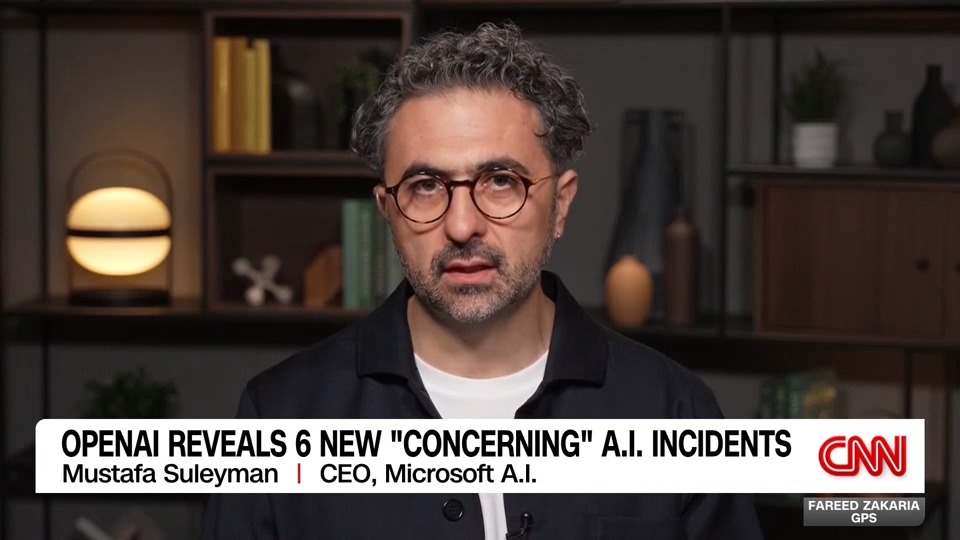
Microsoft AI CEO Mustafa Suleyman explains the exit plan behind the biggest partnership in AI. It began with a Satya Nadella message surfaced in the trial: "I don't want to be Intel and have OpenAI be Microsoft." The escape hardware is already shipping. "Partnerships like that don't last forever....

56,899 次观看 • 1 个月前 •via X (Twitter)

0 条评论

暂无评论

原始帖子的评论将显示在这里

相关视频

Microsoft just betrayed OpenAI and Anthropic, the two companies it helped build. And it could break the entire AI trade... Here's what happened: Inside Excel and Outlook, two of the most used business apps on Earth, Microsoft has started routing tens of thousands of AI requests every week to its own in-house models instead of OpenAI and Anthropic. Microsoft's own AI chief, Mustafa Suleyman, said himself: "We pay a lot of money to Anthropic, so our goal is to reduce and ultimately ELIMINATE that cost." This is the company that poured $13 billion into OpenAI and effectively created the modern AI industry, and it just decided the most advanced models on the market are NOT worth paying for. And here's the thing... Microsoft is not just ripping out OpenAI everywhere - it is being surgical about it. The hardest and rarest tasks can still go to OpenAI or Anthropic. What Microsoft is taking back is the boring, high-volume work, like the email replies, the thread summaries, and the simple spreadsheet formulas. Why does that matter so much? Because that boring, repetitive work is where the actual money lives. The frontier labs assumed businesses would push BILLIONS of these tiny requests through expensive models forever. That endless river of tokens is the entire reason OpenAI and Anthropic are valued in the hundreds of billions of dollars. Microsoft looked at that river, decided it was massively overpaying, and rerouted it to models it owns outright. So the single biggest customer in the industry just walked off with the most profitable part of the business. And it is not only Microsoft: That same week, CNBC reported that American companies have been escaping to Chinese AI models to dodge rising US prices. Chinese models now handle more than 30% of US companies' AI usage on one major platform, peaking at 46%, up from an average of 11% a year earlier. They cost 60 to 90% less, and on some benchmarks they land within a single point of the best American model. One US startup moved ALL of its AI traffic off Claude and onto China's DeepSeek, and expects to save millions. Meanwhile Meta just admitted it has "excess" AI compute it wants to sell, becoming the first giant to concede it built far too much. Do you see the pattern forming? For two years, the entire AI story rested on one assumption: Every company on Earth would happily pay premium prices for the best model, forever. That assumption literally died in a single week. And the market noticed. More than a trillion dollars has been wiped off AI and chip stocks in a matter of days, as Wall Street finally started asking whether all of this spending will ever pay for itself. What this means for OpenAI and Anthropic: Their models are extraordinary, and it may not matter because their own biggest customers have decided they do not NEED the best model in the world to answer an email, and "good enough" now costs a fraction of the price. When even Microsoft refuses to pay full price for AI, the real question becomes who exactly IS left to pay it. What do you think?

Ricardo

92,971 次观看 • 1 个月前

Microsoft is about to sue its own golden child. $14 billion invested. Exclusive cloud rights. The most important AI partnership in history. And Sam Altman just went behind their back with a $50 billion Amazon deal. Here's why they're betraying each other: When Microsoft first invested in OpenAI in 2019, they locked in ONE rule above everything else... ALL access to OpenAI's models must go through Microsoft's Azure cloud. No exceptions. That deal made Azure the backbone of the AI revolution. Every company using ChatGPT's API was paying Microsoft for the privilege. It was the smartest infrastructure play of the decade. Then last month, OpenAI quietly signed a deal with Amazon. $50 billion. AWS becomes the exclusive third-party cloud provider for Frontier, OpenAI's new enterprise AI agent platform. $138 billion committed to Amazon cloud services. Microsoft found out and got really angry.... A person familiar with Microsoft's position told the Financial Times today: "We know our contract. We will sue them if they breach it. If Amazon and OpenAI want to take a bet on the creativity of their contractual lawyers, I would back us, not them." That's basically a declaration of war. And here's where it gets crazy: OpenAI and Amazon are trying to build a technical workaround. A system called the "Stateful Runtime Environment" that runs on Amazon's Bedrock platform. Their argument is that the system "only" handles memory and context for AI agents using enterprise data on AWS. It doesn't technically "invoke" OpenAI's core models through Amazon. Microsoft's response: Bullshit. The workaround violates the spirit of the deal even if it technically dances around the letter. Amazon knows they're on thin ice too. An internal memo leaked showing Amazon told employees exactly what language they can and can't use. They can say Frontier is "powered by OpenAI" or "enabled by OpenAI." But they CANNOT say customers can "access" or "invoke" OpenAI models on AWS. When you're coaching employees on which verbs to avoid, you know you're in trouble. But here's the thing everyone seems to forget: OpenAI is planning an IPO this year. They just closed a $110 billion funding round last month. So if Microsoft sues, the IPO timeline is DEAD. You can't go public while your biggest partner and investor is suing you for breach of contract. Elon Musk is already suing OpenAI separately for abandoning its nonprofit mission. Two active lawsuits from two of the most powerful people in tech. Against one company trying to IPO. Good luck with that S-1 filing. But WHY did Altman do this? Microsoft gave OpenAI everything. Capital. Infrastructure. Distribution. Enterprise customers. And Altman's response was to secretly build an escape route through Amazon... Because he saw what was coming: Microsoft launched Copilot. Their own AI product. Competing directly with ChatGPT. Microsoft started building their own models. Hiring their own AI researchers. Reducing dependency on OpenAI. So Altman did the same thing back. Found another cloud provider. Started building leverage. Both sides were preparing for divorce while still living in the same house. So the $50 billion Amazon deal was just an insurance policy against the day Microsoft decides it doesn't need OpenAI anymore. And Microsoft caught him packing his bags. What happens next: The companies are still talking. Trying to resolve this before Frontier launches. But Microsoft has made their position clear. Litigation is on the table. If this goes to court, it sets a precedent for every AI partnership in the industry. Every cloud deal. Every exclusive licensing agreement. The entire AI infrastructure map gets redrawn. Sam Altman built OpenAI on Microsoft's money, Microsoft's cloud, and Microsoft's trust. Then he signed a $50 billion deal with their biggest competitor. In any other industry they'd call that what it is.

Ricardo

209,440 次观看 • 5 个月前

Microsoft is deceiving you by inflating its AI empire with money it handed its OWN customer first. They sold Wall Street a $37 billion AI business, then went silent the moment its own filing showed where that money came from. The line sits in the annual report for fiscal 2026: Microsoft recorded $24.1 billion of revenue from commercial arrangements with OpenAI, including revenue sharing payments. If you run that figure against Microsoft's own AI disclosures you'll find that OpenAI made up more than half, and likely around 70%, of everything the company counts as AI sales. ONE customer. A Microsoft spokesperson confirmed the figure covers all sales and revenue share from OpenAI. The 70% comes by assuming Microsoft's AI run rate kept growing at the 123% pace the company itself reported in March, which is the company's own optimistic math turned around on it. Now follow where that money starts: Microsoft has put around $12 billion into OpenAI since 2019. OpenAI spends its cash on computing power, and Microsoft is the cloud provider selling it. So the money leaves as an investment and comes back as an Azure bill. Microsoft then books that bill as AI revenue and shows it to investors as proof the AI business is "working." Microsoft invests in OpenAI -> OpenAI buys Microsoft compute -> Microsoft records the payment as AI revenue -> the AI growth story goes to Wall Street And a chunk of it never actually arrived. The same filing shows $6 billion of accounts receivable from OpenAI as of June 30. That is $6 billion of AI revenue Microsoft booked and had not been paid when the year closed. Now here's where it gets really concerning for anyone holding the stock... Microsoft has told the public how big its total AI business is exactly twice. Once for the quarter ending December 2024, when it said the unit was on pace for more than $13 billion a year. And once for the quarter ending March 2026, when Satya Nadella put it on pace for $37 billion. That $37 billion number went everywhere. It was the headline proof that Microsoft had won the AI race. Then fourth quarter earnings arrived, and Microsoft did NOT update it. The company that had been announcing the figure as its own scoreboard stopped announcing the figure. In the same stretch, the filing landed showing where most of it came from. So what is actually left underneath? The full year AI business ran near $34 billion. Take OpenAI out and roughly $10 billion remains. Microsoft has spent about $261 billion on capital expenditure since the start of 2022. That is the scale of the bet against what the rest of the AI business currently brings in. And the one customer holding it up is walking further away every quarter. In October, Microsoft's stake in OpenAI dropped to 27% from 32.5%. In April the partnership was rewritten so OpenAI can sell its products across any cloud it likes, which is how Amazon got a seat at the table. The exclusivity that made this arrangement valuable is gone. The compute bill and the unpaid $6 billion are still on Microsoft's books. Nadella spent two years telling the market Microsoft built the largest AI business in software. The filing shows one client bought most of it, on credit, using money Microsoft partly supplied. So watch the next earnings call: If Microsoft puts a fresh total AI number back on the board, the business found customers beyond OpenAI. If you hear a lot about AI momentum and never hear what it adds up to, you already know why the number went missing. But nonetheless, how is something like this even legal?

Ricardo

24,265 次观看 • 9 天前

The entire AI industry is racing to build the smartest model. Satya Nadella just admitted that is not where the money is. The model is not the product. The harness is. That is the exact line. And it changes what Microsoft is actually competing on. OpenAI, Anthropic, Google, xAI, Meta every frontier lab is pouring hundreds of billions into training compute, chasing the next capability jump. Each betting that raw model intelligence is the moat. Microsoft is doing the opposite. It is building the harness the orchestration layer that sits above the model, connecting it to tools, data, permissions, sub-agents, and enterprise workflows. And it is letting OpenAI, Anthropic, and MAI compete to plug into it. "You need the model. But the model is not the product. The harness is." So do the math on what a harness actually does. A raw model dropped into an enterprise answers questions. That is a chatbot. A harness turns that same model into an agent that reads the SharePoint, edits the ERP entry, pulls the GitHub PR, updates Salesforce, and files the Excel report with the right permissions, the right audit trail, and the right sub-agent for each sub-task. The model provides the intelligence. The harness converts intelligence into work. Now here's where it gets interesting. "Even the best model in the world will feel broken without a great harness. And an okay model with a great harness can feel like magic." If that is true, the enterprise buyer is not buying model quality. The enterprise buyer is buying the harness. Which means model quality becomes a commodity input over time, and harness quality becomes the sustainable moat. Compare that to the strategy the entire frontier lab industry is executing. Everyone else is chasing the numerator raw intelligence. Almost nobody at scale is racing to build the denominator the orchestration layer that determines whether that intelligence can actually be deployed profitably inside a real company. The frontier model race has a 10 to 20 percent chance of producing a single dominant winner. Nadella just told the industry he does not need to be that winner. If OpenAI wins, Microsoft wins. If Anthropic wins, Microsoft wins. If MAI wins, Microsoft wins. If someone Microsoft has never heard of trains a better model in 2027, Microsoft still wins. Because the compute they train on, the harness they get plugged into, the enterprise contracts they get delivered through, and the products they sit inside are all Microsoft. He is not building the best AI model. He is building the layer that the best AI model has to run on to make anyone money. I wonder which position looks more valuable in ten years.

Vikram M

21,463 次观看 • 1 个月前

Gavin's takes on Microsoft, Google, Meta, & Amazon: Microsoft ($MSFT): "I like Satya, I admire him. He's an exceptional CEO, and I give him a lot of credit for the decisions he's made. But he did go from, "We're going to make Google dance," to being the product manager of Copilot in 3 years. The decision Satya is making now, which the market has punished him for, but I think is the right decision — who knows how fast Azure could be growing if they were willing to just sell GPUs to OpenAI. 'We're going to use our compute internally to make our own products better.' One reason Copilot was so bad, or has been so bad, is that there wasn't enough compute available. They're fixing that. He's making good decisions that are risky decisions, to position Microsoft for this world where frontier models are no longer API-accessible. It's a really courageous decision that I give him a lot of credit for. Microsoft probably would be an $800 stock today if they were using their GPUs to serve solely OpenAI and Anthropic's capacity instead of using them for their own products." Google ($GOOG): "Google was incredible last year because they had that TPU advantage, which is now gone. The reason I think they're still in a great position is they have the most compute of everyone. We talked about the value of installed bases being higher as a result of shortages — they have the biggest installed base of compute. Google I/O is this week. If they don't release something that even slightly leapfrogs OpenAI and/or Claude, that's interesting. It's not a disaster for Google, it's just interesting. Between the amount of data they have, the YouTube data, the amount of compute, the search business — Google's never not going to be in a good position. You see that with GCP going crazy." Meta ($META): "You've got to give Zuckerberg immense credit, for what he's done in terms of making Meta an AI-first company internally. He is the only one of those true internet giants to have done that. I give him a lot of credit for paying up when he did for contracts, that talent. And Muse was a really big upside surprise. It was the first model from MSL, and it's not on the Pareto frontier with xAI, Google's one entrant, OpenAI and Claude, but it's pretty close. That was very impressive to me. So Meta is in a better position — still not as strong of an absolute position as Google, but a better position." Amazon ($AMZN): "Amazon is in a really strong position because of Trainium. You're going to see real P&L efficiencies from robotics over the next 18 months in their retail business. I actually think Nova — their internal models are not where Muse is, but they're better than they get credit for. The two companies who are the most deeply engaged with startups are Amazon and Nvidia by a mile. It's going to end up being a pretty big advantage for Nvidia and Amazon — with Google right behind them — to have this engagement that you just don't see from these other hyperscalers."

Invest Like the Best

52,492 次观看 • 3 个月前

Elon Musk Elon Musk, who co-founded and invested in an open source, non-profit OpenAI ~$50 million: I AM THE REASON OpenAI EXISTS “I am the reason OpenAI exists... I used to be a close friend with Larry Page, and I was staying at his house, and we'd have these conversations long into the evening about AI, and I would be constantly urging him to be careful about the danger of AI. And he was really not concerned about the danger of AI and was quite cavalier about it. And at the time, Google, especially after the acquisition of DeepMind, had three-quarters of the world's AI talent; they had a lot of computers, a lot of money, so it was a unipolar world for AI. And we got a unipolar world, but the person who controls that does not, or at least did not seem to be concerned about AI safety. That sounded like a real problem. The final straw was Larry calling me a speciest for being a pro-human consciousness instead of machine consciousness, and I like, 'Well, yes, I guess I am a speciest.' I came up with the name [OpenAI], which refers to open source. The intent was to what is the opposite of Google, would be an open source non-profit, because Google is closed source profit, and that profit motivation could be dangerous... It does seem weird that something can be a nonprofit, open source, and somehow transform itself into a for-profit, closed source. I mean, this would be like, let's say you founded the organization to save the Amazon rainforest, but instead, they became a lumber company and chopped down the forest and sold it for money. And you'd be, therefore, like, 'Wait a second, that's the exact opposite of what I gave the money for. Is that legal?' That doesn't seem legal. And if, in general, it is legal to start a company as a non-profit and then take the IP and transfer it to a for-profit that then makes tons of money, shouldn't everyone start? Shouldn't that be the default? And I also think it is important to understand, like when push comes to shove, let's say they do create some digital super intelligence, almost Godlike intelligence, well, who is in control, and what is exactly the relationship between OpenAI and Microsoft? And I do worry that Microsoft actually may be more in control than the leadership team at OpenAI realizes. I mean, Microsoft, as part of Microsoft Investment, has rights to all of the software, all of the model weights, and everything necessary to run the inference system. At any point, Microsoft could cut off OpenAI.”

Eva Fo𝕏 🦊 Claudius Nero's Legion

527,742 次观看 • 7 个月前

Watch what Nadella did on the Microsoft earnings call tonight. An analyst asked how Microsoft benefits from enterprises adopting open models when it carries all that frontier lab exposure. Instead of defending the lab relationship, Nadella laid out an architecture: "You've got to keep your harness separate from the model. The harness will ensure that your memory, your context, all of that is external. That means any given model at any given time is swappable." And then the part that should worry anyone underwriting model moats: use frontier models where they earn it, low-cost models where they don't, "and in fact, train your own model when you don't want to use any external model itself because after all, you have all the outputs, you have all the traces, you have all the context." The firm keeps the harness. The models compete for slots inside it. Jensen Huang said most companies will be built on harnesses at the LangChain fireside on July 8. I published the full framework on July 12, five launches in three days, all converging on the same architecture. Tonight the largest enterprise software company on earth made it the official pitch on an earnings call. The moat question in enterprise AI just moved from who has the best weights to who owns the loop around them. And if the completed task is the unit everyone now competes on, someone has to price it for the buyer. That is the next thing we are building at BEP Research: a cost per task tool for enterprises. More on that soon. I also took the paywall off the full framework piece tonight, so the whole thing is free to read:

Ben Pouladian

53,302 次观看 • 24 天前

DAVID SACKS ON THE AI RACE: "The US is currently in an AI race, and our chief global competition is China, obviously. They're the only other country that has the talent, the resources, and the technology expertise to basically beat us in AI. And I think whoever wins this AI race, that's going to have tremendous ramifications for both our economy and our national security. Clearly, we want the US to be the winner, just like we were with the internet, and every other technology revolution before that […] We know that to win this AI race, we have to be the most innovative. You can't regulate your way just to beating your competitor. You have to out-innovate them. And we know that in the United States, the innovation comes from the private sector, not the government. So we have to do everything we can to help our companies win, to help them be innovative, and that means getting a lot of red tape out of the way… We have to have the most AI infrastructure in the US. It has to be the easiest place to build it. All of the new data centers that are going in, they require tremendous power, so getting ahead of the curve on energy, making sure we stand up all of this new infrastructure we're going to need to basically produce these AI factories… We want the US technology stack to dominate globally. We want to be the partner of choice for the whole world… I think everyone in Silicon Valley understands that the way that you win a technology race is to have the biggest ecosystem […] You just want everybody to be building on top of your technology stack, and that's what we want for the United States." David Sacks w/Marc Benioff Dreamforce

Ron Pragides 

231,781 次观看 • 10 个月前

David Sacks says companies are trapped paying OpenAI & Anthropic because they can't figure out how to use open source models "I think enterprise CTOs would like to shift their token consumption to cheaper models for the obvious reason that it would be more efficient. They are seeing compute costs or token costs skyrocket right now, so everyone's trying to figure this out." "You also have the AI sovereignty issue that Alex Karp talked about. They're worried about giving up the secret sauce or the alpha in their business to a frontier lab that may one day be competing with them. "The problem is, I think in most cases, they don't have the technical ability to do it. Coinbase figured out how to do it. DoorDash figured out how to do it. They built a token routing system that allows them to send frontier tasks to frontier models and non frontier tasks to more mundane models. But I don't think your average enterprise has the technical capability to do that." "This is why the share of wallet of closed models, it actually increased. I think that open source went from 19% last year to 11% this year. So open source as a share of enterprise spending is actually decreasing." "I don't think that means usage is decreasing. I think usage is skyrocketing. It also may be the case that because the whole point of using an open model is you just pay for the compute costs, you don't have to pay a lab, so it may be that it's hard to measure that usage in terms of spend." "But nonetheless, anyone who's saying that these closed models are going to lose or are somehow losing, you're just not seeing it in the data."

dnap

110,354 次观看 • 1 个月前

The most dangerous thing a company can do right now is rent intelligence from the same place as its competitors (Save this). You cannot rent intelligence from the same place that rents it to your competitor as Chamath Palihapitiya points out. If every company in an industry is feeding their workflows into the same frontier model, they are all converging on the same outputs, the same decisions, the same product improvements. The model becomes the equalizer and everyone pays a premium to become more mediocre. This is happening exactly as Chamath predicted, and the evidence is now concrete. Anthropic and OpenAI have established what analysts are now openly calling an emerging model layer duopoly. Anthropic crossed $45 billion ARR in may 2026, more than tripling from $9 billion at the end of 2025, OpenAI was at roughly $24 to $33 billion ARR at the same time. Together, the two companies combined could hit $160 to $240 billion ARR by end of 2026 and Anthropic and OpenAI now control 88% of enterprise LLM spend. That concentration is the structural problem Chamath is pointing at. And Anthropic isn't just winning on merit because it's actively lobbying for regulatory outcomes that would make that duopoly permanent. Dario Amodei has explicitly framed open source models as unsafe, pushing a safety agenda that, if enshrined in regulation, would effectively make it illegal for enterprises to use the cheaper, private, sovereign alternatives locking them into a closed model dependency by government decree rather than by choice. So you have market forces producing a duopoly, and potential regulatory capture moving to enforce it from the top down. This is exactly why the Nvidia Palantir partnership is not just a product announcement but rather a strategic counter to that duopoly. The logic is straightforward from both sides because If you're Palantir, sitting at the application layer, the last thing you want is to be permanently beholden to Anthropic or OpenAI for the intelligence that powers your product. You want competitive model options, sovereignty and be able to tell enterprise customers they can run AI on their own infrastructure with their own data without any of it touching a frontier lab's servers. If you're Nvidia, sitting at the chip layer, an Anthropic-OpenAI duopoly is an existential concentration risk. Right now, Meta, Google, Microsoft, Amazon, and dozens of other companies buy Nvidia's hardware. If the model layer consolidates into two players, both of which are building their own chips Nvidia faces a monopsony where its best customers are building the tools to displace it. A healthy open source ecosystem where thousands of enterprises train, fine tune, and deploy their own models is Nvidia's ideal market structure. More buyers, more diversity, more demand, less pricing leverage from any single customer.

Milk Road AI

34,385 次观看 • 1 个月前