Video yükleniyor...
Video Yüklenemedi
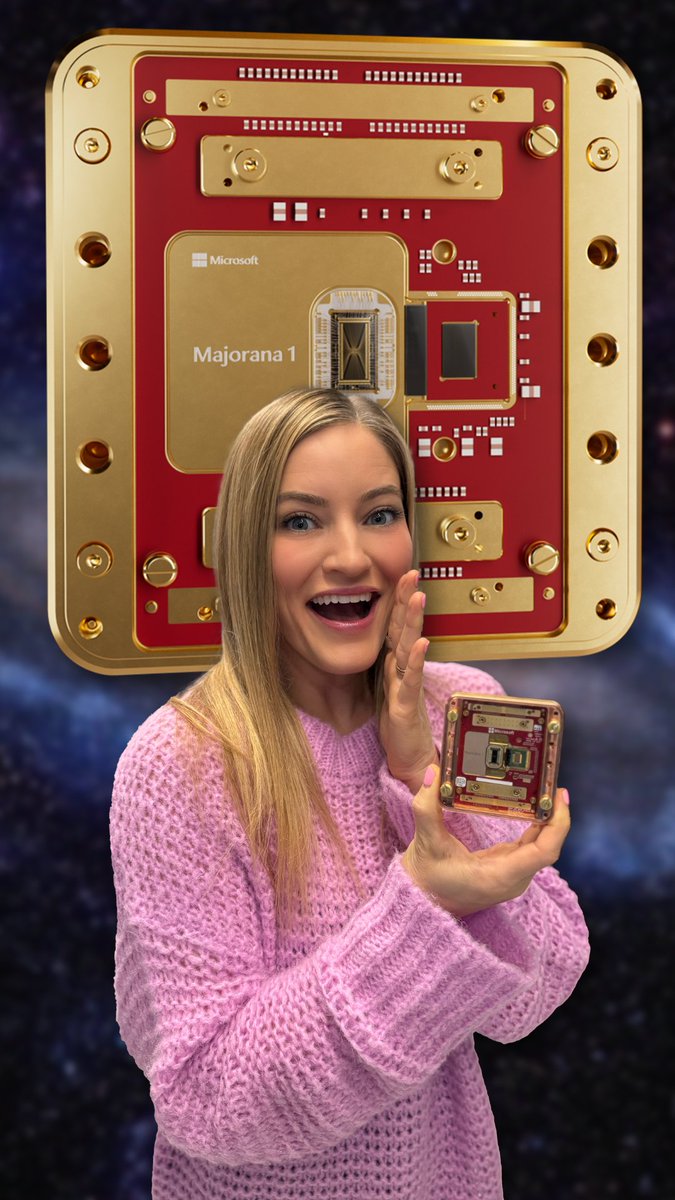
Microsoft finally achieving Majorana qubits. A huge milestone they have been pursuing for quite some time. Now comes the scaling for truly fault tolerant quantum computing. It will take a while, but this is a foundational technology for humanity.

95,103 görüntüleme • 1 yıl önce •via X (Twitter)
11 Yorum

[00:00:00] What would the world look like with a computer that could accurately model the laws of nature? That's the promise of quantum computing, but there have always been limitations. Now, as one of our longest running research projects, our team at Microsoft has been able to take a subatomic particle that has only been theorized until now, and not only observe it, but control it, creating an entirely new material and a new object. [00:00:33] Architecture for quantum computing, one that can scale to millions of cubits on a single chip. This is not a work of science. It's a book of science and art. I gotta be honest. Some of these ideas are a little science fiction sounding. It will solve problems unsolvable by the combined power of all the world's compute today and promises to [00:01:00] revolutionize fields such as medicine, material science. [00:01:04] and our understanding of the natural world. Our first quantum processor based on this architecture. Yeah, [00:01:26] I've always been fascinated with puzzles and challenges and a mixture of mathematics and computers. And so when I learned that there's this type of computer that didn't exist yet, but could solve problems that we couldn't solve with our digital, you know, all of the computers we had, I was just fascinated. [00:01:42] I wanted to learn, well, how can I help that computer be built? Over the years. I ran into problems that I could not solve on the most powerful computers. But then over time, I realized, hey, I could solve that if I had a quantum computer. A laptop can solve a problem of 10 electrons. A [00:02:00] supercomputer can solve a problem of 20 electrons. [00:02:03] But no quantum Any classical computer in the world can exactly solve the behavior of 30 electrons. The number 30, 40, 50 electrons, those numbers are seemingly small, but require up to lifetime in the universe timescales to solve with all of the world's computers operating together. That's until you have a scaled quantum computer that can solve these problems efficiently. [00:02:30] These calculations are so complicated that then if the classical computer was as big as this entire planet it would still not be able to compute it, just to give you a construct of scale. And a quantum computer can do it, and can do it very, very well. At the core of a quantum computer are these qubits. [00:02:49] Qubits are like our classical bits, right? These are essentially zeros and ones, um, in a transistor. Um And we need the analog of that in quantum computing. The analog [00:03:00] is a qubit, a quantum bit that serves as that core information unit. It's where we store the information and then we process on those qubits, uh, to create computation and ultimately, you know, get solutions back out. [00:03:13] Now there's many different ways, right? To create a qubit. The reason quantum computing has been so slow to progress. The industry has been struggling with problems making qubits reliable and resistant to noise. Progress has been incremental. The challenge is, qubits are actually pretty delicate in general. [00:03:34] So you need underlying qubits that are, that are really stable. But, you don't want that to come at a cost. Because, uh, you don't want your underlying qubits to be really big. That's one way to make them more stable is having them really big. If they're really big, and you're still going to need many of them, then, you know, how are you going to fit them all into, into your system? [00:03:50] You don't want to deal with something the size of a, of a, of a warehouse. Then the second thing is you don't want to keep us end up being slow, right? Because [00:04:00] if the, if the price you pay for getting something stable is you have to go really slowly, then a computation that might take you a month ends up taking you a decade. [00:04:09] And that's not you. Then it's not useful. People in the early days of computation used vacuum tubes, and then that technology actually you could build very good computers with it. And then the transistor was invented. And, you know, the earliest transistors weren't necessarily that great, but it became clearer over time as the transistor developed in the integrated circuit developed that this was going to be the technology of the future in that spirit that You know, the first generation of qubits may not be what gets us to the next stage where we can really solve the kind of problems I was mentioning that are really important. [00:04:40] And so we might need to invent a material and therefore a quantum processing unit that has the right properties. So for us, we want something that has some built in level of error protection. And a lot of those ideas actually were explored in the context of software, of quantum error correcting codes, but you can actually build a lot of those ideas [00:05:00] into hardware. [00:05:02] The way you design that qubit matters. [00:05:10] We see the states of matter every day. Solids keep their shape, liquids vary but keep their volume, gases expand to fill the space they're in, all defined ultimately by how their atoms behave. But what if there were more? What if, under the right conditions, you could engineer more? States that have only ever been theorized, that would change how subatomic particles actually behave? [00:05:39] A hundred years ago, mathematicians predicted one such new state of matter, the topological state. And since then, researchers have been looking for a very specific, very useful quasi particle within it, the Majorana particle. Last year, we were able to [00:06:00] observe it for the first time. And this year, we're able to control it and use its unique properties to build a topoconductor, a new type of semiconductor that operates also as a superconductor. [00:06:17] With this material, we can build a whole new foundational architecture for our quantum computers. A topological core, allowing us to scale to not tens or hundreds of qubits on a chip, but millions, all in the palm of your hand. Majorana's theory showed that mathematically it's possible to have a particle that is its own antiparticle. [00:06:41] That means you can take two of these particles and you bring them together and they could annihilate and there's nothing left. Or you could take two particles and you bring them together and you just have two particles. Sometimes it's nothing, the zero state, and sometimes it's [00:07:00] So it really has taken quite some thinking, right? [00:07:05] Some time to design a device, design a chip that can enable measurement of this literally elusive. We've designed a chip that is able to measure the pressure presence of Majorana. [00:07:24] Majorana allows us to create a topological qubit. A topological qubit is reliable, small, and controllable. This solves the noise problem that creates errors in qubits. Now that we have these topological qubits, we're able to build an entirely new quantum architecture, the topological core, which can scale to a million topological qubits on a tiny chip. [00:07:55] Every single atom in this chip. This chip is placed purposefully. It is [00:08:00] constructed from ground up. It is entirely a new state of matter. Think of us as building the picture by painting it atom by atom. In a regular chip, the computation is done using electrons. We don't use electrons for compute. We use myranas for computing. [00:08:17] It's an entirely new particle. It's half electron. When we look at the design of this chip, right, first of all, you can fit so much. Thanks. on just a small form factor, right? This chip can store over a million qubits, right? Over a million can fit on just this small form factor. In addition, we don't want to wait centuries or millennia for a solution. [00:08:43] And so this chip also offers the right speed to get solutions from the chip in a reasonable, efficient, you know, amount of time. That's the beauty in this qubit design, the topological qubit. It has the right size, [00:09:00] the right speed, and the right type of controllability and all of that together means that it has an ability to scale like no other. [00:09:12] The way the system that we are constructing works is you have the quantum accelerator, you have a classical machine that works with it and, and, uh, controls it, and then you have. The application that essentially goes between classical and quantum, depending on which problem it's trying to solve. Once the computations are done, the results are re synthesized on the classical side and produced back to the user as one complete answer. [00:09:39] Where the quantum machine shines, it is able to do simulations, particularly in chemistry and materials that are extremely accurate, as accurate as an actual wet lab experiment. Imagine a world where a scientist computes the material that they want and they compute it to the [00:10:00] accuracy that it's first time right. [00:10:02] So when you walk into a lab, you don't need to experiment anymore. Imagine a battery that you charge it once and you never have to worry about discharging. What can you do? In the last few years, there's an explosion of artificial intelligence, right? Co pilots. And what's so inspiring about a quantum computer is that with a quantum computer, Augmenting. [00:10:32] The AI capability, it can help more, you know, drive even more discovery. What makes me excited about quantum computing is that it will give us the tool to tackle many of these challenges at the fundamental level by creating new chemicals, new drugs, new enzymes for food production. Honestly, it's, it's kind of mind blowing right now because this is something we've thought about for a while, [00:11:00] years or more. [00:11:03] We call the ages of mankind by materials. We've talked about the Stone Age. We've talked about the Bronze Age and the Iron Age. The Steel Age, the Silicon Age. Materials define our culture, define our mankind, define our progress. Thus, what could be more powerful than having a machine that can let you radically change the way we work with materials? [00:11:27] Our leadership has been, has been working on this program for the last 17 years. It is the longest running research program in the company. And after 17 years, uh, when we are showcasing our results, we are showcasing results that are not just incredible. They're real. [00:11:50] They are real because they will fundamentally redefine how the next of the quantum journey takes place. We're at the cusp of a [00:12:00] quantum age, and Majorana I is just the beginning.

Quantum computers can break today’s encryption in seconds.🔑 Quantum tech will reshape our digital lives. Governments & hackers are preparing for the quantum era. How about you?🛡️ Don’t get left behind!🧠 Cybersecurity Dictionary for Everyone can help:

In the actual paper, they do not claim to have achieved Majorana qubits. "These measurements do not, by themselves, determine whether the low-energy states detected by interferometry are topological." While in the press release they lie and claim the paper shows this.
Interesting, I haven't had time to read the paper yet. Will do. Thx for flagging

I don't think people realize what this means. It is the end of death. The end of information destruction. If a thing can be known, it can always be known. If a thing can be, it can always be. If a true universal simulation is successful, there's nothing stopping us from visiting Pompeii and reading its books, or reviving the consciousnesses of the dead. Quantum processing is the quintessential stargate. We are only in the first stages of infinity.

My masters thesis focused on finding the elusive majorana particles. I actually thought they were still a very long way away. This is absurd.
Ikr!

Topological superconductors is the way. They also published a roadmap on arxiv:

Dope

Seems like a big deal

Amazing news! I just leave a name here: @QANplatform 👀