Video wird geladen...

Video konnte nicht geladen werden

Zur Startseite

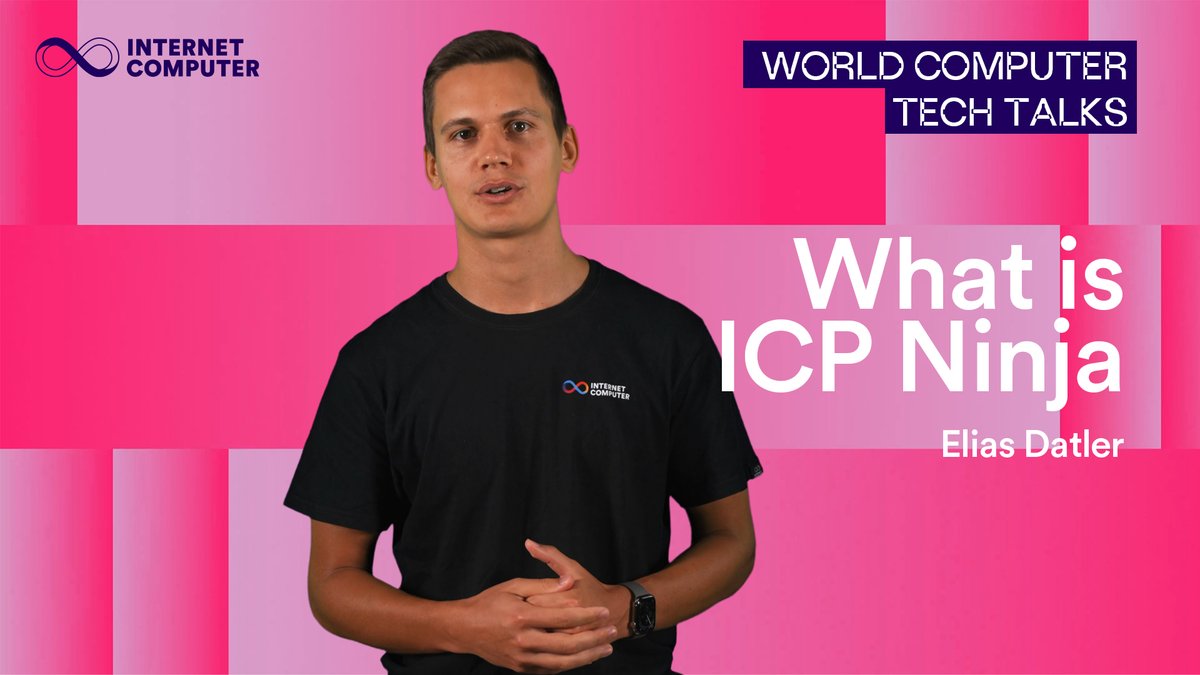
Most dApps still host their frontends on centralized servers. Raymond Khalife from DFINITY Foundation explains how the Internet Computer serves web frontends directly from smart contracts using: - HTTP gateways - Certified data - The Asset Canister Apps like OpenChat ∞ and ICP Ninja already run fully onchain.

39,020 Aufrufe • vor 9 Monaten •via X (Twitter)

0 Kommentare

Keine Kommentare verfügbar

Kommentare vom Original-Post werden hier angezeigt

Ähnliche Videos
Say hello to a massive acceleration of AI smart contracts 🧠 on the Internet Computer #ICP blockchain. Brilliant work by the DFINITY Foundation team has accelerated deterministic floating point instructions by 10X. We continue on our mission to run sophisticated LLMs as smart contracts 👊⚡️🔥 In the demo, image classification is now running 3X+ faster (across 3-4 blocks through consensus compared to 10-12 before). Naturally, the gas/cycles costs of AI inference has come down commensurately. The acceleration was achieved through broad low-level work, which includes commits to the public Wasmtime virtual machine implementation of WebAssembly. Coming optimizations will take us much further. The next optimization will include the integration of SIMD instructions into the smart contract execution environment, which will allow multiple floating point calculations to be performed in parallel through the execution of a single instruction. Something crucial: also in near sight, is the migration of the ICP smart contract environment from 32-bit Wasm to 64-bit Wasm, which will scale the number of AI model weights that can be loaded into contract memory from 2B to whatever is needed for sophisticated LLMs. Somewhat further away, is the provision of new APIs allowing canister smart contract code to export AI computations for accelerated processing on GPUs. This will require substantial work to address the challenges of achieving deterministic computation directly on the silicon, and for the community to agree a new public spec for node machines that pack GPUs, and to add compliant blockchain nodes to the network. Together, these improvements will unlock further orders of magnitude acceleration of AI smart contract inference (and potentially training). We believe that in the future vast numbers of AI models will run as smart contracts, which will prevent them being hacked (and thus the sensitive data they ingest being stolen), make them unstoppable, make them transparent, and where needed, allow them to run autonomously – for example for purposes such as KYC or EVM smart contract verification/certification. In the future, you will be able to have a conversation with a blockchain, and ask it to do reasoning for you. In this bright future, on-chain AI will be at the heart of Web3 – and to be clear, the Internet Computer's chain key technology will allow direct trustless integration with smart contracts on traditional chains such as Ethereum, Solana and NEAR. Join the #ICP mission to run the most impactful AI models on blockchain as smart contracts, and help make the Internet Computer the "everything computer." Join next week's Global R&D for details about the low-level deterministic floating point optimizations. Thanks for following 💪
2:03

Sensitive content

Say hello to a massive acceleration of AI smart contracts 🧠 on the Internet Computer #ICP blockchain. Brilliant work by the DFINITY Foundation team has accelerated deterministic floating point instructions by 10X. We continue on our mission to run sophisticated LLMs as smart contracts 👊⚡️🔥 In the demo, image classification is now running 3X+ faster (across 3-4 blocks through consensus compared to 10-12 before). Naturally, the gas/cycles costs of AI inference has come down commensurately. The acceleration was achieved through broad low-level work, which includes commits to the public Wasmtime virtual machine implementation of WebAssembly. Coming optimizations will take us much further. The next optimization will include the integration of SIMD instructions into the smart contract execution environment, which will allow multiple floating point calculations to be performed in parallel through the execution of a single instruction. Something crucial: also in near sight, is the migration of the ICP smart contract environment from 32-bit Wasm to 64-bit Wasm, which will scale the number of AI model weights that can be loaded into contract memory from 2B to whatever is needed for sophisticated LLMs. Somewhat further away, is the provision of new APIs allowing canister smart contract code to export AI computations for accelerated processing on GPUs. This will require substantial work to address the challenges of achieving deterministic computation directly on the silicon, and for the community to agree a new public spec for node machines that pack GPUs, and to add compliant blockchain nodes to the network. Together, these improvements will unlock further orders of magnitude acceleration of AI smart contract inference (and potentially training). We believe that in the future vast numbers of AI models will run as smart contracts, which will prevent them being hacked (and thus the sensitive data they ingest being stolen), make them unstoppable, make them transparent, and where needed, allow them to run autonomously – for example for purposes such as KYC or EVM smart contract verification/certification. In the future, you will be able to have a conversation with a blockchain, and ask it to do reasoning for you. In this bright future, on-chain AI will be at the heart of Web3 – and to be clear, the Internet Computer's chain key technology will allow direct trustless integration with smart contracts on traditional chains such as Ethereum, Solana and NEAR. Join the #ICP mission to run the most impactful AI models on blockchain as smart contracts, and help make the Internet Computer the "everything computer." Join next week's Global R&D for details about the low-level deterministic floating point optimizations. Thanks for following 💪

dom | icp

278,369 Aufrufe • vor 2 Jahren

Internet Computer's Cycle Burn Rate is Skyrocketing: What it means... Today, the Internet Computer (DFINITY Foundation) dashboard showed a sharp rise in Cycle Burn Rate to about 0.30 TCYCLES per second, a 6–10× increase from its previous rate of 0.03–0.05 TCYCLES/s. This was mainly due to a temporary load test conducted by Toko App, an NFT app on ICP, testing the fleet management capabilities. The test is expected to run for most of the day. However, what it means for the protocol is very important: 1.) Real network usage is increasing: Cycles are burnt only when the canisters perform tasks such as executing programs, storing data, or processing messages. Higher burn rates indicate increased computation being performed by the Internet Computer at present. 2.) $ICP tokens are being destroyed: The creation of those cycles requires burning of ICP tokens through the Cycles Minting Canister process. The ICP tokens are burned forever, hence reducing the number of tokens available in circulation. 3.) Deflationary pressure is increasing: Higher burn rates act as an offset against the constant minting of new ICP tokens for the purpose of rewarding node providers and governance of the network. 4.) It contributes to the Mission 70 objectives: One of the main objectives of ICP's Mission 70 is the significant reduction in inflation until the end of 2026. In other words, the soaring Cycle Burn Rate demonstrates that the Internet Computer is being used productively. Future development will determine whether these rates persist, but the indicator itself is one of the clearest signs of true demand.

BSCN

19,742 Aufrufe • vor 12 Tagen