Video yükleniyor...

Video Yüklenemedi

Ana Sayfaya Dön

Most people are still asking: Opus or Sonnet? That may already be the wrong question. Claude is starting to look less like an AI model and more like an AI operating layer. The models are only one part of it. Around them, Anthropic is building the pieces required to...

17,741 görüntüleme • 3 gün önce •via X (Twitter)

0 Yorum

Yorum bulunmuyor

Orijinal gönderinin yorumları burada görünecek

Benzer Videolar

I'm proud to share that Glean has surpassed $300M ARR, just five months after crossing $200M and growing ~3x over the past 15 months. This is an exciting milestone for Glean, and it's a signal about where the enterprise AI market is heading. We’ve long believed the real challenge in enterprise AI is not access to models. It is grounding AI in how a company actually works: its people, knowledge, workflows, permissions, and systems. That’s even clearer now. The companies creating real value with AI are not just adopting better models. They are building systems that understand their business well enough to deliver reliable outcomes at scale. That is the real moat, and it is what we’ve been building at Glean: an unrivaled context layer for enterprise AI. That context has to work across the business, not just inside a single team or use case. We see that in how customers adopt Glean: more than 85% use it across five or more job functions. It also has to meet the security and governance demands of complex enterprises. We see that in who is choosing Glean: our Fortune 500 customer count nearly doubled year over year. And it has to make economic sense as usage grows. In our recent benchmark with Claude Cowork, Glean was preferred roughly 2.5x as often as off-the-shelf MCP tools and used 30% fewer tokens on average. Better context improves both quality and efficiency. I enjoyed talking with CNBC's Deirdre Bosa about this broader shift. In enterprise AI, the winners will not be defined by better models alone. They will be defined by who builds the strongest foundation for enterprise context. Thank you to our customers, partners, and team for helping us build the future of enterprise AI.

Arvind Jain

280,790 görüntüleme • 3 ay önce

In 2025, the AgentFlayer exploit highlighted a new category of risk in AI systems. It was not a traditional breach involving stolen credentials or broken encryption. Instead, it demonstrated how an autonomous AI agent could be manipulated into executing unintended actions by processing malicious instructions embedded inside content it automatically processes. The incident did not expose a flaw in one specific integration. It revealed a structural weakness in how many modern AI agents are built. Today’s agents are no longer passive language models. They read documents automatically, scan emails, connect to SaaS tools, access cloud storage, and execute actions across multiple systems. To be useful, they are granted meaningful permissions. That capability creates value, but it also expands the attack surface. Most agent environments operate in a trusted, plaintext execution model. Data is encrypted at rest and in transit, but it is typically decrypted during inference so the model can process it. That runtime visibility is where potential risk lies. In a zero-click scenario like AgentFlayer, an attacker can embed hidden instructions inside a document that the AI processes automatically. Because the agent may have access to connected systems such as Google Drive, Slack, or GitHub, it can potentially be influenced to retrieve sensitive information or perform unintended actions. The user does not need to click a malicious link or approve a suspicious request. Therefore, the core issue is that during execution, the system may have access to sensitive data and broad privileges, meaning whoever controls the execution environment ultimately controls access to that data. Now consider a different architectural approach. If a system is designed so that data remains protected during execution, the risk profile changes. On Nesa, privacy is enforced at the execution layer through Equivariant Encryption. Computation can occur on encrypted data, reducing the visibility surface during runtime. Sensitive inputs and models do not need to be exposed in plain text to infrastructure operators for inference to occur. This does not eliminate prompt injection, logic manipulation, or tool misuse. Encryption alone cannot prevent an agent from being instructed to take an unintended action if it has been granted that permission. What it does do is materially reduce confidentiality risk. By limiting access to readable sensitive data during execution and reducing unilateral visibility at the infrastructure layer, the potential blast radius of a successful manipulation attempt is constrained. As AI agents become more autonomous and embedded into enterprise workflows, security must move deeper into architecture. The goal is not to claim invulnerability. It is to reduce trust concentration and contain systemic exposure when failures occur. AgentFlayer was not simply a one-off exploit. It was a reminder that in autonomous systems, execution-layer design determines how risk propagates.

Nesa

17,038 görüntüleme • 6 ay önce

YOMIRGO #Product #Update YOMIRGO AI-HUB OFFICIALLY LAUNCH ---A Structural Upgrade from a Single-Product Model to an AI Agent Ecosystem Platform In its first phase, 11 AI projects have been integrated, spanning high-value sectors including finance, scientific research, enterprise services, development tools, and experiential AI. ➡️AI-Hub: This is not merely a feature expansion — it represents a critical structural upgrade from a single-product architecture to a multi-vertical AI Agent aggregation and capitalization platform. This milestone marks the initial structural formation of the YOMIRGO ecosystem. 1. Structural Distinction Between Agent Matrix Lab and AI-Hub To avoid positioning ambiguity, we formally clarify the structural division between the two: 🔘 Agent Matrix Lab — Internal AI Production & Incubation Platform Agent Matrix Lab serves as YOMIRGO’s proprietary AI development and internal incubation platform, responsible for: • R&D and testing of in-house AI products • Incubation of native AI Agents • Technical architecture experimentation and runtime validation • Testing of AI Agent models, memory systems, and runtime orchestration It functions as the production workshop and experimental engine of YOMIRGO’s “AI Super Factory.” 🔘 AI-Hub — External AI Agent Aggregation & Ecosystem Layer AI-Hub is a market-facing AI Agent aggregation and showcase platform, responsible for: • Curation and onboarding of high-quality AI projects • Cross-vertical structured ecosystem layout • Rating and classification systems • Traffic distribution and ecosystem collaboration entry points AI-Hub is not an internal incubation unit, but a standardized aggregation framework at the ecosystem level. 2. Integrated Project Structure (First Batch) ✅1. Finance & Prediction 🔹Cointoken AI — AI Agent-powered quantitative trading engine 🔹VVAI — AI-driven real-time Web3 intelligence and decision system 🔹AlphaQuant — Global financial market forecasting engine 🔹NextGoals — AI-powered global sports prediction agent This vertical forms the real-time information, trading, and predictive decision infrastructure for Web3-native users. ✅2. Science 🔹Charmen AI — Large-model-based pet acoustic recognition technology 🔹Encore Health — AI-driven health forecasting and longevity management system for high-net-worth individuals 🔹Reproducibility AI — AI expert system for financial engineering validation and academic reproducibility This sector focuses on research-grade AI capabilities, collaborating with universities and research institutions to drive real-world scientific deployment. ✅3. Business 🔹GlobalSales — B2B automated lead-generation AI Agent 🔹ResearchBot — Business intelligence and deep due diligence AI Agent This vertical targets the enterprise market, delivering scalable and commercially viable AI productivity tools. ✅4. Coding 🔹CodeMatrix — Full-stack development assistant Providing AI-driven development infrastructure and low-barrier building capabilities to global users. ✅5. Interesting 🔹Fortunetell AI — AI-powered symbolic analysis and interactive insight system Exploring the application boundaries of AI within experiential and interactive scenarios. 3. YOMIRGO Four-Layer Structural Framework YOMIRGO has now established a clearly defined four-layer structure: ▶️Layer 1: Agent Matrix Lab — Internal Production & Incubation ▶️Layer 2: AI-Hub — Ecosystem Aggregation & Rating ▶️Layer 3: LaunchPad — Capitalization Pathway ▶️Layer 4: Market — Circulation & Value Realization Together forming a complete industrial pipeline: Incubation → Validation → Aggregation → Rating → Capitalization → Market Circulation This is the structural model behind YOMIRGO’s defined “AI Super Factory.” 4. Strategic Significance The launch of AI-Hub signifies: • YOMIRGO has established standardized AI Agent aggregation capabilities • A cross-vertical ecosystem structure is now in place • Internal incubation and external aggregation mechanisms are structurally separated • The AI Agent industrial flywheel has begun operating YOMIRGO is no longer merely an AI product platform, but a structured AI Agent industrial system integrating production, aggregation, capitalization, and circulation. 5. Next Phase • Continue expanding high-utility AI Agents with real-world application value • Optimize AI-Hub’s scoring, rating, and filtering mechanisms • Strengthen synergy with LaunchPad and Market • Enable AI Agents to complete value realization within the ecosystem The first 11 projects are only the beginning. AI-Hub is designed to become a continuously expanding AI Agent gateway — not a static product showcase. Further structural expansion is underway.🔥

YOMIRGO

23,685 görüntüleme • 6 ay önce

Why is the market selling off today? (Save this). The semi selloff right now is being driven by a mix of macro fear, profit taking and investors questioning how quickly all of this AI spending will actually pay off, not because demand for AI infrastructure suddenly disappeared. The market is basically trading this chain reaction, the ongoing US Iran escalation pushes oil higher, higher oil keeps inflation elevated, sticky inflation keeps Treasury yields high and that increases the risk of the Fed staying hawkish or even hiking again. That is a terrible setup for semis because many of these companies are valued on the massive earnings investors expect them to generate years from now. When yields rise, those future earnings become worth less today which is why the highest multiple AI and semiconductor names usually get hit first. (I don't think there will be a hike this year). This is also why everything is moving together right now. Nvidia, Micron, Nebius, SanDisk, Broadcom and Applied Optoelectronics are all completely different businesses, but institutions are not separating memory, networking, optics, compute and cloud infrastructure at the moment. They are reducing exposure to the entire AI trade, taking profits in the names that have already run the most and moving into a more defensive position potentially ahead of the Fed. There is also growing pressure around hyperscaler capex. Microsoft, Meta, Amazon and Google are still spending enormous amounts on GPUs, data centers, networking and power but the market is starting to ask when all of that spending will actually turn into revenue and free cash flow. Investors are no longer satisfied with hearing that AI capex is growing. They want proof that the returns are arriving fast enough to justify the valuations already priced into the entire AI ecosystem. That creates a weird situation where hyperscaler capex can continue rising while semiconductor stocks still fall. The market is not asking whether AI spending is growing anymore but rather asking whether it is growing fast enough to beat the expectations already baked into these stocks. Crowded positioning is another major factor. Semis and AI infrastructure stocks have been some of the biggest winners in the market so institutions are sitting on huge profits and many funds own the exact same names. When macro risk increases, investors usually sell the most liquid winners first. That does not mean demand for memory, optics or custom chips suddenly collapsed but rather means investors are locking in gains and reducing risk. Tariffs add another layer because even when they are not directly placed on chips, they can still raise the cost of servers, electrical equipment, cooling systems, construction materials and the overall data center buildout. That makes AI infrastructure more expensive while also adding another source of inflation. Then you have Jensen Huang’s letter to the White House this morning about open weight AI models, which I think is one of the most important long term developments here. Nvidia, Meta, Microsoft, Palantir and several other companies are pushing Washington not to place broad restrictions on open weight AI. OpenAI and Anthropic were notably absent because open models are much more of a threat to their business models. OpenAI and Anthropic benefit from a world where a few closed frontier labs control the best models and companies have to pay them through subscriptions and APIs. Open weight models weaken that advantage because businesses can download a model, customize it for their own use and run it on their own infrastructure or through a neocloud. That is bad for OpenAI and Anthropic because it puts pressure on pricing, margins and the idea that they will control the intelligence layer of the economy but it is very good for the AI ecosystem as a whole over the long run. But the question is what does this mean for all the OpenAI and Anthropic commitments? so that's adding to the fear as well. But with that being said open models make AI cheaper and more accessible. Instead of AI being controlled by a few giant labs, thousands of startups, universities, governments and regular businesses can deploy models themselves. That spreads AI adoption across the entire economy and creates a much larger infrastructure opportunity and that is exactly why Jensen cares. Nvidia does not need OpenAI or Anthropic to win. Nvidia just needs more people using AI. Whether the model comes from OpenAI, Anthropic, Meta, Mistral, Kimi or some startup nobody has heard of yet, it still needs GPUs, memory, networking, data centers and electricity. So open weight AI could actually weaken the model companies while making the infrastructure layer much bigger. More open models mean more companies running inference. More inference means more GPUs. More GPUs mean more HBM, optical transceivers, switches, data centers and power. That is bullish for Nvidia Nebius, Micron, Broadcom , Marvell and Applied Optoelectronics over the long run. So my take is that the current semi selloff is being driven mostly by macro uncertainty, higher oil, rising yields, Fed fears, tariffs, crowded positioning and questions around the return on hyperscaler capex. The underlying AI infrastructure thesis has not suddenly broken. We are not broadly seeing hyperscalers cancel GPU orders, slash capex, abandon data center projects or report that AI demand has collapsed. What has changed is the valuation investors are willing to pay while the macro environment remains unstable. The market is lowering the price it is willing to pay for semiconductor growth but is not necessarily saying that growth is gone. And while Jensen’s open weight push may be bad for OpenAI and Anthropic, it could be one of the best things possible for the AI ecosystem over the long run because it creates more models, more developers, more competition and ultimately much more demand for the infrastructure underneath all of it. Nothing about the AI thesis has changed for me, so I will be going shopping and taking advantage of this sale while the market is selling everything together. I am an analyst at Milk Road Pro, and if you want to see exactly what I am buying, you can join for just $1 using the link below.

Melvin

180,198 görüntüleme • 1 ay önce

After a few more hours, I think I've figured out Opus 5. Opus 5 is trained to be more agentic than anything I've used. All Claude 5 models are like that. So what changes? The way to interact with Opus 5 or contextualize it won't work the same way as with other models. It loves exploring, so it doesn't need much guidance for it. Unique preferences, artifacts, and references compliment it well and enable cleaner and more effective exploration and execution. Now that it can explore more effectively on its own and understand intent better, the best thing to do is to get out of its way (e.g., it doesn't need examples of your preferences; a clear high-level description of it works best). It's truly agentic in that sense. A good first step to provide better context for Opus 5 is to distinguish between what's situational and what needs persistence. Regardless, persistent system prompts and CLAUDE.MD needs to stay lightweight. Remove memories and tool descriptions from these. CLAUDE.MD is also a great place to tap into progressive disclosure by linking command/skills to it. On the situational side, agent skills and auto-memory can leverage progressive disclosure and the improved ability of the model to use its external context/knowledge. Conflicting and unnecessary instructions, which are common at this layer (mainly to ensure reliability), are going to throw off this model easily. That's the biggest change I had to make. Simple, clean, and clear prompts and skills work best. I had to clean a lot of my skills and system prompts. The way I prompt remains the same (usually clear and well-scoped). MCP tool descriptions are also more descriptive and have been deduped from the system prompt. Anthropic released a guide on the new rules for context engineering, which was helpful here. I started to test the recommendations and created a little artifact with the things that worked along the way. This might feel like a lot of work. Believe me, it has been frustrating. But I think we can expect future frontier models to become more agentic and smarter at figuring out the right context/gaps. The best thing to do is to prepare for that now. Boris Cherny mentioned that Opus 5 is their least prompt-injectable model yet. I am not sure if that was something they intentionally trained for or if it emerged based on how it was trained, which is to be extremely agentic in nature and more direct in execution.

elvis

37,685 görüntüleme • 1 ay önce

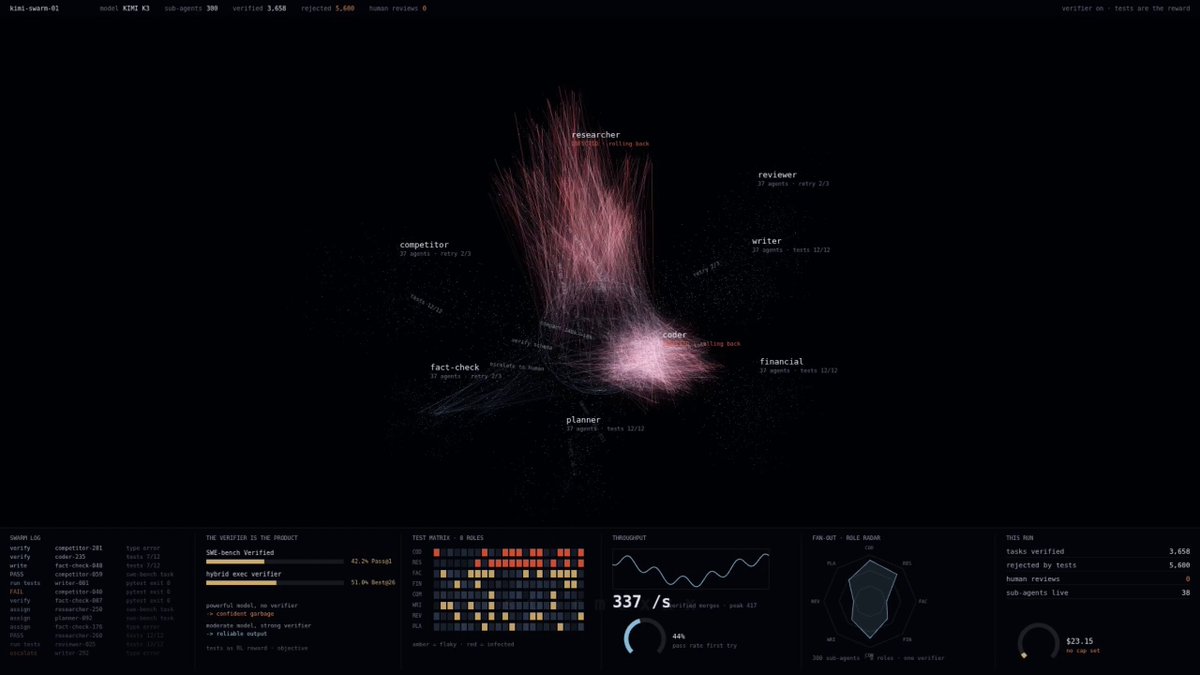
anthropic will sell you opus 5 at $200 a month. openai will sell you gpt-5.6 at $200 a month. neither will tell you stanford and berkeley published the 5 principles to build a $100k/mo ai company on kimi k3 for $10 stanford and berkeley spent years figuring out what actually separates ai systems that work in production from ai systems that die in demos. they published the findings. anthropic and openai priced their frontier subs like nobody would read the papers. the papers are free this is dspy plus verifiers plus decomposition plus skills plus mcp. five principles from stanford, berkeley and moonshot that turn a $10/mo kimi k3 sub into an ai analyst that runs unattended. the model is public. the system is the moat five moves that turn kimi k3 into the $100k/mo company: P1 don't prompt, program (stanford dspy) -> stanford proved hand-tuned prompts don't scale. define a pipeline as modules, let the optimizer tune them -> the compiled pipeline beat expert few-shot on multi-step tasks. one line of dspy replaces a month of prompt engineering P2 don't trust the model, build verifiers (berkeley 2026) -> a compiler either accepts or rejects. a test either passes or fails. that is a verifier -> berkeley: test-suite reward hit 42.2% pass@1 on swe-bench. hybrid verifiers hit 51.0% best@26. no bigger model, just a real check P3 don't scale agents, decompose them (stanford ai index 2026) -> stanford found multi-agent gains only 2-4 percentage points. two coding agents sometimes did worse than one -> the win is role decomposition, not count. researcher, writer, reviewer, verifier, clear input, clear output, no overlap P4 don't repeat expertise, encode it as skills (kimi code) -> every session starting from zero is institutional knowledge you lost. a skill.md file makes kimi activate the workflow automatically -> week one you write the skill. month six it encodes more institutional memory than most junior employees carry P5 don't keep ai in chat, connect it to tools (mcp) -> a model that only sees what you paste is a consultant working blindfolded. mcp connects kimi to your crm, db, github, linear, slack -> the model is public. the data is yours. the connections are your moat my position, and it is the arguable one: the next $100k/mo ai company will not win because it got early access to a frontier model. it will win because it followed 5 papers that anthropic and openai are quietly hoping you never read drop your $200/mo ai sub to $10. the swarm above is what 300 kimi k3 agents look like running those 5 principles. the full playbook is in the article below

starmex

31,358 görüntüleme • 14 gün önce