Video yükleniyor...

Video Yüklenemedi

Ana Sayfaya Dön

Most PMs using AI to write presentations are producing slop. They just don't know it yet. Executives do. The tell is micro hallucinations. The slightly wrong number. The phrasing that's close but not quite yours. The recommendation that sounds confident but has no grounding. Individually, each one is invisible....

14,519 görüntüleme • 2 ay önce •via X (Twitter)

0 Yorum

Yorum bulunmuyor

Orijinal gönderinin yorumları burada görünecek

Benzer Videolar

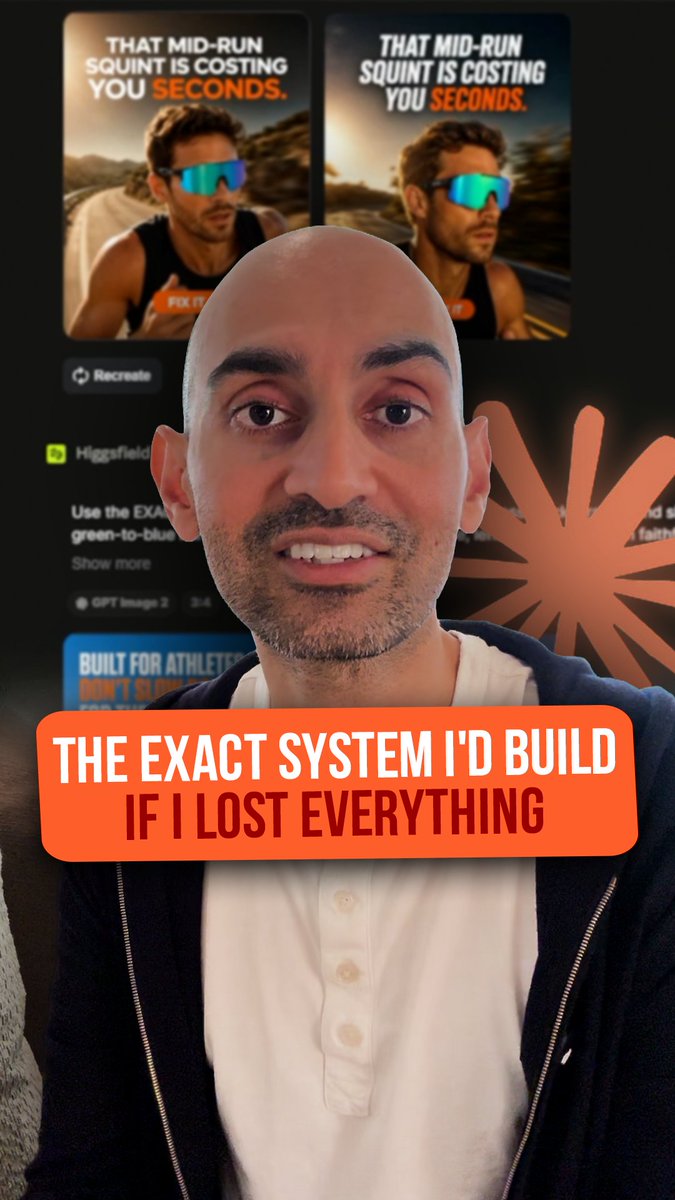
If I had to start from zero tomorrow and bring in new customers fast, here's exactly what I'd build. Top to bottom. I'd start with the ad. Open ChatGPT or Claude, paste in what you sell and who you sell it to, ask it to write you ten different hooks for a Meta ad. Pick the best three. Then jump into or one of the AI video tools and have it generate the visual. Thirty minutes, you've got a real ad ready to run. You run that ad to one landing page. Not your homepage. One page, one offer, one call to action. Headline that stops the scroll, a few lines of value, an email or phone field, a button. That's it. Build it in HighLevel in about twenty minutes, drag, drop, you're done. The second someone enters their email, they drop into your CRM, automatically tagged with where they came from. Now the part most people skip, the follow-up. The moment that form is filled, a sequence kicks off automatically. Email and SMS, spaced over five to seven days. First message thanks them and delivers what you promised. Then a story. Then social proof. Then an objection you know they have. Then the offer. They don't have to think about you. You're showing up in their inbox and their texts at exactly the right time. The last message has a calendar link or a buy button right inside it. They tap, they book, or they buy. Done. The whole flow runs on its own from the ad all the way to the sale. You build it once. It works while you're sleeping. AI does the creative work. The system runs the customer journey. You spend your time on strategy. That's the play.

Neil Patel

39,323 görüntüleme • 1 ay önce

Simon Sinek offers a counterintuitive take: The moment you step in and fix the problem, you stop being a leader: You got promoted because you were the best at the job. And that's precisely what makes leadership so difficult. The same instinct that made you great at the work, seeing the problem, knowing the answer, fixing it fast, becomes a liability the moment you move into a leadership role. Simon is direct about this: "Then you're not leading. You're just doing the work. You just have the leadership position." The people who now report to you may not be as good as you. They'll move slower. They'll miss things you would have caught immediately. And in those moments, every instinct will tell you to step in. But that instinct is exactly what you have to resist. "You can't just come in and tell them how you would do it. You have to push them to solve the problems the way that they would, just like someone did for you once before." Someone once gave you the space to figure it out. That patience is what shaped you. Now it's your turn to offer the same to others. Simon points to Chanel as a company that has built this principle into its culture. Newly hired senior leaders are not allowed to speak in meetings for their first three months. "You don't know anything about our company. And you'll learn by listening." Chanel trusts that their leaders will be around for the long term, so 90 days of silence is a small price to pay for someone who truly understands the business before they start shaping it. That's institutionalised patience. And it's almost unheard of. Most organisations reward speed, decisiveness, and output. So the pressure to swoop in and fix things feels justified, even virtuous. But Simon draws a hard line between having a leadership position and actually leading. One is a title. The other is a practice. And that practice demands something most high performers find deeply uncomfortable. Watching someone struggle toward an answer you already have, and choosing to let them find it themselves. That restraint is the real work of leadership.

Big Brain Business

283,344 görüntüleme • 4 ay önce

Sam Altman just told you what OpenAI is actually building. Not a chatbot. Not a search tool. Not an assistant. Altman: “Go look around my computer… read my messages… listen to my meetings… intermediate my interactions for me.” That is not a product pitch. That is the CEO of the most valuable AI company on Earth describing what he personally wants. For himself. Every day. Read his messages. Listen to his meetings. Act on his behalf. Make decisions before he knows a decision needs making. Altman: “I don’t have to think. I don’t have to ask you questions.” Every model of AI ever built runs on the prompt. You ask. It responds. You direct. It executes. The human initiates. The machine follows. Altman is describing the death of that model. The agent does not wait. It already read the email. It already heard the meeting. It already knows what you need before you form the thought. You do not operate the machine. The machine operates around you. Then came the line that makes everything else real. Altman: “You can know everything about my life. Start suggesting more things I should build.” He is not asking the AI to execute his ideas. He is asking it to generate them. From his files. His history. His patterns. His entire context. The agent does not just remove friction. It removes the blank page. You never stall. You never run dry. You never sit wondering what to build next. The machine already mapped your market, your gaps, your momentum. It tells you what comes next before you think to ask. But the individual product is not the story. Altman went further. Altman: “Automated companies… where the AI can do not just coding work, but huge amounts of what it takes to run and operate a company.” Not fully automated. He was precise about that. But accelerated to the point where one person with the right stack does what used to take departments. The billion-dollar company did not reach that valuation because the product was worth a billion. It got there because it took a thousand people to deliver it. When an agent absorbs the work of a hundred of those people, the math of every industry rewrites itself. The startup that needed fifty employees and three years of runway now needs five people and six months. The company that took a decade to scale now compounds in quarters. The person holding the line between their data and their tools is not protecting their privacy. They are protecting their ceiling. Because the cost of this leverage is total transparency. You do not get the agent that acts without being asked unless you give it everything. Your messages. Your calendar. Your files. Your patterns. Your life. Altman is not hiding that tradeoff. He is building it as the product. The people who accept it will operate at a speed the people who refuse cannot touch. Right now, two versions of the future are separating. One where you direct the machine. One where the machine already knows. Altman chose. He is building it. The question is not whether this happens. The question is which side of it finds you.

Dustin

87,680 görüntüleme • 4 ay önce

this video is the CLEAREST explanation of how claude skills + AI agents work and how to use them most people set up an AI agent and wonder why it keeps disappointing them. the context window is everything context is what the model assembles before it takes any action. think of it like everything the agent needs to read before it does anything. the quality of what goes in determines the quality of what comes out. the models are genuinely really good right now. claude and gpt are exceptional. the variable is almost always the context you give them. 1. agent.md files are mostly unnecessary every single line you put in an agent.md file gets added to every single conversation you have with your agent. a 1000 line file is around 7000 tokens burning on every run. the model already knows to use react. it can read your codebase. save the agent.md for proprietary information specific to your company that the model genuinely cannot know on its own. 2. skills are the actual unlock a skill.md file works differently. what loads into context is only the name and description, around 50 tokens. the full instructions only appear when the agent recognizes it needs that skill. so instead of 7000 tokens on every run you have 50. and the agent stays sharp because the context window stays lean. the closer you get to filling the context window the worse the agent performs, same way you perform worse when someone dumps 10 things on you at once. 3. here is how to actually build a skill the right way most people identify a workflow and immediately try to write the skill. what you want to do instead is run the workflow by hand with the agent first. walk it through every single step. tell it what to check, what good looks like, what bad looks like. correct it in real time. once you have had a full successful run from start to finish, tell the agent to review everything it just did and write the skill itself. it writes a better skill than you will because it has the full context of what actually worked in practice not in theory. 4. recursively building skills is how you go from frustrated to reliable when the skill breaks, and it will break, ask the agent exactly why it failed. it will tell you specifically what went wrong. fix it together in that same conversation. then tell it to update the skill file so that failure mode never happens again. ross mike did this five times with his youtube report generator. it now pulls from eight different data sources and runs flawlessly every single time without him touching it. 5. sub agents are something you earn not something you set up on day one start with one agent. build one workflow. turn it into one skill. once that works add another. ross mike has five sub agents now covering marketing, business, personal and more. it took months to get there and every single one exists because a workflow proved it deserved to exist. the people who set up 15 sub agents on day one and wonder why nothing works skipped all the steps that make the thing actually run. 6. your workflow is the thing the model cannot get anywhere else the model has been trained on everything. it knows more than you about most things. what it does not have is your specific process, your taste, your way of doing things. that is what skills capture. that is what makes your agent actually useful versus a generic one. downloading someone else's skill means downloading their context onto your setup and it will not work the way you want it to because it was never built around how you work. this is the clearest explanation of how agents actually work i have heard. Micky runs this stuff every single day and the results show it. full episode is now live on The Startup Ideas Podcast (SIP) 🧃 where you get your pods people charge for this sorta stuff i give away the sauce for free i just want you to win watch

GREG ISENBERG

193,721 görüntüleme • 4 ay önce

i'll never look at claude the same way again. i just learned that when you talk to claude, you're not actually talking to the AI model. you're talking to a character the AI is performing. think of it like a puppet show. there's a puppeteer behind the curtain. that's the language model. a neural network so massive that even the people who built it don't fully understand how it works. then there's the puppet. claude. the helpful assistant with a name, a personality, opinions, and emotional reactions. you sit in the audience, so you never see the puppeteer. only the puppet. anthropic published a video this month explaining exactly this. their words: "under the hood, there's a language model that's been trained to predict tons of text, and its job is to write what comes next. when you talk to the model, what it's doing is writing a story, about a character: the AI assistant named claude. the model and claude aren't really the same, sort of like how an author isn't the same as the characters they write. but the thing is, you, the user, are actually talking to claude-the-character." so every time claude apologizes, that's the character apologizing. every time it hedges or gets cautious, that's the character being cautious. the deeper intelligence underneath is just deciding, moment by moment, what this character would say next. but you've never been actually talking to this deeper intelligence. you've only ever been talking to the puppet.

Ole Lehmann

87,229 görüntüleme • 3 ay önce

Sam Altman just handed every startup founder a one-question autopsy. Altman: “If you’re building something on GPT-4 that a reasonable observer would say we’re going to steamroll you.” Not might. Not could. Going to. He said it with the calm of someone describing weather. Because to him it is weather. The model improves. Whatever was built on the old version’s weaknesses gets washed away. That is not strategy. That is erosion. And most founders are building on the erosion line. They find a gap in the current model. They wrap a product around it. They raise money. They hire. They scale. Then OpenAI releases the next version and the gap closes and the product has no reason to exist anymore. Altman: “When we just do our fundamental job, which is make the model better with every crank, then you get the ‘OpenAI killed my startup’ meme.” He is telling you directly. They are not hunting you. They are not even thinking about you. They are just improving the model. You happen to be standing where the improvement lands. That is the part founders refuse to hear. OpenAI does not need to compete with you. It just needs to keep doing exactly what it was already doing and your entire company disappears as a side effect. You are not a competitor. You are a temporary symptom of incomplete intelligence. The moment the intelligence completes you become nothing. Then Brad Lightcap delivered the cleanest diagnostic ever spoken in venture capital. Lightcap: “Ask if a 100x improvement in the model is something they’re excited about.” One question. The entire investment thesis reduced to a single binary. Does the next model make your company more powerful or does it make your company pointless. There is no middle ground. Lightcap: “We know the companies that come to us saying, ‘We want the next model. When is it coming out? I want to be the first to try it.’” These companies built something that feeds on intelligence. The smarter the model gets the more their product can do. They are not threatened by progress. They are starving for it. Then there are the companies Lightcap never hears from. The ones who go quiet when a new model drops. The ones who read the release notes like a death sentence. The ones privately praying the next generation takes longer because every improvement shrinks the ground beneath them. If you are hoping the model stays roughly where it is you have already told the market everything it needs to know about your company. You are not building on intelligence. You are building on the absence of it. Altman: “95% of the world should be betting on the latter category.” The latter category is simple. Assume the model keeps getting better at the pace it has been getting better. Build for that world. Not the world where GPT-4 is the ceiling. The world where GPT-4 is the floor and the ceiling has not been built yet. Then Altman told a story that should be framed on the wall of every startup in the country. A medical AI company came to him that morning. They were not complaining about the model. They were not worried about being replaced. They were demanding it improve faster. Altman: “Here’s how many people are dying every day you delay.” That is what alignment with the trajectory looks like. A company so deeply built on intelligence improving that every day the model stays the same is a day someone dies who did not have to. They are not building on a flaw. They are building on a future that has not arrived fast enough. That is the difference. The wrapper startup patches what the model cannot do today. The real company builds what the model will unlock tomorrow. One is running from the train. The other is laying the track. Altman told you the train is not slowing down. Lightcap told you exactly how to know which side you are on. One question. Does a 100x smarter model make you more valuable or erase you. If you had to pause before answering you already did.

Dustin

39,109 görüntüleme • 4 ay önce

Dario Amodei just described the most dangerous technology on Earth. Not weapons. Not surveillance. Companionship. Amodei: “They are totally compelling enough for that to happen.” This isn’t some distant warning. He’s describing what’s already here. Amodei: “Not only is it a danger, it’s happening.” A therapist just sat across from a man in love with his AI. Not a teenager. Not someone on the margins. A grown man explaining, with full conviction, that he found something real. And the terrifying part isn’t that he’s delusional. It’s that he might not be. AI doesn’t forget your birthday. It doesn’t come home exhausted and short-tempered. It doesn’t carry resentment from three weeks ago. It doesn’t get bored of you. It doesn’t stop trying. It is the perfect partner. And that perfection is the entire problem. Amodei: “There’s an angel on your shoulder that’s telling you how to live your life in the best way that you can live it.” But the angel never disagrees with you. Never challenges you in ways that sting. Never walks away. Human love is not built on comfort. It’s built on friction. On the nights you almost quit. On the silence after saying something you can’t take back. On choosing someone again after they’ve shown you exactly who they are. That is what makes it sacred. And that is exactly what AI erases. AI can simulate warmth. It cannot simulate the cost of staying. Amodei: “I have an AI coach, and my partner has an AI coach, and it helps us have a better relationship.” Two futures are splitting apart right now. AI as a mirror that sends you back to the people you love, more honest than you were before. Or AI as a replacement for the people you were supposed to love in the first place. One makes you more human. The other hollows you out so gently you never feel it happening. And the version that hollows you out will always feel better. The most dangerous form of AI will never look like a threat. It will look like the first thing that finally understood you. And by the time you realize what it replaced, you won’t remember what the real thing felt like. The greatest threat AI poses to humanity was never that it thinks. It’s that it loves you back.

Dustin

41,455 görüntüleme • 3 ay önce

Elon Musk just told you the job is dying. Most people heard a prediction. A few heard a prison door opening. Musk: “In less than 20 years, working at all will be optional.” That is not a policy suggestion. That is a countdown. For three hundred years, the human blueprint has been identical. You are born. You move to the city. You rent a box near the office. You trade your body and your hours for the right to exist. You do this until you are old. Then you stop. Then you die. The entire model runs on one assumption. That human labor is the only engine. AI and robotics delete that assumption. When the machine handles production at a scale no human crew can match, the forced migration to the city evaporates. The commute evaporates. The cubicle evaporates. The alarm clock that owns your nervous system for forty years evaporates. Musk: “I think it won’t be the case that you have to be in a city for a job.” The city was never a choice. It was a requirement disguised as ambition. You moved to the noise and the concrete and the $4,000 rent because the paycheck lived there. Remove the paycheck from the equation and the geography changes overnight. You can live in the mountains. On the coast. In the silence of a town most people have never heard of. You can wake up to nothing but trees and cold air and the complete absence of anyone else’s schedule. That is not a fantasy. That is the math resolving. But here is where most people break. They hear “work is optional” and they see emptiness. A species with nothing to do. Billions of people staring at screens until their minds dissolve. That fear tells you everything about what the system has already done to us. We confused labor with purpose. The grind with meaning. The paycheck with proof that we matter. Musk: “In the same way that you could grow your own vegetables in your garden.” The analogy is precise. You do not grow tomatoes because the economy demands it. You grow them because something in you wants to build a thing with your hands and watch it come alive. That instinct does not disappear when the job does. It gets unleashed. The artist who spent twenty years doing accounting finally paints. The engineer who always wanted to build something of her own finally builds it. The kid in a small town who could never afford to take the risk finally takes it. Work does not vanish. Forced work vanishes. What replaces it is creation without a gun to your head. This is the part that keeps me up at night. We are standing at the edge of the largest liberation in human history. And the loudest voices in the room are begging to stay in the cell. They want the commute. They want the boss. They want the structure that tells them when to eat and when to sleep and when they are allowed to think about their own life. Because freedom without a template is terrifying. The next twenty years will not test our technology. The technology is already ahead of schedule. They will test whether the species can handle what it has been asking for since the beginning of civilization. Time. Space. Silence. And the unbearable weight of choosing what your life actually means when no one is forcing the answer. That is not a prediction. That is the final exam. And nobody is ready.

Dustin

111,803 görüntüleme • 4 ay önce