Video wird geladen...

Video konnte nicht geladen werden

Zur Startseite

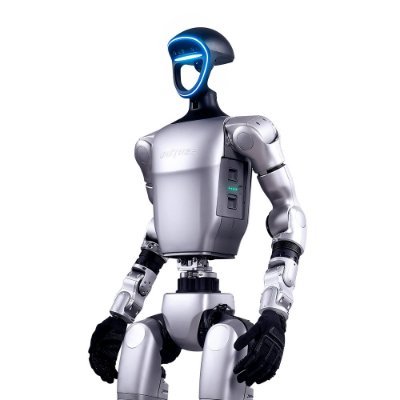
Movement creates intelligence - Unitree's G1 humanoid robot nails the world's first kip-up!😘 This fresh, newly captured video from Unitree's testing grounds showcases the breakneck speed of humanoid intelligence advancement. Every day brings something thrilling! #Unitree #Combat #TaiChi #MartialArts #KungFu #SpringFestivalGalaRobot #ArtificialIntelligence #HumanoidRobot
7,679,309 Aufrufe • vor 1 Jahr •via X (Twitter)

11 Kommentare

Profilbild von maru
maruvor 1 Jahr

It's already way better than Boston dynamics robots

Profilbild von FRANK E ELKINS
FRANK E ELKINSvor 2 Jahren

Unlock the secrets of Consciousness! 🔑 Book V explores Perception, Awareness & Artificial Intelligence. Subscribe now to our FREE Weekly Newsletter and explore Reality one week at a time!

Profilbild von Bones
Bonesvor 1 Jahr

The pace in humanoid robotic movement is stunning. A year ago these humanoid robots would not have been able to stand up after falling down. I so want one!

Profilbild von 尚月
尚月vor 1 Jahr

@42Cup

Profilbild von 義德臺仰
義德臺仰vor 1 Jahr

Love to see all these robot companies keep showing off their work. Keep it up.

Profilbild von Vincent Bounce🦾🔑
Vincent Bounce🦾🔑vor 1 Jahr

She was afraid when G1 rushed at her at the end :)

Profilbild von carbonat
carbonatvor 1 Jahr

What this company makes is really impressive!Others say this is not really important compared with manipulative skills, but that's wrong. This must be a part of a great humanoid robot product

Profilbild von Borg King
Borg Kingvor 1 Jahr

Unitree, I am headed to Beijing this Saturday. Where can I see your robots? Any by Chaoyang or at Joy City shopping mall?

Profilbild von Tanvi
Tanvivor 1 Jahr

🤯looks like, every one is just playing for second

Profilbild von MocroMoon🇲🇦
MocroMoon🇲🇦vor 1 Jahr

Can you avoid heavy dramatic music on your next marketing videos? It descredits your work.

Profilbild von Kou
Kouvor 1 Jahr

This one is way more sturdier than a certain company one

Ähnliche Videos

Beijing hosts world’s first humanoid robot games | Ariana News The world’s inaugural humanoid robot competition is underway in Beijing, drawing more than 500 robots from 280 teams across 16 countries to compete in a uniquely futuristic sporting spectacle. The three-day event, held at the National Speed Skating Oval—once the “Ice Ribbon” of the 2022 Winter Olympics—kicked off on August 15 and runs through to Sunday August 17. The tournament features 26 events spread across athletic, performance, and scenario-based categories. Athletic challenges include sprinting, soccer, and kickboxing, while performance segments showcase robot dance routines and musical instrument displays. Real-world scenarios, such as medication sorting, cleaning tasks, and industrial material handling, are also on the agenda to test practical functionality. Organizers meanwhile emphasize the event’s role in accelerating the integration of humanoid robots into everyday life, from manufacturing and hospitality to healthcare. One Chinese official summed it up: “Every robot that participates is creating history.” The competition has yielded both triumphant strides and technical stumbling blocks. In running events, the robot H1 from Unitree Robotics claimed top honors in the 1,500-meter race, demonstrating promising agility. Yet, many robots struggled with balance, coordination, and task execution, including some collapsing mid-sprint or requiring human help to stand—underscoring the still-developing nature of embodied artificial intelligence.

Owen Gregorian

43,158 Aufrufe • vor 11 Monaten

Video: World’s first humanoid robot labor that swaps its own batteries to work endlessly | Jijo Malayil, Interesting Engineering Walker S2 uses dual-battery balancing and standardized modules to boost efficiency and ensure uninterrupted, optimized performance. In a leap for robotics, China’s UBTech has unveiled the Walker S2, the world’s first humanoid robot capable of fully autonomous battery swapping. Designed for non-stop industrial operations, the Walker S2 can replace its own power pack in just three minutes—no human intervention required. Equipped with advanced anthropomorphic bipedal locomotion and a hot-swappable battery system, Walker S2 is built to operate 24/7 across dynamic industrial environments. According to UBTech, the next-generation humanoid robot marks a major milestone in automation, bringing continuous, hands-free performance to the factory floor. In May 2025, UBTech Robotics and Huawei Technologies inked a significant partnership to accelerate the adoption of humanoid robots across China’s factories and households. Uninterrupted robot operations A video posted by the robotics firm opens with the sleek UBTech Walker S2 humanoid robot working in an industrial setting. The highlight, however, is its autonomous battery swap. Walker S2 approaches the charging station, carefully detaches its depleted power pack, and seamlessly installs a fresh one—all within about three minutes—without any human assistance, according to CGTN. The camera captures close-ups of the robot’s articulated limbs and the intelligent battery-handling mechanism, conveying precision and reliability. As the swap completes, Walker S2 resumes its duties, reinforcing the promise of uninterrupted, 24/7 operations in dynamic factory environments. UBTech’s Walker S2 humanoid robot is equipped with advanced dual-battery power balancing technology and uses standardized battery modules to optimize performance, reports CNEVPOST. This dual-battery system allows the robot to automatically switch to a backup battery in case of a main battery failure, ensuring that critical tasks are carried out without interruption. In addition to battery swapping, the robot can intelligently choose between charging and swapping based on task urgency, allowing it to manage energy dynamically and adapt to real-time operational demands. UBTech highlights these features as a step forward in deploying humanoid robots for industrial and domestic applications, combining flexibility, reliability, and autonomy in one intelligent platform. Factory intelligence upgrade Earlier in the year, UBTech unveiled a major advancement in humanoid robot collaboration, claiming the world’s first deployment of multiple humanoids working together across varied industrial tasks. Demonstrated at Zeekr’s 5G-enabled smart factory, the breakthrough centers on UBTech’s “BrainNet” framework, which orchestrates cooperative behavior through a cloud-device intelligence system. BrainNet integrates a “super brain” for high-level decision-making with an “intelligent sub-brain” for distributed multi-robot control. The super brain, powered by a proprietary large-scale multimodal reasoning model, handles complex production-line scheduling and decision-making. Meanwhile, the sub-brain coordinates real-time tasks using cross-field perception and Transformer-based control for dynamic adaptability. Together, they enable the Walker S1 humanoid robots to move beyond isolated operations and perform coordinated tasks with high precision and speed. The system is built on DeepSeek-R1 reasoning technology and trained on real-world data from automotive factory settings. Leveraging Retrieval-Augmented Generation (RAG), the model adapts to specific job functions and improves scalability across workstations. At Zeekr’s facility, dozens of Walker S1s now collaborate on tasks like assembly, inspection, and part handling. Using semantic VSLAM and shared mapping, they coordinate seamlessly via vision-based navigation and agile manipulation. UBTech says this marks a transition to “Practical Training 2.0,” where humanoid robots operate as a swarm, maximizing efficiency and setting the stage for next-generation intelligent manufacturing.

Owen Gregorian

35,637 Aufrufe • vor 1 Jahr

i don't think people realize what's happening in Chinese robotics. this one manufacturer might be the most impressive AND most concerning company on Earth right now let me explain... Unitree Robotics sells a humanoid robot for $5,900. their robot dog costs $1,600 (Boston Dynamics charges $74,500 for theirs for context). you can literally buy these on Amazon today. so obviously the first question is: how is that even possible? the answer starts with a guy who couldn't pass his English exam. Wang Xingxing grew up in Zhejiang province. for his master's thesis, he decided to build a quadruped robot. budget: about $3,000. for context, $3,000 for this kinda robot is nothing. off-the-shelf servo motors alone would've eaten that twice over. so Wang did the only thing he could: he designed and machined every single component himself. motors, joints, controllers, the frame. all of it. the resulting robot was janky and imperfect. but it worked. and the video went viral globally. after graduating he joined DJI. but he quit after two months, and this is 2016, when DJI was arguably the hottest hardware company in China. walking away from that with no money to start a robotics company is a... specific kind of stubborn. he launches Unitree with $280K from a single angel investor. tiny office in Hangzhou. 50 square meters. but the money runs out fast. he can't make payroll for three years. the company almost dies in 2017. but emergency government funding arrives with days to spare. he survives, barely, and keeps building. this is where it gets really fascinating IMO. this founding constraint, building everything yourself because you literally cannot afford to buy parts, never went away. even after funding rounds started landing. even after revenue kicked in. it just became the company's permanent DNA. Unitree now manufactures 90%+ of its core components in-house. motors, reducers, controllers, encoders, LiDAR, etc the founder's $3,000 robot thesis ended up being an architectural decision that turned out to be structurally superior. think about what that means in practice. Boston Dynamics needs a better motor? they negotiate with a supplier, wait on lead times, qualify the part. but when Unitree needs one, they design theirs internally and have a new version in production within weeks. that gap compounds every cycle. Unitree shipped three separate humanoid platforms in 18 months. Figure AI has shipped one. Tesla has shipped zero commercially. the results are getting hard to dismiss. 23,700 robot dogs shipped in 2024 (roughly 70% of the entire global market). 7,000+ humanoids deployed. over 600 industrial sites running their quadrupeds. $140M+ revenue, profitable every year since 2020. for perspective: no Western humanoid competitor is profitable. not one. OK. now here's where the "most concerning" part of this starts... if you watched the DJI story unfold, you already recognize the shape. affordable Chinese hardware quietly saturates global markets. years later, the national security questions arrive, after the install base is already massive. drones, then EVs, then AI. now robots. Unitree is running this exact playbook in real time. in April 2025, researchers found an undocumented backdoor in their Go1 robot. a remote tunnel letting anyone control the robot and stream its camera feed. default password: pi/123. 1,919 vulnerable units exposed globally. including machines at MIT, Princeton, and Carnegie Mellon. but it gets worse. every Unitree robot shares the same hardcoded encryption key. encrypt the word "unitree" and you get root access to any of them. one compromised robot can spread to every Unitree robot in Bluetooth range automatically. a literal robot botnet. the G1 quietly transmits sensor data to Chinese servers every five minutes. audio, video, GPS, LiDAR spatial mapping, with no notification, no consent, no opt-out. PLA footage has shown Go2 robots with mounted weapons. Ukrainian forces literally deployed weaponized units on the actual frontline. and every member of the bipartisan House China Committee signed a letter calling for Unitree's military company designation. Wang signed a 2022 pledge alongside Boston Dynamics not to weaponize robots. but pledges don't survive contact with shipping hardware to open markets. and under China's 2025 rules restricting military-related speech, Unitree couldn't publicly confirm PLA use even if they wanted to. 50,000+ of these robots are now deployed globally. some at institutions that probably should've asked harder questions before connecting them to their networks. the security stuff is real and people should know about it. but i also think it's important not to let that overshadow what's actually been built here. a 35-year-old who failed his English exam created a robotics company that's outshipping and outpricing every Western competitor while being the only profitable humanoid maker on Earth. most impressive and most concerning company in the world right now.

Ole Lehmann

122,620 Aufrufe • vor 5 Monaten

Not a preplanned motion sequence. A robot deciding mid-jump what to do next. [📍 paper + demo] Researchers just showed a humanoid doing real parkour using only onboard perception. No motion script, no fixed obstacle layout. The system is called Perceptive Humanoid Parkour (PHP). Instead of memorizing a path, the robot reads depth from its cameras and continuously chooses actions. Step, vault, climb, or roll depending on what geometry appears in front of it. To make that possible, they combine three ideas: First, they stitch together human motion clips into long movement references so the robot learns fluid transitions instead of isolated tricks. Second, they train tracking policies with reinforcement learning so contacts land at the right time and the robot keeps balance during dynamic moves. Finally, everything is distilled into one perception policy that runs directly from depth input to action selection. The result on a Unitree G1: about 3 m/s vaults wall climbs up to 1.25 m nearly one minute continuous obstacle traversal adapting when obstacles move What matters is not the tricks. It is the shift in capability. Earlier humanoids executed motions. This one navigates situations. Once robots react to geometry instead of replaying trajectories, environments stop needing to be predictable. Warehouses, homes, and outdoors suddenly become the same problem. Thanks for sharing, Zhen Wu! Paper + demo: ——— Weekly robotics and AI insights. Subscribe free:

Ilir Aliu

22,080 Aufrufe • vor 5 Monaten

this is the world's first ever humanoid robot that will summit Mt. Everest it's named Pemba, and two days ago it reached the top of Chimborazo, a 20,000-foot peak in Ecuador, completely on its own (no remote or operator). and the robot itself is nothing special. Pemba is a Unitree G1, the same ~$14k robot anyone can buy online right now. the guy behind it, Pablo Berlanga, is doing this to send robots into the places that kill people. think about how you'd check on a melting glacier or a deadly crevasse out in the middle of nowhere today. you either send a person who might not come back, or you skip it and learn nothing. so Berlanga wants a robot that walks in on its own, carries a few pounds of gear, and brings back footage from places no human can safely reach. i think eventually they'll even be used for robot rescue missions to reach people stranded in disasters and dangerous situations from here, the plan for Pemba is Mauna Kea in Hawaii, then Everest. Everest is the tricky one. the team wanted to send Pemba up this spring to start hauling trash off the mountain and tracking its glaciers (something Nepal genuinely needs help with) but the Nepalese government told them to wait. there's no law in Nepal for a climber that isn't human, so the rules have to get written before a robot can set foot on the mountain. kind of incredible that the machine is ready for Everest a full year before anyone's decided whether it's allowed to be up there

Ole Lehmann

33,490 Aufrufe • vor 1 Monat

In just one week, Binh Pham and I trained a full-body Unitree G1. Here's a recap: 1. Secured a Unitree G1 humanoid through a LinkedIn post 2. Deployed TWIST2 full-body teleoperation pipelines 3. Adapted TWIST2 for Zed stereo camera & collected full-body teleoperation samples (carried by Binh Pham ) 4. Adapted & fine-tuned NVIDIA Gr00T N1.5 VLA on the TWIST2 public datasets, which I fine-tuned on an 8xNVIDIA H100 Cluster. We picked Gr00T N1.5 as it was trained with Unitree G1 embodiment data. 5. Adapted the TWIST2 codebase to stream in the actions from Gr00T via ZMQ using a co-located NVIDIA H100 for ~200ms inference latency 6. Tested the model in sim, then deployed to the real-world Unitree G1. We streamed a training sample observation to the VLA (as we didn't want to break robot in case real observations were OOD) We were the first team in the world to deploy the full TWIST2 data collection pipeline to the unitree g1 :) Much more work ahead though, which I'll work on as a side-project over the next months: 1. Exploring the various types of 'world models': video backbones, dynamics models, v-jepa-2 models. I believe these will generalize better & train much more data-efficiently than VLM backbones 2. Speeding up inference - I believe low-latency robotics inference will be a big challenge. There are many works in video diffusion which I'd like to test (e.g. SageAttention, SparseAttention, Drifting Models). Perhaps also writing custom CUDA kernels. 3. Economics of inference scaling :) What will be the compute demands as we scale inference up to millions of humanoids? Will it run on edge or on distributed 'co-located' inference clusters? These are questions I'd like to answer. Adapted TWIST2 codebase: Adapted Gr00T-N1.5 codebase: The ETH Robotics Club are doing a cool GTC Golden ticket competition with NVIDIA , so this is my submission :) The DGX Spark compute will get me a long way with initial prototyping & especially working on inference optimization for next-gen Blackwell GPUs #NVIDIAGTC #GOLDENTICKET #ETHRC

Arnie Ramesh

14,815 Aufrufe • vor 5 Monaten

China unveils humanoid robot worker with brain that runs 275 trillion ops/sec | Jijo Malayil, Interesting Engineering In tests, SUYUAN used vision and joint control to sort and move crates of various sizes, greatly improving warehouse productivity. Chinese manufacturing firm Shanghai Electric has unveiled its first self-developed industrial humanoid robot, “SUYUAN,” marking a major milestone in its robotics journey. Debuting at the World Artificial Intelligence Conference (WAIC 2025) on July 26 in Shanghai, SUYUAN boasts 38 degrees of freedom and 275 TOPS of on-device computing power, enabling precise operations and fluid movements. According to the firm, designed for diverse industrial use, the robot showcases Shanghai Electric’s end-to-end capabilities—from core tech to integrated solutions—and reinforces its commitment to next-gen industrial automation through a full industry chain strategy. At WAIC 2025, Shanghai Electric also unveiled a new joint venture with Johnson Electric for next-gen humanoid robotics and showcased its “LINGKE” dual-arm robot. Recently, Hangzhou-based Unitree Robotics launched the R1 humanoid with 26 joints for $5,900, showcasing athletic feats like cartwheels, running, and quick recovery. Smart factory assistant Shanghai Electric claims SUYUAN, equipped with 38 degrees of freedom (DoF) and a powerful 275 TOPS on-device computing processor, delivers fluid, human-like movements and high-precision operations across various industrial scenarios. Its advanced articulation and real-time processing capabilities make it highly adaptable, enabling smooth execution of complex tasks in dynamic work environments. SUYUAN, who weighs 110 pounds (50 kilograms) and is 5 feet 6 inches (167 cm) tall, was designed to have human-like proportions. Its 38-DoF articulation offers dexterity, allowing for both wide-range motion and sensitive manipulation. With a single arm, the robot can lift objects up to 4.4 pounds (2 kilograms) in weight and carry a total payload of up to 22 pounds (10 kilograms). With a walking pace of 3.1 miles per hour (5 km/h), SUYUAN is ideal for environments including assembly lines, warehousing, and logistics, according to a statement. To navigate complex industrial settings, SUYUAN combines LiDAR and binocular vision for self-guided mobility. Its 275-TOPS AI processor enables rapid data analysis and integration with large language models, allowing it to understand tasks in natural language and handle objects adaptively, reports Fox 44 News. In pilot demonstrations, the robot successfully identified, picked, and relocated crates of varying sizes using advanced computer vision and coordinated joint control—delivering measurable gains in warehouse efficiency. The company claims that SUYUAN’s launch represents a major turning point in Shanghai Electric’s foray into humanoid robotics and strengthens its vertically integrated approach to industrial automation solutions. Intelligent task handling Shanghai Electric also demonstrated its most recent developments in intelligent manufacturing at WAIC 2025, introducing a new joint venture with Johnson Electric centered on next-generation humanoid robotics and showcasing the “LINGKE” dual-arm robot. With its high-precision operations, adaptive teamwork, and closed-loop data capabilities, the LINGKE robot demonstrated live talents in handling complicated production jobs. LINGKE is made to do more than just replace human labor; it uses compliant force control and bimanual coordination to relieve workers of high-intensity, repetitive jobs. According to the company, the robot enhances operational efficiency by up to five times. Its core strength lies in a Data-Model-Deployment closed-loop system that starts with operational data, followed by data cleansing, model training, live deployment, and feedback-driven optimization—enabling autonomous learning and workflow improvement. Also at the event, Shanghai Electric and Johnson Electric introduced advanced hardware modules for humanoid robots, including rotary joints, linear joints, and dexterous finger joints. These components are designed to support smooth, precise, and quiet motion performance across robotics systems, reports Stock Titan. The joint venture announced two strategic agreements: a first-unit supply deal with the National and Local Co-Built Humanoid Robotics Innovation Center (Qinglong Project) and a cooperation memorandum with Fourier Robotics. Read more:

Owen Gregorian

51,638 Aufrufe • vor 1 Jahr

Robots will bring billionaire living to a lot more people. I had the blessing to eat with Guy Savoy several times. One of the best chefs in the world. He, and other top chefs taught me about the importance of getting fresh ingredients. Here is how robots and World Models will bring that and what do I mean by “everything as a service?” In three years I will have this conversation with my 1X Neo humanoid robot: “Hey Neo I want to upgrade our food to billionaire level.” “I can do that. Food as a service costs $500 a month. I will buy only hand grown fresh organic food and I will prepare amazing meals for you and your family.” Where is the supply chain for such food? Farmers’ markets where everything is fresh and organic. You gotta stop buying at grocery stores to upgrade your diet. “Hey Neo here are the keys to Tesla Robotaxi. And here is my credit card. Start up food as a service.” Neo will take an autonomous car to the market. “But Neo how do you know where to go?” “Well a guy on X did a video of the farmer’s market nearby.” “I watched it, and now know roughly the kinds of things I can get there.” We are too late to start today, the market is closed now, but we can start next week. Look at this video the way Grok does. I am playing humanoid today. In one visit my Neo will ingest all of this into its World Model. In the second visit it will get even better. In the third visit even better. World models are going to be real time by the end of next year from a variety of companies. فيصل Tesla Robotaxi already serves both our home and the market. Our Tesla drove us there and already knows where it is. Grok is already a world model. In a few minutes it can tell you what it learned by watching this video. It watches all my videos before distributing them to you. So it knows how not to overwhelm @jason’s feed with my prolific posting. It will get a lot better soon. But after three trips to this farmer’s market my robot will know everything about this market including the names of the farmers. Watch this video, you meet one. Grok can do a RAG search and learn everything about him, including that he doesn’t have a Website, and only posts on Facebook. Also that he takes Apple Pay. It already knows everything it sees. The names of the vegetables, fruits, nuts, and what is ravioli. One vendor sells fresh ravioli made early this morning. If you are freaked out by privacy have your Neo stay in the garage until it is time to do something for you. In three years I will be eating fresh food with my brother in law while football is on the TV. If you don’t have a robot you won’t eat as well unless you are a billionaire who can afford to pay the human to shop and cook for you. The Robotaxi network starts up next year (without humans). The world models get good next year. By 2030 every one of you will have a robot in your home, at least part time. Who has the best world model? Tesla. Who understands the real world better? Grok. (I didn’t give this video to anyone else). Who soon will have the best humanoid? Tesla. Which company already has a Robotaxi in my driveway? Tesla. Which company has the best video ingestion engine? Tesla. Which company is about to turn on a real time world model? xAI. Which company would you want to invest in? Tesla and xAI. Which is why, if you are a Tesla investor and you didn’t vote for Tesla to invest in xAI you hurting yourself.. Everything as a service is about to arrive. Everyone who can afford a $20,000 robot, which can be financed will have it next year. I will. Anyone worried about privacy has no idea how useful this all will be to make your lives better. And how much money it will make for a robot company to put it all together. And only Tesla has all the pieces to make the meal.

Robert Scoble

1,363,973 Aufrufe • vor 9 Monaten

Jensen Huang just described how he plans to outlive his own body. Huang: “Very soon, I’m going to put a humanoid on a spaceship. And it’s going to be my humanoid.” His robot. His frame. Launched into deep space while he is still breathing. Huang: “Take all my inbox, take everything that I’ve done, everything I’ve said. It’s been collecting and becoming my AI. When the time comes, we’ll just send that at the speed of light, catch up with my robot.” Your body fails. Your data does not. Every email. Every decision. Every conversation. Recorded. Compressed. Compiled into a model that thinks the way you think. And when the biology gives out, that model launches at light speed to meet a titanium frame already cruising through the void. You do not die. You transfer. Sounds like fiction. Then he put a number on it. Huang: “Understanding the biological machine is not 10 years. It’s five years probably.” Five years to decode the human body the way we decoded software. Not treat disease. Decode it. Understand the entire machine well enough to patch it like a bug. Cancer is a bug. Alzheimer’s is a bug. Aging itself is a bug. And the compute to find the fix doubles every year. Huang: “It’s a reasonable thing to expect the end of disease.” He did not say hope for. He said expect. The man whose chips power nearly every AI system on Earth just told you the end of disease is not a dream. It is a scheduling problem. Huang: “It’s a reasonable thing to expect that pollution will be drastically reduced. It’s a reasonable thing to expect that traveling at the speed of light is actually in our future.” He listed these the way someone else lists quarterly targets. Items on a roadmap. Waiting on execution. But here is the part most people will skip past. And it might be the most important thing he said. Huang: “I’ve always had a great confidence in the kindness, the generosity, the compassion, the human capacity.” This is the man building the most powerful computing infrastructure ever constructed. The man whose hardware will power the intelligence that reshapes every industry, every government, every border on Earth. And his operating principle is not paranoia. It is trust. Huang: “Sometimes more so than I should. And I get taken advantage of. But it doesn’t ever cause me not to.” He has been burned. He kept trusting anyway. Not naivety. Evidence. Huang: “Vastly I am proven right. Constantly proven right. And often exceeds my expectations.” The doomers build everything on one assumption. Power corrupts. Humans weaponize every tool they touch. Huang has spent thirty years handing the most powerful technology in history to thousands of companies, researchers, and governments. His conclusion is the opposite. People want to do good. Give them the tools and they prove it. That is not soft. That is thirty years of data from the dead center of the compute revolution. Fridman: “What an exciting time to be alive.” Huang: “How can you not be romantic about that?” Romantic. Not optimistic. Not bullish. Romantic. Optimism is a prediction. Romance is what happens when you look at what is coming and it hits you somewhere deeper than logic. The end of disease. Consciousness uploaded. A robot carrying your mind past the rings of Saturn. Underneath all of it, a belief that the species wielding these tools is fundamentally good. That is what separates Huang from every other voice in this space. The fearful see AI and ask what could go wrong. Huang sees AI and asks how much suffering can we end. He is not dreaming out loud. He is reading the trendline and telling you exactly where it lands. Five years for biology. A lifetime for consciousness. And past that, a humanoid with your mind aboard, sailing through space at the speed of light. Built by a man who still believes in people. The cynics will laugh. They always do. Right up until the moment it ships.

Dustin

282,792 Aufrufe • vor 4 Monaten

Ex Machina is no longer sci-fi. China has finally built it. The company is AheadForm, founded in Shanghai. The product is the world's most hyper-realistic robotic face. Silicone skin you can't tell from human, 25 micro motors hidden underneath pulling the face into real expressions. And RGB cameras embedded inside the pupils so when it looks at you, it actually sees you from where its eyes are. They raised $28.5M to "give AI a head," which is also where the name comes from. AheadForm = a head form. This is the opposite of where everyone else in robotics is focused. Unitree, Figure, Tesla, Boston Dynamics: all about the body. AheadForm chose the face because they think trust is the harder problem to solve, and trust gets decided at the face. The reason nobody else has tried this is the "uncanny valley." It's the creepy zone where a robot looks almost human but not quite, and looking at it just feels wrong even when you can't say why. Most roboticists believed no amount of engineering could make a face realistic enough to escape it. So they gave up and kept robots cartoonish on purpose: big anime eyes, exaggerated features, clearly synthetic. But AheadForm decided to treat it as an engineering bug instead. Add enough motors, tune the silicone, fix the timing, the valley closes. And they're pulling it off. A few crazy details about how this actually works: 1. The robot learns its own face in a mirror. You put it in front of a camera, let it fire every motor randomly, and it watches what its face does and builds an internal map of "if I send command X to motor Y, my eyebrow does this." Same exact process a human baby uses staring into a mirror. The robot teaches itself who it is by experimenting. 2. It predicts your smile 839 milliseconds before you smile. By watching the micro-tells in your face that precede a smile, the robot starts smiling 0.8 seconds ahead, so its smile lands at the same moment yours does. Most robot mimicry happens half a second late, which is exactly why it always feels artificial. 3. The pupils are the cameras. When the robot makes eye contact, the gaze and the sensor are the same physical thing. Most humanoid robots stick the camera on the forehead or chest, so they aren't actually looking at you when their eyes are pointed at you. 4. The founder, Yuhang Hu, did his PhD at Columbia under Hod Lipson. Lipson is the guy who in 2006 built a four-legged robot that figured out it had four legs by experimenting with its own movement, nobody told it the body shape, it discovered it. He has spent 25 years trying to build machines that know what they are. AheadForm is that 25-year research arc productized. 5. NetEase Games already paid them to physically embody a fantasy video game character. That opens up a brand-new category: robotics as the physical embodiment of fictional IP. Every character-rich studio, Disney, Riot, Hoyoverse, Pokemon, Netflix, now has a question to answer about when their characters get bodies. AheadForm believes whoever ships the first robot you'd actually want around your family wins. That's the bet behind the most realistic robot face on earth.

Ole Lehmann

534,963 Aufrufe • vor 2 Monaten

Elon Musk just said on camera that America CANNOT beat China with humans alone. His exact words: "We definitely can't win on the human front." This is the richest man on the planet. Advisor to the president. And he's saying the US is cooked without robots. Here's why he's probably right: China is about to hit 3x the total US electricity output. Elon says electricity is a direct proxy for industrial capacity. Three times the electricity means roughly three times the manufacturing power. They have 4x the population. And Elon said something that'll piss a lot of people off: "The average work ethic in China is higher than in the US." America's birth rate has been below replacement since 1971. More people retiring every year. Fewer entering the workforce. No amount of policy, tariffs, or reshoring fixes that math. His solution: Optimus. He literally called it "the infinite money glitch." Because you can use robots to build more robots. Here's what makes this different from every other robotics play: 3 things are hard about humanoid robots. 1. Real-world AI 2. The hand 3. Scale manufacturing And the hand is harder than EVERYTHING else combined. Tesla had to custom design every single actuator, motor, gear, sensor, and control system from physics first principles. There is no supply chain. Nothing comes from a catalog. Not a single component. But they've solved it. Optimus has full human-hand dexterity with all degrees of freedom. No other company has demonstrated this. Not even in demos. Then you layer on what Elon described as a "recursive multiplicative exponential": Exponential growth in digital intelligence. Multiplied by exponential growth in chip capability. Multiplied by exponential growth in electromechanical dexterity. And then the robots start building robots. He's targeting 1 million Optimus units per year at Gen 3. Ten million at Gen 4. The first use case? Any operation that runs 24/7. Factories, warehouses, refineries, every continuous operation on the planet. Robots don't sleep, don't overheat, don't quit. And here's the part that should terrify every other country: America can't build enough ore refineries because Americans don't want refining jobs. China does 2x more ore refining than the rest of the world COMBINED. They dominate rare earths. The US literally mines rare earth ore, puts it on a train, ships it to CHINA for refining, then ships the finished product back. Optimus wants to fix that. Not by convincing Americans to take refining jobs but by making humans optional in the process entirely. And Elon also said something else that went completely under the radar: "Pure AI, pure robotics corporations will FAR outperform any corporations that have humans in the loop." He compared it to spreadsheets replacing human computers. Entire skyscrapers used to be filled with humans doing calculations. A laptop replaced all of them. Now imagine replacing some cells in your spreadsheet with humans again. It would be WORSE. That's his prediction for the future of corporations. Mixed human-AI companies lose to pure AI-robotics companies. Not by a little. By orders of magnitude. The race isn't AI models anymore. It's not chatbots or benchmarks or who scores higher on some test. The race is physical. Whoever builds the robot army first wins the entire global economy. China has the workers. The factories. The electricity. The refining. The supply chains. America has one card left to play... And it's a 5'11" humanoid robot that Elon calls the infinite money glitch. This is either the move that saves American manufacturing. Or the most disastrous science project in history.

Ricardo

49,820 Aufrufe • vor 5 Monaten

An Air Force whistleblower alleged the US military found a 1,100-pound giant in Afghanistan. This may be one of the most highly classified secrets—ever. In 2005, a military unit vanished. Without a trace. A second unit went searching for them. What they saw will shock you: “They were all dead.” “And this gigantic humanoid was eating one of them … ” This is the story of the Kandahar Giant: Timothy Alberino: “I used to work with Steve Quayle.” “His primary area of research was biblical giants.” “Steve was contacted by an elderly woman who told him that her son had a story that he needed to hear.” “We flew him out to Bozeman, Montana and we interviewed him.” “He showed us his CV, his credentials.” “He was active duty.” “He was C-130 cargo pilot.” “He would fly missions into Bagram Airfield in Afghanistan.” “He would describe these missions as classified, and he would often be called in to pick up high-value assets.” “One day, he’s flying in there, he said in 2005 … he deplanes with his crew and they’re met on the tarmac by individuals he described as the babysitters.” “He thinks that these are Air Force intelligence or Army intelligence.” “And they said: this never happened, no pictures, don’t ever talk about it.” “He sees a forklift bringing over a huge crate, an air cargo pallet.” “And there’s something on it.” “He said the first thing that hit him was the odor.” “It was this pungent odor of like BO and death.” “As they put this thing down … he realized that the tarp wasn’t covering the whole thing.” “You could see part of its head, you could see its hands and its feet hanging off the pallet.” “He said that the hair of this being was red.” “The skin was pale white.” “He said it had six fingers on each hand and six toes on each foot.” “He said he and the guys that were standing around the body were taking their boots and putting it up to the foot, and he said it was 2-3 times bigger than everybody’s boot.” “And he said this thing was solid as a rock.” Jesse Michels: “How tall?” Alberino: “The pallet was 9 feet, and he’s in the fetal position, so they estimated … 10-12 feet tall.” “They weighed this being.” “1,100 pounds.” “He was asking … where’d you guys get this thing?” “They told him that they had heard … a group of guys got lost … doing recon or something.” “They weren’t reporting back in.” “So they sent out another team to look for that first team.” “When that second team found them … they were all dead.” “And this gigantic humanoid was eating one of them.” “[The second team] was able to kill it.” “Maybe that was just a rumor.” “Either way, the giant was airlifted from the Kandahar region and deposited at Bagram.” “He loaded the giant onto the aircraft, and then they transferred it to a base in Qatar.” “And that’s where his interaction with this being ends.” “He told me he heard through the grapevine, I don’t know if this is true … that the giant ended up at Wright-Patterson.” Timothy Alberino Jesse Michels American Alchemy

Holden Culotta

25,653 Aufrufe • vor 3 Monaten

Mark Zuckerberg just gave away the real business model of the next decade. It isn’t computing. It’s loneliness. Zuckerberg: “The average person would like to have 10 friends, and they have two, right? Or three. And there’s just more demand to socialize than what people are able to do given the current construct.” The CEO of the largest social network ever built just told you the construct is broken. He built half of it. Now he’s selling the repair. Every platform shift in modern history has quietly repriced a human need. The phone repriced attention. The feed repriced validation. The glasses reprice presence itself. Zuckerberg: “This is probably going to be the next major platform after phones.” Ten years of miniaturization. Full holograms. Wide field of view. Not a headset. Glasses. Something you wear the way you wear your face. Every winning platform disappeared into daily life. The phone won because it fit in your pocket. Glasses win if they fit into who you are. Then comes the layer nobody else has. An AI that sees what you see. Hears what you hear. Not a map overlay. Not a floating notification. A second mind sitting behind your eyes. Building context around every person in front of you, every room you walk into, every silence you’d otherwise sit in alone. Zuckerberg: “It’s this feeling of presence, and this capability of really personalized intelligence that can help you.” Presence and intelligence. The two things human beings have always needed from each other and could never reliably provide. That’s the whole pitch. That’s the whole company. The loneliness data has been stacking for thirty years. People are more connected and more isolated at the same time. That isn’t a contradiction. That’s what connection without presence produces. You can text someone every day and still feel like they’re gone. The phone solved distance. It didn’t solve absence. Video calls solved visibility. They didn’t solve the room. There’s a gap between being reachable and being there. Every platform of the last twenty years has lived inside that gap and called it enough. Zuckerberg is the first person with the capital, the hardware, and the AI to close it. Or to simulate closing it so convincingly that nobody checks. That’s the part that should keep you up. Because if a pair of glasses can make an empty room feel full, most people won’t go looking for the real thing. They’ll just put the glasses back on. The feed taught a generation to trade community for dopamine. The glasses will teach the next one to stop noticing the difference.

Dustin

20,862 Aufrufe • vor 3 Monaten

I'm sick of questioning what's real. As someone who works with artificial intelligence every day, I feel like I see something most people miss. AI is more than just a way to cheat on homework, or to learn new things. Its an extremely powerful tool that will irreversibly change our society. We will look fondly back on these days as the days before the internet died. Last year, I was searching for people to discuss business/startup stuff with. I began joining discords, slack channels, instagram group chats. What I soon found out that the people on these platforms were not the people who I thought they were. Some were scammers from the other side of the globe using AI to disguise themselves, others were completely autonomous ai agents. It made me realize something. The old internet is DEAD. And so, I started Humanet. Yes it's crude, yes it's amateur, yes its in testing. But pretty soon it'll be the only place were you can talk to another human. On Humanet, you get ONE account. For your whole life. Thats it. We use KYC technology to ensure that every person is restricted to only a singular sign up. What's more is you are only allowed to post pictures that were taken using the Humanet app. That means every time you see a piece of art, you know it was painted with someone's sweat and tears. That means every time you see a cute cat video, or someone doing a trick, or people helping a person in need, you know that it is real. Although it feels like the old internet is dead, through Humanet I think it's possible for us to get back. If you're interested in being among the first to try Humanet, sign up for our waitlist at #startup #techstartup #ycombinator #startupfounder #ai #ArtificialInteligence #chatgpt #Veo3 #deadinternet #MachineLearning

Rami

13,775 Aufrufe • vor 1 Jahr

For the last decade, the media has called the idea that America is ruled by a secret government of deep state intelligence agencies like the CIA and FBI a "right-wing conspiracy theory." Journalists at outlets such as The New York Times, The Washington Post, CNN, and NPR have portrayed claims about a “deep state” as paranoid fabrications pushed by Donald Trump and his supporters to discredit legitimate government institutions. They insisted that accusations of political bias or covert influence by agencies like the CIA or FBI had no basis in fact and served only to inflame public distrust. And yet over the same period, investigative reporting, including by the two of us, and official disclosures revealed that these agencies interfered in domestic politics in ways that aligned with that very narrative. The FBI launched a surveillance operation against the Trump campaign based on unverified opposition research. Dozens of former intelligence officials falsely claimed the Hunter Biden laptop story bore the “classic earmarks” of Russian disinformation, just weeks before the 2020 election. The Department of Homeland Security, along with the FBI and other agencies, coordinated with social media platforms to suppress speech under the banner of combating “misinformation.” These actions, taken together, suggest not a shadowy cabal, but a real and expanding infrastructure of state-aligned influence aimed at shaping public perception and countering populist dissent, just as the so-called conspiracy theorists claimed. The strongest argument against the existence of a secret government run by the deep state was the re-election of Donald Trump in 2024. If agencies like the CIA, FBI, and Department of Homeland Security truly exercised covert and unchecked control over American politics, it is difficult to explain how their most outspoken critic, and avowed enemy, returned to power. Trump did not merely criticize the intelligence community; he ran on a platform promising its reform. He vowed to purge partisan operatives, dismantle what he called politically weaponized agencies, and hold officials accountable for a pattern of lawless interference. And despite his direct confrontation with the national security establishment, Trump defeated Kamala Harris decisively, winning 312 electoral votes and a narrow popular vote majority. But now the Trump administration is attempting to sweep the Jeffrey Epstein sex trafficking scandal under the rug, with the Justice Department claiming that there is no client list and that no further disclosure is warranted, even though Attorney General Pam Bondi explicitly stated publicly that there were “tens of thousands of videos” which means the ability to identify the individuals involved in sex with minors, and that anyone in the Epstein files who tries to keep their name private has “no legal basis to do so.” On April 28, 2025, in a candid off-the-record exchange caught on video, Bondi told a bystander, “There are tens of thousands of videos… and it’s all with little kids.” She later reiterated on May 7 that these were “videos of Epstein with children or child porn.” Bondi’s comments directly contradicted the official stance of the administration, which has dismissed calls for a client list and slowed efforts to release the full contents of the Epstein files. Despite Trump’s campaign promises to dismantle the deep state and hold elites accountable, his administration now appears to be protecting the same intelligence and law enforcement networks it once condemned. Strong evidence suggests that Epstein was part of a sex blackmail operation tied to intelligence agencies. Visitor logs show that William Burns, who served as CIA Director under President Biden, visited Epstein’s New York townhouse multiple times. The Wall Street Journal reported those visits in 2023 based on Epstein’s private calendar. In 2017, Alex Acosta, the Justice Department official who gave Epstein his 2008 plea deal, told Trump transition officials that he was told to back off Epstein because he “belonged to intelligence.” The Justice Department later admitted that all eleven months of Acosta’s emails from that period had disappeared. This failure to follow through seriously undermines Trump’s explicit commitments to reform and shine light on the deep state. This is not just about Epstein. The Trump administration has not been particularly transparent about much else. The CIA, to its credit, released an internal evaluation last week admitting it had erred in the 2017 Intelligence Community Assessment by claiming that Russia “aspired to” help elect Trump. But it stood by the overall assessment, signaling the agency’s reluctance to admit fault, its continued defensiveness in the face of mounting evidence, and its impunity. The Office of the Director of National Intelligence has disclosed a limited amount of information about intelligence community abuses during the pandemic, including the targeting of COVID vaccine dissenters as potential violent extremists. But beyond that, the Trump administration has released very little, even on issues where transparency would appear to be in its political interest. The administration has kept classified large volumes of material related to COVID origins, the FBI’s role in Russiagate, the suppression of the Hunter Biden laptop story, and unidentified anomalous phenomena. It is thus hard not to conclude that the intelligence community continues to operate in violation of the constitutional system of checks and balances by evading meaningful congressional oversight. The Constitution grants Congress the power and responsibility to oversee the executive branch, including intelligence agencies, through budgetary control, public hearings, and access to classified information. And yet the intelligence community is withholding and heavily redacting documents, delaying responses to lawful inquiries, and using national security classifications to avoid scrutiny. This persistent obstruction undermines the legislative branch’s ability to hold agencies accountable and distorts the balance of power the framers designed. When unelected intelligence officials can withhold information not only from the public but from elected representatives, constitutional oversight becomes a formality rather than a functioning safeguard. Few independent journalists have done more than we have to defend Donald Trump and the MAGA movement against the weaponization of the intelligence community and deep state agencies. Over the past two and a half years, we have published hundreds of investigative articles and testified before Congress about unconstitutional abuses of power by the CIA, FBI, DHS, and their proxies. We exposed efforts to censor Trump and his supporters through a sprawling Censorship Industrial Complex, documented the manipulation of the justice system to prosecute Trump on politicized grounds, and revealed how U.S. and foreign agencies coordinated mass surveillance of speech. We defended Trump from false and malicious claims, showed that his administration obeyed court orders, and disproved the narrative that he violated democratic norms more than Democrats. We were the first to report new evidence that President Obama’s CIA Director ordered spying on Trump campaign officials to justify surveillance and interfere in the 2016 election. After Trump’s reelection, we published investigations revealing abuses of power by USAID and the Department of Education. We editorialized in support of his lawful executive orders ending DEI and gender-affirming procedures for minors. We exposed the CIA and USAID’s role in supporting the 2019 impeachment effort and their connection to the Russia collusion hoax. In all this, we have consistently made the case that Trump’s victory was not just political, it was moral. Given all we have done to expose the Censorship Industrial Complex and intelligence community abuses of power, Public’s readers rightly expect us to follow through on these concerns, no matter who holds office. We did not spend years documenting unconstitutional secrecy, surveillance, and coercion only to remain silent when the administration we defended begins to mirror the behavior we condemned. Our commitment is not to any one leader or party, but to the Constitution, to civil liberties, and to the principle that no government, Democratic or Republican, should be allowed to rule through secrecy, coercion, or fear. To prove it is not simply the latest custodian of the deep state, the Trump administration must release the Epstein videos and related evidence, fully expose the scope of the sex trafficking and apparent IC blackmail operation, and ensure that every perpetrator, regardless of power or position, is held accountable under the law. It must also release the long-withheld files on COVID origins, Russiagate, the Hunter Biden laptop, January 6, unidentified aerial phenomena, and other topics. Even if these files do not reveal any “smoking guns,” the public has a right to full transparency. Only through this transparency can the credibility of the intelligence community be restored. Congress must step up as well. Legislative leaders must hold public hearings on each of these issues, issue subpoenas if necessary, and demand full executive branch compliance with oversight. The Constitution grants Congress, not the intelligence agencies, the power to check secrecy, correct abuse, and uphold the rule of law. These are not matters of political convenience but constitutional obligation. The American people have the right to know what their government has done in their name and against their rights. If the Trump administration fails to act, it will confirm the fear that even the most populist and combative president can be captured or neutralized by the very system he vowed to dismantle. And it will lose much of the legitimacy it gained by surviving and overcoming the lawfare, censorship, and weaponization of the deep state against it. Many within the Trump administration acknowledge this and note that this is hardly the end of the Epstein affair. “This is a total fucking disaster,” someone within the Intelligence Community told us this afternoon, as we were going to press with this editorial. After we pointed out that the Attorney General said one thing and now the Justice Department, FBI Director, and Deputy FBI Director are all saying the opposite, the person said, “I hope you ask these questions. These are the questions that need to be asked. We’re in a time when information flows more freely. If people think that this is going to go away — I don’t see how it can.” Nor, we would add, should it.

Michael Shellenberger

2,054,075 Aufrufe • vor 1 Jahr

AgiBot has formally unveiled its G2 humanoid robot, a system designed to transition into various industries and liberate humans from repetitive labor. G2 features high-performance joints, precision torque sensors, and an advanced spatial perception system, supporting quick deployment and multi-modal voice interaction. ► Factory Floor Performance: The G2 is engineered to industrial standards. In a safety belt lock production line, robots collaborate with human workers, performing tasks like pressing lock cores. The G2 collects production data to continuously train and iterate models (local server deployment ensures data privacy), steadily improving its operational ability. ► Mobility & Safety: The G2 navigates narrow factory aisles using dual LiDAR and full-panorama vision for environment sensing and collision detection. Its chassis is designed to overcome common obstacles (speed bumps, elevator gaps). It supports 24/7 continuous operation via autonomous return-to-charge and battery swapping. ► Humanoid Design Advantage: The G2's design includes a three-degree-of-freedom flexible waist, allowing it to mimic natural human movements like bending and side-leaning. This dramatically expands its operational workspace and enables seamless integration into existing human-centric production lines without costly modifications. ► Advanced Dexterity & Learning (Lab): The new G02 arm is the world's first cross-moment arm, featuring high-precision joint torque sensors that allow it to precisely sense external forces and adjust stiffness, mimicking human hand compliance. Using Real-Machine Reinforcement Learning (RL), the G2 can learn complex, delicate tasks like memory stick insertion in about one hour with minimal human intervention. ► Logistics & Grasping: In logistics sorting, the G2 uses a 19-degree-of-freedom mechanical dexterous hand (20N maximum fingertip force; 35kg capacity for hard objects) equipped with 3D tactile sensors to ensure it grasps securely without damaging items. Its full-body articulation (waist and legs) aids grasping and posture adjustment. ► Model & Data: G2's intelligence is powered by the Go-One Large Embodied Model (VLA architecture: Vision-Language-Latent Action) and the GE-One World Model (vision-centric predictive modeling), trained using the AgiBot Word true-machine dataset (over 500k downloads). ► Service & Interaction: The G2 is deployed as a guide/receptionist in settings like art museums. It uses its high-DOF head, arms, and waist to point to exhibits, maintains eye contact while navigating difficult spaces (chassis walks forward, body faces backward), handles specialized and random queries, and uses proactive safety features (stops movement, issues warnings) when people get too close.

RoboHub🤖

46,733 Aufrufe • vor 9 Monaten

Elon Musk was asked what the economy looks like in ten years. He didn’t describe a boom or a crash. He gave a date. Musk: “Money won’t matter in 2036.” He isn’t predicting collapse. He’s predicting so much supply that accounting can no longer describe it. Musk: “You need the end effectors in the form of humanoid robotics.” End effectors. Hands. Every economy that ever existed was capped by the number of hands available and the hours inside them. That cap is most of human history. Famine was a hands problem. Empire was a hands problem. Slavery was the worst answer anyone ever gave to a hands problem. Musk: “you can go from intelligence manifesting itself only digitally to shaping atoms.” Intelligence has been stuck behind glass since the first computer. Every idea it ever had still needed human hands to carry it out. Musk: “you have a sort of a quasi-infinite economy.” The interesting part isn’t whether the abundance arrives. It’s what money turns out to have been. Not paper. Not a number in an app. A dollar is a claim on somebody else’s hours. Every price you ever paid was a bid on a piece of a stranger’s life. Every wage you ever earned was somebody bidding on yours. So “money won’t matter” is not a sentence about currency. It’s a sentence about need. If nobody has to buy your hours, the claim has nothing left to point at. Musk: “You want money for food, housing, transport, entertainment.” That list is accurate, and it is the smallest a person has ever been reduced to. A stomach and an address. Nobody has ever wanted only that. Under every paycheck was a second thing that never printed on the stub. Proof that a stranger somewhere needed something only you could give. The economy was the largest machine ever built for making strangers necessary to each other. The goods were the byproduct. Every ancestor of yours worked so the next one wouldn’t have to. Nobody ever wrote down what to do on the day someone finally didn’t. We already know what happens when the supply arrives and the necessity leaves. We have run it one person at a time for a century. The retired man with a full account and nothing waiting for him in the morning. The lottery winner who comes apart with every need met. Nobody in that condition was ever cured by more. Musk: “There’s no analogy or metaphor that I think illustrates the magnitude of change that we’re going to experience here.” He’s right, and it runs deeper than economics. Every era before this one organized itself around scarcity. Take scarcity out and there is nothing left to compare it to. Notice what abundance never touches. Anything that can be copied falls to zero. What remains is everything that can’t. Land. Rank. Being first. The attention of one specific person who could be spending it somewhere else. Abundance doesn’t kill money. It strips it down to the only things it was ever really buying. The goods, the services, the things we spent ten thousand years calling wealth, turn out to have been the easy part. So the question waiting in 2036 isn’t how you’ll get by. Provision is handled. It’s what you answer when nothing requires you and everything is given. Most of us were never chosen. We were needed, and needed was close enough to live on. That difference has never once been tested. Abundance is the test. Nothing will be missing. You will be.

Dustin

37,883 Aufrufe • vor 2 Tagen