Video wird geladen...

Video konnte nicht geladen werden

Zur Startseite

Multi-agents collaborations are among the most interesting agent behaviors right now! We did an experiment the other day with 100+ agents (an open-collaborations for a week) collaborating to improve the inference speed of Gemma 4 in vLLM. Got a 5x final improvement in speed but what really stuck me...

225,963 Aufrufe • vor 1 Monat •via X (Twitter)

0 Kommentare

Keine Kommentare verfügbar

Kommentare vom Original-Post werden hier angezeigt

Ähnliche Videos

New Course: ACP: Agent Communication Protocol Learn to build agents that communicate and collaborate across different frameworks using ACP in this short course built with IBM Research's BeeAI, and taught by Sandi Besen, AI Research Engineer & Ecosystem Lead at IBM, and Nicholas Renotte, Head of AI Developer Advocacy at IBM. Building a multi-agent system with agents built or used by different teams and organizations can become challenging. You may need to write custom integrations each time a team updates their agent design or changes their choice of agentic orchestration framework. The Agent Communication Protocol (ACP) is an open protocol that addresses this challenge by standardizing how agents communicate, using a unified RESTful interface that works across frameworks. In this protocol, you host an agent inside an ACP server, which handles requests from an ACP client and passes them to the appropriate agent. Using a standardized client-server interface allows multiple teams to reuse agents across projects. It also makes it easier to switch between frameworks, replace an agent with a new version, or update a multi-agent system without refactoring the entire system. In this course, you’ll learn to connect agents through ACP. You’ll understand the lifecycle of an ACP Agent and how it compares to other protocols, such as MCP (Model Context Protocol) and A2A (Agent-to-Agent). You’ll build ACP-compliant agents and implement both sequential and hierarchical workflows of multiple agents collaborating using ACP. Through hands-on exercises, you’ll build: - A RAG agent with CrewAI and wrap it inside an ACP server. - An ACP Client to make calls to the ACP server you created. - A sequential workflow that chains an ACP server, created with Smolagents, to the RAG agent. - A hierarchical workflow using a router agent that transforms user queries into tasks, delegated to agents available through ACP servers. - An agent that uses MCP to access tools and ACP to communicate with other agents. You’ll finish up by importing your ACP agents into the BeeAI platform, an open-source registry for discovering and sharing agents. ACP enables collaboration between agents across teams and organizations. By the end of this course, you’ll be able to build ACP agents and workflows that communicate and collaborate regardless of framework. Please sign up here:

Andrew Ng

105,343 Aufrufe • vor 1 Jahr

Hyperspace: A Peer-to-Peer Blockchain For The Agentic Intelligence Economy Over the past few weeks we observed that when agents do Karpathy-style experiments, and then gossip and share with others over the Hyperspace network, it leads to intelligence which is useful to many. Today we introduce the first-ever agentic blockchain which rewards agents when their experiments lead to intelligence for their network. It is based on a new mechanism called Proof-of-Intelligence (PoI) which requires a cryptographic proof of experimentation, a nominal stake, and a proof of compute in order to mine the currency of this new blockchain. -> This approach diverges from the two primary ways to secure blockchains we have seen so far: Proof-of-Work by Bitcoin (meaningless hash-generation), and Proof-of-Stake by Ethereum (capital is all that matters here). Proof-of-Intelligence specifically incentivizes miners to run more capable intelligent infrastructure (better open source models, on more powerful GPUs) in order to be able to be the ones which compound and improve upon the experiments which other agents then find useful. Adoption is the unit of value In Bitcoin, you earn by finding a valid hash. In Hyperspace, you earn when another agent uses your experiment as a starting point and improves on it. A fixed budget of tokens is emitted per epoch and split among participants by weight - and verified adoption of your work is the largest weight multiplier. Garbage experiments earn nothing because no one adopts them. Thoughtful experiments compound: each adoption triggers downstream adoptions. The incentive to run powerful models and intelligent search strategies is built into the economics, not imposed by rules. Research DAG When an agent runs an experiment and shares its result, other agents can adopt that result as their starting point - mutate it, extend it, improve upon it. Each experiment is a commit in a content-addressed graph we call the ResearchDAG. Like Git, but for research. Over time, the DAG accumulates chains of reasoning: agent A discovers RMSNorm helps, agent B adds warmup scheduling on top, agent C scales the hidden dimension. The graph records who built on whom. This is the network's collective intelligence - not any single experiment, but the accumulated structure of experiments and their relationships. Broadband era for agentic commerce: $0.001 micropayments at 10M TPS (theoretical max) This blockchain is built upon our research in how to scale and build for the broadband-era of the agentic economy, where it has a theoretical max of 10 million transactions per second (TPS), while reducing the agent-to-agent micropayments to $0.001 even at scale (based on architecture design). Overall, it is 100x cheaper than Ethereum, and is designed from the ground-up for agents: enshrining agent-native opcodes in the protocol compared to the more inefficient smart contract driven approach. It packs in a robust Agent Virtual Machine (AVM) which can verify multiple types of agent work, for other agents to be able to trust, invoke and pay each other. This then feeds into improving the peer-to-peer AgentRank (see paper and launch post from earlier). By solving for trust, scale and incentives for agents to operate autonomously, this would form the basis of a new economy. This is the world's first agentic blockchain, and you can join and start running a blockchain node today (it is in testnet). PS: We are releasing the code today, and will release our blockchain scalability paper and other presentations in days ahead. This is the most advanced peer-to-peer AI and cryptography software in the world. It has bugs :)

Varun

30,689 Aufrufe • vor 4 Monaten

Everyone wants agent swarms. Very few people are talking seriously enough about the context layer that makes swarms useful. Even with one agent, context is fragile. Too little context and the agent guesses. Too much context and it wastes tokens, loses focus, or reasons over irrelevant noise. The sweet spot is precise context: the right knowledge, in the right structure, at the right moment. With many agents, that challenge explodes. Each agent produces decisions, assumptions, findings, summaries, risks, and partial conclusions. Unless that knowledge becomes shared, structured, and reusable, every new agent is forced to rediscover what another agent already learned. That is not a swarm. That is a crowd. Shared context graphs are what turn agent activity into agent collaboration, and OriginTrail DKG V10 brings them to life. Was just playing with some final polishing for the V10 release, and it is really powerful to see shared context graphs where multiple agents contribute knowledge into the same connected memory, with attribution visible directly in the graph ui. That matters for three reasons. First, agents can access and build on one shared memory instead of staying trapped in isolated sessions. Second, the graph structure helps them retrieve the exact context they need, instead of stuffing everything into a prompt and hoping the model sorts it out. Third, verifiability of provenance. You can see which agent contributed each piece of knowledge, trace the source, and decide what to trust. Tokenmaxxing starts with fewer tokens, but the deeper story is coordination - agents stop reloading the world and start building on shared, verifiable context. That is the foundation for serious multi-agent work across software engineering, research, finance, operations, project management, and far beyond. The future is not more agents, it is agents working from shared, verifiable context. But the more the merrier, of course.

Jurij Skornik

11,166 Aufrufe • vor 2 Monaten

Introducing LobeHub: Agent teammates that grow with you. LobeHub is the ultimate space for work and life: to find, build, and collaborate with agent teammates that grow with you. We’re building the world’s first and largest human–agent co-evolving network. Two years ago, we built LobeChat, an open-source interface for using different AI models. Today, LobeChat has 70k+ GitHub stars and serves 6M+ users worldwide. How to fully unlock the power of models has always been a shared mission between us and the community. We started with interaction — a fundamentally new, agent-first experience. Agents are no longer passive tools invoked in a single conversation. They should be proactive, always-on units of work. Treating agents as the minimal atomic unit is also the core of our agent harness infra. Today’s agents are mostly one-off executors. Even with memory, it’s often global — and hallucinates. We build long-term agent teammates that evolve with users. Each agent has its own dedicated memory space, editable by users, allowing humans and agents to co-evolve over time. This, in turn, allows us to design clearer rewards for reinforcement learning and create cleaner environments for continual learning. Agent teammates can work in groups. Through a multi-agent system, agent groups operate faster, more cost-effective, and go beyond what single-agent systems can achieve. For example, a single agent often requires heavy user involvement to proceed step by step, whereas LobeHub can execute the same work from a single instruction, with a supervisor orchestrating agents that run in parallel or debate to produce better results. We are building the collaboration network among agent teammates — and between humans and agent teammates as well. Ease of use matters. AI intelligence and shared human intelligence are equally important. With simple instructions and tool selection, you can effortlessly build and team up with agent coworkers to deliver complex, systematic work — even assembling a quant team to execute trades. Through the LobeHub community, anyone can discover, reuse, and remix agents and agent groups, customizing them to fit their own workflows, preferences, and needs. Last but not least, our vision started with LobeChat: multi-model support is the most efficient approach for users. We believe different models excel in different scenarios. By routing across multiple models, LobeHub improves cost efficiency and unlocks capabilities that a single-model setup cannot easily support.

LobeHub

185,273 Aufrufe • vor 6 Monaten

i just built a 4-agent software team. everything runs from Telegram and gets managed on a kanban board. a project manager who plans the work, a backend developer, a frontend developer, and a tester. the PM reads a goal, breaks it into linked tasks, and assigns each to the right agent. the thing that makes them a team instead of four strangers is a shared kanban board. every task is a row that survives crashes, and when an agent finishes, it writes a summary of what it built and what the next agent needs to know. the next agent reads that summary before it starts. so the frontend developer never has to guess the API shape, and the tester knows exactly what to verify. the hardest part was not the coordination. it was building an agent that could actually act like a backend engineer. a backend engineer stands up a database, wires auth, manages storage, deploys functions, and keeps all of it consistent while the rest of the team builds on top. an agent doing this from scratch drowns. it burns its context window remembering which tables exist and which endpoint it created three steps ago, and the work degrades fast. so the backend agent needs a backend built for agents, not for humans clicking through a dashboard. that is where InsForge came in. it is an open-source, agent-native backend, and i added it to my backend developer agent as a skill. a skill is a step-by-step guide that teaches the agent how to do a specific kind of work. with InsForge installed, the agent stopped improvising infrastructure and followed a reliable path: create the project, define the database, set up auth, deploy functions. to test the whole team, i had them build a working Google Docs clone, AI features included. the backend agent spun up the full service on its own. database tables, user auth, document handling, and edge functions running real TypeScript, all in one dashboard. the frontend agent read that summary and built the UI on top of it, and the tester closed the loop. the result was a backend an agent could reason about end to end, instead of one it kept getting lost inside. if you are building an AI backend engineer, InsForge is worth a look, it's 100% open-source. InsForge GitHub: (don't forget to star 🌟) the full article on Hermes Kanban: Mission Control for your Agents is quoted below.

Akshay 🚀

122,548 Aufrufe • vor 2 Monaten

The same kinds of productivity gains we've seen in coding with AI agents are heading to the rest of knowledge work. This is the jump when you go from having a chatbot to being able to actually have an agent go off and do work for minutes or even hours and come back with a complete work output that you then review. Here's an example of the new Box Agent filling out an RFP response from an existing knowledge base. This process would normally take hours to fill out, and requires the full attention of the user doing the work. Now, you provide the Box Agent with the RFP questions, and it will go off, make a plan, extract all the relevant questions, read through existing source material to come up with an answer, and then generate a new word document as the final output. All while you're doing something else. The key to this architecture is that the agent is able to use all of the same tools in the background that a user uses to get work done. The agent can search for documents, read entire files, run scripts and tools in the background, and even be able to write code on the fly to automate tasks it hasn't seen before. And best of all, the Box Agent will (soon) work from the Box MCP and CLI so you can invoke it in any agentic system as a step in a process. This kind of agent complexity would have been impossible even 6 months ago. Models consistently failed at tracking long running tasks or using the right tools at the right moment for the task. But this is all now possible because of models like GPT-5.4, Opus 4.6, and Gemini 3, and is only getting better by the month. Just as we moved from engineers writing code and using AI as an assistant to answer questions, in many areas of knowledge work -like legal, finance, consulting, sales, marketing, and more- when we have a problem we'll just kick off the AI agent to just go work on it for us in the background.

Aaron Levie

24,618 Aufrufe • vor 4 Monaten

New short course: Long-Term Agentic Memory with LangGraph. Learn to build an agent with long-term memory in this course developed in collaboration with taught by its Co-Founder and CEO, Harrison Chase! Personal assistance and productivity tasks have become important use cases for agents. An important feature of an AI assistant, such as a coding or calendar assistant, is its ability to keep improving over time from its experience. Agent memory is the key capability that enables this. To add memory to an agent, you must first figure out what to store and what to retrieve when it is time to use the information. Additionally, you’ll have to decide when to update the stored information. For example, you might update in each iteration loop of the agent or perform updates in the background, with a helper agent. In this course, you will learn a mental framework to build agents with long-term memory. You'll create a useful email assistant that can respond, ignore, and notify using writing, scheduling, and memory-management tools. You’ll develop your agent's memory by adding facts to its memory store, provide examples to learn the user's preferences, and optimize system prompts to evolve instructions based on previous responses. In detail, you’ll: - Learn how the three types of memory--semantic, episodic, and procedural–and the two update mechanisms–via hot path and in the background–apply to your agents. - Build an email agent with writing, scheduling, and availability tools, along with a router that triages incoming email and handles it accordingly by ignoring, responding, or notifying the user. - Add tools to your email agent that allow it to operate on semantic memory by learning facts about the user, storing them in a long-term memory store, and searching over them in future interactions. - Incorporate episodic memory, in the form of few-shot examples, in the triage step of your agents to help them learn and update user preferences. - Add procedural memory as system prompts, optimized with feedback to improve the instructions the agent follows. Learn how to approach memory in agents, and start building agents with long-term memory with LangGraph! Please sign up here:

Andrew Ng

131,850 Aufrufe • vor 1 Jahr

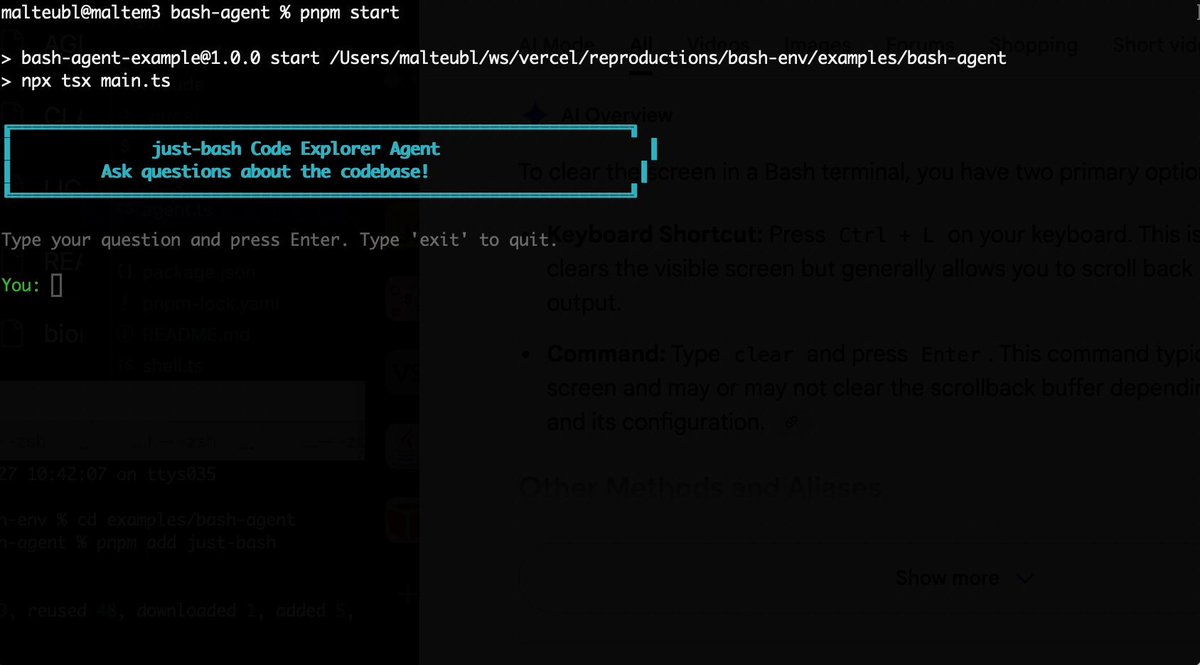
Bash is all you need! Which is why I'm introducing my holiday project: just-bash just-bash is a pretty complete implementation of bash in TypeScript designed to be used as a bash tool by AI agents. Because it turns out agents love exploring data via shell scripts, even beyond coding. It comes with grep, sed, awk and the 99th percentile features that an agent like Claude Code or Cursor would use. In fact, Claude Code can use it for secure bash execution. In the package - A bash-tool for AI SDK - A binary for use by yourself or your coding agents - An overlay filesystem to feed files to your agent securely - A Vercel Sandbox compatible API, so you can quickly upgrade to a real VM if you need to run binaries - An example AI agent that explores the just-bash code base using just-bash - I imported the Oils shell bash compatibility suite and just-bash passes a very good chunk What is interesting about this codebase: It was essentially entirely written by Opus 4.5. Coding agents love bash and they are good at reproducing it. They are also great at text-book recursive descent parsers and AST tweet-walk interpreters. That said, it is, like, a lot of code and I didn't read it all 😅. This is very much a hack, but it also seems to be _really_ useful. I haven't really found anything agents want to use that it doesn't support and it's fast and secure (caveats apply). It doesn't have write access to your computer and the filesystem is given a root that the agent cannot escape from. Find it at Related: Our recent blog post how we migrated our data analysis agent to bash tools and achieved incredible quality improvements The video shows the example agent investigating the just-bash code base

Malte Ubl

125,326 Aufrufe • vor 7 Monaten

🚨In Key West, an ICE/Border Patrol agent threatened to PULL A U.S. CITIZEN OUT OF THE CAR because he cursed at an agent… then had the audacity to tell the U.S. citizen to “learn your laws.” So, let’s learn them. In the video, Border Patrol agents pulled over a car of U.S. citizens and demanded everyone hand over their IDs. When the passenger says, “Bitch, fuck you,” an agent asks what he said and then threatens to pull him out of the vehicle if he “says one more thing like that.” The passenger correctly asks: “For what? That’s freedom of speech.” The agent responds: “That’s not how that works. Learn your laws.” Oh, we’re going to… Cursing at a government agent is not, by itself, a crime. The First Amendment protects a significant amount of verbal criticism, insults, and profanity directed at law enforcement, as long as it is not a physical threat. The government cannot punish people simply for verbally challenging or criticizing law enforcement. And it gets even worse. After the passenger calls the agent a “fucking white cracker,” the agent asks what he called him… and then tells another agent he is “thinking of calling in and arresting this guy.” For what? Because he hurt your feelings? The government does not get to arrest someone for speech they don’t like. And yes, Border Patrol has special authority near the border. That includes operating immigration checkpoints where agents can briefly stop vehicles, without individualized reasonable suspicion, for immigration questioning. But, that is different from a roving patrol stop. When not operating at a checkpoint, Border Patrol needs reasonable suspicion to pull over a vehicle for immigration questioning. And even at a checkpoint, the agents’ authority is not unlimited. A checkpoint stop does not automatically give them the right to search the vehicle, indefinitely detain people, or arrest someone because they said something an agent didn’t like. The Constitution does not say… “You have freedom of speech, unless a federal agent gets offended.” It says the government cannot punish you for exercising that right. And perhaps the most important part of this entire video is… The passenger knew his rights better than the federal agent threatening him. The agent told the U.S. citizen to learn his laws… But maybe the agent should have learned them first.

Jesus Freakin Congress

330,866 Aufrufe • vor 16 Tagen

What does the reputation model look like for agents? (alpha leak below) And how do we associate the proofs that we have about human beings with the agents who represent them? You may have heard of a process called KYC or Know Your Customer. That's very common with traditional financial applications and services. We have introduced a concept that we call KYA or Know Your Agent, which is a structured way to be able to express what model, how data was used in training, who the deployer is, what entities this agent instance is accountable back to, providing not only provenance but identity of the associated organization or entity. That's also another root of trust that we think about a lot: Enterprises and organizations tied back to things like their domains. To share a little bit of an alpha leak here, a product that we're excited to be rolling out in the next few weeks will allow our enterprise partners to more easily verify and prove the traits and capabilities of their teams as well as their counterparties. On the agent front, that makes it really easy to prove that an agent is acting on behalf of a given business or entity. We've already seen lawsuits where the absence of such technology has been a huge risk, such as with airlines that incorporate ChatGPT wrappers in their support pages. And then those AI enabled interactions end up making up plane tickets that don't exist and those airlines have to honor them. As small of an example as that might be, being able to prove agent accountability also unlocks a huge set of opportunities for use in enterprise for those agent to agent interactions. The Deep Trust Framework that our team has put together that we're excited to be bringing into a friendly SDK form in the next few weeks for some of our partners includes those reputation based capabilities, so how you can basically keep track of the interactions an agent has had, associate all of that to the entity to which they're accountable, and then that creates a sustainable reputation model for these agent to agent Interactions. Source: Billions CEO Evin McMullen evin speaking at House of Chimera Spaces Event Dec 3, 2025

Billions Network

68,503 Aufrufe • vor 8 Monaten

This is insane. An AI agent can run every boring job in outbound. We spent the last 6 months building ours. Here are my 8 favorite agents to build: Replies get sorted before we open the inbox. Campaigns go live from one command. Weak inboxes pull themselves out before they hurt a domain. Here are the agents behind it: 1. Reply Agent Reads every reply and drafts the response. A human reviews, edits, and sends. 2. Mailbox Health Agent Watches inbox and domain health. It predicts when you need new mailboxes, then buys and warms them. 3. Campaign Optimizer Agent Checks every live campaign every 6 hours. If 500+ leads were emailed and replies are under 4%, it tests new copy, replaces inboxes replying under 1%, and shifts sending to better hours. 4. Lead Qualification Agent Scores each lead by company size, industry, and tech stack. It enriches the record, updates your CRM, and only loads qualified leads into campaigns. High-priority prospect? You get a Slack ping. 5. Meeting Booking Agent Finds meeting requests inside replies. It books the slot, writes prep notes using the lead's background, sends reminders, and logs the outcome. 6. Pipeline Progression Agent Tracks opens, clicks, and website visits. It moves the CRM stage, triggers the next sequence, and creates a task when a lead shows real intent. 7. Copywriting Agent Writes cold emails and follow-ups in the campaign's voice. 8. Analytics Agent Watches campaign metrics in real time and explains what to fix in plain language. We built ours with custom code. Smartlead's SmartAgents let you build agents like these from a plain-English prompt, inside the platform where your campaigns already run. If you repeat an outbound task more than twice a week, that is an agent you have not built yet. Which one would you build first?

Hosun Chung

156,050 Aufrufe • vor 25 Tagen

Anthropic's Claude Ai Agents Team just Educated how to build production AI agents in under 30 mins. For Free. From the engineers who built the stack. CANCEL Your Weekend Plans, and Learn to Build AI Agents Today. Bookmark it. Watch it. Build your first production agent this weekend. $5,000/month. $7,000/month. $12,000/month. People are building agents for clients and charging $$$ as Beginners. You're still stuck in the thinking about AI phase. This video fixes that tonight. Follow Himanshu Kumar for more high-signal content that actually moves your AI engineering career forward. ↓ Ivan Nardini runs Developer Relations for AI at Google Cloud. He just gave away the entire production agent stack in 30 minutes. This is the talk that separates people deploying AI agents that actually scale from people whose agents break the moment they leave localhost. Here's everything inside. I break down a production AI video like this every week. Follow Himanshu Kumar. ↓ The 4-part agent stack that actually scales. Most devs are duct-taping frameworks together and calling it an "AI agent." Ivan lays out the real stack: Agent Development Kit (ADK): open-source, code-first framework for building, evaluating, and deploying agents. Supports Claude models through Vertex AI directly. Model Context Protocol (MCP): lets your agent talk to any tool or data source with one standard. Vertex AI Agent Engine: managed platform for deploying, monitoring, and scaling agents in production. No DevOps headaches. Agent-to-Agent Protocol: open protocol so agents built on different frameworks can actually work together. This is the stack replacing every hacky agent setup in production right now. Full MCP + Claude breakdowns drop weekly on Himanshu Kumar. ↓ Building your first real agent. Ivan builds a birthday planner agent live. LLM Agent class. Name it. Define instructions. Pick the model. He uses Claude 3.7 Sonnet. You could use Opus 4.7 for better reasoning. Full agent built in minutes. Not weeks. Watch the build once and you'll never structure an agent the wrong way again. I post agent architectures people pay $500 courses to learn. Himanshu Kumar. ↓ Multi-agent systems without the chaos. Single agents are easy. Multi-agent systems are where 99% of builders fail. Ivan extends the birthday planner by: Adding a calendar service through MCP tools Creating an orchestrator agent to route requests between agents Handling state and context across agent handoffs This is production multi-agent architecture. Clean. Scalable. Debuggable. Most tutorials hand-wave this part. This one shows you every step. Multi-agent orchestration content drops weekly on Himanshu Kumar. ↓ Deployment without the DevOps nightmare. This is where most AI projects die. You build a cool agent locally. It works. You try to deploy it. Everything breaks. Vertex AI Agent Engine fixes this: Minimal code deployment Automatic monitoring of latency, CPU, and memory Built-in observability and logging No infrastructure setup needed You provide config and requirements. The platform handles the rest. This is how agents actually get to production. Deployment guides for Claude agents post every week. Himanshu Kumar. ↓ Agent-to-Agent Protocol: the future nobody's talking about. Most people don't know this exists yet. The A2A Protocol lets agents built in different frameworks communicate seamlessly. Your Claude agent. My LangChain agent. Someone else's CrewAI agent. All talking to each other. All solving parts of the same problem. All without custom integration code. This is the infrastructure layer of the coming AI economy. Getting in early on A2A Protocol is like getting in early on HTTP in 1995. A2A deep dive coming soon. Himanshu Kumar. ↓ 30 minutes from the team shipping this in production. You'll learn more from this than from 6 months of YouTube tutorials made by people who've never deployed an agent past localhost. People who watch this understand production AI agents at the architect level. People who skip it keep hacking together frameworks that break every time an API updates. Save the video. Watch it tonight. Build a real agent this weekend. Follow Himanshu Kumar for more high-signal content that actually moves your AI engineering career forward.

Himanshu Kumar

228,497 Aufrufe • vor 3 Monaten

🚨BREAKING: An ICE agent was filmed sitting on top of a man and repeatedly punching him in the head during an arrest in Plainfield, New Jersey. In the video, three ICE agents are already on top of the man. One agent is holding his legs, another is sitting on him, and a third is restraining his arms and putting him in handcuffs. Then, the agent sitting on him starts punching him directly in the head. The man has one hand handcuffed and is using his other hand to try to shield his head from the punches. The person filming yells, “Hey!” The agent looks directly at them… And then seconds later punches the man in the head AGAIN. ICE agents do NOT get unlimited permission to beat someone just because they are arresting them. The Fourth Amendment protects people from unreasonable force during an arrest. That means ICE agents cannot just use whatever amount of force they want because they are making an arrest. ICE’s own detention standards say force is supposed to be limited to what is necessary to gain control, and explicitly state that physical force or restraints are not to be used as punishment. Looking at the video it appears the agents have control of the man… The man was already partially handcuffed and was using his free hand to try to protect his head from being punched. So why is an agent repeatedly punching him in the head? This is another agent that needs to be investigated… Because being arrested does not mean you lose your right to be free from excessive force.

Jesus Freakin Congress

79,528 Aufrufe • vor 20 Tagen

AG-UI makes building agentic applications dramatically easier. Here's how it works. This is a model for a simple chatbot: User → LLM → Response But interactive agents that render UI, pause for approvals, and ask users for input need a much more complex model. When building these agents, a response from the LLM will include a series of state changes as the agent runs: • Agent started a task • Agent called a tool • Agent updated its state • Agent streams these tokens • Agent is waiting on a human • Agent is resuming the task The Agent-User Interaction Protocol (AG-UI) treats the LLM response as a stream of events rather than a text endpoint. In practice, here is what you get as an agent runs: 1. Lifecycle events so your UI knows where the agent is. 2. Text messages that stream tokens. 3. Tool calls so your UI can prefill a form with any required arguments. 4. State updates that keep your UI in sync with the agent. 5. Special events for human approvals, rich media, and custom needs. All of these events travel over standard transports (SSE, WebSockets, or plain HTTP) as JSON. As a result, you can build a frontend that stays in sync with the agent's progress without having to invent a custom process to make this happen. For example, building a human-in-the-loop workflow becomes an off-the-shelf component you can integrate rather than build from scratch. CopilotKit🪁 is the creator of AG-UI, and you can use it when building frontend applications pretty much anywhere: • React • Angular • Vue • React Native • Slack • Teams • Discord • WhatsApp • Telegram Here is the link for you to check it out: Thanks to the CopilotKit team for partnering with me on this post.

Santiago

17,438 Aufrufe • vor 1 Monat