Video wird geladen...

Video konnte nicht geladen werden

Zur Startseite

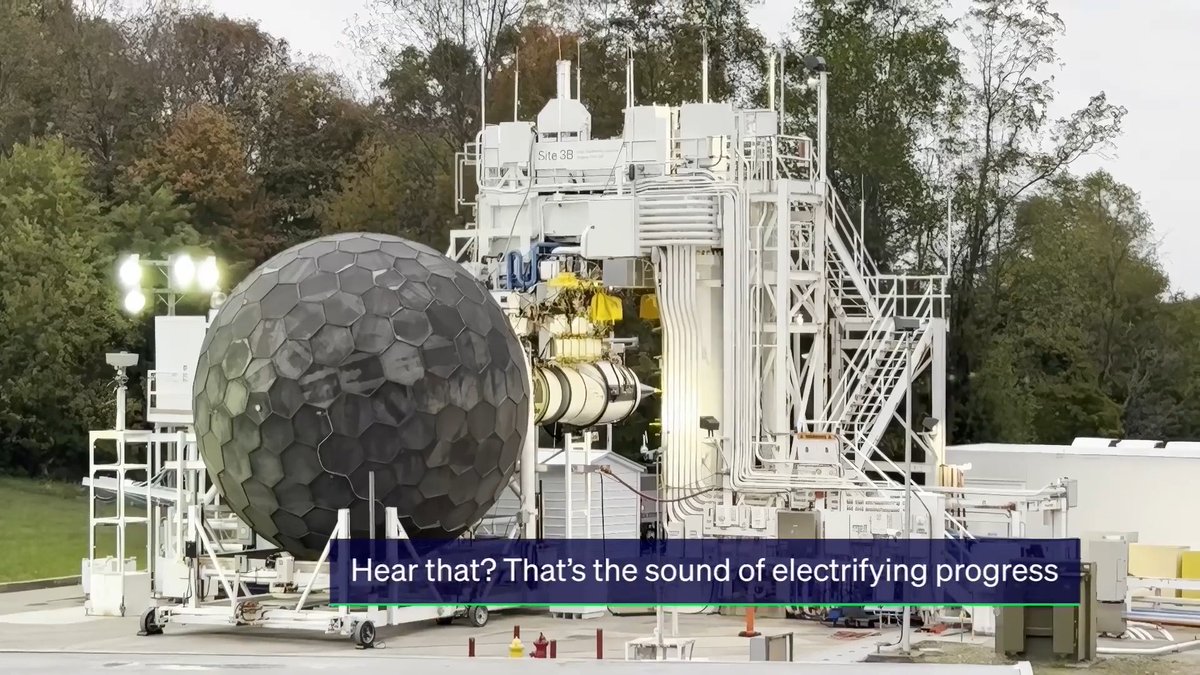
NASA has developed and tested this Rotating Detonation Rocket Engine (RDRE). Engineers at NASA’s Marshall Space Flight Center in Huntsville, Alabama, successfully tested a novel, 3D-printed RDRE for 251 seconds (or longer than four minutes), producing more than 5,800 pounds of thrust. That kind of sustained burn emulates typical...

3,958,858 Aufrufe • vor 2 Jahren •via X (Twitter)

0 Kommentare

Keine Kommentare verfügbar

Kommentare vom Original-Post werden hier angezeigt

Ähnliche Videos

NEWS: SpaceX has released a statement after today's successful 11th Starship test flight. "Every major objective of the flight test was achieved, providing valuable data as we prepare the next generation of Starship and Super Heavy. The flight test began with Super Heavy igniting all 33 Raptor engines and ascending over the Gulf. The successful first-stage ascent was followed by a hot-staging maneuver, with Starship’s upper stage igniting its six Raptor engines to continue its flight to space. Following stage separation, the Super Heavy booster completed its boostback burn to put it on a course to a pre-planned splashdown zone off the coast of Texas using 12 of the 13 planned engines. Under the same angle of attack tested on the previous flight, the booster descended until successfully igniting all 13 planned engines (including one that did not relight during the boostback burn) for the high-thrust portion of the landing burn. The booster successfully executed a unique landing burn planned for use on the next generation booster. Super Heavy hovered above the water before shutting down its engines and splashing down. After completing a full-duration ascent burn, Starship achieved its planned velocity and trajectory. During flight, Starship successfully deployed eight Starlink simulators and executed the third in-space relight of a Raptor engine, demonstrating a critical capability for future deorbit burns. Starship re-entered the Earth’s atmosphere and was able to gather extensive data on the performance of its heatshield as it was intentionally stressed to test the limits of the vehicle’s capabilities. In the final minutes of flight, Starship performed a dynamic banking maneuver to mimic the trajectory that future missions returning to Starbase will fly. Starship then guided itself using its four flaps to the pre-planned splashdown zone in the Indian Ocean, successfully executing a landing flip, landing burn, and soft splashdown. Focus now turns to the next generation of Starship and Super Heavy, with multiple vehicles currently in active build and preparing for tests. This next iteration will be used for the first Starship orbital flights, operational payload missions, propellant transfer, and more as we iterate to a fully and rapidly reusable vehicle with service to Earth orbit, the Moon, Mars, and beyond."

Sawyer Merritt

273,302 Aufrufe • vor 9 Monaten

🚨 A FORMER NASA ENGINEER CLAIMS HE’S DISCOVERED A “NEW FORCE” THAT CAN OVERCOME EARTH’S GRAVITY WITHOUT ANY PROPELLANT. Charles Buhler, who spent years leading NASA’s Electrostatics and Surface Physics Laboratory at Kennedy Space Center, says his private company Exodus Propulsion Technologies has found a way to generate thrust using only electric fields. In vacuum chamber tests, their device reportedly produced enough force to counteract Earth’s gravity a claim that would completely rewrite the rules of propulsion. Why this matters: For over a century, every rocket we’ve ever launched has had to carry massive amounts of fuel. If this “New Force” is real, spacecraft could one day maneuver indefinitely without expelling mass potentially making deep space travel, satellite station-keeping, and even atmospheric flight dramatically cheaper and more efficient. The deeper implication is staggering: We may be looking at the first real breakthrough in propellantless propulsion since the invention of the rocket. If verified, this wouldn’t just change space travel it could reshape how we think about energy, momentum, and the fundamental laws of physics. Of course, extraordinary claims require extraordinary evidence. As of now, the work is still awaiting independent replication by outside laboratories. But if this holds up… What changes first space travel, energy production, or something we haven’t even imagined yet? Follow for more frontier physics and emerging technologies.

TheNewPhysics

122,021 Aufrufe • vor 2 Monaten

🚨 NEWS FROM NASA In a bold and decisive move, NASA Administrator Jared Isaacman just announced a $20 billion plan to build America’s permanent base on the Moon — and they’re doing it in just 7 years. Today, NASA officially confirmed it is cancelling plans for the Lunar Gateway — the small space station that was supposed to orbit the Moon as a waypoint for astronauts. Instead, those components and resources will be repurposed directly for the surface base, accelerating humanity’s return to sustained lunar presence. The goal is clear — move beyond short visits and flags-and-footprints missions. NASA wants a real, long-term foothold on the Moon: habitats, power systems, rovers, scientific labs, and infrastructure that can support crews for months at a time. This base will serve as the foundation for deeper space exploration, resource utilization (like mining lunar ice for fuel and water), and eventually — Mars. The $20 billion investment over the next seven years will reshape major parts of the Artemis program. It comes with real urgency too — China is pushing hard toward its own crewed Moon landing by 2030, and the U.S. is determined to lead, not follow. This isn’t just about science. · A permanent lunar base means:Testing technologies for Mars missions in a real off-world environment · Developing in-situ resource utilization (turning Moon dirt into rocket fuel and oxygen) · Opening the door to a true cislunar economy · Inspiring the next generation of engineers, scientists, and explorers Private industry will play a massive role, as always — with contractors already building key hardware now being redirected. This is the kind of ambitious, focused leadership the space program has needed. From the first boots on the Moon in 1969 to building a thriving outpost there by the early 2030s — what an incredible leap forward. Significanly, the Moon isn’t just a destination anymore: it’s becoming home base for humanity’s expansion into the Solar System.

Massimo

241,646 Aufrufe • vor 4 Monaten

🚨 CHINA IS RACING TO BUILD A SPACE SOLAR POWER PLANT THAT COULD BEAM ELECTRICITY FROM ORBIT TO EARTH. Scientists at Xidian University have successfully tested a ground-based system that can wirelessly transmit kilowatt-level power over 100 meters using microwaves. Their ultimate goal is far more ambitious: placing large solar power stations in geostationary orbit (36,000 km up), where sunlight is available 24/7 with no weather or atmosphere blocking it. The project, called Zhuri (“chasing the sun”), uses mirrors to concentrate sunlight onto solar panels, converts the electricity into microwaves, and beams it down to a receiving antenna (rectenna) on Earth. Why this matters: • In space, solar energy is up to 6 times more efficient than on Earth because there’s no night, clouds, or atmospheric filtering • A single large space solar station could theoretically generate gigawatts of continuous clean power enough for millions of homes • The team has already proven the system can beam power to multiple moving targets at once • China is now among the world leaders in this technology, alongside the US and Japan The deeper implication: Space-based solar power has been a dream for decades because it could provide truly baseload renewable energy. While the technical and financial challenges are enormous (building massive structures in orbit, precise microwave beaming, and safety), steady progress like this brings the concept closer to reality. If successful, it could fundamentally change how humanity generates and distributes energy moving power collection off the planet entirely. Near-term applications could include wirelessly charging satellites or powering future lunar bases. Do you think space-based solar power will become a major energy source in the coming decades, or will it stay too expensive and complex? Follow for more frontier energy and space technology developments.

TheNewPhysics

15,361 Aufrufe • vor 1 Monat

When a spacecraft leaves Earth, it doesn’t just fire its engines and head straight to its destination. In many missions, especially those going beyond low Earth orbit, there’s a more subtle and elegant strategy at play, one that uses gravity itself as part of the navigation system. This is often called a gravity assist, or a slingshot maneuver. But in the case of missions like #Artemis II, what’s being used is a closely related idea known as a free-return trajectory. At first glance, it might sound simple: the spacecraft goes to the Moon, loops around it, and comes back. But the physics behind it is anything but simple. Instead of relying on continuous propulsion, the spacecraft follows a carefully calculated path through the gravitational field of the Earth–Moon system. It is launched with just the right speed and direction so that, as it approaches the Moon, the Moon’s gravity bends its trajectory. The spacecraft is effectively flung around the Moon, redirected onto a path that naturally brings it back toward Earth. No major engine burn is needed for the return. Small trajectory corrections may still be required, but gravity does the heavy lifting. That’s the key. This kind of trajectory is not just efficient, it’s also safe. If something goes wrong with the spacecraft’s engines or onboard systems, gravity itself ensures the return. It’s an inherent backup plan, built into the trajectory from the very beginning. The same fundamental idea appears in gravity assists used across the Solar System. When a spacecraft flies past a planet, it can gain or lose speed by exchanging momentum with that planet. From the spacecraft’s point of view, it’s as if it has been accelerated without using fuel. In reality, it has borrowed a tiny amount of orbital energy from the planet itself. That’s how missions like Voyager reached the outer planets, and how probes continue to explore regions far beyond what their onboard fuel alone would allow. But there’s an important distinction. An interplanetary gravity assist is typically used to change speed and direction, often increasing the spacecraft’s energy. A free-return trajectory, like the one used in Artemis II, is designed for something more specific: a path that naturally loops back to Earth without requiring additional propulsion. It’s less about gaining energy, and more about shaping a trajectory that guarantees a return. To understand why this works, it helps to stop thinking in straight lines. In space, motion follows curves defined by gravity. The spacecraft is constantly falling, first toward Earth, then toward the Moon, and then back toward Earth again. What looks like a loop is really a continuous free fall through a changing gravitational landscape. This way of navigating space reveals something deeper. We tend to think of engines as the drivers of motion, but once a spacecraft is on its way, gravity does most of the work. The art of spaceflight is not just about thrust. It’s about knowing when not to use it. #GoodLuck #Artemis NASA Artemis

Erika 

234,886 Aufrufe • vor 4 Monaten