Loading video...
Video Failed to Load
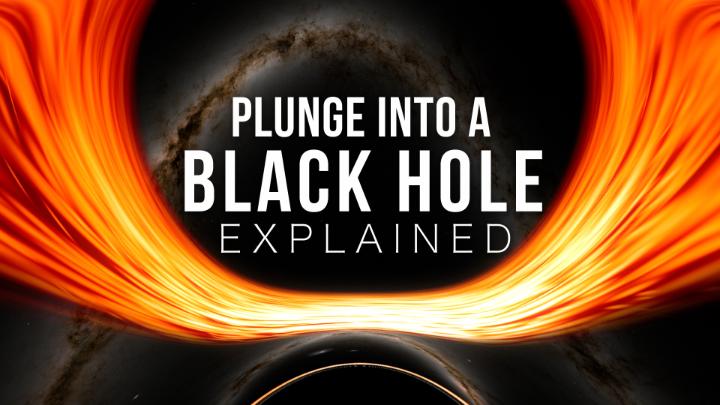
NASA supercomputer recreate what it would look like fall into black hole.
231,474 views • 2 years ago •via X (Twitter)
10 Comments

No offense, but it took a supercomputer to come up with THAT?

NASA is wasting money by creating these completely fake animations of what it would be like to fall into a black hole. We have no idea what it would look like, we have no idea if visibility would even be possible but here they create this.

They get $65 million dollars of US tax payers money a day and this is the best they can do?! 🤦🏻♂️

I was expecting this as soon as it zoomed into the void.

Anytime I seem the word NASA I keep scrolling…

we don't know what we don't know....

Cue the music from 2001 A Space Odyssey as Dave gets spaghettified

It misses something important: As you fall into the black hole, the universe around you will move faster and faster. First, the accretion disc will turn blue and become hard radiation before you will see the galaxies around you dance faster and faster until the last lights go out

A black hole is a region in spacetime where gravity is so strong that nothing, not even light, can escape. They are formed by the collapse of massive stars at the end of their life cycle. Key characteristics of a black hole: Event Horizon: The boundary around the black hole beyond which nothing can escape, not even light. It's like a point of no return. Singularity: The theoretical center of the black hole, where the laws of physics as we know them break down. It's a point of infinite density and gravity. How black holes form: Massive Star: A star at least 20 times the mass of our Sun runs out of fuel. Collapse: The star's core collapses under its own gravity. Supernova: This collapse triggers a massive explosion called a supernova. Black Hole: If the remaining core is dense enough, it continues to collapse, forming a black hole. Types of black holes: Stellar black holes: Formed from the collapse of a single star. Supermassive black holes: Millions or even billions of times the mass of our Sun, found at the center of most galaxies. Intermediate black holes: A hypothetical type of black hole with mass between stellar and supermassive black holes. Detecting black holes: Black holes cannot be directly observed since they do not emit light. However, their presence can be inferred through their effects on surrounding matter: Gravitational lensing: The bending of light around a black hole, which can distort the appearance of distant objects. Accretion disk: A hot, glowing disk of gas and dust orbiting a black hole. X-ray emissions: Produced when matter is heated to extreme temperatures as it falls into a black hole. Gravitational waves: Ripples in spacetime caused by the collision of two black holes.

Black hole is entrance to 2nd dimension. We would be altered in form.