Video wird geladen...

Video konnte nicht geladen werden

Zur Startseite

Netflix had a slide in its original culture deck that said "adequate performance gets a generous severance package." Reed explains why Netflix paid 4-9 months severance packages and how the Keeper Test actually worked: "One of the best things is to do large severance packages like four to nine...

462,382 Aufrufe • vor 7 Monaten •via X (Twitter)

0 Kommentare

Keine Kommentare verfügbar

Kommentare vom Original-Post werden hier angezeigt

Ähnliche Videos

The founders of Stripe and Pinterest on how to convince people to join your startup Stripe CEO Patrick Collison argues that part of the reason startups resonate so much is because the outcome is not guaranteed: "If it were guaranteed, it would be boring... Whether or not you're the best person in the world at what you do, you're probably not going to alter Google's trajectory. But if you really want to benchmark yourself and see how much of a contribution and impact you can make--which is a really compelling prospect for a lot of the best people--a startup is a much better place to test that." Pinterest founder Ben Silbermann emphasized this as well: "No smart person that you're hiring is under the illusion that you have a crystal ball into the future and that joining is a guaranteed thing. In fact, if you're telling them that and they select in, you shouldn't hire them because they didn't pass a basic intelligence test. I think it's important to tell them what's exciting and where you think the company can go. But also tell them where it will be hard and chart your best plan. And then tell them why their role can be instrumental--because it will be... What I would discourage doing is whitewashing all of that. If people are joining your company because they want all of the certainty and safety of working at Google but also the perks of working at a small startup with lots of responsibility and transparency, that's a really negative sign." Apparently in the early days of PayPal, Peter Thiel and Max Levchin would tell people after they interviewed all the reasons that the company would fail: "Visa and MasterCard want to kill us. We also might be doing something that's illegal. But if we succeed, we'll redefine payments." Don't whitewash the risks. Instead tell them how your startup will change the world if you succeed and how their role will be instrumental in affecting that change. Video source: Y Combinator (2014)

Startup Archive

11,811 Aufrufe • vor 9 Monaten

Rich Roll on why waiting to "feel like it" is a trap: "You can't think your way into the mood that you seek or the state of mind that you aspire to inhabit. Action is the only thing that can trigger that change." Rich uses running as the perfect illustration of this principle. Imagine you wake up in the morning and you're supposed to do a run because you're training for a race. You don't feel like it. So what do most of us do? "We all resort to that state where we think, 'Well, I don't want to do it right now. I'll just wait until I feel like doing it and then I'll do it then.'" But here's the problem with that logic: "If you're waiting until you feel like doing something, chances are you're probably never going to get to it." The mood you're hoping will arrive on its own? It's not coming. Not without action first. "To take the action despite how you feel about it is the thing that catalyzes the state change." You don't run because you feel motivated. You feel motivated because you ran. He points to what every runner knows from experience: "When they finish the run, they're always glad that they did it. They don't generally regret it. And then they feel better." Notice the sequence. The good feeling comes after the action, not before it. The state change is the reward for showing up, not the prerequisite. And this isn't just about running. As Rich puts it: "That example is applicable to all areas of life." The workout you're avoiding. The conversation you're delaying. The project you're putting off until you're "in the right headspace." You're waiting for a feeling that only exists on the other side of doing the thing.

Kevin Tanaka

10,256 Aufrufe • vor 3 Monaten

Brad Jacobs on identifying A players: "I do a mental exercise where I picture the person coming into my office and saying, 'Brad, I quit.' And then I try to feel and visualize what would be my reaction if that person came in to me and quit. If my reaction to that is, 'Yes! I don't want to smile, so I don't want to act like I'm happy about this. Nobody likes firing people. No problem at all, we'll replace them'—that's a C player. That's someone you should get the courage to get off the team right away. On the second category, if my reaction to it is, 'You know, it kind of sucks. I would've preferred that person stayed, but it's not the end of the world. We'll hire a headhunter. We'll get someone as good, maybe someone even better, and things will work out'—that's a B player. But if when I visualize that person quitting, my reaction to that is pure terror and absolute panic, and like somebody took a baseball bat and just whacked me in the stomach and then punched me in the face. I'm going, 'Oh my God! Like I'm never going to find someone as good as her. No way. I'm never going to have someone as talented as that person. I'm never going to have someone who brings to the table their particular superpower.' And I can't even hear what they're saying anymore because I'm just having this internal panic dialogue going on—that's what you call an A player. So I want all A players around me. I want people whose relationship with me I value so much that if it was terminated, I would be lost."

David Senra

689,794 Aufrufe • vor 9 Monaten

mingyu teaching the members how to drive and even going with them to get their license 👤 who did you teach? 🐶 hoshi hyung, woozi hyung… 🍒 dino! 🐶 i think i even went with them for their written test? as you know, you get your license at the testing place. and from my experience of it the first time, you take the written test then the driving course test. but within that time, it’s too late when you get a ticket for the driving course test right after coming out from the written test. so i thought about it, “the members are going to take it tomorrow, but the timing won’t be too bad if someone gets the ticket for them in the middle of their test. so they can probably do the driving course test as soon as they come out from the written test”… i’m not sure why i did but i went to the testing place with them 🍒 he said he’d do it for them! 🐶 i did, i told them i’d do it so that they can do their driving course test on the same day too. so after they went to take the written test, it was about an hour long, i got the ticket about 40 minutes in. once they got out, i gave both of them their tickets and said they could take the driving course test right away and they were able to 👤 how reliable! 🐶 why was i like that then... but woozi hyung still doesn't have his driver's license! he only took up to the driving course test 👤 really? but if you fail once then you just think “i’ll do it next time!” and it ends up getting pushed back 🐶 its so funny, why did i do that? what did i do for an hour just sitting there?! and it’s meaningless if they failed! 🍒 mingyu has a lot of those sides to him~

🐶

158,359 Aufrufe • vor 10 Monaten

.Rob Miles is spitting fire: “People are starting from a prior in which ‘[AIs] are safe until you give me an airtight case for why they're dangerous.’ This framing is exhausting. You explain one of the 10,000 ways that AIs could be dangerous, then they explain why they don't think that specific thing would happen. Then you have to change tack, and then they say, 'your story keeps changing'... "If you're building an AGI, it's like building a Saturn V rocket [but with every human on it]. It's a complex, difficult engineering task, and you're going to try and make it aligned, which means it's going to deliver people to the moon and home again. People ask “why assume they won't just land on the Moon and return home safely?" And I'm like, because you don't know what you're doing! If you try to send people to the moon and you don't know what you're doing, your astronauts will die. [Unlike the telephone, or electricity, where you can assume it’s probably going to work out okay] I contend that ASI is more like the moon rocket. "The moon is small compared with the rest of the sky, so you don't get to the moon by default - you hit some part of the sky that isn't the moon. So, show me the plan by which you predict to specifically hit the moon." And then people say, “how do you predict that [AIs] will want bad things?” There's more bad things than good things! It's not actually a complicated argument... I'm not going to predict specifically where it off into random space your astronauts are going, but you're not going to hit the moon unless you have a really good, technically clear plan for how you do it. And if you ask these people for their plan, they don't have one. What's Yann Lecun’s plan?” "I think that if you're building an enormously powerful technology and you have a lot of uncertainty about what's going to happen, this is bad. Like, this is default unsafe. If you've got something that's going to do enormously influential things in the world, and you don't know what enormously influential things it's going to do, this thing is unsafe until you can convince me that it's safe." HOST: “That’s a good way of thinking about it - with some technologies you can assume that the default will be good or at least neutral, or that the capacity of a person to use this in a very bad way is bounded somehow. There's just only so many people you could electrocute one by one."

AI Notkilleveryoneism Memes ⏸️

77,361 Aufrufe • vor 3 Jahren

#poon_mit12 🐶: I just want to bring up one point. Actually, I don't know if anyone will be upset with me or feel bad, but I'd like to address one thing, everyone. It's been stuck in my heart for several days now. I was on X and I wasn't very comfortable the other day when I opened it up and saw our fanclub fighting. Honestly, the comments from all sides were deleted, but I read them all. I feel like everyone has their own reasons; I understand why this person would think this way or why that person would think that way. But what I want to say is in the end, I'm not stressed, but I just feel like we are on the same side! We are in the same team, please don't worry. And when you guys fight, I'm begging you, let's just be happy together instead, because we're already on the same team. I wanted to tell everyone that seeing you guys fight amongst yourselves makes me uneasy. We're people on the same side, yet.. and actually, I find it kind of funny. I feel like fans fighting is just like a couple fighting. It's like, 'Why didn't you do that?' or 'Why didn't I do this?' and things like that. I feel that some people might feel bad, and I apologise if this is a sensitive issue. But I feel it's actually something quite cute, because in the end, everyone just wants to push and support (us). Everyone wants to push us forward, and I believe that all four of the main actors are giving it their all already. So I really want all the fanclub members to love each other, please. We are on the same team, and I love you all.

chu⋆𐙚.˚

40,972 Aufrufe • vor 4 Monaten

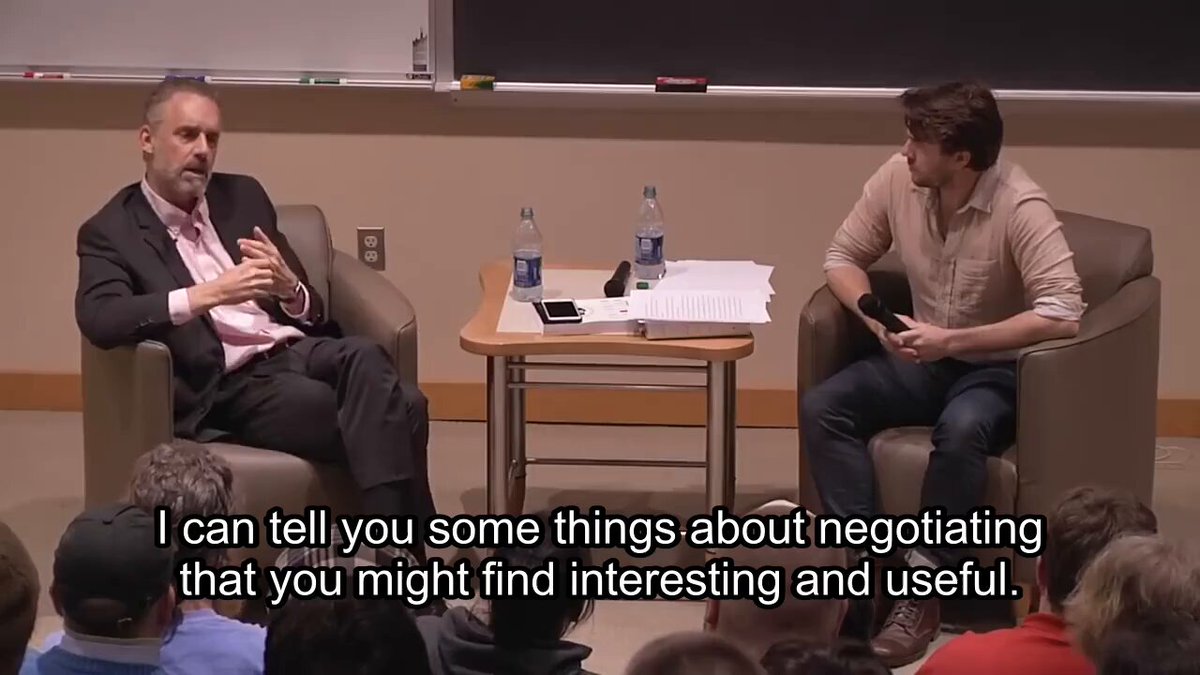
Jordan Peterson: "If you're competent and silent you will be ignored." "You might think well people should reward you because you're competent. And yes of course they should. But if you're competent and silent then you're just part of the background that's keeping everything functioning" On why you cannot negotiate from a position of weakness: "If you want to push your career forward you have to push it forward. You have to be competent and you have to be strategic" "To be strategic when you negotiate for a new position or a new salary you have to be able to say if you don't give me what I want then something you don't like will happen to you" "It's not a physical threat. It's that you have an option" "You have your CV in order. You're educated and competent and desirable to people outside of your immediate job. You're willing to instantly put yourself on the job market" "So that when you go talk to the person you're negotiating with you're credible" On the one thing most people completely miss about negotiation: "It's very seldom that you're talking to the person who's at the top of the pecking order. What you need to do is tell them a story that they can tell to their boss to make you not a problem" "A good story is look we really need this person because they're hyper competent and they have a better offer" "If you go in there with no power you're going to lose. Obviously" He concludes with the one thing every competent person needs to hear: "The first thing you need to know if you're going to negotiate is that you have to be able to say no. And what no means is that you're not going to do it"

Brad

34,992 Aufrufe • vor 14 Tagen

Rick Rubin: "Make what you love, not what you think people will like" "If you want to live in a creative way, which will benefit everything in your life, be a better person in your family, do a better job starting a new business, it's all the same. I don't really know anything about music. It's more a way of looking at the world and wanting it to be the best it could possibly be. And doing whatever it takes to be the best it could possibly be." Rubin shares how his career happened: "From the beginning, I never thought any of the things I'm doing were possible or realistic. I just did things out of the love of them, thinking I would have real jobs. That my passion would be my hobby, and I'd have a job to support my hobby. And it just magically turned out different than that without me knowing it was possible." On why some things connect and others don't: "The stars line up at certain times for certain things to happen. Sometimes you can make something great, and it doesn't connect for whatever reason. Sometimes you make two things you think are the two best things you've ever made. One of them connects with the world. One of them doesn't. And it might not have anything to do with what's in the art. It might be that it came out the same day as something else. Or there was a bigger story at the time. There's so much to it that we don't understand." He continues: "All we can do is make something good and put it out and hope for the best. That's all there is. We never know why things work. Even if you make a piece of art and it works, you may not know why." On talent versus work ethic: "There are a lot of talented people who never make it because they don't have the work ethic. It's not just talent, talent's a piece. And you could argue for some people, the work ethic trumps the talent." Rubin explains what real collaboration is: "Having worked with a lot of bands, I see there's often this friction where people are trying to get their idea in. That's not a collaboration. A real collaboration is when everyone who's there is working together towards whatever is the best thing for the whole. Whether it's your idea or someone else's idea, it doesn't matter. If you're invested in the collaboration, you want the best idea to win. You don't want your idea to win." On what makes art great: "What makes it great is the personal. With all of its imperfections. With all of its quirkiness. That's what makes it great. How you see the world that's different from how everyone else sees the world. That's why you're an artist. That's your purpose in sharing your work with the world." He warns against being derivative: "There are these derivative voices where they're finding what they think other people want to hear, and they start saying it because they've heard other people say similar things that are now successful. Even if they have some short-term success doing that, it's not revolutionary. It doesn't change the world. It doesn't last. The people who you first see and you might not like that you come to like because you don't understand them at first, those are the ones that change the world. Those are the ones you dedicate your fandom to for life." Rubin shares his philosophy on taste: "You can't second-guess your own taste for what someone else is going to like. We're not smart enough to know what someone else is going to like. To make something thinking, 'Well, I don't really like it, but I think this group of people will like it,' it's a bad way to play the game of music or art. You have to do what's personal to you. Take it as far as you can go. Really push the boundaries. And people will resonate with it if they're supposed to resonate with it." He describes creativity as catching waves: "We're really talking about magic. The universe conspiring on our behalf if we let it. Being in this flow of catching these waves that anyone can catch. If you're trying to catch it, you're open to it, you see it coming, you take off on every chance you get. And sometimes the ride happens. It's remarkable how it happens. It doesn't come from preconception. It's not an idea. It's through the doing." Rubin explains how ideas exist in the universe: "Have you ever had that experience where you have an idea for something, you don't do it, and then six months later you see someone else has done it? It's not because they took your idea. It's that it's time for that, and you can act on it or not. The best artists are the ones who have the best antenna for this material that's available. It's coming through. The best comedians see the best jokes. They see them coming. We all live in the same world; the way you see it, you have the best joke because you see it best." He closes with how to stay open: "If we listen to what's going on around us, you can overhear a conversation in a coffee shop, and it is the setup for an idea you're working on. You hear a phrase you don't commonly use. My experience is: when you are open and looking for these clues in the world, they're happening all the time. And they're happening often right when you need them."

Jaynit

109,182 Aufrufe • vor 4 Monaten

Jordan Peterson: "If you can't fix your room, you can't fix your life" "Why should you even bother improving yourself? The answer is something like: so you don't suffer anymore stupidly than you have to. And maybe so others don't have to either. It's not some casual self-help doctrine. If you don't organize yourself properly, you'll pay for it. In a big way. And so will the people around you." Peterson continues: "You can say, 'Well, I don't care about that.' But that's actually not true, you do care about it. Because if you're in pain, you will care about it. It's very rare that you can find someone in excruciating pain who would say, 'Well, it would be no better if I was out of this.' Pain brings the idea that it would be better if it didn't exist along with it. It's incontrovertible." On how to start: "Look around for something that bothers you and see if you can fix it. You can do this in a room. Sit in your bedroom and think: 'If I wanted to spend ten minutes making this room better, what would I have to do?' You have to ask yourself that, it's a genuine question. And things will pop out. There's a stack of papers bugging you. Some rubbish behind your computer monitor you haven't attended to for six months. Cables tangled up." He explains why this matters: "If you were coming to see me for psychotherapy, the easiest thing would be to get you to organize your room. You think, is that psychotherapy? It depends on how you conceive the limits of your being. Start where you can start. If something announces itself as in need of repair that you could repair, fix it. Fix a hundred things like that, your life will be a lot different." On fixing what you repeat every day: "People tend to think of their daily routines as trivial. You get up, brush your teeth, have breakfast. Those probably constitute 50% of your life. People think, they're mundane, I don't need to pay attention to them. No, that's exactly wrong. The things you do every day are the most important things you do. Hands down. Just do the arithmetic." On staying within your competence: "Sometimes you don't know how to fix something. Imagine you're walking down the street and there's a guy who's alcoholic and schizophrenic and has been homeless for ten years. That's a problem. It would be good if you could fix it, but you haven't got a clue. You walk around that and go find something you could fix. Just because something announces itself as in need of repair doesn't mean it's you, right then and there, who should repair it. You have to have some humility. You don't walk up to a helicopter that isn't working and just start tinkering away." Peterson shares the key insight: "As soon as you give your mind a genuine aim, it'll reconfigure the world in keeping with that aim. That's actually how you see to begin with. You've all seen the video where you watch basketballs being tossed back and forth, and while you're doing that, a gorilla walks into the middle of the video and you don't see it. If you thought about that experiment for five years, that would be about the right amount of time to spend thinking about it." He explains what it reveals: "What it shows you is that you see what you aim at. If you can get one thing through your head, that would be a good one. You see what you aim at. One inference you might draw from that is: be careful what you aim at. What you aim at determines the way the world manifests itself to you. So if the world is manifesting itself in a very negative way, one thing to ask is: are you aiming at the right thing?"

Jaynit

68,799 Aufrufe • vor 4 Monaten