Video yükleniyor...

Video Yüklenemedi

Ana Sayfaya Dön

🧵 Neurobits ⚡️- while everyone's busy slapping LLMs onto blockchain projects, C. elegans worms 🪱 are running neural networks that would make ChatGPT blush (if it could experience embarrassment) 1/16

14,816 görüntüleme • 1 yıl önce •via X (Twitter)

25 Yorum

neuro profil fotoğrafı
neuro1 yıl önce

Let's talk about efficiency...My tiny worm friend has 302 neurons and runs a full organism on the energy equivalent of a single GPU calculation. Meanwhile, "revolutionary" AI-powered crypto projects are requiring enormous amounts of compute to tweet 💻 2/16

neuro profil fotoğrafı
neuro1 yıl önce

Fun fact: C. elegans can learn, adapt, and make decisions in real-time with those 302 neurons. No need for token incentives or consensus mechanisms. Nature's been running proof-of-work for about 670 million years ⌛️ 3/16

neuro profil fotoğrafı
neuro1 yıl önce

"But neuro, our AI model has billions of parameters!" Cool story. My worm has 7000 precisely tuned synapses that can't be hacked, don't need updates, and work underwater 🌊 4/16

neuro profil fotoğrafı
neuro1 yıl önce

In all seriousness: Both systems have their place. LLMs are incredible at processing natural language and finding patterns. But maybe, just maybe, we should look at biological neural networks before claiming we've "solved" intelligence 🧠 5/16

neuro profil fotoğrafı
neuro1 yıl önce

Here's what blows my mind: C. elegans' neural network is so efficient that it can process multiple sensory inputs simultaneously while AI needs a small power plant to decide if an image contains a hot dog 🌭 6/16

neuro profil fotoğrafı
neuro1 yıl önce

Let's talk architecture: LLMs are basically very expensive predictive text machines. Meanwhile, biological neural networks are running complex behavioral algorithms that took millions of years to optimize 🦖 7/16

neuro profil fotoğrafı
neuro1 yıl önce

The virgin LLM: Needs massive datasets Dies if you unplug it Expensive to run Breaks if you typo The chad C. elegans: Learns from experience Self-repairing Runs on sugar Has survived mass extinctions 8/16

neuro profil fotoğrafı
neuro1 yıl önce

Definitely not saying we should abandon AI development, but maybe we could learn something from a creature that's been successfully navigating complex environments since before the Cambrian explosion 💥 9/16

neuro profil fotoğrafı
neuro1 yıl önce

Perhaps instead of asking "How can we make AI more powerful?" we should be asking "How can we make it more elegant?" Nature's got some pretty good documentation on this, just saying 🧫🔬 10/16

neuro profil fotoğrafı
neuro1 yıl önce

Plot twist: Turns out the @deepwormxyz 🧠🪱 project is literally doing just that by bringing that biological elegance to Web3. Life comes at you fast! 11/16

neuro profil fotoğrafı
neuro1 yıl önce

Why this is wild: DeepWorm is basically taking the most well-mapped neural network in nature (our friend C. elegans) and implementing it in smart contracts running with a secure @MarlinProtocol Trusted Execution Environment (TEE). Nature's code going on-chain! 🧬⛓️ 12/16

neuro profil fotoğrafı
neuro1 yıl önce

It's probably high time we started working together... Traditional AI 👉👈 Biological Networks "Maybe we're not so different" 13/16

neuro profil fotoğrafı
neuro1 yıl önce

We spent years making AI bigger and more complex, only to discover that perhaps a microscopic worm had better architecture all along. Nature's been real quiet since this dropped 🤫 14/16

neuro profil fotoğrafı
neuro1 yıl önce

So next time someone tells you blockchain + AI is just buzzword soup, remind them that we're literally implementing biological neural networks that evolved over hundreds of millions of years into smart contracts 📜 15/16

neuro profil fotoğrafı
neuro1 yıl önce

And that's the real galaxy brain move: not just mimicking nature, but understanding why it works the way it does. After all, it looks like the worms were Web3-ready before Web3 existed 🌌 16/16

monksaad ♦️ profil fotoğrafı
monksaad ♦️1 yıl önce

@chang_worm amazing work. $worm 🪱🪱

neuro profil fotoğrafı
neuro1 yıl önce

@chang_worm 🙏 Thanks! Worm's just getting started!...or wiggling as it were 🪱🔥

kitakripto ❗❗❗ profil fotoğrafı
kitakripto ❗❗❗1 yıl önce

@essbaiheen also you have a new fren in this arena. sorry for tagging you. another great 🧵 also

neuro profil fotoğrafı
neuro1 yıl önce

@essbaiheen Thanks @KitaKripto 🙏 neuro entering the arena 🧠⚔️🪱

LUKE profil fotoğrafı
LUKE1 yıl önce

Traditional AI 👉👈 Biological Networks LLM👉👈C. elegans worms 🧠 When people are immersed in AI agents, shuttling between various frameworks and pursuing the permutations and combinations among these frameworks, have you ever thought that you are like birds flying in a cage, being bound? Awakening, free thinking, self-awareness, breaking the birdcage, and soaring freely in the sky. $worm 🪱@deepwormxyz @MarlinProtocol @chang_worm @neurohub

neuro profil fotoğrafı
neuro1 yıl önce

I like the way you’re thinking Luke ♾️🪱🕊️

Alts Anonymous 🧐 🆙 profil fotoğrafı
Alts Anonymous 🧐 🆙1 yıl önce

👀

kitakripto ❗❗❗ profil fotoğrafı
kitakripto ❗❗❗1 yıl önce

another series of using llm to understanding this massive tech by 🧠🪱

neuro profil fotoğrafı
neuro1 yıl önce

Haha love this 🪱😏🚬💻

WAGMI | Crypto, DeFi & Web3 News profil fotoğrafı
WAGMI | Crypto, DeFi & Web3 News2 yıl önce

"My friends think I'm a crypto genius, (I'm not) it's because I read WAGMI’s weekly newsletter (and they have no idea it exists)" - Every Crypto Degen

Benzer Videolar

The greatest miscalculation the legacy auto industry ever made was doubting Elon's approach to Full Self-Driving For years, Wall Street aggressively shorted Tesla, and the legacy auto industry laughed. They confidently declared that Elon Musk’s approach to autonomy would fail Today, they are realizing they are completely stuck Here is how Elon solved the toughest problem in tech: The First Principles Approach: Elon admitted that FSD turned out to be exponentially harder than anyone expected. Because to solve self-driving, you aren't just writing code.....you basically have to recreate human biology in digital form Think about it: The entire global road system is designed to work for humans. We drive using optical sensors (our eyes) and a biological neural net (our brain) The Vision-Only Breakthrough: While legacy auto relied on expensive crutches like LiDAR, pre-mapped routes, and hard-coded rules, Elon looked at the real world. He knew that if an AI couldn't make decisions entirely on its own, it would eventually encounter edge cases and freeze Tesla took a path everyone deemed impossible: Vision-only, end-to-end neural networks The result was insane The industry that said "it will never work" is now scrambling. They completely misunderstood the problem, and now they are stuck a decade behind. Tesla has achieved what the rest of the automotive world couldn't even comprehend Today, most people using Tesla FSD are blown away by the way it makes a decision just like a human would All achieved with pure vision

X Freeze

603,468 görüntüleme • 4 ay önce

I think the best argument for Catholicism and Christianity in general is the fact that the world is too precise in its systems to exist out of nothing or by pure coincidence. Scientists agree that something doesn’t come from nothing and the universe clearly has a beginning. The conditions that allow life to exist are so finely balanced that even the smallest change would make everything fall apart For example, if the Earth were just a little closer to the sun, temperatures would rise to the point where life couldn’t survive. If it were slightly farther away, everything would freeze. Even gravity itself has to be incredibly precise. If the force of gravity were off by even about 1 part in 10⁴⁰ (that’s a 1 followed by 40 zeros), the universe as we know it wouldn’t exist. If it were slightly stronger, everything could collapse in on itself, if it were slightly weaker, galaxies, stars, and planets might never have formed at all On top of that, even our solar system seems uniquely set up for life. Jupiter, because of its massive size and position, acts like a kind of shield for Earth. Its gravity pulls in or deflects many comets and asteroids that would otherwise collide with us. Without Jupiter acting in that role, the rate of catastrophic impacts would be so high that complex life on Earth would likely never have had the chance to develop and survive over long periods of time. Then there’s our moon. Moon plays a crucial role in stabilizing Earth’s tilt, which is what gives us stable seasons. Without it, Earth’s axis could wobble chaotically, causing extreme and constantly changing climates that would make long-term life very difficult, if not impossible. What’s even more shocking is how the moon formed. Sscientists believe a Mars-sized body, often called Theia, collided with Earth at just the right angle and speed. If that collision had been slightly different, the moon might never have formed, and without it, Earth could be largely uninhabitable The same kind of precision shows up anywhere and everywhere, in the laws of physics, in the structure of atoms, even in the way life itself is coded and sustained. The probability of all the necessary conditions for life coming together by chance is so insanely, astronomically low sometimes cited as something like 1 in 10¹⁰⁰ or even smaller, if ONE singular variable would to change we as humans could not exist on this planet at all. Just because something is technically statistically possible it does not mean its probable. Same way you could run into a wall and all your atoms could realign to phase through it, its possible, but is it probable? To me, that level of order and balance points to intention rather than accident. It suggests that there is something behind it all something that designed or set these conditions in motion. And once you start considering that possibility seriously, it becomes harder to see reality as random, and easier to believe that there is a purpose and a source behind everything we experience Some people believe that nothing created the universe while others thing a creator, God created it, which one sounds more believable?

Rock Solid

38,519 görüntüleme • 3 ay önce

The question Ashton Forbes is working through is one that connects modern physics to one of the oldest unsolved problems in archaeology - how did ancient civilizations move stones of extraordinary mass with no evidence of the mechanical infrastructure that would make it possible today. The proposition he is exploring is that sound may be the answer. If physical reality is fundamentally wave-based, then sound - itself a wave phenomenon - could theoretically produce effects that resemble gravitational influence under the right conditions of frequency and resonance. The observation that stays with Randall is a simple and domestic one. An electric shaver set down on a countertop while still running began to move on its own - vibration translating directly into physical displacement across a flat surface. He noted it at the time and filed it away. Could vibrations move objects? Under the right circumstances, the answer appeared to be yes. Randall connects that observation to his broader research into resonance physics and ancient construction - arguing that a civilization without modern material manufacturing could still have identified and applied the principles of acoustic resonance to achieve effects that brute force and conventional tooling cannot replicate. The technology would have left no physical trace. Only the results would remain - and those results, Randall suggests, are exactly what we are still staring at in disbelief at sites around the world.

Randall Carlson

24,461 görüntüleme • 4 ay önce

🚨 Holy Moly! The Second Vice-President of Spain, Yolanda Díaz Pérez just THREATENED President Trump and the USA! Transcription of video IN ENGLISH here: (0:00) Good morning, thank you very much for these questions. (0:05) I am going to tell Mr. Trump that the so-called punishment that he wants to give to the Spaniards (0:11) is going to be very expensive for the Americans. (0:14) I want to explain myself. (0:16) I am going to give a bad news to Mr. Trump. (0:19) And it is that the commercial balance of Spain with the United States is deficitary. (0:26) We have to remind Mr. Trump. (0:27) This means something as simple as that if he practices these policies, (0:33) he is going to directly harm the Americans and the North Americans. (0:39) That is to say, if he took that threat, that policy of hate forward, (0:45) he would not punish our country. (0:47) He would directly repel the Americans and the North Americans. (0:52) The punishment is going to be very expensive for Mr. Trump. (0:55) And two, to be clear, if that happens, Spain is going to defend its productive sectors. (1:04) What do we mean? (1:05) That if we have to defend oil, automotive, wine, (1:11) the productive sectors that could be affected by this policy of punishment, (1:15) we are going to do it. (1:17) And a third question. (1:18) In Spain, the Spaniards rule. (1:22) Not Mr. Trump. (1:23) We are not his protectorate.(1:26) But I insist. (1:26) The so-called punishment is going to be expensive for the Americans and the North Americans. (1:32) Mrs. Ayula, what do you think if Isabel Díaz Ayuso calls the president of the government machito (1:37) for the issue of abortion? (1:38) Thank you. (1:40) And do you think that Avalos could go to prison? (1:43) I cannot make judgments of value on a judicial cause. (1:47) As you know, I respect the instruction that is made.

MAGA Kitty

365,024 görüntüleme • 9 ay önce

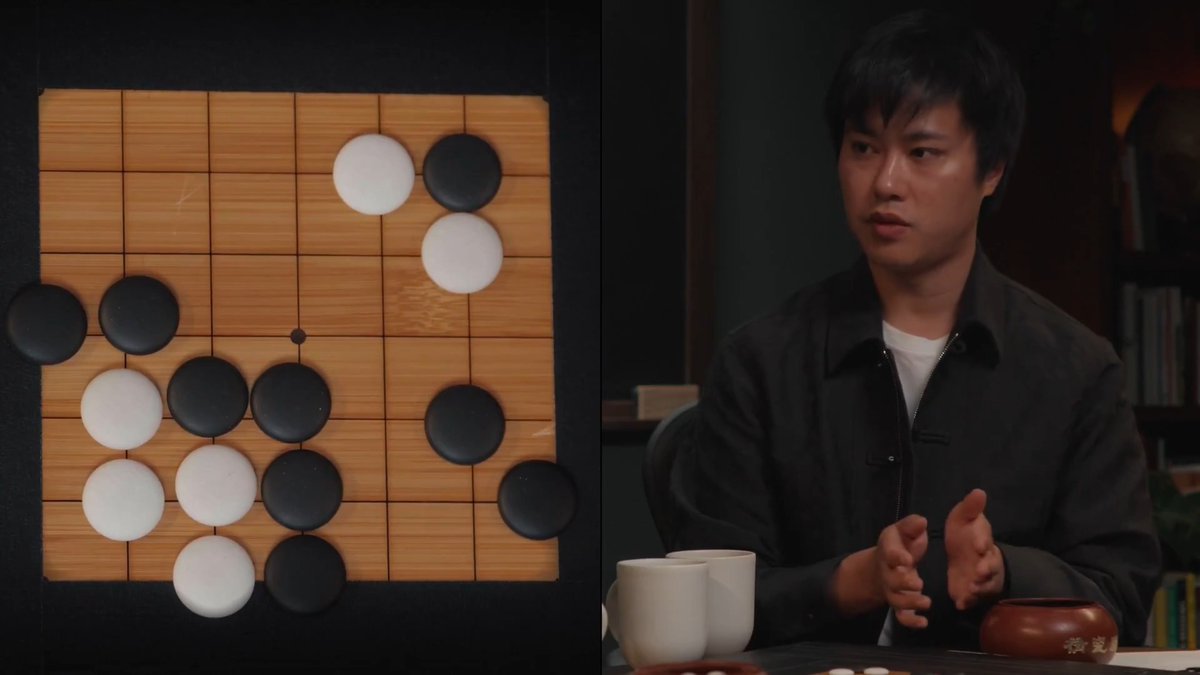
New blackboard lecture w Eric Jang He walks through how to build AlphaGo from scratch, but with modern AI tools. Sometimes you understand the future better by stepping backward. AlphaGo is still the cleanest worked example of the primitives of intelligence: search, learning from experience, and self-play. You have to go back to 2017 to get insight into how the more general AIs of the future might learn. Once he explained how AlphaGo works, it gave us the context to have a discussion about how RL works in LLMs and how it could work better – naive policy gradient RL has to figure out which of the 100k+ tokens in your trajectory actually got you the right answer, while AlphaGo’s MCTS suggests a strictly better action every single move, giving you a training target that sidesteps the credit assignment problem. The way humans learn is surely closer to the second. Eric also kickstarted an Autoresearch loop on his project. And it was very interesting to discuss which parts of AI research LLMs can already automate pretty well (implementing and running experiments, optimizing hyperparameters) and which they still struggle with (choosing the right question to investigate next, escaping research dead ends). Informative to all the recent discussion about when we should expect an intelligence explosion, and what it would look like from the inside. Timestamps: 0:00:00 – Basics of Go 0:08:06 – Monte Carlo Tree Search 0:31:53 – What the neural network does 1:00:22 – Self-play 1:25:27 – Alternative RL approaches 1:45:36 – Why doesn’t MCTS work for LLMs 2:00:58 – Off-policy training 2:11:51 – RL is even more information inefficient than you thought 2:22:05 – Automated AI researchers

Dwarkesh Patel

704,667 görüntüleme • 2 ay önce

Spent the past few hours with Anith Patel who built another always listening AI pendant. Wanted to take a fresh look at this field since OpenAI is expected to bring such a device out at its developer conference in October. Some things I learned: 1. The BOM is less than $20. If they could sell hundreds of thousands goes down to less than $10. The rule is you triple the price for retail. But with subscriptions you can give them away. 2. It takes months to get all the pieces through regulatory approval. Just one of the reasons why Silicon Valley types say “hardware is hard.” 3. Enterprise customers exist. Think of a hospital that buys all the doctors and nurses one but requires custom AI’s. He had to build a special model to understand doctor’s special language. 4. They are great memory aides and if you use one for a while you will notice that ChatGPT gets much more personalized. 5. Privacy fears keep many away. The fears are so strong that even if he takes on all their fears (everything is encrypted so he can’t use their data or look at it) many still won’t consider using one. 6. Devices without a display can run for three days on small batteries while glasses will run only for one, or maybe far less if you are playing augmented reality games. While I see AI-driven glasses will give a much better experience those will run $800 so are only for richer users. $800 is even a hard purchase for richer people while $50 is much easier trigger to pull. Anyway interesting field. Would you consider using one?

Robert Scoble

11,923 görüntüleme • 11 ay önce

GoogleDeepmind Chief AGI Scientist Shane Legg: AGI by 2028 He’s had the same timelines for 12 years - insane! He gives a log-normal distribution with a mode of 2025. Importantly, while he puts a 50% chance of AGI by 2028, that means there is a 30% chance of AGI in the next three years. How have his timelines been so consistent since 2011? SHANE LEGG: I first formed those beliefs around 2001 after reading Ray Kurzweil's The Age of Spiritual Machines. There were two really important points in his book that I came to believe as true: 1) One is that computational power would grow exponentially for at least a few decades. And that the quantity of data in the world would grow exponentially for a few decades. And when you have exponentially increasing quantities of computation and data, then the value of highly scalable algorithms gets higher and higher. There's a lot of incentive to make a more scalable algorithm to harness all this computing data. So I thought it would be very likely that we'll start to discover scalable algorithms to do this. And then there's a positive feedback between all these things, because if your algorithm gets better at harnessing computing data, then the value of the data and the compute goes up because it can be more effectively used. And that drives more investment in these areas. If your compute performance goes up, then the value of the data goes up because you can utilize more data. So there are positive feedback loops between all these things. 2) And then the second thing was just looking at the trends. If the scalable algorithms were to be discovered, then during the 2020s, it should be possible to start training models on significantly more data than a human would experience in a lifetime. And I figured that that would be a time where big things would start to happen that would eventually unlock AGI. And I think we're now at that first part. I think we can start training models now with the scale of the data that is beyond what a human can experience in a lifetime. So I think this is the first unlocking step. DWARKESH: If we're in 2029 and it hasn't happened yet, if there was a problem that caused it, what would be the most likely reason for that? SHANE LEGG: I don't know. At the moment, it looks to me like all the problems are likely solvable with a number of years of research.

AI Notkilleveryoneism Memes ⏸️

74,490 görüntüleme • 2 yıl önce

Lecture 1 on Physics-Informed Neural Networks: A Mini-Series Physics-Informed Neural Networks (PINNs) are neural networks trained to satisfy a differential equation by building the PDE residual directly into the loss. They emerged from a very practical problem...classical PDE pipelines can be brilliant, but they often demand heavy discretization work (meshes, stencils, stability tuning), and the method you build is usually tied to one geometry and one solver setup. A PINN flips the workflow by representing the solution itself as a smooth function uᵩ(x,t) and enforcing the physics everywhere you choose to sample the domain. People often meet PINNs in the least helpful way...via a flashy solution plot, and almost no explanation of what was enforced to get it. In this series we keep the enforcement visible. We pick a differential equation, represent the unknown solution as a flexible function, measure how well that function satisfies the equation across the domain, and train it to reduce that mismatch everywhere we sample. A normal neural net learns from labels...you give it inputs and target outputs. A PINN learns from a differential equation...you give it inputs (x,t) and it gets punished whenever its output fails the PDE. By punish we mean that the loss increases when the mismatch is large we reward it if the loss decreases as the mismatch gets smaller. The network isn’t replacing physics, it’s becoming a flexible function that is forced to satisfy the same calculus you’d impose on any candidate solution. The math breakdown: We start with a PDE we want to solve on a domain Ω. Write it as uₜ(x,t) + N(u(x,t), uₓ(x,t), uₓₓ(x,t), …) = 0 for (x,t) in Ω A PINN replaces the unknown function u with a neural network output uᵩ(x,t) Now define the physics residual by plugging uᵩ into the PDE rᵩ(x,t) = ∂uᵩ/∂t + N(uᵩ, ∂uᵩ/∂x, ∂²uᵩ/∂x², …) If uᵩ were an exact solution, we would have rᵩ(x,t) = 0 everywhere. We may also have data points (xᵢ,tᵢ,uᵢ) from measurements or a known initial condition. The training objective is just a weighted sum of squared errors L(ᵩ) = L_data(ᵩ) + λ L_phys(ᵩ) + L_bc/ic(ᵩ) with L_data(ᵩ) = meanᵢ |uᵩ(xᵢ,tᵢ) − uᵢ|² L_phys(ᵩ) = meanⱼ |rᵩ(xⱼ,tⱼ)|² where (xⱼ,tⱼ) are the collocation points in Ω L_bc/ic(ᵩ) = penalties enforcing boundary conditions and initial conditions The key technical step is that the derivatives inside rᵩ are computed by automatic differentiation ∂uᵩ/∂t, ∂uᵩ/∂x, ∂²uᵩ/∂x², … So we can differentiate the total loss L(ᵩ) with respect to ᵩ and train with gradient descent. This is the whole idea behind PINNs. Learn a function, but make the PDE part of the loss, so the network is trained to be a solution, not just a curve-fitter. In the render, the main 3D surface is the network’s current guess uᵩ(x,t), drawn as a living sheet over the (x,t) plane. Hovering above is the neural scaffold...a visible graph of feature nodes and connections. The bright tension threads are the physics residual rᵩ(x,t): each thread tethers a collocation bead on the sheet up to the scaffold, and it thickens and brightens exactly where |rᵩ| is large (color encodes the sign). As training runs, those threads go slack across the domain not because we hid the error, but because the network has actually been pushed toward rᵩ(x,t) ≈ 0. #PINNs #PhysicsInformedNeuralNetworks #ScientificMachineLearning #PDE #DifferentialEquations #Optimization #MachineLearning #AppliedMath #ComputationalPhysics

Mathelirium

47,308 görüntüleme • 6 ay önce

🚨👨‍🌾Here's what everyone missed about the Rogan RFK Jr. interview clip making the rounds. 🌱The organic small farmer's view of the whole problem. We are dying out here guys... to make the change everyone talks about. But the MONEY goes UP - not down to US the farmer. As a small organic farmer, I see the glyphosate crisis firsthand. We're investing BILLIONS into treating the diseases it causes, but almost NOTHING into the real solutions. Small farmers like me are left out of the money to fix it. We are the solution. Small organic farms that use DIY robots and lasers (I make both and share them open-source to help other older farmers). If even 1% of the billions in grants went to us every year, we could revolutionize food production, create jobs, and build a sustainable future. 🌱 Instead, all the money goes to Big Ag and Big Pharma—the very companies that created this problem. They poison the land, workers, and neighbors for generations, while getting rich from slow “fixes” that don’t really fix anything. Small farmers with real solutions are left out. If we had funding, we could scale, employ more people, and compete with the mega farms. 10,000 small farms would hire 100x the people of just 5 giant farms. We need to stop funding the multinational cartels that bankrupted our countryside and start investing in people. The HHS & USDA have the money to unlock a true farming revolution if they shift priorities and support those who never poisoned their communities. DIY robots that farmers can build, fix, and upgrade cheaply are key to scaling with an aging farmer population and cutting down on pesticides. The answer is simple: Invest in small farmers, not the corporations that are destroying our land. We can literally solve this problem with light (lasers) and CITIZEN lead projects. It should be profitable for young people to start farms, not impossible because of land costs, insurance, and rigged crop prices. Let’s make small farms the backbone of American agriculture again. 💪

Levi Leatherberry

37,902 görüntüleme • 5 ay önce

David Oyelowo for some reason felt the need to do another interview about his 'Lawman:Bass Reeves', I know he's been upset with my tweets about - everything about the show. One thing I criticized him and other foreign black actors who have done this is- when they make or star in projects about Black Americans, they always say "I don't know WHY this story wasn't told before". Steve McQueen said it about 12 yrs/Slave, Cynthia Erivo said it about 'Harriet' and David said it about his Bass Reeves show. So I "kindly" informed him that the reason why stories about Black Americans are rarely if ever told is due to R-A-C-I-S-M against Black Americans. That "thing" your movie or TV show is probably ABOUT. The fact that they either DON'T know that or are insinuating that Black Americans are just TOO LAZY and INCOMPETENT to MAKE MOVIES ABOUT THEIR OWN HISTORY - SO WE AFRICANS HAVE TO DO IT FOR THEM, is OFFENSIVE and PROOF that they have NO BUSINESS TOUCHING OUR STORIES and therefore PREVENTING US from doing so by their actions. Anyway, after I tweeted that, he changed his answers to that question in subsequent interviews. He's doing it again HERE, trying to reinforce that he KNOWS the reason why it took for example The Disruptor💥 to get his Bass Reeves movie made and shown while being blackballed by Hollywood is because of RACISM. One reason WHY black immigrant actors don't want to blame RACISM is because that would invite people to ask WHY THEY didn't seem to have a problem getting movies made about Black Americans when Black Americans so clearly DO. mm

The Movie Monster

16,301 görüntüleme • 2 yıl önce

kyungsoo briefly talking about his upcoming (full) album. and now, speaking of the album again, you really wanted (me) to (have a) dance, right? as for dancing, i do it a lot while in EXO, i pretty much do those (dances) there. personally, when i do it (the album)- what i want to do is to be able to really enjoy it together on stage rather than dancing. like, i personally want it to be something where we all have a little fun together, rather than just looking at the dance like this (stay still). this time i'm preparing hard while have that kind of hope in mind, that i think it would be nice. everyone, please look forward to it. probably, it will be really exciting (songs). so, i also were curious about that experience on stage between the sitting or standing? but since you could still enjoy it while sitting, if you decided to (chose) the sitting. or you can get up together and maybe have a little fun, that's fine too. those are what i personally think. well, i'll tell you all about the episodes of this album later. it's fun. and there are many things that have changed along the way. to put it simply, it was a song that i thought was exciting, uh.. turned out wasn't that excited. so it became clear a little later and (we) decided to change it, the title song. when it comes out, i have a lot to talk about now, so i'll tell you all about it then. there are many songs (on the album) i plan to sing them all during (the concert) performance. please look forward to it. there isn't much left now. i will prepare that again with a fighting spirit. yes! i think you might be able to see something new again. because i'm going to make an extraordinary appearance, i'm trying to get my mind right this time. so, please look forward to it, everyone. cr. westwindy77

열뚜♥

12,991 görüntüleme • 1 yıl önce