Loading video...

Video Failed to Load

Go Home

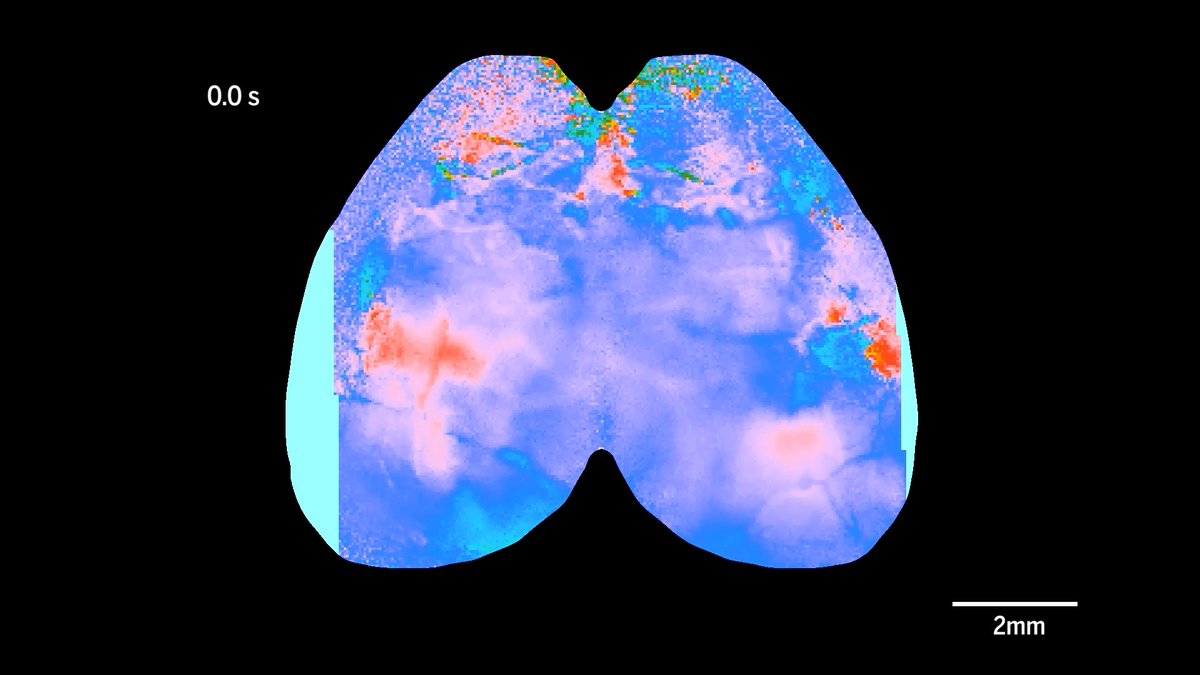
Neurons don’t physically touch—they communicate across tiny gaps called synapses. Signals travel as electrical impulses within a neuron and chemical neurotransmitters between neurons, enabling thought, memory, and movement

71,962 views • 4 months ago •via X (Twitter)

0 Comments

No comments available

Comments from the original post will appear here

Related Videos

I've been editing this article about "brain mapping" and connectomics, and I'm just stunned by how quickly the cost estimates to map, say, a mouse brain have plummeted in just the last couple years. It actually seems feasible that we could map the entire human brain -- all 86 billion neurons, and their connections -- in this lifetime. In the 1970s, Sydney Brenner started mapping all the connections between neurons in C. elegans. His team sliced the worm into thin pieces, took photos using an electron microscope, and manually traced and reconstructed each synapse for 302 neurons total. This project took more than a decade of work, and it cost about $16,500 to reconstruct each neuron. Scaling this up to a human brain boggles the mind. Electron microscopy remained the norm in connectomics for decades, because it was the only option available to see synapses at a resolution high enough to be able to trace their paths. Each electron microscope costs several hundreds of thousands of dollars, though, and you need lots of them to map even a mouse brain in a reasonable timeframe. In 2023, the Wellcome Trust released a report estimating how long, and how expensive, it would be to map the mouse connectome (~70M neurons). They estimated that imaging alone would cost $200-300M, and that proofreading (or ensuring that traces between neurons are correct) would cost $7-21 BILLION. (A human can only manually trace about 1 mm of neuron per hour.) Also, the images would occupy about 500 petabytes of data, and getting those data would require 20 electron microscopes running in parallel for about 5 years, continuously. They estimated the whole project would take about 17 years of work. This is, understandably, insane. But now it seems like there's an actual path toward mapping the full mouse brain in about five years for ~$100M dollars. There have been three major breakthroughs in the last year or so: 1/ Expansion microscopy, first developed in 2015, showed that it's possible to "enlarge" the brain by about 5x using a swellable polymer. But an improved method increases this number to >20x expansion, meaning we can now expand brains and image neurons much more easily using cheap light microscopes, rather than expensive electron ones. 2/ E11 Bio (a nonprofit research org) developed protein barcodes that get delivered into brain tissue; each neuron gets a unique combination of barcodes. These cells are then stained with colorful antibodies, which stick to a matching protein barcode, causing each neuron to light up in a distinct color. This makes tracing neurons so much easier. 3/ Google Research released PATHFINDER this May, an AI-based neuron tracing tool that can proofread about 67,200 cubic microns of brain tissue per hour, with very high accuracy. It works on electron micrographs, but something similar could be presumably be developed for the E11 / colorful tag approach. This is an extremely exciting time for neuroscience. (C. elegans connectome below.)

Niko McCarty.

67,050 views • 8 months ago

How ICP Token Holders Can Literally Vote To Upgrade The Internet Computer? Most blockchains rely on developers and node operators to coordinate when the protocol needs a major upgrade. The Internet Computer (DFINITY Foundation) takes a different approach. Its Network Nervous System, or NNS, puts governance directly onchain. Here is how it works: 1. ICP HOLDERS LOCK TOKENS INTO NEURONS internet-computer:native holders can lock their ICP into a “neuron.” A neuron is essentially a governance position that gives the holder voting power over NNS proposals. Voting power depends mainly on: • The amount of ICP locked • The neuron’s dissolve delay • The age of the neuron The longer a holder commits their ICP, the greater their potential voting power. 2. NEURONS VOTE ON NETWORK PROPOSALS The NNS allows neuron holders to vote on proposals affecting the Internet Computer. These can include: • Protocol upgrades • Subnet changes • Network configuration • Node provider decisions • Governance parameters • Changes to the network’s underlying software This is where the system becomes particularly interesting. NNS governance is not simply deciding how a community treasury should spend money. Some proposals can directly affect how the blockchain operates. 3. VOTING CAN TRIGGER ACTUAL PROTOCOL CHANGES A successful proposal can instruct the network to adopt an approved change. For example, NNS proposals can be used to upgrade the replica software running across Internet Computer nodes. Once the proposal is approved, the NNS can coordinate the upgrade across the network. That means token holder voting can ultimately result in the protocol itself changing. 4. HOLDERS DO NOT HAVE TO VOTE ON EVERYTHING The NNS also uses a system known as liquid democracy. Neuron holders can choose to follow other neurons for particular proposal categories. When the followed neuron votes, the follower can automatically vote in the same direction. This creates a delegation system without requiring users to give up ownership of their ICP. In simple terms: • Stake ICP • Create a neuron • Choose your voting preferences • Vote yourself or follow another neuron • Earn rewards for participating 5. GOVERNANCE PARTICIPATION CAN EARN REWARDS The NNS gives users an economic incentive to participate. Neurons can accumulate maturity through governance participation. That maturity can later be used to generate new ICP. This turns governance participation into more than just a voting mechanism. It becomes part of the network’s economic design. 6. THE NNS IS ITSELF PART OF THE INTERNET COMPUTER This is arguably the most important part. The NNS is not simply a website where the community discusses proposals. The governance system itself runs on the Internet Computer. Its rules, proposals, neurons and governance decisions are handled through onchain infrastructure. That allows governance decisions to become executable actions. 7. WHY THIS MATTERS FOR PROTOCOL UPGRADES Traditional blockchain upgrades can require significant coordination. Developers may need to release new software. Node operators need to install it. Validators or miners need to support it. Exchanges and infrastructure providers may also need to update their systems. If coordination fails, competing versions of the blockchain can emerge. The NNS is designed to reduce some of that coordination problem. The community can approve a proposal through onchain governance, and the network can then execute the approved change. 8. IT IS NOT ONE ICP TOKEN, ONE VOTE Simply holding ICP does not automatically give someone governance power. Users need to commit their tokens through a neuron. And voting power is not based solely on the number of ICP held. Factors such as dissolve delay and neuron age also influence voting power. This means the system rewards committed participation rather than treating every wallet as an identical vote. 9. SO WHAT MAKES THE NNS DIFFERENT? The key difference is that governance is built into the protocol itself. On many blockchains, governance can look like: Community discussion → Vote → Developers implement the decision. The Internet Computer aims for something closer to: Stake ICP → Vote through NNS → Proposal passes → Network executes the change. The NNS is designed to make governance part of the Internet Computer’s operating machinery. ICP holders therefore have a direct role in deciding how the network evolves. Under the right proposal, their votes can ultimately determine which software the network runs.

BSCN

18,482 views • 27 days ago

Visual Preset #03 High Voltage High-end cinematic 3D realism fused with hyper-energized electrical phenomena. Every movement generates branching plasma arcs, snapping lightning filaments, electromagnetic distortion, ionized air ripples and cascading sparks that dance across surfaces instead of conventional energy effects. Electric currents crawl over characters, weapons and environments with rhythmic pulse patterns, while shockwaves illuminate drifting particles, vapor and debris in synchronized flashes. Aggressive camera movement, dramatic perspective, volumetric light shafts, dynamic exposure shifts and dense atmospheric haze amplify every discharge, creating a world where electricity constantly reshapes the surrounding space. Feature-film rendering, physically believable materials and realistic electrical interactions preserve scale, weight and cinematic realism. Seedance 2.0 Prompt for this video: @[character re] lowers into a sprint as brilliant blue-white electricity condenses around one outstretched hand, crackling with violent intensity. Every accelerating step tears glowing fractures through puddles, while branching lightning lashes across the ground and nearby structures. The air warps with electromagnetic distortion as the fighter bursts forward in a blinding dash, piercing through the opponent's guard with a single lightning-charged palm strike. The impact erupts into an explosive sphere of plasma arcs and cascading sparks, briefly freezing the battlefield in white-blue light before the electrical current dissipates into the storm-filled sky. ...rest is visual preset.

Kōda

31,553 views • 2 months ago

What is Chainlink CCIP? Chainlink's (Chainlink) Cross-Chain Interoperability Protocol, or CCIP, is designed to let applications communicate across different blockchain networks. Put simply, CCIP acts as a secure messaging and transfer layer between otherwise disconnected blockchains. Here's how it works: (1) It moves data between blockchains CCIP allows smart contracts on one blockchain to send messages to smart contracts on another network. That means an application can trigger an action on a different chain without requiring users to manually move between ecosystems. (2) It can transfer tokens across networks CCIP also supports cross-chain token transfers. Projects can use token pools and other mechanisms to move assets between supported chains while maintaining controlled supply across networks. (3) It lets you combine messaging and asset movement A major feature of CCIP is that developers can send arbitrary messages, transfer tokens, or do both in a single cross-chain transaction, rather than needing separate systems for each. (4) It uses Chainlink's decentralized oracle infrastructure CCIP relies on Chainlink's decentralized oracle network to validate and deliver cross-chain messages. The system uses multiple independent components to help verify transactions and protect against failures or manipulation. (5) It adds programmable token transfers CCIP is not limited to simply sending an asset from one chain to another. Developers can attach instructions to transfers, allowing receiving applications to automatically perform actions when tokens arrive. This could make cross-chain lending, payments, trading, and other DeFi applications easier to build. (6) It is designed for multiple blockchain environments CCIP supports communication across different blockchain ecosystems rather than forcing applications to operate within a single network. That matters as liquidity, users, and applications become increasingly fragmented across chains. The bigger idea is simple. Blockchains were originally built as separate networks, but users and capital increasingly need to move between them. CCIP is Chainlink's attempt to provide the infrastructure for that movement. If cross-chain applications continue expanding, secure interoperability could become one of the most important layers in the blockchain stack.

BSCN

17,349 views • 18 days ago