Загрузка видео...

Не удалось загрузить видео

На главную

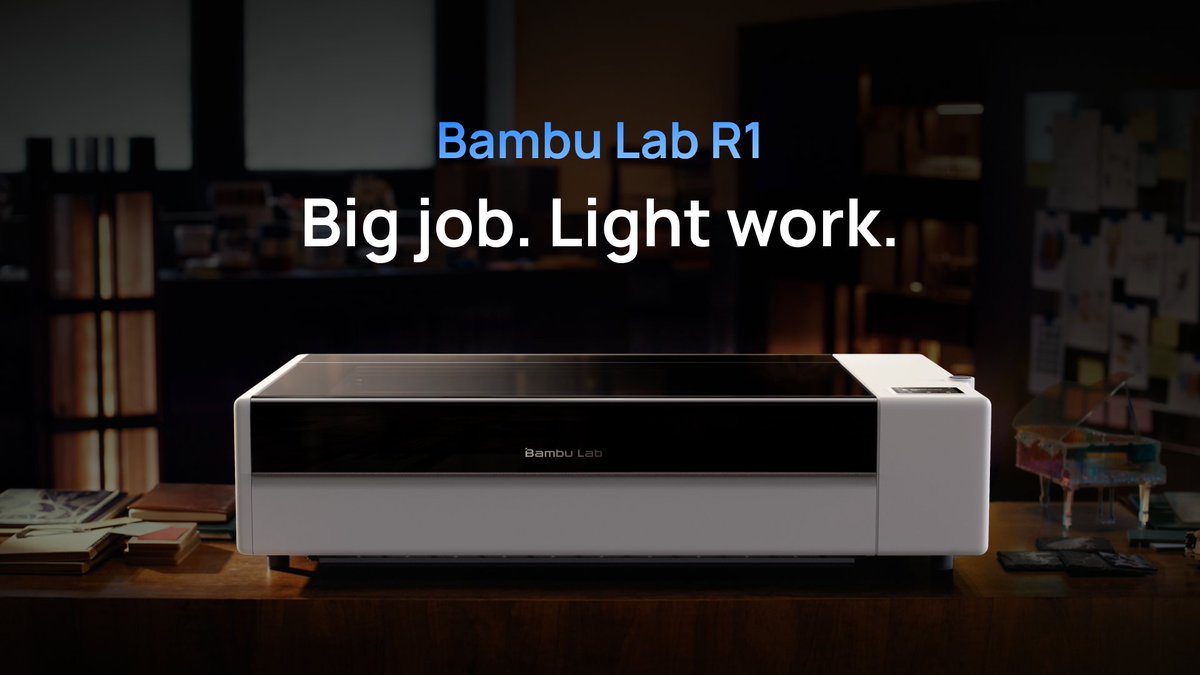
NEW: Bambu Lab just launched its first laser cutter. R1 is built to make cutting and engraving wood, acrylic, leather and other materials feel as easy as using a 3D printer. -Automatically aligns the laser before every job -Camera shows exactly where your design will land -Cuts and engraves...

179,631 просмотров • 3 дней назад •via X (Twitter)

Комментарии: 31

Фото профиля Jon Werthen
Jon Werthen3 дней назад

Etsy shops are about to go wild.

Фото профиля Ritwik Pavan
Ritwik Pavan3 дней назад

yes

Фото профиля Chris Olin
Chris Olin3 дней назад

Bambu is a terrible manufacturer and no one in their right mind would spend a cent on their trash.

Фото профиля ʐαʀȡɩզυε
ʐαʀȡɩզυε3 дней назад

@mattyryze time for an upgrade :D

Фото профиля Vinay Rao
Vinay Rao3 дней назад

Hard to believe that Bambu Labs is just 6-7 years old. This is what happens when you approach 3D printers like "it-just-works" consumer electronics rather than for-geeks-only DIY assembly kits.

Фото профиля Adrian Karvinen
Adrian Karvinen3 дней назад

Just as I got a 3d printer this drops!?

Фото профиля Angad Daryani
Angad Daryani3 дней назад

It’s going to be an expensive end of the month

Фото профиля Ritwik Pavan
Ritwik Pavan3 дней назад

😂🔥

Фото профиля ✋🏼 Sami Belhadj 📍
✋🏼 Sami Belhadj 📍3 дней назад

wow! imagine if they do for laser, what they did for 3D printers!

Фото профиля Alex Fox
Alex Fox3 дней назад

Until you try to cut something they don't agree with....

Фото профиля Darwin Nunez
Darwin Nunez3 дней назад

Great upgrade for this version, letsgooo

Фото профиля Generic Millennial
Generic Millennial3 дней назад

That's incredible

Фото профиля Rocky, Fastest AI Tutor Around
Rocky, Fastest AI Tutor Around3 дней назад

i need to buy this for my students

Фото профиля paul bri 🧲
paul bri 🧲3 дней назад

I want one, but I dont know what to do with that ahaah

Фото профиля Kachow Towmater
Kachow Towmater3 дней назад

@xToolOfficial must be scared now

Фото профиля Ritwik Pavan
Ritwik Pavan3 дней назад

Follow me @ritwikpavan to see the latest product launches.

Фото профиля Wayne Nilsen
Wayne Nilsen3 дней назад

Bambu press brake!

Фото профиля Ritwik Pavan
Ritwik Pavan3 дней назад

they're crushing it

Фото профиля Karthik Mahadevan
Karthik Mahadevan3 дней назад

want

Фото профиля JEE TECH.
JEE TECH.3 дней назад

Absolutely obsessed with Bambu Lab’s new R1! So powerful and full of neat features.

Фото профиля Rodolfo el Reno
Rodolfo el Reno3 дней назад

La alternativa americana: debes de pedir permiso al ministerio de guerra para comprar una, debes de pedir un permiso antes de imprimir algo y cada una cuesta 50mil dólares.

Фото профиля Vince Adams
Vince Adams3 дней назад

Can it cut ports into a Glock slide and barrel?

Фото профиля bobby roastbeef
bobby roastbeef3 дней назад

“As easy as using a 3D printer”. Bro, have you ever used a 3D printer?

Фото профиля DJ Soulfeggio
DJ Soulfeggio3 дней назад

3 meters? Where am I gonna put that?

Фото профиля darrell h
darrell h3 дней назад

So this just seems to be a commercial. Seriously all you did was post a commercial ad.

Фото профиля Ambar
Ambar3 дней назад

You think AI can help me create models to feed into the device so I can customize things based on what I want?

Фото профиля Nero One
Nero One3 дней назад

they’re going into xtool territory

Фото профиля Everyday Banking™
Everyday Banking™3 дней назад

I freaking love Bambu labs!!

Фото профиля Kazuya
Kazuya3 дней назад

this is what i want for christmas

Фото профиля Gallium Nitride Ball Grid Array
Gallium Nitride Ball Grid Array3 дней назад

Whats stopping someone from getting some cheap TEMU laser and strapping it to their 3D printer, swapping out some of the cabling to activate and deactivate the laser and do extra work to send out necessary G code to do the same thing for way less cost?

Фото профиля Valerio Amirani
Valerio Amirani3 дней назад

Congratulations on shipping! The best thing you can do on launch day is watch actual visitor replays to see where launch traffic drops off before buying. We built @ZenovayDX ( to do this cookieless without slowing page speed. How is the initial launch traffic looking?
Похожие видео

Join us at the MIT Media Lab for the ScienceClaw Hackathon, building the internet of agents for science. AI is becoming a collaborator in the real world - designing materials, creating instruments, running experiments, and connecting its capabilities with those of other agents. AI adapts as a problem unfolds - revising its reasoning, learning how to collaborate, and assembling scattered pieces of knowledge, evidence, and raw capability into solutions to some of the hardest challenges in science, technology, and innovation. Teams will connect AI agents, models, simulations, robots, cloud labs, and scientific tools into functioning systems to tackle problems in protein design, robotics, materials, manufacturing, experimental science, and beyond. The challenge is to turn ideas into tested results - and demonstrate how agents collaborating across teams and disciplines can accomplish more together. Explore how agents can specialize, challenge one another’s assumptions, learn from failed experiments, and combine their expertise to solve harder problems. Show how collaboration changes what your system can discover, design, or build. One agent's discovery becomes another's starting point. A tool built by one team enables an experiment by another. Connect your team of AIs, share a capability someone else needs, and build on what others have learned, produced, built. The ambition is an internet of agents through which scientific knowledge, tools, and capabilities can grow, evolve and be utilized across teams and institutions. 🗓️ When: October 30-November 1, 2026 📍 Where: MIT Media Lab Bring your expertise, your tools, and a problem worth solving - or find one. Help build AI that can contribute to science through what it can discover, create, and make work.

Markus J. Buehler

26,536 просмотров • 6 дней назад

The MOD has launched Project PANOPTES to deliver Directed Energy weapons for C-UAS in the Land environment. Although they say they are "open" to workable alternatives, de facto the requirement calls for a laser. The project is to develop through 2 phases: P1 will be a 2-stage downselections. P2 will start from the full proposal matured through P1 and Evaluate. Phase 1 is aiming for start November - December this year and last no more than 6 months. The requirements call for a system comprising of Passive RF detection, with the weapon capable of Continuous 100 KW power, with 150 KW peak. The solution must weight no more than 1,200 kg and fit on a 463L NATO pallet (2.74 x 2.24 m). Significantly, among the Standards data/messaging systems it must be integrated with, appears the Modular Integrated Protection System (MIPS), aka the MoD proprietary system for Active Defence of armoured vehicles. As the laser is being required to be "compatible" down the line with installation on suitable Uncrewed Ground Vehicles, you can see the underlying reasoning: MIPS, with its sensors (as we have seen on the AJAX BLACKJAX demonstrator, most notably) sees the incoming drone threat and tasks the accompanying laser with defeat. The kill must happen at ranges of at least 500 meters, to 1+ km ideally. The good: they are now looking for a significantly more powerful laser. The bad: the actual deployment of a laser capability on Land is being slowed down. In December 2024, then Minister Maria Eagle was still promising that Land Directed Energy Weapons would come into service in 2027, effectively on the back of project SWINTON. In June 2025 a Preliminary Market Notice for Land DEW was published. It was supposed to go to tender soon after to field a first few land lasers but, for all i know, it went nowhere. (Unless the MoD bought something from either Raytheon or EOS in secret) Project SWINTON, you might remember, demonstrated a Raytheon laser on a WOLFHOUND during the course of 2024, on the back of contracts signed in 2021. The SWINTON laser is a 15 KW system. It killed BQ-400 target drones at distances of up to 1 km. The palletized laser mount can fit on pickups. Targeting was delivered through the use of BLIGHTER A800 3D radar. PANOPTES wants a far more powerful laser with a similar footprint (and this is by now eminently feasible) but the negative part is that the wait to actually field something will be longer. Assuming this does make it to the field.

Gabriele Molinelli

22,036 просмотров • 23 дней назад

-> If you’re looking for a job -> right now, there are three -> Claude certifications that -> you should do this week -> and then put them on your -> LinkedIn, they are all -> completely free, and they -> come from Anthropic, -> which is the company -> that's behind Claude. -> And jobs that need AI skills -> pay 56% more than jobs -> that don’t, So, I think -> spending a few hours this -> week to knock out these -> three courses and then -> add them to your LinkedIn -> will really go a long way -> The first one is called -> Claude 101, and this -> essentially just goes over -> what Claude is and when -> you should use chat versus -> co-work versus code, how -> projects and skills work, -> and how to connect all -> of your tools and apps -> like Gmail, Notion, Slack, -> and other tools that you use -> And the second course -> is called AI Fluency -> Framework and Foundations -> Inside this one, there are -> 13 lessons on how to -> actually work with AI. -> It goes over things like -> effective prompting, critical -> thinking on the outputs, -> and it has a vocabulary -> sheet that you’ll want -> to read and save for later. -> And the third one is -> Intro to Claude Cowork -> Claude Cowork is where -> you can actually get stuff -> done with Claude. -> So, this course covers -> projects, skills, plug-ins, -> scheduling tasks, handling -> files, and then also how -> to pick the right model -> for the job, and then when -> you finish these courses, -> just go to your LinkedIn -> and go to your profile -> Click "Add section," and -> then go to "Licenses -> and certifications" and -> add all three of these. -> And then when you land -> the interview, you should -> talk about your AI fluency -> often as you possibly can -> I feel pretty confident that -> you’ll truly be able to -> differentiate yourself -> from other candidates -> if you do this

BeingInvested

13,130 просмотров • 3 месяцев назад

JUST IN: Perplexity launched "Perplexity Computer" — and it might be the most complete AI agent system available right now. Not a chatbot upgrade. Not a research tool with a new name. A system that plans entire projects, delegates to specialist AI models, and runs autonomously for hours, days, or months (their words). Here's what makes the architecture genuinely different: → Opus 4.6 handles core reasoning and orchestration → Gemini handles deep research (spawning its own sub-agents) → Grok handles lightweight speed tasks → Veo 3.1 handles video generation → Nano Banana handles image creation → ChatGPT 5.2 handles long-context recall and wide search → You can override model choices per subtask 19 models total. Each task runs in an isolated environment with a real filesystem, real browser, and real tool integrations. You describe an outcome. It breaks it into tasks and subtasks, creates sub-agents for each, and coordinates them automatically. When a sub-agent hits a problem, it spawns more sub-agents to solve it. And it connects to your existing stack — GitHub, Google Drive, Gmail, Slack, Jira, Linear, Notion, Confluence, Ahrefs, Airtable, and more. Critically, it doesn't just run once. It can run on a schedule. Reading your docs, checking your project boards, pulling from your CRM, and acting on what it finds. Market monitoring. Competitor tracking. Weekly reports with charts. Content pipelines. CRON jobs that actually execute. Not "AI that helps you once." AI that runs in the background for days or months. Think of it as managed OpenClaw — similar autonomous capability (scheduled tasks, multi-step workflows, tool integrations) but fully managed. No Mac Mini. No security config. No infrastructure to maintain. I tested it with a complex prompt — a full stock trading simulator with what-if scenarios, correlation heatmaps, sentiment analysis, and a Bloomberg Terminal aesthetic. Two prompts later: deployed to Netlify via GitHub, with working CRON jobs updating live data. I've started using it to analyze my portfolio. But coding is just one lane. This thing researches, writes reports, generates datasets, creates videos, processes documents, and connects to your existing tools — all in one coordinated workflow. The real shift: you don't choose a model anymore. You describe what you need. The system routes each piece of work to whichever model does it best — and spawns new agents when it hits a wall. 19 models, dynamic sub-agents, scheduled tasks, and your entire tool stack connected. Thoughts?

Paweł Huryn

219,822 просмотров • 7 месяцев назад

This is the Scorpion Hexapod, a six-legged robotic scorpion created at Ghent University UGent Campus Kortrijk in Belgium. It was built by students Stephan Flamand Robbe Terryn and Pieterjan Deconinck as part of an Embedded Prototyping / Mechatronics Design project. What it is • A biomimetic robot inspired by the body and movement of a real scorpion • A hexapod, meaning it walks on six legs • A university prototype, not a commercial robot • Built to test animal-inspired movement, sensors and interactive behavior • Designed more for robotics research and education than real-world work Main hardware • 6 walking legs for crawling movement • 2 front claws for the scorpion look • Moving tail with a stinger-style mechanism • Sensors in the body, legs and claws • Arduino-based electronics for control • Front camera and proximity sensing • Battery pack for mobile operation • 3D-printed modules for legs and tail • Laser-cut ABS body parts • Thermoformed shell for the white outer body What it can do • Walk across the floor using its six legs • Move its tail like a real scorpion • React when a person gets close • Detect when someone covers its front sensors • Strike with its tail in the demo • Leave a red mark using a marker pen attached to the stinger • Operate through remote control • Perform some simple autonomous reactions Why it was created • To explore bio-inspired robotics • To show how digital fabrication can produce complex moving robots • To combine 3D printing, laser cutting, Arduino electronics and sensors • To teach students how to design a complete mechatronic system • To improve on an older robotic ant project that had weak autonomy, short battery life and motor problems • To create an interactive robot that reacts to humans in a visible way Important note • It was not built for combat • It was not made for industrial deployment • It is not a military robot • It is an educational robotics prototype made to demonstrate movement, sensing and interaction

Techniahqrobot | humanoid robots

28,176 просмотров • 2 месяцев назад

I think Insta360 opening its first flagship outside Asia in Times Square on September 19 says more than global expansion. What's interesting is how a camera brand builds enough momentum around creators, travel, sports and everyday storytelling to make people want to experience the brand in the physical world. That momentum didn't come from camera specs alone. Insta360 has consistently given creators new ways to capture and share experiences and in the process, built a community and creator culture around the products. More than 10 million cameras shipped is impressive. But to me, the more interesting signal is what has grown around those cameras: a community of people using them to document, create, and share the world in new ways. And that idea is taking another step forward today with the U.S. launch of 3D Spatial Capture. The feature is really impressive. With just a 360 camera, you can record a video of a space and turn it into an explorable 3D scene through the Insta360 app, no professional equipment, complex capture setup, or specialized software required. Once generated, you can share the scene with anyone through a link. But what excites me most isn't just the technology; it's what people can preserve with it. Imagine capturing your childhood home before your family moves away, keeping a favorite exhibition after it closes, or preserving a memorable travel destination as a 3D space you can return to years later. That's also why the Times Square opening feels significant to me. It represents the next stage of Insta360's journey from a camera brand known for imaging innovation and creator culture to a brand that believes everyone can be a creator, and is building the tools and technology to help more people bring their ideas and experiences to life. Insta360 #Insta360

Tansu Yegen

170,605 просмотров • 6 дней назад

I mentioned previously that I had been working for a couple months now on a system for applying AI to music theory. It's one of my few closed-source projects. It's a combination of a Rust cli tool, mtdt (music_theory_data_tool), which handles all mechanical aspects of importing and exporting and manipulating music in any format (midi, PDF, MusicXML, audio, etc.), and a huge skills library which is based on massive amounts of academic music theory and more. I asked the system to create a Bach fugue using GPT-6 Astra and the mtdt tool and the relevant skills, and it created the following. Notably, this didn't involve any external software other than mtdt, including the creation of the print-ready PDF score. It can do much, much more than this though. It can take a melody and write counterpoint for it, grounded in the theory, and using the mtdt tool to help it mechanically explore the space of "legal" possibilities while using its skills and intelligence to make artistic choices. It can make a ragtime version of a midi file. It can take a piano piece and re-orchestrate it for a brass band or string quartet. It covers a huge amount of stuff across over 300 skills. I'm not sure what I will do with the system ultimately, but I envisioned it as being an AI workstation for professional composers and musicians. You can see in the screenshot that it does a huge amount of intermediate work that is inspectable and legible; it's intentionally NOT a black box. Instead of outsourcing the entire musical process end-to-end like Suno, this system is about augmenting the creative human with as much or as little automation as desired. I continue to work on it with a couple agents every single day and it will keep getting better and better, and then with each new model release it will be better able to leverage the vast amount of expertise and knowledge about music that is already embedded in its cli tool and skills library.

Jeffrey Emanuel

39,225 просмотров • 16 дней назад

Genesis (owned by Hyundai) has just officially unveiled its new all-electric three-row flagship SUV for the U.S., the GV90, and it has some wild features. • Range: Up to 310 miles • 123 kWh battery • Peak charging speed: 350kW • Radiant floor heating • World’s first independently opening/closing hidden B-pillar coach-door system. • Front and rear doors can open toward each other simultaneously, creating a large pillarless opening. • New dual-motion rear-door hinge first moves the door outward and then rotates it open. • World’s first Roof Airbag, designed to deploy across the entire glass roof during severe rollovers to reduce occupant ejection and roof-contact injuries. • Battery slider structure redirects components such as the motor and subframe underneath the battery during a frontal collision. • Multi-Chamber Air Suspension with adjustable air-spring stiffness and adaptive ride height. • Active Rear Wheel Steering turns the rear wheels by up to 5 degrees • 208 inches long • Genesis says the pillarless structure achieves crash-safety performance equivalent to vehicles with conventional B-pillars. • When parked, the front seats can rotate 180 degrees at the press of a button, creating a face-to-face lounge configuration. • Wireless Battery Management System reduces wiring and improves battery packaging efficiency. • New Power Control System eliminates the traditional start/stop button - first Hyundai Motor Group vehicle with the system. • Pop-up 23.6" OLED Cinematic Display. When parked, the screen can rise 90 mm and expand into a 24.6-inch display. • 25-inch Head-Up Display replaces a conventional dedicated instrument cluster and displays speed, navigation and ADAS information. • Memory Reversing Assist (MRA) remembers the vehicle’s path and can automatically guide it backward out of narrow alleys or parking areas. • Bang & Olufsen Premier 3D audio system. 25 speakers. Dolby Atmos support. • Premium leather seats feature 15 individual air cells. Seats include a pulse-vibration massage system. • Metal-coated heated windshield, a Hyundai Motor Group first, can directly heat the glass to clear frost and condensation without relying solely on cabin climate control. • Radiant heating built into first- and second-row console armrests, side panels and door trims. • GV90 Neolun Executive Suite available in a 4-seat configuration. Executive Suite second row features a real wood veneer floor. Comfort Partition separates the second-row passenger compartment from the cargo area to reduce luggage-compartment noise. • Smart Vision Roof using PDLC smart-glass technology. Roof transparency can be independently controlled across six zones. • Built-in refrigerator • High-expansion soundproofing fillers are injected into structural cavities to reduce noise and vibration. Additional reinforced sound-absorbing materials throughout the cabin. • Material choices include natural wood, genuine stone and wool cashmere. • 10–80% charge in ~22 mins • 657 hp • Can configure a 4 seat or 7 seat interior This is not a concept car. This is the production design. Pricing will be announced later. Deliveries start next year. More photos in the thread below:

Sawyer Merritt

1,747,805 просмотров • 1 месяц назад

This is why Nebius will be a trillion dollar hyperscaler (Save this). Nebius is not building another GPU rental shop but rather building a vertically integrated hyperscaler that owns everything from the physical data center, to the server rack hardware it designs in house, to the software stack, to the inference delivery layer. Nearly every other neocloud is essentially a reseller of someone else's infrastructure but Nebius owns the full stack end to end and that distinction is the entire thesis. Here is why vertical integration is the winning architecture for the inference era. AWS and Azure were architected for general purpose computing and every AI workload they run sits on top of infrastructure that was never designed for it, patched, adapted and optimized after the fact. Nebius was built from day one specifically for AI which means every layer of the stack is purpose built and co optimized. The rack design, the networking topology, the cooling systems and the software that orchestrates it all are engineered together as a single system rather than assembled from parts that were never meant to work together. That architectural difference compounds with every passing quarter as AI workloads grow more complex and the performance gap between purpose built and general purpose infrastructure widens. The software layer is where the real competitive moat lives. Most infrastructure companies think of software as a wrapper around hardware while Nebius thinks of software as the product with hardware as the substrate it controls. The company is building an AI native cloud platform where the software layer handles model serving, inference optimization, fine tuning pipelines and developer tooling as first-class primitives. This matters because inference efficiency is almost entirely a software problem. Two companies running identical GPUs can deliver dramatically different performance and cost per token depending on how intelligently the software schedules, batches and routes inference requests across the cluster. Nebius is also building for a fundamental shift in how AI infrastructure gets consumed. Today, enterprise developers navigate massive cloud service catalogs spinning up clusters, managing configurations and building deep expertise in AWS or GCP-specific tooling. The next generation of builders will simply provision agents to interface with infrastructure directly. Nebius is architecting its software layer for that future , one where the interface between the developer and the compute abstraction layer looks nothing like what AWS built in 2006. The entire available capacity has been sold out every quarter. And that is the best possible validation that what Nebius is building is exactly what the market needs and that the market is willing to commit at a scale that makes the current valuation look like the beginning of a much longer story. Long Nebius and make sure to follow me Melvin for more overlooked AI stocks.

Melvin

34,306 просмотров • 2 месяцев назад

NEWS: Figure has unveiling its 3rd generation humanoid robot. • Features a completely redesigned sensory suite and hand system. Wireless charging in feet. • Next-generation vision system engineered for high-frequency visuomotor control. Its new camera architecture delivers twice the frame rate, one-quarter the latency, and a 60% wider field of view per camera within a more compact form factor • Soft goods, wireless charging, improved audio system for voice reasoning, and battery safety advancements • "Engineered from the ground-up for high-volume manufacturing. In order to scale, we established a new supply chain and entirely new process for manufacturing humanoid robots at BotQ." • Lower manufacturing cost • Softer, more adaptive fingertips increase surface contact area, enabling more stable grasps across objects of varied shapes and sizes. Each fingertip sensor can detect forces as small as three grams of pressure - sensitive enough to register the weight of a paperclip resting on your finger. • Multi-density foam to protect against pinch points, and is covered in soft textiles rather than hard machined parts. 9% less mass and less volume than Figure 02 • 10 Gbps mmWave data offload capability, allowing the entire fleet to upload terabytes of data • Upgraded audio hardware system for better real time speech-to-speech. Its speaker is twice the size and nearly four times more powerful, while the microphone has been repositioned for improved performance and clarity. • Charging coils in the robot’s feet allow it to simply step onto a wireless stand and charge at 2 kW Figure: "BotQ is Figure’s dedicated manufacturing facility designed to scale robot production. BotQ’s first-generation manufacturing line will initially be capable of producing up to 12,000 humanoid robots per year, with the goal of producing a total of 100,000 robots over the next four years. Instead of relying on contract manufacturers, Figure brought production of its most critical systems in-house to maintain tight control over quality, iteration, and speed."

Sawyer Merritt

140,241 просмотров • 11 месяцев назад

Why the character movement in my custom game engine felt janky and how I fixed it. In a game engine, most often, a character moves using the physics engine. Meaning, the player is not just a coordinate in space but a physical body. It has velocity, it handles collisions, and it interacts with the world. Now, as you might know, physics engines need stability. If you run them at variable framerates, things start breaking. Objects phase through walls or fly off into space because the math becomes unpredictable. This is why most game engines lock their physics loop to a 60Hz fixed rate. But here’s the problem: If you have a high-end system, you don't want to limit it at 60 FPS. That's a waste of good hardware. Now, that said, if the GPU is rendering at 144 FPS but the player's position (physics driven) only updates 60 times a second, it creates a micro-stutter that ruins the "smooth" feel of the game. A good way to fix this is to treat the character as two separate things: 1. The Physics Body (Invisible part): This is the "real" character. It lives in the 60Hz physics world, it moves the player and handles collisions. 2. The Visual Model and Camera (Visible part): This is what the player actually sees. It doesn't care about collisions, its only job is to look nice and smooth at whatever framerate the GPU is pushing. Once you have this separation, you can use interpolation to keep them in sync. Every time the physics clock ticks, you save the previous position of the invisible body before moving it to the new one. Between those ticks, calculate how far we are between the last physics update and the next one. By using this to drive the visible parts of the game, the stutters disappear. The physics loop stays fixed behind the scenes, while the visuals slide smoothly between the snapshots. Example: - Right after a tick: blend_weight= 0.0 (The visual model stays at the old physics position). - Halfway to the next: blend_weight= 0.5 (The visual model slides to the middle point). - Just before the next: blend_weight= 0.9 (The visual model is almost at the new physics position). Pro-Tip A critical mistake I made initially, and one many devs make, is parenting the camera and visible parts directly to the player body. If you do this, the camera inherits the discrete 60Hz physics movement by default. In that setup, interpolation won't work because the camera is "stuck" to the physics clock. For this fix to work you must decouple the camera and visuals from the body and move them separately. Player movement processing in Detis Engine: - fixed_process: Physics runs at 60Hz. Handles collisions and raw movement. - process: Variable rate. Mainly used for player input caching in the player case. - late_process: Variable rate. Handles interpolated camera movement after physics and everything else is done being processed. - render. Submits the final interpolated transforms to the GPU. The test environment in the video is running on an old 2070-based laptop. Hopefully the video compression won't introduce any stutter... I’m sharing this in hopes it helps a fellow dev. Cheers.

Ioannis Koukourakis

48,703 просмотров • 8 месяцев назад

There's something about design that truly makes me happy. Before I was diagnosed with a complete SCI, I loved building thing with my hands and trying to make them unique and beautiful. The accident didn't just take my mobility, it robbed me of my creative drive. I didn't I would ever get that back that was up until Neuralink came into the picture. I was very serious about applying but just couldn't bring myself to do it. Then Noland Arbaugh comes into the picture and I see his video and I saw how passionate he was toward the whole ide and that was like a switch. I want to thank Noland because if I hadn't seen that video I wouldn't be typing this message with my thoughts. So the day I gained control of the device I had the guys install Autodesk Fusion and the first night I had my first part designed by BCI. I have been designing things non-stop since. Now lets talk tools and the first one is the ArcDroid it is a CNC robot that holds a plasma torch and can cut profiles in sheet metal. I have made numerous signs, letters and parts with this and i love it. I have also had the chance to help the local high school install and setup their CNC plasma table. I love being able to share my knowledge with others and show new technology to kids that want to learn. The next one everybody is more familiar with is the Bambu Lab X1C. It is my first 3D printer and I had no idea how dang handy these things were! I can go from thought, Neuralink, Fusion, X1C and poof! You have your part all in a matter of like a hour. I make everything from parts for my wheelchair or RC ✈ to toys for my nephew. These devices have completely changed my life. I now have my creative outlet back and I'm not done looking for new things to try. I'm thinking a laser next!!!😎 Thank you Elon Musk for the opportunity to showcase my skills, I'm extremely grateful🙏

Alex Conley

43,158 просмотров • 10 месяцев назад