Video wird geladen...

Video konnte nicht geladen werden

Zur Startseite

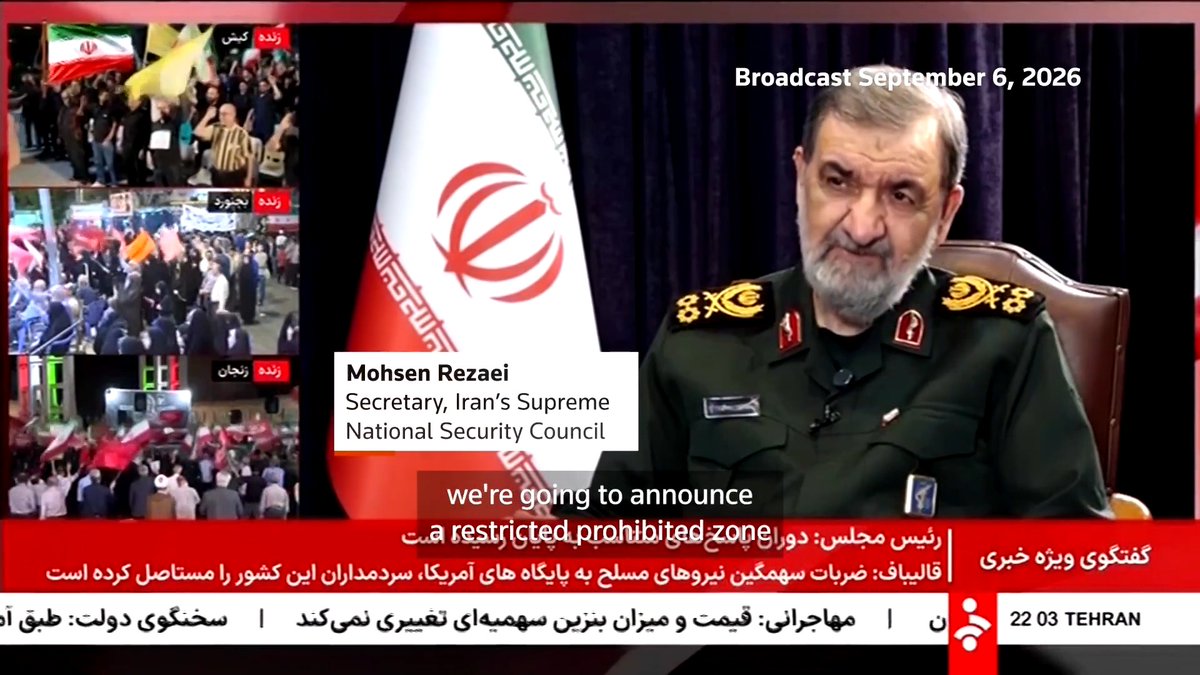
🇮🇷 NEW: Iran will soon declare a restricted maritime zone stretching from the U.S. naval blockade line toward the Strait of Hormuz and into the Persian Gulf, Mohsen Rezaei, secretary of Iran’s Supreme National Security Council, said Sunday. 🔹Ships entering the zone to transit Hormuz without Tehran’s coordination will...

23,669 Aufrufe • vor 19 Tagen •via X (Twitter)

0 Kommentare

Keine Kommentare verfügbar

Kommentare vom Original-Post werden hier angezeigt

Ähnliche Videos

💢 “Security in the ports of the Persian Gulf and the Sea of Oman will either be for everyone, or for no one.” Spokesperson for the Khatam al-Anbiya Central Headquarters: 🔹 The armed forces of the Islamic Republic of Iran consider defending the country’s legal rights a natural and lawful duty. Accordingly, exercising Iran’s sovereignty in its territorial waters is the natural right of the Iranian people. 🔹 Based on this, ensuring security in Iran’s territorial waters will continue decisively by its armed forces. As repeatedly stated, vessels affiliated with enemies are not permitted and will not be permitted to pass through the Strait of Hormuz. Other vessels may continue to transit, provided they comply with the regulations set by Iran’s armed forces. 🔹 Given the continued threats against Iran’s people and national security, even after the war ends, Iran will decisively implement a permanent mechanism to control the Strait of Hormuz. 🔹 The restrictions imposed by the United States on maritime movement in international waters are illegal and amount to piracy. 🔹 Iran’s armed forces state clearly and firmly: security in the ports of the Persian Gulf and the Sea of Oman will either be for everyone, or for no one. 🔹 If the security of Iran’s ports in the Persian Gulf and Sea of Oman is threatened, no port in these waters will remain safe. 🎥 Former IRGC Navy Commander Commodore Alireza Tangsiri, assassinated March 26 by Israeli forces.

Drop Site

34,402 Aufrufe • vor 5 Monaten

🇮🇷 BIG: Iran’s Deputy FM Says Strait of Hormuz Will Remain Closed Until Tehran Secures Oversight of Inbound and Outbound Shipping Lanes Iran will keep the Strait of Hormuz closed unless Oman agrees to a new arrangement handing Tehran control over the waterway's shipping lanes, Iran's deputy foreign minister for legal and international affairs, Kazem Gharibabadi, said in an interview on Iranian state television, offering the clearest official account yet of Iran's thinking about the negotiations around the strait after months of crisis in the world's most important oil chokepoint. 🔶 What Iran is demanding For 60 years, the main shipping lanes through Hormuz, the internationally recognized Traffic Separation Scheme, have run through Omani waters. Gharibabadi said Iran no longer accepts that. Tehran wants to redraw the routes so that it, not Oman, holds oversight of the traffic entering and leaving the Persian Gulf. According to Gharibabadi, the two sides are negotiating over a temporary replacement route, but they are stuck on who controls it: 🔹 Oman proposed a 50-50 split, with one half of the transit corridor under Iranian control and the other half under Omani control. Iran rejected it, saying an even division does not address its security concerns. 🔹 Iran's counter-demand is that one shipping lane pass entirely through Iranian territorial waters, while at least part of the second lane also runs through Iranian waters, giving Tehran oversight of both inbound and outbound traffic. "This is our definitive position, and Iran will accept no other formula," he said. 🔹 Gharibabadi cast the demand as modest, arguing Iran could reasonably insist both routes move entirely to its side after 60 years in Omani waters. "This is not bullying. It is not coercion," he said, adding that Iran stayed silent for decades while the lanes sat in Omani waters. 🔶 Negotiating while the strait stays shut Crucially, Gharibabadi said Iran is refusing to reopen the waterway while talks continue. Oman and other intermediaries have urged Tehran to at least let ships use the southern route in the meantime, he said, but Iran has declined: "At no point, not even for one hour, will we formally recognize the southern (Omani) route." He tied the latest round of fighting directly to that red line, saying the new military confrontation began when a tanker used the southern route along Oman's coast, the corridor Iran refuses to recognize. 🔶 The wider threats In the same interview, Gharibabadi went further than the transit dispute, according to wire reports: 🔹 He warned that any European warship approaching Hormuz would be treated as a "legitimate target," as some European states weigh joining US efforts to reopen the strait. 🔹 He said Iran would not permit any third country, even one invited by Oman, to clear mines from the strait. 🔹 He framed the entire standoff around a broader goal: ensuring Hormuz never returns to its pre-war status. "If the Strait of Hormuz returns to the situation before the war, our success in the war will not be complete," he said. See post below for additional details. 🔺Gharibabadi reiterated that the strait is not open: "If the Americans happen to say that the Strait of Hormuz is open, that is nonsense," he said, describing the occasional vessel that slips through as doing so illegally and "at their own peril." Before the war, roughly 130 to 140 ships transited Hormuz each day; about a fifth of the world's oil passes through it.

Drop Site

30,541 Aufrufe • vor 1 Monat

Dr Trita Parsi told Breaking Points that Iran’s six demands are not conditions for reopening the Strait of Hormuz, but just for restarting direct talks with the United States. He said Tehran presented the list after Washington allegedly moved the goalposts at the last minute, and that it may be more posturing than a set of concrete demands. 📌 Parsi also said: 🔹Iran may deliberately prolong the crisis until Trump concludes that renewed bombing has failed and fully commits to diplomacy. 🔹Formal negotiations continue between Iran and Oman, though Oman is effectively carrying a U.S.-approved position. Parsi called Iran’s success in limiting the official talks to the two coastal states a partial victory for Iran. 🔹The core U.S. interest is predictable, nondiscriminatory commerce, not control of Hormuz. An Iran-Oman management agreement could meet that interest, even with service fees. 🔹He said oil prices are being artificially suppressed but physical and paper prices will eventually converge, likely pushing prices higher. 🔹Parsi described Iran’s security appointments as an opaque old-guard reshuffle showing the supreme leader reasserting control, not necessarily a policy change. 🔹The Saudi-Turkish-Pakistani pact reflects collapsing confidence in the U.S. security umbrella and appears intended primarily as a buffer against Israeli aggression, though it could eventually evolve into a regional bloc aimed at containing Iran.

Drop Site

39,908 Aufrufe • vor 1 Monat