Video yükleniyor...

Video Yüklenemedi

Ana Sayfaya Dön

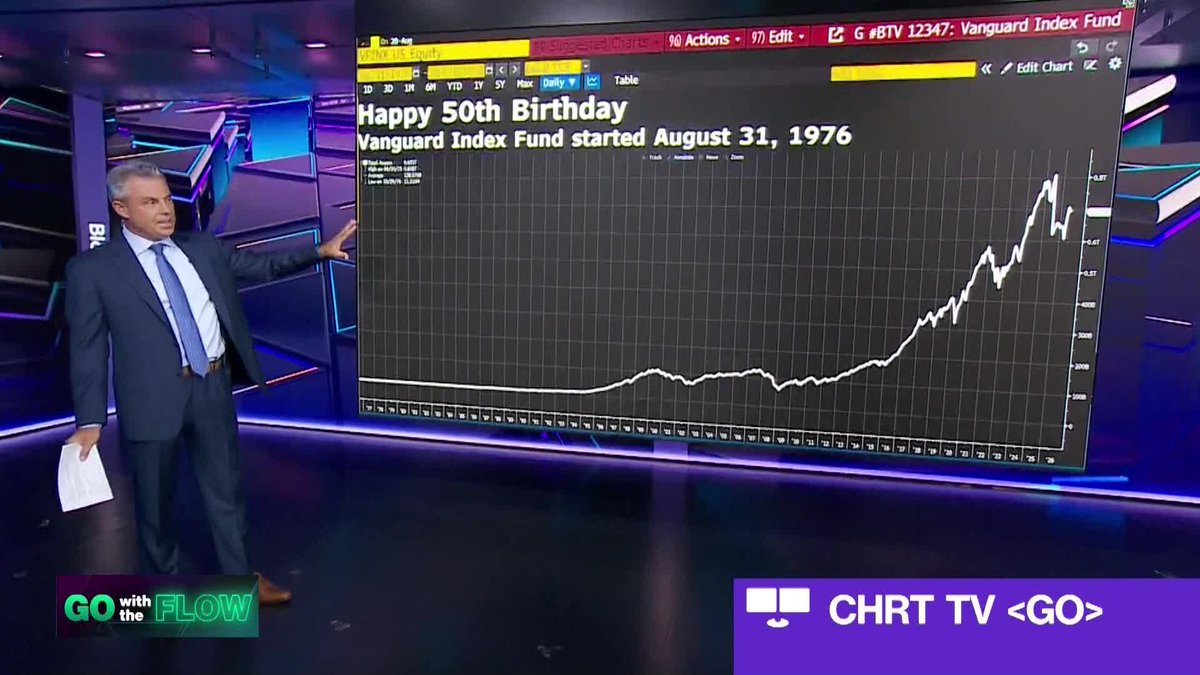
🎧 New Podcast! Bloomberg’s Eric Balchunas on the Index Fund That Changed Investing Eric reflects on the 50th anniversary of Vanguard’s first index fund and its transformative impact on investors and the asset management industry. Plus, VettaFi's Kirsten Chang spotlights several recent launches, including the State Street SPDR UC...

18,975 görüntüleme • 25 gün önce •via X (Twitter)

1 Yorum

Desmond Lim profil fotoğrafı
Desmond Lim24 gün önce

@EricBalchunas @Vetta_Fi @kirstenchang16 Indexing won by making a sophisticated idea behaviorally simple: diversify, lower costs, keep contributing. What product innovation could improve outcomes at comparable scale without adding back the complexity Bogle removed?
Benzer Videolar

Vanguard founder Jack Bogle explains his nuanced view on index funds vs. ETFs: Jack Bogle, the man who created the index fund, clarifies that his concerns aren't with broad index investing itself. His issue is with how ETFs tempt investors to behave badly and how the industry has weaponized the ETF structure for gimmicks. He starts by noting just how dominant index funds have become: “The dominance of index funds, which accounts for 28% of the market, is partly due to ETFs representing more than half of that share." But here's where he draws the line: “I have nothing against broad ETFs per se, but rather the narrow, managed ones and the way people misuse the broad versions." On broad ETFs vs. traditional index funds: they're the same thing Bogle makes clear that structurally, there's no meaningful difference between a Vanguard S&P 500 ETF and what he calls a "TIFF" (Traditional Index Fund), a term he coined to distinguish them: "They both own exactly the same portfolio and are part of the same portfolio, meaning their returns will be identical. Both types cost around five or six basis points at the Admiral class level." He explains Vanguard's pricing: Below roughly $10,000 invested, you'll pay 10 to 12 basis points, but once you cross the Admiral threshold, "the funds are identical." So what's the real problem with ETFs? Behavior. The ability to trade intraday creates temptation: "My slight bias against ETFs stems from the temptation to trade in the middle of the day when trouble arises." He points out how pointless this reactive trading is: "Getting out in the middle of the day is often a reaction to market volatility, such as the market dropping 300 points and then recovering in the second half of the day. This 'bouncing around' is meaningless in the long run." What he actually endorses: Bogle is clear that broad market index funds, whether structured as ETFs or traditional funds, all serve investors well: "Broad market index funds, including the S&P 500, total bond market, total US stock market, international, and even emerging market funds, are all acceptable 'total market funds'." Where the industry lost the plot: His sharpest criticism is reserved for what the ETF industry has become: "The industry has become a marketing business focused on 'crazy' or 'stupid' ideas that no one else has thought of." He offers specific examples: An emerging cancer ETF" he once criticized in the Wall Street Journal, today's "cloud computing" ETFs, and leveraged products offering 100%, 200%, or even 300% exposure, letting investors bet on the market going up or down by three times. His verdict on these: "The sense behind these types of investments is beyond my comprehension."

Black Edge

13,757 görüntüleme • 4 ay önce

Tomorrow a company that holds close to 5% of all ethereum is set to join the russell 1000. Once done, index funds that have never had an opinion on crypto will be forced to buy it. Nobody in those funds chose this, a benchmark rule did it for them 👇 ◢ How index inclusion actually works Getting added to a major index is one of the strongest demand events in markets, and it has nothing to do with whether the company is good. Funds that track the russell 1000 have to hold what the russell 1000 holds, or they stop tracking it. So, when a stock joins, every passive fund benchmarked to that index becomes a forced buyer, at whatever the price is, on the schedule the index sets. Passive vehicles tend to hold something like 20 to 25% of a large-cap stock, which for this one points to roughly $2B of buying that arrives because a rule says it must. ◢ The part that makes it crypto Bitmine is not a normal company that happens to get indexed, it's an ethereum treasury, sitting on millions of $ETH as its core balance sheet. So the chain runs like this: the index adds the stock, passive funds are forced to buy the stock, and the stock is essentially a wrapper around a giant pile of ETH. The result is that ordinary equity index money ends up with ethereum exposure without a single person deciding they wanted it. No ETF approval, allocation vote or opinion required. ◢ A side door, not a front door Everyone in crypto watches the spot ETF as the official entrance for institutional money, the thing that needs sign-off and gets headlines. Index inclusion is the entrance nobody guards. strategy walked a bitcoin treasury into the nasdaq 100. Coinbase took a crypto exchange into the s&p 500. now an ethereum treasury is stepping into the russell 1000. Each time, the underlying business didn't change. what changed is who was suddenly required to own it. ◢ Why front-running it is harder than it looks The mechanism is concrete, but the easy trade around it usually isn't. The inclusion isn't final until the reconstitution actually closes, so the flow is conditional, not guaranteed. The stock is already down around 50% on the year, which is a reminder that a one-time wave of buying doesn't repair something tied to ETH's price and to confidence in the treasury model. And there's a quieter problem: "diversified" index funds are now obligated to hold a leveraged, single-asset crypto bet that most of their investors would never have picked on purpose. What it means that the biggest new buyer of a crypto-linked company is a rule, not a person, and that millions of people now hold a slice of ethereum because an index told their fund to?

Onur 🍌🦍

14,337 görüntüleme • 3 ay önce

A 15-YEAR-OLD HIGH SCHOOL STUDENT FOUND A WAY TO SPOT NEW COMPANIES BEFORE MAJOR INVESTORS DID The interviewer walked into the house as Eric finished a business call and asked the person to call back in 30 minutes. Eric was 15. During lockdown, Eric Zhu joined Discord servers where high school students discussed startups and venture deals. He was the only middle school student in those chats. Eric joined a young company as one of its first employees. He then launched his own startup, sold it, and began building Aviato. Investors searched databases for new companies. A startup usually appeared only after its first funding rounds and visible growth. By then, dozens of other funds had seen it. Eric started hunting for signals that appeared before a company entered a database. The Aviato team gathered early signals about new projects and organized them into a search engine for investors. A fund could discover a company before its name started showing up in every venture database. Eric used the same approach as cofounder of his own fund. His team invested at an early stage and took equity. If a larger company acquired the startup or it went public, the fund made money on its stake. At 15, Eric was the cofounder of a fund with roughly $20 million. He also raised more than $1 million for Aviato. To stay near his customers, Eric moved to San Francisco and rented a house with office space for $8,000 a month. He hated the city. The funds had millions for deals. Eric sold them something scarcer: time before everyone else found the same company.

Blaze

14,265 görüntüleme • 1 ay önce