Video wird geladen...

Video konnte nicht geladen werden

Zur Startseite

New Tools for a New Era. Coding agents like Claude and Cursor have dramatically reduced the time it takes to go from idea to functional software. But the experience of designing and refining with them sucks. One reason for this is that while the terminal is an incredible tool...

82,950 Aufrufe • vor 9 Monaten •via X (Twitter)

51 Kommentare

Profilbild von joshpuckett
joshpuckettvor 9 Monaten

Also, I think the “copy prompt” pattern is going to explode. Incredible DX.

Profilbild von joshpuckett
joshpuckettvor 9 Monaten

got this—very roughly—working with Base UI this morning 🤔

Profilbild von Greg Huntoon
Greg Huntoonvor 9 Monaten

Josh, my team and I have been building things JUST like this. The speed at which you can spin up a sandbox for exploring the way that any given code will work, look, and feel is unreal. Timelines are collapsing with the barriers to entry. Absolutely love how quickly we can all move now!

Profilbild von joshpuckett
joshpuckettvor 9 Monaten

nice! excited to see what y'all ship here. P.S. Y'all/@zoink should sponsor Tailwind! Love that Figma's already sponsoring Motion.

Profilbild von Greg Huntoon
Greg Huntoonvor 9 Monaten

@zoink To be clear, “my team” is referring to the NAMER Advocacy crew.

Profilbild von joshpuckett
joshpuckettvor 9 Monaten

@zoink one team, one dream, right?

Profilbild von Greg Huntoon
Greg Huntoonvor 8 Monaten

@zoink Indeed

Profilbild von Saïd Aitmbarek
Saïd Aitmbarekvor 9 Monaten

Refining still has too much *cognitive* friction Human-in-the loop is the sweat spot for now ;)

Profilbild von Jason
Jasonvor 9 Monaten

This is the way I'm pretty bullish on the idea that we will build all of our stuff as part of the same flywheel. An operating system The UI and motion system, and the tools to maintain and adjust things are all baked in. Themeable, hackable, malleable That's at least what I'm investing all the time building 😂

Profilbild von joshpuckett
joshpuckettvor 9 Monaten

Ya, I do question the longstanding decision of most headless libraries to stay agnostic (to some extent). That *might* have been appropriate in a time and a place, but every system I've designed internally at larger co's (Dropbox, Wealthfront, etc.) has been all encompassing. Seems things will trend that way as well

Profilbild von Jason
Jasonvor 9 Monaten

Yea it's difficult to say But I do love your approach above. I found myself trying to solve things visually without the "code and refresh" approach One thing I've been building through my operating system project is bi-directional visual and code editing with the ability to edit on top of production Although I love code, I want freeform exploration to refine. No one has ever done that in a way that made sense to me. AI will probably help us build these tools

Profilbild von Max Ropohl
Max Ropohlvor 9 Monaten

Wil def do this for the design system I’m working on right now. So far started with building a custom variable explorer and editor where I can play around with my design variables which is already awesome.

Profilbild von joshpuckett
joshpuckettvor 9 Monaten

Excited to see it

Profilbild von Justin Farrugia
Justin Farrugiavor 9 Monaten

so good! are you planning on open sourcing this? would love to play around!

Profilbild von joshpuckett
joshpuckettvor 9 Monaten

There’s been a lot of interest, so I might release it in some way.

Profilbild von Diego Francisco Guzmán
Diego Francisco Guzmánvor 9 Monaten

Bullish on your take👌🏻 Idk wich software you are using but it looks really cool for iteration and fine tuning animations and small details.

Profilbild von joshpuckett
joshpuckettvor 9 Monaten

thanks! It's homecooked software I made with claude. Working name: AnimationKit. Should i release it?

Profilbild von Diego Francisco Guzmán
Diego Francisco Guzmánvor 9 Monaten

You should release it yesterday! And if you're not planning to charge, I would open source it immediately. It would go viral pretty quickly and give you great exposure.

Profilbild von Aaron Mak Hoffman
Aaron Mak Hoffmanvor 9 Monaten

What’s this app? Link?! 👀

Profilbild von joshpuckett
joshpuckettvor 9 Monaten

one I'm just toying with right now. Should i release it?

Profilbild von Aaron Mak Hoffman
Aaron Mak Hoffmanvor 9 Monaten

Listen to the people - do iiiiit

Profilbild von Bobby
Bobbyvor 9 Monaten

Such a great idea! Once the prompt is copied over you can just ask the model to record to context or even better use it to establish a motion system in your project to have consistency across all interactions. So cool thanks for sharing!

Profilbild von BuildTradePlay
BuildTradePlayvor 9 Monaten

Yeah, the ability to manually make edits with the mouse in conjunction with the ability to prompt in the same interface is a great combo IMHO. Sky is the limit. Great work 🤙

Profilbild von Sam
Samvor 9 Monaten

This is dope man!

Profilbild von joshpuckett
joshpuckettvor 9 Monaten

cheers Sam!

Profilbild von Noah Stokes
Noah Stokesvor 9 Monaten

Love this Josh!

Profilbild von joshpuckett
joshpuckettvor 9 Monaten

Thanks Noah! Just trying to further conversations

Profilbild von Jade
Jadevor 9 Monaten

Totally agree! The speed from idea to working code is incredible now. For the design/refinement UX gap, I've been combining Claude Code with component libraries and it helps a lot. The iteration cycle is still way faster than before even with some rough edges 🚀

Profilbild von Alex Burdin
Alex Burdinvor 9 Monaten

i’d use it 100%

Profilbild von joshpuckett
joshpuckettvor 9 Monaten

Ok but I just have to say your PFP took me like way too longer to figure out 🙈

Profilbild von Alex Burdin
Alex Burdinvor 9 Monaten

ahah i promise, no ai involved! just Utah nature:)

Profilbild von 🇺🇦🍉 Geopolitics expert 🍉🇺🇦
🇺🇦🍉 Geopolitics expert 🍉🇺🇦vor 9 Monaten

Don't you think that terminal was made for developers not for "idea guys" ?

Profilbild von Ranveer Singh Ranawat
Ranveer Singh Ranawatvor 9 Monaten

design is something that significantly lacks in ai and always questioned why that was the case because i am pretty sure it was trained on some great looking software, but the touch and feel part explains a lot.

Profilbild von Ee Venn Soh
Ee Venn Sohvor 8 Monaten

Dope! Would love to play with it!

Profilbild von ramin tahbaz
ramin tahbazvor 9 Monaten

I have been building something similar and it takes this same direction

Profilbild von Abhinav Srivatsa
Abhinav Srivatsavor 9 Monaten

This is really cool! Please release it, hopefully open source 🙏. Would love to play around with it and bring in my own components at some point.

Profilbild von Ari
Arivor 9 Monaten

pleaes release it, can we try it?

Profilbild von abhinav ramesh
abhinav rameshvor 9 Monaten

This is brilliant UX! Would love to explore integration with @matterhornso

Profilbild von United Records
United Recordsvor 9 Monaten

crazy

Profilbild von John
Johnvor 9 Monaten

this mirrors how i've been building animation playgrounds for each project. the "guess and check" loop always felt broken. visual tools that export intent > trying to decode easing curves in your head

Profilbild von joshpuckett
joshpuckettvor 9 Monaten

you get it 👌

Profilbild von Spencer ⭐️
Spencer ⭐️vor 9 Monaten

Completely agree! I wish Figma MCP was good enough to create a visual and attach it to a flowchart data model with a description of what you want, and that’d be ingested by the AI in order to produce code.

Profilbild von Josh Mantooth
Josh Mantoothvor 9 Monaten

This is amazing. And so useful for designers learning the ins and outs of coding with motion. Would love to be an early adopter of this!

Profilbild von Samuel Horn af Rantzien
Samuel Horn af Rantzienvor 9 Monaten

Love the idea. Feels like there’s a lot of tools that needs to be cooked around design and AI! 👍🏻

Profilbild von Rami
Ramivor 9 Monaten

Are you also looking at manipulating the GUI? Like many, I find the pixel pushing stage of vibe coding a drain.

Profilbild von Gökhan Kurt
Gökhan Kurtvor 9 Monaten

I've written an article about this topic in last year. The human brain is naturally wired for visual and motor based interactions rather than structured linguistic articulation. Love your tool concept, hope you can release it to test.

Profilbild von flutur
fluturvor 9 Monaten

This resonates hard. Built jsOM to solve the same pain: Visual canvas → LLM-readable spec → agent builds it. No screenshots. No guessing. Open source.

Profilbild von Aqib
Aqibvor 9 Monaten

Wow 😮

Profilbild von Kangkona
Kangkonavor 9 Monaten

I took a shot at building exactly this. Here is Tangent – a bi-directional visual tuner for AI-generated code. Open source here:

Profilbild von 𝖆𝖉𝖔𝖓𝖎𝖘
𝖆𝖉𝖔𝖓𝖎𝖘vor 9 Monaten

You should share the prompt, or throw this on GitHub pages and let some people beta it

Profilbild von Guillermo López
Guillermo Lópezvor 9 Monaten

Looks super interesting, release it so we can try it out and help you iterate — those of us backend folks who are forced to do front-end stuff will really appreciate it

Ähnliche Videos

How to create Farcaster mini app without coding - Step 1: > Go to ChatGPT > Just type: "I would like to create a Farcaster mini app, can you give me some ideas?" > Choose any one of the ideas - Note: - You can also type your own idea to ChatGPT and alter it - Step 2: - Go to ChatGPT > Paste the first prompt (shared in my channel) > Include the project you chose and tell ChatGPT to alter the prompt according to the idea below - Step 3 - Go to: > Sign up using Gmail or GitHub > Projects -> New Project -> Type the name of your project >Just paste the prompt we created earlier > It will start creating your app > If you need to alter anything, just go to GPT and type: [ I need a prompt to alter "your issue (like changing colour, etc.)" in my app already created in v0app by Vercel ] > Copy the prompt and paste it in v0 > No need to worry about errors , it will rectify them for you > If your project is finished, just click "Publish" on your top right > It will automatically host your app in Vercel > Click "Visit site" to see your app on another device and copy the website URL - Step 4 - Go to: v0 app > Just paste Prompt 2 from the file I provided > Click Publish once it’s completed - Step 5 - Go to: v0 app > Just paste the prompt 3 from the file I provided - Step 6 (Important) > Just paste Prompt 4 from the file I provided - Step 7 > Just paste Prompt 4 from the file I provided - Step 8 > Just paste Prompt 6 from the file I provided > It’s an important step to do — you need to create a manifest inside your app so that you can host it on Farcaster - Step 9 - Go to: > Sign up or Login > Settings → Developers → Mini Apps → Create Manifest (New) > Paste your website URL (remove https) > It should be like: > If you find any error while doing this, just copy and paste it in the v0 app > Once everything is finished, you need to create Account Association > Scan the QR on your mobile and tap and hold the Yes button > It will show an error — just copy and paste those errors into the v0 app > Click Publish again, and then click Refresh in Manifest > Click Open your app > for the main prompt file check our tg channel link in our bio

Maran

48,529 Aufrufe • vor 11 Monaten

New short course: Collaborative Writing and Coding with OpenAI Canvas! Explore new ways to write and code with OpenAI Canvas, a user-friendly interface that allows you to brainstorm, draft, and refine text and code in collaboration with ChatGPT. In the short course, created with OpenAI, and taught by , a research lead at OpenAI, you’ll learn to use Canvas to enhance your workflows. Canvas lets you go beyond simple chat interactions. It provides a side-by-side workspace where you and ChatGPT can edit and refine text or code collaboratively. This makes brainstorming, drafting, and iterating as you write feel more natural and effective. As the first major update to ChatGPT’s visual interface since its launch in 2022, Canvas gives a new, innovative approach to collaboration with AI. For instance, after writing the first version of your code, Canvas can review it and give suggestions for improvement. It can also help with debugging by adding logging, identifying problems to fix, and writing comments. In addition, you'll also learn what it takes to train the model for an interface like Canvas. In this video-only short course, you’ll: - Learn how to ask for in-line feedback and control the iteration of your work by directly editing selected areas of your text or code from the model’s output. - Learn how to access quick automation tools in a shortcut menu that allows you to modify your writing tone and length, enhance your code, and restore previous versions of your work. - Learn how to use Canvas as a research assistant tool with an example of asking the model to reason through the screenshot of a plot to write a research report, in which you can ask questions within the created report. - Ask the model to write Python code to replicate the graph seen on a screenshot image. - Go behind the scenes of how you can create a video game, such as Space Battleship, from scratch, edit it, and display it in one self-contained HTML file. - Get a real-world application example of creating a SQL database from the image of its architecture. - Understand the model training and design processes that power Canvas! Please sign up here:

Andrew Ng

128,180 Aufrufe • vor 1 Jahr

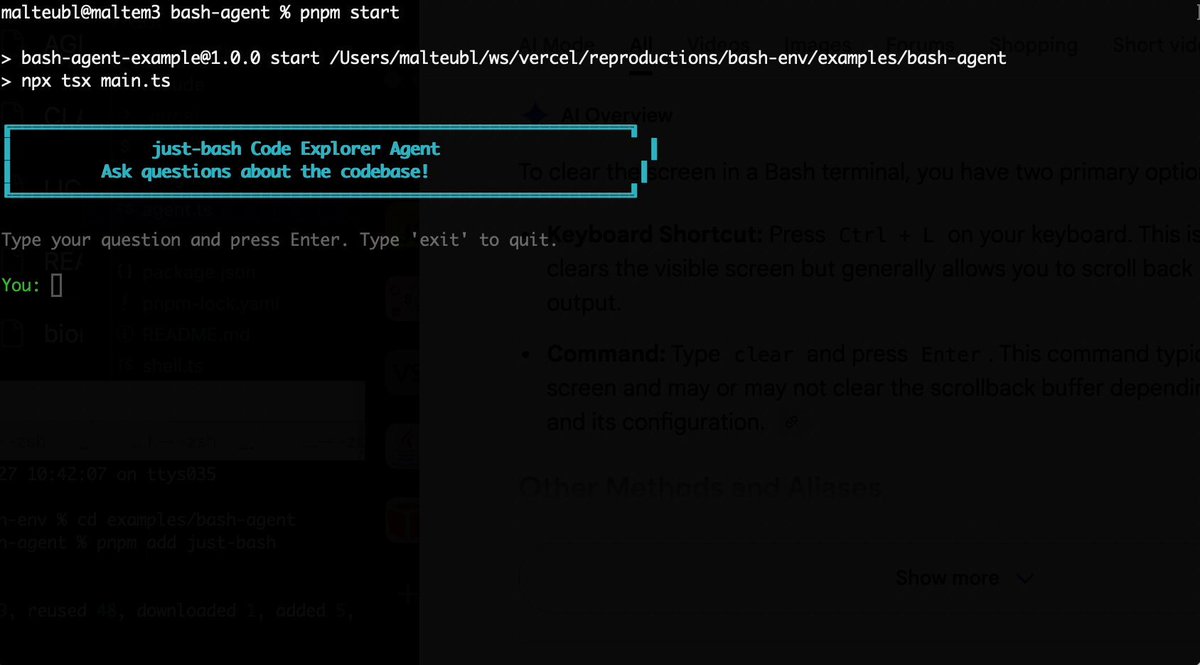
Bash is all you need! Which is why I'm introducing my holiday project: just-bash just-bash is a pretty complete implementation of bash in TypeScript designed to be used as a bash tool by AI agents. Because it turns out agents love exploring data via shell scripts, even beyond coding. It comes with grep, sed, awk and the 99th percentile features that an agent like Claude Code or Cursor would use. In fact, Claude Code can use it for secure bash execution. In the package - A bash-tool for AI SDK - A binary for use by yourself or your coding agents - An overlay filesystem to feed files to your agent securely - A Vercel Sandbox compatible API, so you can quickly upgrade to a real VM if you need to run binaries - An example AI agent that explores the just-bash code base using just-bash - I imported the Oils shell bash compatibility suite and just-bash passes a very good chunk What is interesting about this codebase: It was essentially entirely written by Opus 4.5. Coding agents love bash and they are good at reproducing it. They are also great at text-book recursive descent parsers and AST tweet-walk interpreters. That said, it is, like, a lot of code and I didn't read it all 😅. This is very much a hack, but it also seems to be _really_ useful. I haven't really found anything agents want to use that it doesn't support and it's fast and secure (caveats apply). It doesn't have write access to your computer and the filesystem is given a root that the agent cannot escape from. Find it at Related: Our recent blog post how we migrated our data analysis agent to bash tools and achieved incredible quality improvements The video shows the example agent investigating the just-bash code base

Malte Ubl

125,326 Aufrufe • vor 10 Monaten

Scott Wu (Scott Wu) on what programming will look like in the future: “All programming really comes down to is how do you tell your computer what to do? For every single piece of software that you use, some team of engineers came together and thought through all these details of, "Okay, here's what I want it to do. Here's how I want it to look. Here's what I want this button to do. Here's how I want to architect it." Every single little decision was made by somebody. And the computer is then executing it according to the wishes of its creators. At this point you don't need to know a programming language. You don't need to know Python or Java or something like that in order to build your own software. You can just say, "Hey, here's what I want. I wanna make a cool website that does this and that." Or in my existing product, "Here' what we have today, and I wanna change this thing or add this new feature," and just have the agent go and do that for you. I think we're gonna continue to go further down that axis. I think we'll start to see that abstraction will continue to climb. I think what we'll see a lot more of in the near future is making a piece of software which you're going to use one time and never again. To create software today the math only really works out if it's gonna be used at least a million times or something. Maybe it's 10,000 times or whatever. My point is if you wanna go build a product today, you need a whole team of engineers. Engineers are expensive. You need that software to be used enough times to create enough value for that to be worth it. But there are so many things out there which are very specific things that only need to be used a few times, or even only once. There’s all of these things that could be done with software. It just obviously doesn't make sense to hire a whole team of people to go make you that piece of software, which you're gonna use one time and never again. We're gonna get to a point where you are just giving your instructions to your agent, and the agent is gonna figure out, okay, I'm gonna write this code that's gonna go do this. I'm gonna put a script that automates this part etc. and that's what's gonna allow [single use software]. What [this is all about] is really just how you control your computer and how you get it to do what you wanna go do. You’ll wake up in the morning and you’ll talk to your agent about it. The agent does the literal writing of the code and you're the one that's deciding what to do.”

David Senra

12,855 Aufrufe • vor 3 Monaten