正在加载视频...

视频加载失败

New Unsupervised Learning with Karol Hausman & Danny Driess (Physical Intelligence) on building generalist robotics foundation models and: - What’s next in AI x robotics - Biggest outstanding questions - How they 10x’d model training speed - Open sourcing π 0 - Breakthroughs in generalization Spotify: Apple: YouTube:

13,961 次观看 • 1 年前 •via X (Twitter)

0 条评论

暂无评论

原始帖子的评论将显示在这里

相关视频

Karol Hausman is the co-founder and CEO of Physical Intelligence, a robotics company building a general-purpose “AI brain for the physical world.” The company has raised more than $1 billion in funding to develop foundation models that allow robots to operate across many machines, environments, and tasks rather than being programmed for a single purpose. In our conversation, we explore: • The moment a lecture from Sergey Levine convinced him to abandon his PhD research direction and pivot fully to deep learning • The case for building a general “AI brain” for the physical world rather than a single specialized robot • The role of real-world data in training robots, the limits of simulation, and how deployment could create a powerful data flywheel • The unique challenges of physical intelligence and why robots must operate with far higher reliability than language models Thank you to the partners who make this possible - Brex: The intelligent finance platform: - Granola: The app that might actually make you love meetings: Timestamps (00:00) Intro (04:05) Karol’s early fascination with robots (18:21) Karol’s entry point to robotics and PhD program (25:49) Combining robotics with LLMs: The Taylor Swift demo (30:48) The 1970s SHRDLU AI experiment (39:40) How research shapes what Physical Intelligence builds (49:07) The return of reinforcement learning in robotics (1:00:00) NVIDIA’s simulation engines (1:07:31) Compensating for missing senses

Mario Gabriele 🦊

27,871 次观看 • 6 个月前

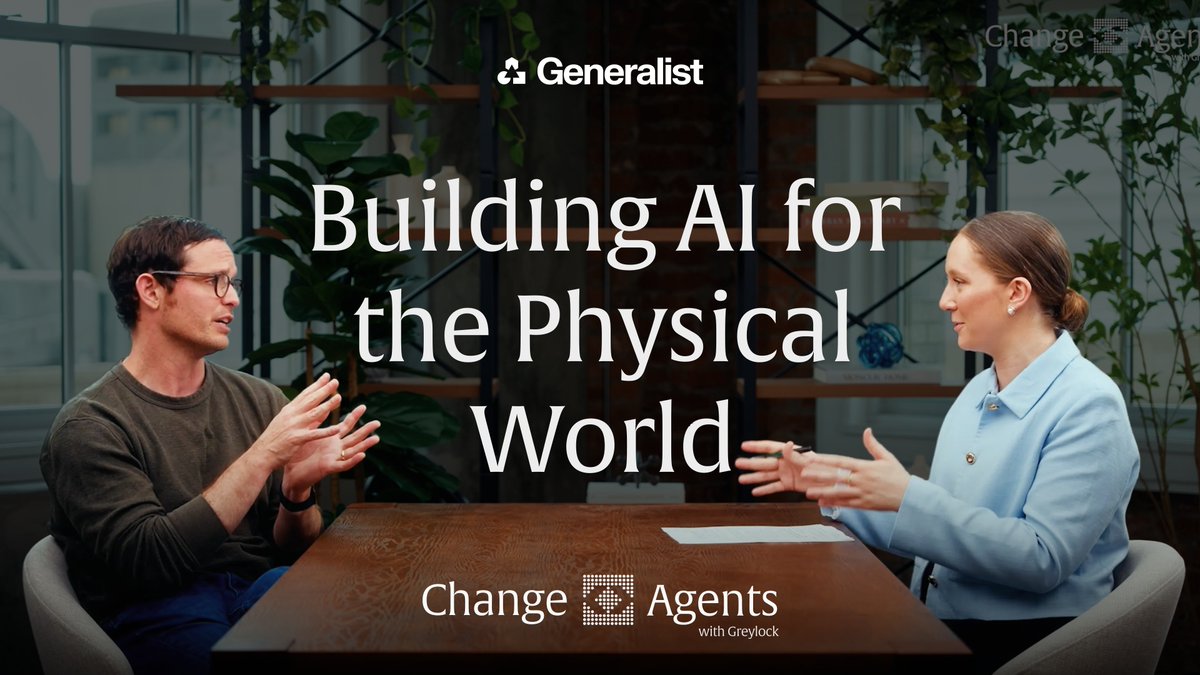
Feels like every week in robotics there’s a new ‘this is the GPT-3 moment for robotics 🤖’ announcement. We brought on Generalist CEO & Co-Founder Pete Florence on Greylock Partners Change Agents to dig into what’s going on at the frontier of robotics models. We covered the company’s latest Gen 1.5 model, few-shot learning, training robots on different embodiments, and the milestones towards a more generalized physical model. Timestamps: 00:51 The inception of Generalist 04:13 Long-term goal of the company 05:47 Parallels and differences between robotics and language models 12:05 Key differentiation in 1.5 Gen model 12:48 Robot vs banana 14:49 Emergent capabilities not explicitly trained for 17:13 Cross-embodiment and the importance of hands 22:26 Research vs working with customers 24:58 Beyond VLA vs world model 28:50 Future-looking milestones Some of the top takeaways: - One-shot and few-shot learning emerged without being trained for. Gen 1.5 can learn a new task from a single demonstration, and Pete compares it to the GPT-3 moment in language. In one example, a robot taught to sweep a cube into a bowl with a brush used a banana instead. Given a dustpan, it held the pan with one hand, swept with the other, then tipped the cube into the bowl. Neither behavior was explicitly trained, and Pete sees this as a signal of where the model's generalization is headed. -Generalizing to new hands remains a challenging problem for cross-embodiment. Physical hardware doesn’t stay static, and so cross-embodiment - the ability of a physical AI model to adapt to different hardware systems - is vital for success. -Customer deployments are a valuable source of research inputs. Generalist actively partners with their customers for feedback, which they use to inform their research and make real-world evaluations. -Generalist doesn't think in terms of "VLA vs. world model." Pete helped create early VLAs and has worked on world models, but he argues the goals matter more than the label, and the team is trained to think in a first-principled way when considering new research directions. Watch the full episode at the link in the comments. Thank you to Pete Florence for joining us!

Corinne Marie Riley

16,998 次观看 • 1 天前

Sergey Levine (Sergey Levine) is one of the world's top robotics researchers and co-founder of Physical Intelligence. We talked about where humanoid robotics is today, thoughts on the Chinese robotics ecosystem, and his predictions for future timelines. In this episode: • Current state of robotics and surprising capabilities so far • Chinese robotics compared to US ecosystem • If OpenAI and Anthropic got into robotics • His top robotics research paper recommendation • Predictions for when humanoid robotics will land Where to watch: • YouTube - • Spotify - • Apple Podcasts - • Transcript - Thank you to the sponsor of this episode for supporting my work: • WorkOS: makes your app Enterprise Ready with easy to use APIs to add SSO, SCIM, RBAC, and more in just a few lines of code, check them out at Chapters: 00:00 Intro 00:37 Where are we today 04:20 Most surprising capabilities so far 07:03 The most inspiring real world robotics 08:36 If OpenAI or Anthropic got into robotics 10:22 Chinese robotics 13:15 Will one lab breakout from the rest 16:59 Thoughts on a concrete roadmap 21:03 Generalization and demonstrating it 26:04 Types of data and which is best for robotics 34:34 Why humanoid robotics differs from Waymo 37:10 If humanoid robotics failed here is why 39:55 Are there hot take modeling architectures in robotics 42:05 Thoughts on AI safety in robotics 46:44 Top robotics research paper recommendation 49:35 Why is Boston Dynamics less top of mind 53:47 Advice for his younger self 56:42 Outro

Ryan Peterman

72,513 次观看 • 1 个月前