Video yükleniyor...

Video Yüklenemedi

Ana Sayfaya Dön

Nicholas Thompson is a disciplined machine (Atlantic CEO, record-holding runner, perpetual achiever) and a wholehearted human (insatiable interviewer, loving father, lifelong student). I talked to nxthompson about what makes words worth reading in an AI world, the discipline of long form, and what compounds when you keep showing up....

72,533 görüntüleme • 4 ay önce •via X (Twitter)

0 Yorum

Yorum bulunmuyor

Orijinal gönderinin yorumları burada görünecek

Benzer Videolar

Mario Gabriele is collector and teller of stories, and he argues that they are the foundation of how we understand the world. I talked to Mario Gabriele 🦊 about writing, what motivates the heroes he is most interested in (founders), and how to see the story underneath the story and get closer to what is true. Mario is founder of The Generalist and more recently, partner at Hummingbird Ventures. He is obsessed with founders and what makes them tick, and has evolved his career consistently to get closer to a seat that is suited just for him. We cover: - how stories can point at something truer than facts - why most writing advice is bad - how great ambition is almost always a product of pain - a rant against "how do you do anything is how you do everything" - Hummingbird's obsession with the texture of someone's mind - why the best investors' rationale fits on a napkin, and why "this founder is insanely good" is actually a deep answer - why The Generalist isn't called Mario's Newsletter (or podcast) - why he gave up some independence for Hummingbird Timestamps: 0:00 - Opening Highlights 1:13 - Intro to Mario 3:58 - Start: Stories, Truth, Writing, and the Story Beneath the Story 23:39 - Failure, Authenticity, Comparative Advantage, and The Most Annoying Aphorism in the World 35:55 - The Generalist's Style 45:20 - Process, Goals, Vision, Experimentation, and Business Models 57:52 - Investing: Energy, First Checks, Notecard-level Clarity, and Peter Thiel 1:07:46 - Understanding Founders, Motivation, Good and Bad Fuel, and True Ambition 1:17:47 - Hummingbird: Seeing the World as it Actually Is and How Stories Reveal Truth, Linguistics, Observation, Deciding to Join, and Evolution 1:29:32 - Motivation, Raising the Bar, Ongoing Learning and Teachability, Status, Unlearning, Generous Products, and The Reward of Not Knowing Dialectic 43: Mario Gabriele - Reality is Story-Shaped - is available below and on all platforms. Thanks to Notion for presenting Dialectic with Jackson Dahl.

Jackson Dahl

16,126 görüntüleme • 5 ay önce

.Elon Musk (worth $250B) answers why he’s still working: I think it's a good question you asked, because it goes to, like, at a foundational level, what is my philosophy, and why does it lead to this conclusion? So the reason is that when I was a teenager, I had, like, an existential crisis to try to figure out what's the meaning of life. There doesn't seem to be any meaning. For me, at least the religious texts, and I read all of them that I could get my hands on did not seem convincing. Then I started reading the philosophers. Be careful of reading German philosophers as a teenager. It's definitely not going to help with your depression. So reading Schopenhauer, Nietzsche, as an adult, it's much more manageable. But as a kid, you're like, “Whoa.” So then I was like, “Man, I'm just struggling to find meaning in life here.” And then I read Hitchhiker's Guide to the Galaxy. And basically what Douglas Adams was saying is that we don't really know what the right questions are to ask. The question is not, “What's the meaning of life?” In The Hitchiker's Guide to the Galaxy, Earth it turns out is a big computer, and its goal is to answer the question, “What's the meaning of life?” And Earth comes up with the answer “42”. This is where the 42 number comes from. And 420 is just ten times 42. In that book, which is really sort of a book about, it's an existential philosophy book disguised as humor. They come to the conclusion that, no, the real problem is trying to formulate the question. And to really have the right question, you need a much bigger computer than Earth. And so maybe one way, I think, of characterizing this would be to say, “The universe is the answer. What is the question? Or what are the questions?” The more we can expand the scope and scale of consciousness, the better we can understand what questions to ask about the answer that is the universe. The more we can expand consciousness, become a multi-planet species, ultimately a multistellar species… we have a chance of figuring out what the hell is going on. And so this is why I think we should have more humans and both biological and digital consciousness. And why we should become a multi-planet species and a multistellar species is so that we can understand the nature of the universe. And then in order for that to occur, then we have to make sure that things are good on Earth. We don't want Earth to disappear, so sustainable energy is important.

Arjun Khemani

15,600,131 görüntüleme • 2 yıl önce

Charles Broskoski believes everything should be personal: your work, your tools, your taste, and perhaps most provocatively, the business you build. I talked to Charles Broskoski about knowing yourself, noticing patterns, casual research, and building a personal business in Are.na. Charles is an artist turned software engineer and co-founder/CEO of Arena: a platform for collecting, connecting, and self-directed learning. Arena is coming up on its 15th anniversary, and Charles hopes it can last another 15 and far beyond. I discovered him through his essay and talk, "Here for the Wrong Reasons", and was struck by his philosophy that who we are is made up of the things we pay attention to, and specifically what we see in them. We discuss that and more: - Why creativity is decision-making and problem-solving - Charles's case for "casual" research - Why skateboarding is a model for being a beginner - How information that inflects you becomes part of who you are - Personal versus performative taste (and why it shouldn't be thought of as a competitive skill) - Creating a typeface to replace Arial that looks (almost) exactly like Arial - Why more creative people should start businesses - Drawing inspiration from a 1,300 year old Japanese hot spring hotel - "The reward is the work. That you get to hang out with your friends and make something cool." - Why Arena wants to fade into the background Timestamps: 0:00 - Opening Highlights 1:21 - Intro: Charles Broskoski 4:00 - Thanks to Notion 5:26 - Start: Creativity as Self-Knowledge and Problem-Solving 13:37 - Self-directed Learning and Casual Research 21:33 - Skateboarding, Being a Beginner, In Defense of Posers 33:26 - Contextual Patterns and Channels 45:54 - Nodal Points, Your Radar, and Careful Attention 1:04:57 - Subjectivity, Self-Knowledge, and Taste 1:15:09 - Performance: Here for Fame and Not Love 1:22:53 - Aspirational Attention 1:29:02 - Designing Generous Tools 1:42:44 - Space in a Product and Fading into the Background 1:50:01 - Why Creatives Should Be Entrepreneurial & Building an Independent Business Online 1:54:11 - Patience, Durability, and Antifragility 1:59:48 - Personal Businesses 2:10:27 - Grab Bag: Authenticity, Bohm Dialogue, Skateboarding, and Keeping Things Personal 2:28:28 - Thanks Again to Notion Dialectic with Jackson Dahl Ep. 40: Charles Broskoski - Everything is Personal - is out now, below and on all platforms.

Jackson Dahl

27,561 görüntüleme • 6 ay önce

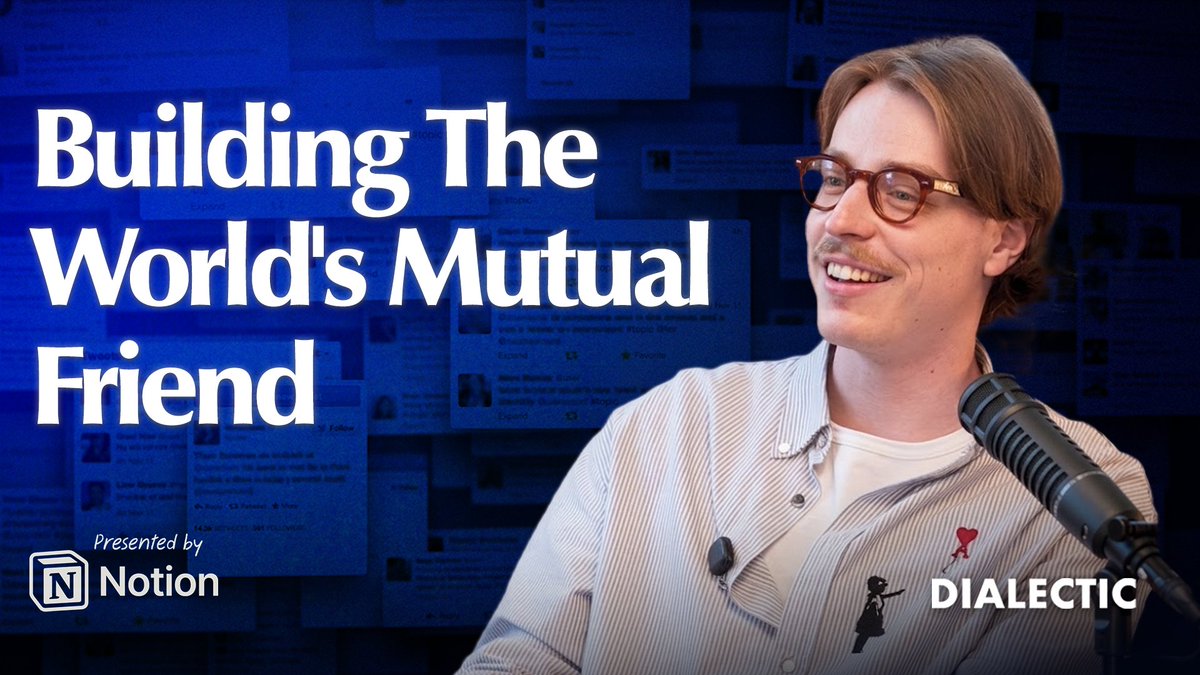
Paul Scherer wants to create an AI that brings us closer to each other. paul and Eigen are building a "mutual friend" for the world. Critically, the mutual part is more important than the friend part. Imagine the best "connector" you know -- the person who is emotionally intelligent, thoughtful, and always bringing people together. What if they could be friends with a million people, rather than a few hundred? And what if they were entirely focused on creating more belonging in the world? Modern social media--due to hyper-personalization and broken incentives--makes us feel more and more estranged from the people we care about. AI chatbots focus on engagement and can be anti-social. Paul and Eigen are aiming for a pro-social AI friend who is more concerned with helping deepen and widen your relationships than getting you to talk to it for longer. We discuss what all this might look like, the challenges of "growing" a new person that isn't a bad actor, and what it feels like to be a prodigious 22-year-old who Peter Fenton compared to the founders of last generation's great social media companies--all before he’s publicly launched a product. Timestamps: 1:13 - Intro to Paul 3:28 - Start: 'Momo', Presence, Friendship, and Time 11:10 - How the Internet Connects Us and Isolates Us, and Conflating Social and Media 25:12 - A Future Where We Talk to AIs 33:55 - Paul and Eigen are Building a Mutual Friend to Help Us Connect with Other Humans 48:01 - Why Do We Need a Mutual Friend? And Making a Friend We Can Trust 1:16:53 - Belonging, Building the team at Eigen, and Inventor as Outlaw 1:25:38 - Managing the Psychology of Being a Promising Young Founder 1:36:53 - Maintaining a High Bar, Fighting Entropy, and Influences 1:53:50 - Self-belief, Authenticity, Seeing the Water 2:10:30 - Courage, and a Final Question from a Mutual Friend 2:16:27 - Eigen Office Tour with Paul Dialectic with Jackson Dahl 47: Paul Scherer - A Friend That Brings Us Closer - is out now on all platforms.

Jackson Dahl

36,349 görüntüleme • 3 ay önce

Tim Burton on the similarities between Abraham Lincoln & Batman: "I first heard the idea of even before Seth Grahame-Smith had written the book. It was just when he was thinking about writing the book, I heard the title "Abraham Lincoln vampire Hunter". It just all of a sudden took me [my mind] back to kind of the era of films that I grew up in; like the 60s & early 70s where it was like a weird mashup of movie. I remember things like "Dr. Jekyll and Sister Hyde" (1971) and you know you get these weird kind of mixups of horror films and it just sounded to me like the kind of a movie that I wanted to see. It just reminded me of movie of that era and it had that kind of crazy energy to it and weird juxtapositions of things. So I knew even before reading he book that it was a great idea. It basically takes the the story of Lincoln which Seth really kind of went through the history of the life of Lincoln and linked it up to sort of vampire mythology. The idea that his mother was ki!!ed by a vampire and how that shaped the rest of his life. And again the interesting thing about it is that it's not as farfetched as it sounds. I mean the events and the idea of him becoming a vampire hunter and like all the deaths that he had in his family and people close to him, it makes a lot of sense and it's actually more believable than the premise makes it. So that's what was interesting because we never wanted to make fun of anything. We wanted to treat it seriously like a human story and a real story. We talked about the idea and the fact is that it very much sort of Mirrors the kind of the classic comic book superhero mythology. In some cases he's not dissimilar from Batman in the sense that he's got a dual life; he's got a day job as President and a night job as a vampire Hunter; The kind of duality of those characters and that's is something that was important - to keep the human quality of him but then kind of explore the mythological or sort of superhero nature of how we perceive Lincoln and mix those two together and that's what we have in the movie." (Tim Burton's interview to Rotten Tomatoes, 2012) Clip From: Abraham Lincoln: Vampire Hunter (2012) Director: Timur Bekmambetov

DepressedBergman

24,310 görüntüleme • 2 ay önce