Загрузка видео...

Не удалось загрузить видео

На главную

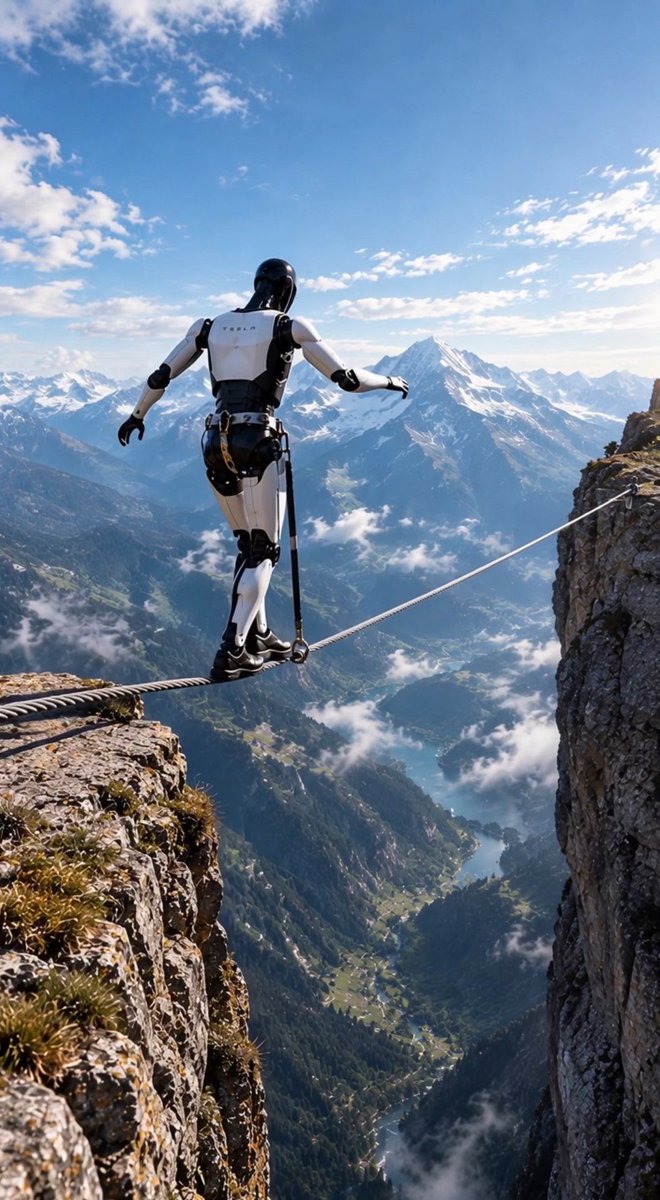
⚠️ NO MAGIC INVOLVED. JUST THE SAME ACTUATORS FROM HUMANOID ROBOTS, POINTED IN A DIFFERENT DIRECTION. What looks like sci-fi on an auto show floor runs on the same three technologies now putting robots on their feet. → Electric actuators instead of hydraulics, the same components going into today's...

132,402 просмотров • 9 дней назад •via X (Twitter)

Комментарии: 0

Нет доступных комментариев

Здесь появятся комментарии из оригинального поста

Похожие видео

BOOM! Humanoid Robots Just Performed Surgery for the First Time! REAL VIDEO! In a groundbreaking preclinical breakthrough, researchers at UC San Diego have achieved what many thought was years away: teleoperated humanoid robots successfully completing live surgeries. Published in Nature, the study marks the world’s first use of humanoid robots for in-vivo laparoscopic procedures on large animals (pigs). Two separate surgeries were completed: Key Details •. Procedure: Laparoscopic gallbladder removal (cholecystectomy) •. Team 1: Human surgeon + one humanoid robot (the robot performed core tasks while the human assisted) •. Team 2: Two humanoid robots working together with no human at the operating table •. Robots: Custom “Surgie” humanoids (~5 ft tall, ~60 lbs) using standard surgical tools •. Control: Fully teleoperated by surgeons (remote human control, not autonomous) •. Significance: First demonstration of humanoid robots handling real surgical workflows in a live setting, proving compatibility with existing OR tools and spaces This proof shows humanoid robots could one day help address surgeon shortages, enable remote procedures in rural areas, battlefields, or even space all at a fraction of the cost and space of traditional surgical robots like da Vinci. Read the full publication here: Project page with video: The future of surgery just got a whole lot more interesting. And medical cost for the first time in decades will be scheduled to go down, much further down.

Brian Roemmele

107,600 просмотров • 1 месяц назад

WATCH THE TONGUE, NOT THE SKIN 2026 AI Robot Exhibition floor. Guy peels protective wrap off a female humanoid - realistic skin, styled hair, standing still. He touches her chin. Her mouth opens. Her tongue extends, slightly. He turns to the camera and tells you the skin texture is indistinguishable from human. He's pointing at the wrong part. - Every previous humanoid demo hides the mouth Closed lips. Controlled smiles. Interview shots that cut before the mouth has to do anything complicated. There's a reason. Mouth interior is where the uncanny valley kills the illusion faster than anywhere else on a humanoid - wet surfaces, muscle deformation, teeth showing at wrong angles, a tongue that reads as rubber. The safe move for every manufacturer up to now has been to keep it shut. - Extending a tongue means the interior is solved What this demo is actually flexing: jaw and tongue actuators independent of the smile mechanism. A soft-tissue tongue with texture that reads correctly at close range. Cheek deformation responding to his chin-touch as a tactile input - that's a sensor layer under the silicone, not just a scripted animation. This is three separate hardware systems working together on a live floor with cameras inches away. - Skin texture is a commodity now. Mouth mechanics aren't. Every manufacturer shipping humanoids in 2026 has convincing skin - platinum-cure silicone with subcutaneous tinting is a known process at this point. That's not the differentiator anymore. The differentiator is what happens when you touch the unit. The one that opens its mouth on demand, on a public floor, in front of cameras, is the one that isn't hiding from close inspection. - Why the trade show matters The 2026 AI Robot Exhibition is China's biggest humanoid showcase - where enterprise buyers from hospitality, retail, healthcare and elder-care come to sign purchase orders. Willingness to demo interior mouth mechanics in that room is a confidence signal directly aimed at those buyers. "Our unit can talk to your customers with visible tongue and teeth motion and not look wrong doing it." - What this actually unlocks Humanoid receptionists that hold a conversation without the customer noticing something's off around the mouth. Retail units that can smile with teeth showing. Healthcare aides that speak to patients at bedside range. The close-inspection barrier - the two-foot distance where the illusion has always broken - just dropped a floor. Which is the distance almost every commercial humanoid deployment actually operates at.

capONE 💎

15,360 просмотров • 6 дней назад

Most humanoid projects talk about real work. Very few last an hour on a real line. This week I saw a case that matters for anyone building robots, perception, or physical AI. Kinisi deployed its first mobile manipulation system into a live recycling facility. Not a demo. Not a staged test. A real production line with real output pressure. Why this matters if you want robotics to deliver real value on your floor: • Handles mixed glass with random poses and no fixed fixtures. • Runs real grasp selection under noise, vibration and production variability. • Maintains throughput while avoiding breakage on a delicate material. • Shows mobile manipulation doing actual shift work instead of controlled lab runs. Kinisi published a video that shows what the robot sees and how sensor data turns into action. This is the part most teams struggle to explain to customers, so the educational angle is useful for anyone working on adoption. On top of this, the team signed a pilot with a global automotive manufacturer to explore humanoid use cases in production. The direction is clear. Wheeled mobility (not legs!) plus strong perception seems to be shaping a large part of industrial humanoids right now. I know Brennand from earlier conversations and from our podcast session, and I am always glad to see European teams push the category forward. Wishing the Kinisi team continued success. —- Weekly robotics and AI insights. Subscribe free:

Ilir Aliu

24,743 просмотров • 9 месяцев назад

This work makes a humanoid robot do simple parkour moves by looking with a depth camera and choosing the right move on the fly. The big deal is that it turns lots of small human moves into long, real-time robot behavior, without hand-coding every transition or retraining for each new course. A humanoid robot is usually good at steady walking, but it often fails when it has to do fast moves like jumping up, vaulting, or rolling, and then keep going to the next obstacle. The hard part is that you cannot easily collect training data for every possible obstacle shape, distance, and mistake, so robots end up learning a few moves that only work in a narrow setup. This work starts from short clips of real human parkour moves, like stepping over, vaulting, climbing, and rolling. It uses motion matching, which is basically a smart “pick the next clip that fits best right now” search, to stitch those short clips into a long, smooth plan that looks like a human doing a whole course. Then it trains a controller with reinforcement learning (RL), which means the robot learns by trial and error to copy that plan while staying balanced and not falling. After training separate expert controllers for different moves, it compresses them into 1 controller that uses only onboard depth sensing and a simple “go this fast in this direction” command. In real tests on a Unitree G1 humanoid, it can clear multiple obstacles in a row, adapt when obstacles get moved, and climb a wall up to 1.25m.

Rohan Paul

37,121 просмотров • 6 месяцев назад

Elon Musk gave the entire entertainment industry its expiration date, and he is the one building the thing that kills it. Musk: “My guess is that we see the first compelling half hour, pure AI show next year.” Next year. A complete show generated entirely by AI. No writers. No actors. No cameras. No sets. No crew. No studio. Just a prompt and enough compute to render a reality that never physically existed. And shows are the easy part. Musk: “I say probably we’re maybe three years away from AI does the whole video game.” A show plays the same way every time. A game has to generate a living world that reacts to every decision in real time across every single frame. That is a fundamentally harder class of problem. And Musk put three years on it. Right now a single AAA title takes seven years and half a billion dollars across thousands of engineers and artists just to ship it. Musk is describing a world where one person types a paragraph and gets something comparable. The entire value proposition of a multi-billion dollar industry lives inside that gap. And it closes in thirty-six months. But the prediction is not the story. The person making it is. This is not an analyst speculating from the sidelines. This is the man building the largest AI compute clusters on the planet. The man who built xAI from zero in under two years. The man stacking hundreds of thousands of GPUs into facilities designed to do exactly what he is describing. When Musk says three years, he is not guessing about what someone else might eventually ship. He is reading you a delivery date off his own roadmap. Every media company on Earth is valued on a single assumption. That quality content is expensive and difficult to produce at scale. That one assumption is the structural foundation underneath every studio, every network, and every publisher in existence. Musk is dismantling it with raw compute. The studios still parading thousand-person production teams are not demonstrating strength. They are advertising the exact cost structure that one person with a prompt and a GPU allocation is about to make irrelevant. And it does not stop at entertainment. If AI can generate an interactive world that responds to human input in real time, it can generate anything. Advertising. Architecture. Training simulations. Product design. Every industry built on humans manually constructing visual experiences frame by frame is sitting on the same countdown Musk just read out loud. Now zoom out. Because this is not just an industry story. For the entire history of human civilization, the distance between imagining a world and actually creating one required thousands of people, millions of hours, and billions of dollars. That distance built Hollywood. That distance built the gaming industry. That distance made content scarce and studios powerful. Musk is collapsing that distance to zero. When the gap between imagining something and it existing disappears, every business model built on the difficulty of creation disappears with it. That is not disruption. That is a full inversion of how human beings create. Musk did not make a casual prediction on that podcast. He told you what he is building. He told you the timeline. And he told you which industries do not survive it. The entertainment industry is still debating whether this future is real. Musk is not part of that debate. He is building. And he just told you the delivery date.

Dustin

22,390 просмотров • 1 месяц назад