Загрузка видео...

Не удалось загрузить видео

На главную

Nothing beats open-source! We now have a fully open-source coding agent that can compete with any proprietary solution out there: • 500+ available models • It doesn't train on your code • It doesn't charge a penny for tokens • It's open. You can change if you want. Kilo...

73,304 просмотров • 11 месяцев назад •via X (Twitter)

Комментарии: 39

Фото профиля Emanuel | freeapp.ai
Emanuel | freeapp.ai11 месяцев назад

I am using it daily. It's the best open source. Grok fast and Claude Code are the best. I've build a Jira ticket bug analyser with it.

Фото профиля Santiago
Santiago11 месяцев назад

Cool!

Фото профиля Andrew
Andrew11 месяцев назад

This is what happens when builders, not corporations, lead innovation. Open-source stays undefeated.

Фото профиля Srinivas
Srinivas11 месяцев назад

Lately, open sourced tools have matured a lot. I went from using vscode to cursor to windsurf to vscode with kilo lately :)

Фото профиля Abdur Rahman Abul Hossain
Abdur Rahman Abul Hossain11 месяцев назад

Can someone explain the difference between kilo and roo code? I know kilo is fork of roo. What does it provide that roo doesn’t? @grok

Фото профиля Dr G Hodl
Dr G Hodl11 месяцев назад

That's great to see, more innovation in the OSS space!

Фото профиля Falkon Snow (e/acc)
Falkon Snow (e/acc)11 месяцев назад

Whats the business model if they don’t make money on tokens?

Фото профиля Santiago
Santiago11 месяцев назад

They have two paid tiers, offering more features.

Фото профиля Swupel e.U.
Swupel e.U.11 месяцев назад

Open Source is king!

Фото профиля Prathamesh Sakhadeo
Prathamesh Sakhadeo11 месяцев назад

I have been using Kilo Code since last month. I think the plan mode is fantastic.

Фото профиля Alexandru Indrei
Alexandru Indrei11 месяцев назад

Those modes remind me of RooCode.

Фото профиля Suhrab Khan⚡️
Suhrab Khan⚡️11 месяцев назад

Kilo Code proves what open collaboration can achieve: five specialized modes, full transparency, and zero token costs.

Фото профиля mandrake
mandrake11 месяцев назад

Thank you for sharing

Фото профиля Moritz Bierling
Moritz Bierling11 месяцев назад

Can you run it in the terminal?

Фото профиля Ross Forrester
Ross Forrester11 месяцев назад

Gonna try it out, thanks Santiago! I suppose at the very least it'll save costs as it could cover some of the work you'd use paid for ones for right? Like even if performance is less perfect.

Фото профиля Call Me Cobby
Call Me Cobby11 месяцев назад

@SimplyVision_

Фото профиля Mr Q
Mr Q11 месяцев назад

This post doesn't make sense. This is not an agent, it's a coding platform. The api calls still 'probably' train on your tokens even when they say they don't. If you're not running the actual model itself locally then you can't guarantee it.

Фото профиля Lydia_CanopyWave
Lydia_CanopyWave10 месяцев назад

We can offer most top open source models for free. DM me if you need it

Фото профиля weathermanj
weathermanj11 месяцев назад

Kilo is just a fork of cline/roo.

Фото профиля Memori Labs
Memori Labs11 месяцев назад

Nice

Фото профиля Murad
Murad11 месяцев назад

Clearly, open-source just turned coding agents into a playground with zero gatekeepers.

Фото профиля AbumbahJustin
AbumbahJustin11 месяцев назад

@Lameprotagonis

Фото профиля shyam🇮🇳
shyam🇮🇳11 месяцев назад

How does it differ from Roocode?

Фото профиля Farseen
Farseen11 месяцев назад

i never understood why folks opensource the codebase cost saving or something please enlighten

Фото профиля Gerson
Gerson11 месяцев назад

hahhhah incredible! So goooooood...

Фото профиля ItIsWhatItIs
ItIsWhatItIs11 месяцев назад

Does Kilo Code work with local hosted models?

Фото профиля Zoe
Zoe11 месяцев назад

👍

Фото профиля Juan Roa
Juan Roa11 месяцев назад

@platzi and @freddier helped spread @kilocode around LATAM a lot!

Фото профиля John
John11 месяцев назад

What do you mean it doesn’t charge a penny for tokens ? You still have to use an LLM with it

Фото профиля Movan
Movan11 месяцев назад

Models in kilo works better compared to other tools

Фото профиля Gam_B1t
Gam_B1t11 месяцев назад

What are the benefits of kilo code compared to roocode ? I tried both solutions long time ago and finally return to roocode.

Фото профиля NanoCore
NanoCore11 месяцев назад

Well Kilo Code is actually built upon Cline and Roo - kind of mixing the best of them

Фото профиля Pushpit.exe
Pushpit.exe11 месяцев назад

Evertime i open X there is some new tool framework model... new 60M dollar funding. Its getting too difficult to catch up woth AI 🫠

Фото профиля Mihai Constantin
Mihai Constantin11 месяцев назад

YES !

Фото профиля Laurence Molloy
Laurence Molloy11 месяцев назад

Lemme ask you something @svpino - there is also a commercial product (subscription model) here. If I am just using this on my own code, what is there in the $29 subscription that would make me want to pay? i.e. what is the free model missing that is of any note?

Фото профиля Santiago
Santiago11 месяцев назад

If you are working solo, the two features that might be interesting are: - Creating custom modes - Billing and analytics dashboard Everything else is very team-centric.

Фото профиля Laurence Molloy
Laurence Molloy11 месяцев назад

Ah... but I thought it was supposed to be free, so why would the "billing" aspect of the dashboard be of interest here?

Фото профиля Santiago
Santiago11 месяцев назад

If you want to use the tool for free, you can. If you pay for the teams subscription, there are additional features (like custom modes and billing/analytics dashboard) that aren't part of the free plan. If I'm part of a team, it's nice to see a breakdown of how different people are using the models. Token usage, model type, etc.

Фото профиля DMartini
DMartini11 месяцев назад

Basically how roo code works? What is better here?

Похожие видео

Nothing beats Augment Code answering questions about large codebases. It's a free extension (works in VSCode, JetBrains, and NeoVim), and has a community edition you can run for free forever. Try this experiment: 1. Download any large open-source project from GitHub 2. Augment will index the code 3. Start asking questions about the codebase 4. Do the same using any other coding agent 5. Compare the speed and the depth of the answers you get If you have a small codebase, the differences with other coding agents won't be obvious, but if you are working on a large project, things will click immediately. Suggestion: download the Keras repository (~180,000 lines of code). I know the library well, and the answers I got from Augment were pretty impressive. By the way, Augment is a fully-fledged AI coding assistant. You can use its agent in every imaginable way: • To implement brand new functionality • To make quick edits to your code • To refactor existing functionality • To generate unit tests • To generate documentation • To handle GitHub—pull requests, commits, branching, etc My favorite feature is their "Next Edit" functionality: 1. You edit the code 2. Augment analyzes the change (across the entire codebase!) 3. Augment determines the ripple effects of that change 4. Augment suggests everything you need to update Here is a link to the tool: Thanks to the team at Augment Code for partnering with me on this post.

Santiago

34,977 просмотров • 1 год назад

8 rules to improve your AI coding agent. All of these rules work with Claude Code, Cursor, VS Code, and with most programming languages. Automating these rules will 10x the code quality and security produced by your AI coding agents. 1. Dependency checks - Prevent your agent from suggesting insecure libraries based on outdated training data. 2. Secret exposure - Auto-fix the use of hardcoded credentials introduced by your coding agent. 3. File and function size - Automatically refactor any files or functions that exceed a reasonable length. 4. Complexity and parameter limits - Simplify overly complex code written by the agent. 5. SQL Injection - Auto-fix all database interactions with unsanitized user input. 6. Unused variables and imports - Detect and remove dead code. 7. Detect invisible unicode characters in AI rules files - Remove zero-width spaces, direction overrides, and other invisible characters that can hide malicious behavior. 8. Insecure OpenAI API usage - Enforce use of secure OpenAI endpoints, proper authentication, and context isolation Here is how you can automate this: Install the Codacy extension. This will give you access to a CLI for local scanning and an MCP server for agent communication. From here on out, every time you need to generate some code: 1. Your agent will write the code 2. It will then call Codacy's CLI to check it 3. It will find any issues in real time 4. Your coding agent will fix the issues 5. When the code passes all checks, you are done Level of effort on your side: literally zero! Code quality and security because of this: 100x better! Here is the link to download the extension for your IDE: Thanks to the Codacy team for collaborating with me on this post.

Santiago

49,331 просмотров • 1 год назад

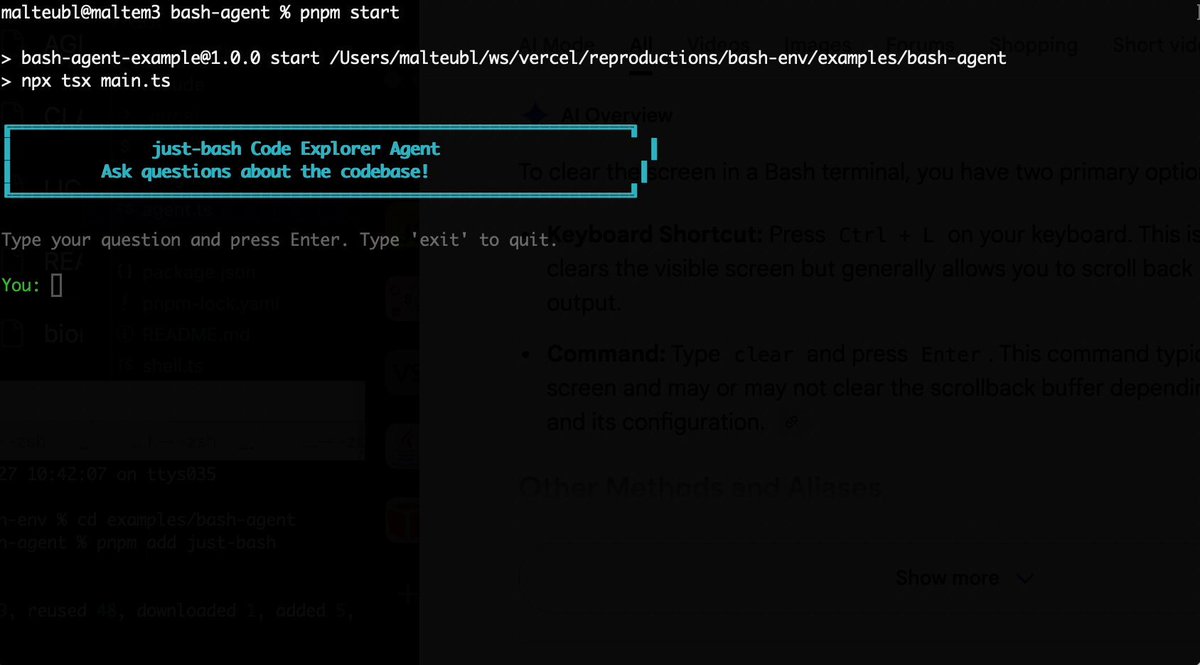
Bash is all you need! Which is why I'm introducing my holiday project: just-bash just-bash is a pretty complete implementation of bash in TypeScript designed to be used as a bash tool by AI agents. Because it turns out agents love exploring data via shell scripts, even beyond coding. It comes with grep, sed, awk and the 99th percentile features that an agent like Claude Code or Cursor would use. In fact, Claude Code can use it for secure bash execution. In the package - A bash-tool for AI SDK - A binary for use by yourself or your coding agents - An overlay filesystem to feed files to your agent securely - A Vercel Sandbox compatible API, so you can quickly upgrade to a real VM if you need to run binaries - An example AI agent that explores the just-bash code base using just-bash - I imported the Oils shell bash compatibility suite and just-bash passes a very good chunk What is interesting about this codebase: It was essentially entirely written by Opus 4.5. Coding agents love bash and they are good at reproducing it. They are also great at text-book recursive descent parsers and AST tweet-walk interpreters. That said, it is, like, a lot of code and I didn't read it all 😅. This is very much a hack, but it also seems to be _really_ useful. I haven't really found anything agents want to use that it doesn't support and it's fast and secure (caveats apply). It doesn't have write access to your computer and the filesystem is given a root that the agent cannot escape from. Find it at Related: Our recent blog post how we migrated our data analysis agent to bash tools and achieved incredible quality improvements The video shows the example agent investigating the just-bash code base

Malte Ubl

125,326 просмотров • 9 месяцев назад

Introducing /visual-plan - a skill to generate rich, visual plans for Claude Code and Codex. Plan mode in Claude Code is incredible. But I always find my eyes glazing over when it gives me this huge markdown essay in my terminal. I found I can make much better visual plans with reusable components. So I made a skill called `/visual-plan`. It generates plans as MDX with visual, interactive components. Diagrams, interactive API specs, schema design changes, annotated code, and even pan and zoomable wireframes. So for any UI work, you can look at a wireframe first, comment on it, iterate, and then have the agent work. I’ve found this to be a much more intuitive interface for reasoning about what the agent is doing. It’s somewhat inspired by that popular post about how HTML is better than Markdown. But HTML can be slow and verbose to write. And it doesn’t look good checked into a repo. This has really made me feel like humans and engineering are entering a new abstraction phase, where we reason about things at the plan level. As long as the plan is good, agents are getting more and more reliable at executing on it. Almost to the degree that we trust the C compiler to compile to assembly reliably. Plans are the new intermediate representation. I also made a skill for the reverse of this, called `/visual-recap`. After the agent works, it gives you a recap of everything it did. Same idea: wireframes, interactive API specs and diffs, schemas, annotated code, etc. So now when you’re reviewing what the agent did for you, or looking at a pull request of somebody else’s code, you can see a visual recap instead of just reading a wall of text. It’s all free and open source. You can find it on my GitHub. Will link to it in the reply because we all know how dumb these algorithms are with links.

Steve (Builder.io)

126,758 просмотров • 4 месяцев назад