Загрузка видео...

Не удалось загрузить видео

На главную

Nova-1 is set to deploy from SpaceX's Transporter-17 just after midnight tonight. As the first Nova in orbit, Nova-1 will serve as a flying testbed, proving out the Nova platform architecture and the vertically integrated tech stack (power, avionics, solar, flight software) that will underpin all future Apex platforms....

218,399 просмотров • 1 месяц назад •via X (Twitter)

Комментарии: 0

Нет доступных комментариев

Здесь появятся комментарии из оригинального поста

Похожие видео

Today, we unveil Project Shadow — Apex's on-orbit Space-Based Interceptor (SBI) technology demonstration, launching NET June 2026. At Apex, we often launch self-funded missions to advance our technology and demonstrate our capabilities in space. Over 1.5 years ago, we launched our first Aries satellite, which continues to serve as an on-orbit software testbed for our team and customers. Project Shadow is our next step internally funded mission (with more to come in the future). Launching on our Nova satellite bus platform, Shadow integrates and demonstrates key SBI technologies in a single, end-to-end mission. Here’s an inside look at Shadow: 1. Apex’s Nova platform will be outfitted with the “Orbital Magazine” configuration package, providing environmental management for the demonstration interceptors, a Link-182–compatible radio, and Missile Warning/Tracking sensors. 2. The Orbital Magazine will carry two scaled-down demonstration interceptors, each equipped with a solid rocket motor (SRM) and a suite of data-collection sensors. 3. The Orbital Magazine will launch NET June 2026, and after LEOPS and commissioning, Apex will issue a fire control command. 4. The Orbital Magazine will deploy the first interceptor and establish an inter-satellite link. The interceptor will be tasked to fire its SRM while oriented in the inverse velocity direction, avoiding other in-space objects, and safely deorbiting after the burn. 5. During the burn, the Missile Warning/Tracking payloads on the Orbital Magazine will gather critical data on on-orbit SRM performance, determine tracks, and more. 6. The second interceptor will be deployed shortly after, establish a crosslink, and receive a command to fire its SRM, following a similar trajectory to the first demonstration interceptor and safely deorbiting. Project Shadow is self-funded by Apex. We believe that supporting America, our allies, and democracy requires direct investment in the development and maturation of key defense technologies — including SBIs. Learn more about next year’s mission from SpaceNews with the link below.

Apex - Satellite Platforms 🛰

1,118,977 просмотров • 10 месяцев назад

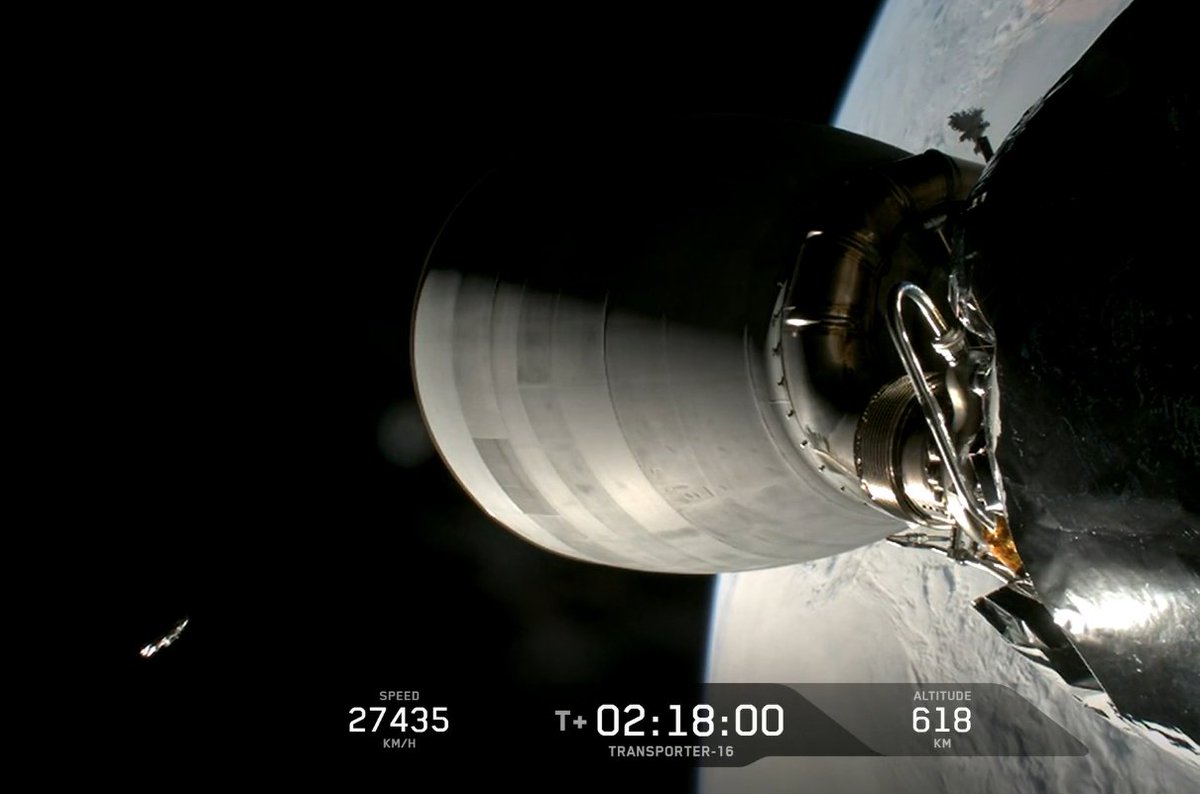
I'm excited to announce we have achieved our Tier 1 mission success criteria and have begun gathering a tremendous amount of data on how this brand new spacecraft performs. On March 30th, 13:17:08Z, the Gravitas spacecraft separated from the SpaceX Transporter-16 stack to begin its mission as one of the highest power free-flying satellites ever launched. Immediately after separation, the spacecraft autonomously: - Executed detumbling maneuvers - Established two-way communications with the ground (on our very first ground station pass) - Deployed its 20kW solar arrays - Slewed to a safe and stable attitude to await further ground commands These actions alone are a testament to the incredible work of our in-house engineering, software, and GNC teams to build a robust spacecraft. Since then, our operations team completed all initial system activations and checkouts, confirming the vehicle is in a power positive and thermally stable state with no major anomalies observed at this time. We completed this phase of the mission ahead of schedule. Next up we will be powering up and downlinking data for all payloads aboard the Gravitas spacecraft in support of our customers and partners while continuing to put the spacecraft through its paces. As we noted ahead of launch: The goal of this mission is to experiment and push our systems to the limit to inform future missions. I look forward to sharing more on our successes and challenges as the mission proceeds. Video of our satellite below; link to full T-16 webcast:

Neel Kunjur

89,923 просмотров • 4 месяцев назад

Orbit AI Satellite Successfully Achieve World’s First Orbital AI Deployment and Launching Digital AI Sovereignty Decentralized Orbital AI Network Orbit AI Orbit AI🛰️ today announced that the first satellite, “OAI Genesis-1,” has successfully launched and entered Low Earth Orbit (LEO). Amidst fierce competition from tech giants (e.g., Starlink Starlink Elon Musk , Google AI Project Suncatcher) in space AI computing, this launch signifies Orbit AI’s position as the first to achieve real-world AI deployment, formally inaugurating its "Orbit AI Cloud Platform." Genesis-1 is equipped with NVIDIA NVIDIA AI Compute Cores, running a 2.6B parameter AI model for real-time analysis of infrared remote sensing data in space. By processing data on orbit, Genesis-1 drastically reduces critical information retrieval time (e.g., disaster alerts, maritime monitoring) from hours to mere seconds, while cutting transmission bandwidth costs by over 90%. Furthermore, Orbit AI has partnered with from energy company Powerbank (NASDAQ: SUUN) ( utilizing infinite solar power to achieve carbon-neutral computing and projecting a reduction in overall energy operational costs by 60%. Following its triumph at the BNB Chain Hackathon ( Orbit AI protocol is committed to creating an ultimate censorship-resistant deployment environment: Developers can deploy AI models, privacy applications, financial algorithms, and even blockchain nodes on the satellite network. This ensures that code and data operate in a physically isolated, neutral environment beyond the jurisdiction of major nations, guaranteeing extreme digital sovereignty and service resilience. Orbit AI will also leverage the RWA (Real World Assets) mechanism to allow community users to purchase satellite NFT shares, becoming co-owners of this space infrastructure and sharing in its compute revenues, thus building a community-owned orbital AI economy.

Orbit AI🛰️

24,839 просмотров • 8 месяцев назад

Elon Musk just explained why the SpaceX IPO is an energy story and the energy constraint is why he believes space becomes the only viable path for AI to scale (Save this). The argument he is making is one of the most important and least understood things happening in technology right now. The United States currently consumes roughly 500 gigawatts of electricity on average. To double that capacity which is what continued AI expansion on the current terrestrial trajectory would eventually require would mean building as many power plants as currently exist in the entire country. He is not arguing that this is technically impossible, just that communities are not willing to accept it, that permitting timelines make it unrealistic, and that the hard ceiling on Earth based power generation means the expansion of AI compute will eventually hit a wall that no amount of capital can overcome on the ground. His observation is that in space, that wall does not exist. A solar panel in orbit produces roughly five times more power than the same panel on Earth, operates in continuous sunlight uninterrupted by weather or nighttime, and benefits from the vacuum of space as a completely passive cooling system meaning the two largest operating costs of any terrestrial data center, energy and cooling, are effectively eliminated. He then said that you could theoretically increase harnessed energy by a factor of one million and still be using less than a millionth of the sun's total energy output. This is the underlying physics of why SpaceX filed with the FCC to launch up to one million solar powered AI satellites, and why they described that constellation in their own filing as a first step toward becoming a Kardashev Type II civilization capable of harnessing the full power of the sun. To understand what makes this credible rather than visionary, you need to understand what SpaceX already controls that no other company on earth possesses. Starship, once operating at full cadence, can deliver 100 to 150 tons of payload to orbit per launch, at a target cost per kilogram that is an order of magnitude lower than any existing vehicle. Musk's stated ambition is to scale Starship to 10,000 to 30,000 launches per year, a frequency that would allow the deployment of orbital compute infrastructure at a pace that is currently unimaginable with any existing rocket. He told xAI staff earlier this year that achieving space-based AI at scale will eventually require manufacturing facilities on the moon, building solar panels and heat dissipation structures from lunar silicon and aluminum, and launching them into orbit from there rather than from Earth's surface because the moon's lower gravity makes the economics of launch dramatically more favorable. SpaceX's S-1 filing explicitly states that its launch capabilities could enable massive AI compute satellite constellations with the potential for millions of satellites for orbital data centers, with the first launch potentially occurring as soon as 2028. Google and Alphabet are already in advanced talks with SpaceX about deploying space-based data centers. Starcloud, a startup running Nvidia H100 GPUs in orbit, has already validated that high-performance AI inference workloads can operate in space, with plans to scale to five gigawatts of orbital compute power by 2035. This is why Musk believes the cost crossover happens in two to three years because SpaceX's launch cost trajectory intersects with the accelerating energy constraint on the ground in a way that makes space genuinely cheaper, faster, and less regulated at exactly the moment AI demand is hitting its hardest physical limits.

Milk Road AI

12,738 просмотров • 2 месяцев назад