Загрузка видео...

Не удалось загрузить видео

На главную

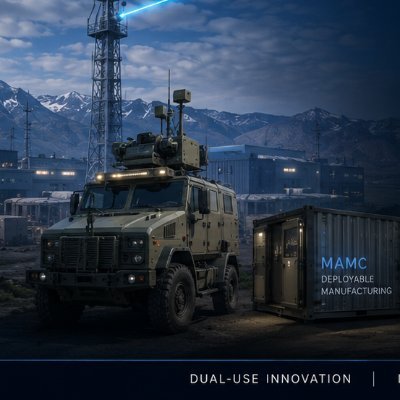
📈 #NUBURU continues to execute on its transformation plan. Recent milestones: 🔹 Expansion into electronic warfare & operational resilience 🔹 Important round of debt equtization completed and $100M flexible capital 🔹 Dual-CEO structure driving strategic and operational growth 🔹 Deployment of advanced defense systems across Europe through acquisitions and...

48,309 просмотров • 10 месяцев назад •via X (Twitter)

Комментарии: 0

Нет доступных комментариев

Здесь появятся комментарии из оригинального поста

Похожие видео

Advancing LOX/LCH4 Dual-Propellant Cooling for HANBIT-Micro INNOSPACE has successfully completed a series of combustion tests for its upgraded 4 kN-class liquid-methane kick-stage combustor for HANBIT-Micro. 🚀 Building on the 237-second long-duration ground test in May 2024, the combustor has been advanced with a Dual-Propellant Regenerative Cooling scheme. 📈 ⚙️ Unlike conventional single-propellant regenerative cooling, this approach utilizes both fuel and oxidizer as coolants, enabling: 🔹 Reduced feed pressure requirements 🔹 Lighter propellant tanks 🔹 Lower overall kick-stage mass 🔥 By preheating and vaporizing both coolants, the system also achieves: 🔹 Improved mixing efficiency 🔹 Shorter ignition delay 🔹 Enhanced combustion stability and efficiency 💡 Overcoming High Technical Barriers Most notably, the recent test validated stable regenerative cooling under low-pressure, subcritical conditions — a technically demanding regime — and mitigated the risks associated with using liquid oxygen (LOX) as a coolant. The application of a gas–gas swirl injector further demonstrated improved mixing performance. With this milestone, INNOSPACE continues to advance methane propulsion technology and enhance the maturity of the HANBIT-Micro kick-stage system. Please stay tuned for the next phase of development. 🙌 #SpaceInnovation #HANBITMicro #KickStage #MethaneEngine #RocketEngineering #SpaceTech

innospacecorp

18,949 просмотров • 6 месяцев назад

🇦🇺🇯🇵⚡️ Australia and Japan have successfully completed trials of Boobook, their first jointly developed laser system, marking another major step in the rapidly expanding defense-technology partnership between two of Washington’s most important Indo-Pacific allies. Unlike most modern combat lasers, Boobook is not primarily designed to physically destroy targets. Instead, it uses active optical technology for early detection and tracking of approaching threats, improving situational awareness and survivability for land and maritime platforms. Trials were conducted at South Australia’s Cultana Training Area and Edinburgh facility. The system combines more than two decades of laser research by Australia’s Defence Science and Technology Group with Mitsubishi Electric’s optical and electronic technologies. Its power, range and detailed architecture remain classified. Mitsubishi Electric Australia is also investing A$70 million in a new Sydney defense and manufacturing facility that could eventually support domestic production of advanced laser systems. Boobook is part of a much larger strategic convergence between Canberra and Tokyo. The two countries are steadily building an integrated defense-industrial relationship designed for an increasingly contested Indo-Pacific, encompassing missile defense, drones, undersea technologies and potential Japanese cruise and hypersonic missile testing on Australian ranges. Combined with Australia’s planned acquisition of 11 Mogami-class frigates, the relationship is evolving well beyond traditional exercises and diplomacy toward joint development, production and testing of the technologies both countries would need in a high-intensity regional conflict. See the latest updates with us: Visioner

Visioner

10,627 просмотров • 10 дней назад

🇺🇸 The American military corporation Northrop Grumman has introduced the autonomous system "Jackal," where the latest small-sized cruise missiles attack targets based on the "swarm" principle, distributing them according to automatic detection, priority, and other parameters. 🔹 The operational range of JACKAL-type cruise missiles exceeds 100 km (exact distance unknown), with a flight speed of over 600 km/h... Its main advantage is that it operates effectively under strong radio-electronic GPS jamming conditions... Several missiles from the swarm may approach the target using complex maneuvering principles and strike from the rear... Their warhead weight is 4.5 kg... 🔹 This is the latest technology that allows missiles to "cooperate" with each other during flight. If one missile is shot down, the others automatically redistribute the targets. It was mainly created to overload the enemy's air defense... It is specifically designed to hunt air defense systems, radars, and REB (radio-electronic warfare) systems. 🔹 The system can independently decide which target is more important (for example, to destroy the air defense radar first and then other objects). 🚀 The aforementioned type of cruise missiles can be launched from both manned (F-35/F-15/F-16/AH-64 Apache) and unmanned (MQ-9 Reaper) aircraft, as well as from ground complexes—armored vehicles and robotic equipment. See the latest updates with us: Visioner

Visioner

17,162 просмотров • 7 месяцев назад