Video wird geladen...

Video konnte nicht geladen werden

Zur Startseite

$NVDA $MU $SNDK $LITE PAPER OVERVIEW AND CORE CLAIMS The paper “KV Cache Transform Coding for Compact Storage in LLM Inference” introduces kvtc, a transform-coding pipeline that compresses transformer key-value (KV) caches primarily for storage and transfer in LLM serving, rather than for accelerating the per-token attention kernel during...

16,549 Aufrufe • vor 6 Monaten •via X (Twitter)

0 Kommentare

Keine Kommentare verfügbar

Kommentare vom Original-Post werden hier angezeigt

Ähnliche Videos

A tricky LLM interview question: You're serving a reasoning model on vLLM, and it keeps running out of GPU memory on long traces. So you add KV cache compression and evict 90% of the cached tokens. VRAM usage stays as is and GPU still runs out of memory. Why? (answer below) Evicting 90% of the KV cache can free almost none of the memory it was using. This sounds counterintuitive, but it follows directly from how production servers store the cache today. The KV cache grows with every token a model generates. Each token appends its key and value vectors across every layer, and nothing is freed while generation continues. This is the dominant memory cost for reasoning models. If a 32K-token CoT caches ~32K tokens of KV vectors, a Qwen3-32B with 4-bit weights will run out-of-memory around 24K tokens on a 24GB GPU. One obvious solution is to keep the important tokens and drop the rest, since attention is sparse enough to allow it. But this does not solve the memory problem yet. The reason is paged attention, which is the memory manager behind vLLM and most production servers. Under the hood, it splits GPU memory into fixed physical blocks, each one holds the KV for about 16 tokens. This block returns to the allocator only when every slot inside it is empty. Since the eviction logic selects tokens by importance, and such tokens are scattered across blocks... ...so despite eviction, almost every block is left with at least some survivor tokens. For instance, if the logic evicts 14k of 16k tokens across 1,000 blocks, most likely every block will still have a token. This means the allocator frees almost nothing. Placing the new tokens into those freed slots is not ideal because it breaks the cache's layout. Say token 16,001 arrives, and it's placed in the slot the 40th token used to hold. The cache now reads position 38, then 16,001, then 41, so the cache is no longer in token order. Attention can still compute the right answer from that, but only if every slot now carries a separate note recording which position it actually holds. This introduces another bookkeeping cost that an in-order layout inherently avoids. So the cache is logically 90% smaller and still physically the same size. Many compression results miss this because they measure on pre-allocated contiguous tensors rather than a paged server. There's another problem. Eviction methods pick which tokens to keep by looking at the attention scores themselves (as expected). But fast attention kernels used in production, like FlashAttention, never save those scores. They compute attention in small pieces and throw the full score grid away as they go, which is also why they're fast. So the exact signal eviction methods need isn't available in memory. The workaround is to fall back to eager attention and build the full matrix, which gives up the speed FlashAttention was there to provide. NVIDIA published a method called TriAttention to solve both these problems. It never needs attention scores. Instead, it scores tokens from the geometry of the model's key and query vectors before RoPE is applied, where those vectors sit in stable clusters. For the memory problem, it runs a compaction pass every 128 decoded tokens. The surviving tokens slide forward to close the holes eviction creates, so whole blocks empty out and return to the allocator while the cache stays in token order. On long reasoning traces, the approach matches full-attention accuracy while decoding 2.5x faster and using 10.7x less KV memory. KV cache compression is a big infrastructure problem. The number that decides whether it works is the count of freed blocks, not the count of evicted tokens. You can find the NVIDIA write-up here: I wrote a first-principles breakdown of how the KV cache works. It walks through why the model stores keys and values at all, why the cache grows with every token, and a comparison of LLM generation speed with and without KV caching. Read it below.

Avi Chawla

271,839 Aufrufe • vor 1 Monat

The Cost of Intelligence is Heading to Zero | Hyperspace P2P Distributed Cache We present to you our breakthrough cross-domain work across AI, distributed systems, cryptography, game theory to solve the primary structural inefficiency at the heart of AI infrastructure: most inference is redundant. Google has reported that only 15% of daily searches are truly novel. The rest are repeats or close variants. LLM inference inherits this same power-law distribution. Enterprise chatbots see 70-80% of queries fall into a handful of intent categories. System prompts are identical across 100% of requests within an application. The KV attention state for "You are a helpful assistant" has been computed billions of times, on millions of GPUs, identically. And yet every AI lab, every startup, every self-hosted deployment - computes and caches these results independently. There is no shared layer. No global memory. Every provider pays the full compute cost for every query, even when the answer already exists somewhere in the network. This is the problem Hyperspace solves where distributed cache operates at three levels, each catching a different class of redundancy: 1. Response cache Same prompt, same model, same parameters - instant cached response from any node in the network. SHA-256 hash lookup via DHT, with cryptographic cache proofs linking every response to its original inference execution. No trust required. Fetchers re-announce as providers, so popular responses replicate naturally across more nodes. 2. KV prefix cache Same system prompt tokens - skip the most expensive part of inference entirely. Prefill (computing Key-Value attention states) is deterministic: same model plus same tokens always produces identical KV state. The network caches these states using erasure coding and distributes them via the routing network. New questions that share a common prefix resume generation from cached state instead of recomputing from scratch. 3. Routing to cached nodes Instead of transferring KV state across the network for every request, Hyperspace routes the request to the node that already has the state loaded in VRAM. The request goes to the cache, not the cache to the request. Together, these three layers mean that 70-90% of inference requests at network scale never require full GPU computation. This work doesn't exist in isolation. It builds on research from across the industry: SGLang's RadixAttention demonstrated that automatic prefix sharing can yield up to 5x speedup on structured LLM workloads. Moonshot AI's Mooncake built an entire KV-cache-centric disaggregated architecture for production serving at Kimi. Anthropic, OpenAI, and Google all launched prompt caching products in 2024 - priced at 50-90% discounts - because system prompt reuse is so pervasive that it changes the economics of inference. What all of these systems share is a common limitation: they operate within a single organization's infrastructure. SGLang caches prefixes within one server. Mooncake disaggregates KV cache within one datacenter. Anthropic's prompt caching works within one API provider's fleet. None of them can share cached state across organizational boundaries. Hyperspace removes this boundary. The cache is global. A response computed by a node in Tokyo is immediately available to a node in Berlin. A KV prefix state generated for Qwen-32B on one machine is verifiable and reusable by any other machine running the same model. The routing network provides the delivery guarantees, the erasure coding provides the redundancy, and the cache proofs provide the trust. What this means for the cost of intelligence Big AI labs scale linearly: twice the users means twice the GPU spend. Every query is a cost center. Their internal caching helps, but it's siloed - Lab A's cache can't serve Lab B's users, and neither can serve a self-hosted Llama deployment. Hyperspace scales sub-linearly. Every new node that joins the network adds to the global cache. Every inference result enriches the cache for all future requests. The cache hit rate rises with network size because query distributions follow a power law - the most common questions are asked exponentially more often than rare ones. The implication is simple: as the network grows, the effective cost per inference drops. Not linearly. Logarithmically. At 10 million nodes, we estimate 75-90% of all inference requests can be served from cache, eliminating 400,000+ MWh of energy consumption per year and avoiding over 200,000 tons of CO2 emissions. The first person to ask a question pays the compute cost. Everyone after them gets the answer for free, with cryptographic proof that it's authentic. Training is competitive. Inference is shared Open-weight models are converging on quality with closed models. Labs will continue to differentiate on training - data curation, architecture innovation, RLHF tuning. That's where the real intellectual property lives. But inference is a commodity. Two copies of Qwen-32B running the same prompt produce the same KV state and the same response, byte for byte, regardless of whose GPU runs the matrix multiplication. There is no moat in multiplying matrices. The moat is in training the weights. A global distributed cache makes this separation explicit. It doesn't matter who trained the model. Once the weights are open, the inference cost approaches zero at scale - because the network remembers every answer and can prove it's correct. No lab, no matter how well-funded, can match this. They cannot share caches across competitors. They scale linearly. The network scales logarithmically. The marginal cost of intelligence approaches zero. That's the endgame.

Varun

37,555 Aufrufe • vor 5 Monaten

$MU $SNDK $LITE $VRT NVIDIA and Groq: 2nd and 3rd Order Strategic Infrastructure Effects and Market Implications Public reporting indicates NVIDIA has agreed to acquire Groq for approximately $20,000,000,000 in cash, while excluding Groq’s nascent cloud business from the transaction perimeter. The reported carve-out materially constrains the immediate, direct linkage from the acquisition to incremental, NVIDIA-controlled data center capacity build-out because GroqCloud appears to be the principal channel through which Groq hardware is currently monetized at scale as a service. The infrastructure-market implications therefore depend primarily on post-close product strategy: whether NVIDIA (1) commercializes Groq silicon as a distinct inference product line and drives broad deployment through OEM/ODM channels and partners, (2) uses the acquisition mainly to absorb IP and talent while de-emphasizing standalone Groq hardware volumes, or (3) uses Groq technology to reshape NVIDIA’s own inference systems and networking roadmaps. The dominant transmission mechanism into memory, networking, and facility infrastructure markets is the degree to which NVIDIA shifts incremental inference deployments away from GPU architectures that are tightly coupled to external high-bandwidth memory (HBM) and toward Groq’s current architecture, which emphasizes large on-chip SRAM, deterministic compiler-scheduled execution, and direct chip-to-chip connectivity. Independent and company-published materials describe Groq’s current-generation approach as having no external memory, keeping weights and KV cache on-chip during processing, and requiring model sharding across multiple chips due to limited on-chip SRAM per device. That architectural choice is directionally HBM-negative on a per-accelerator basis and ambiguous for DRAM, NAND, networking, power, and cooling on a per-token basis because the design can reduce memory wall losses and tail-latency overhead while potentially increasing the number of chips and interconnect endpoints required to serve large models and long-context workloads. HBM implications are the most mechanically straightforward but should be framed as second-derivative rather than absolute. If Groq-class inference silicon meaningfully displaces NVIDIA GPU-based inference deployments, incremental HBM bit demand tied to inference growth could be reduced relative to a GPU-only baseline because Groq’s current approach does not appear to attach HBM stacks to each accelerator. However, current market structure suggests HBM remains supply-constrained and is being pulled by multiple vectors including continued GPU training scale and high-capacity inference configurations, with leading suppliers signaling tight conditions extending beyond 2026. In that environment, reduced inference-driven HBM intensity could primarily reallocate scarce HBM supply toward higher-end training and premium inference GPUs rather than creating an outright volume collapse, preserving high utilization of HBM capacity while potentially affecting the slope of pricing power and capacity expansion urgency over a multi-year horizon. The key downside scenario for the HBM complex would be a durable architectural bifurcation where “good-enough” inference shifts disproportionately to HBM-less ASICs across a broad swath of deployments (latency-sensitive, batch-1, cost-per-token optimized), while training remains GPU-HBM dominated; such a split would reduce the portion of future inference compute that naturally monetizes through HBM content and could compress the incremental HBM-per-AI-dollar ratio. The key upside/neutral scenario for HBM is that the supply chain remains fully allocated regardless, with NVIDIA using any “freed” HBM to ship more high-end GPUs into training and long-context inference, especially as roadmaps increase HBM per GPU, sustaining robust aggregate bit demand even if inference becomes more heterogeneous. Conventional DRAM implications split into 2 channels: (1) DRAM wafer capacity diversion into HBM and (2) DDR content per server in AI clusters. Supplier commentary indicates that AI-driven memory demand is supporting elevated DRAM markets more broadly, and HBM production is resource-intensive versus conventional DRAM, tightening supply for DDR products in parallel. A meaningful NVIDIA pivot to an inference architecture that reduces HBM dependence could, at the margin, ease the most acute HBM-driven bottlenecks and allow memory manufacturers more flexibility in balancing DRAM mix, which could be modestly DDR-positive on the supply side (less crowding-out) even if it is DDR-neutral or slightly negative on the demand side (if per-node CPU/DDR requirements decline due to more efficient accelerator utilization). The dominant practical outcome is likely that DDR demand remains supported by broad AI server proliferation and increasing memory footprints at the system level (CPUs, networking stacks, caching layers, retrieval-augmented pipelines), while HBM remains the premium profit pool; therefore, any HBM displacement that increases total server volumes could indirectly keep DDR demand resilient even if DDR per accelerator is not rising materially. NAND flash implications are comparatively indirect and volume-driven rather than architecture-driven. Inference clusters require SSD capacity for model storage, container images, logging, and increasingly for fast local retrieval indices and embedding stores, but the storage footprint per unit of compute is typically smaller than in training pipelines that stage large datasets and checkpoints. If NVIDIA uses Groq to lower inference cost and latency enough to expand the total number of inference deployment locations (regional colocation, enterprise on-prem, sovereign footprints), aggregate SSD attach could rise through geographic fragmentation and replication of model artifacts across more sites, even if per-site storage is modest. The NAND effect is therefore likely to be demand-broadening and mix-positive (datacenter SSDs) but not a primary swing factor versus the macro AI capex cycle and consumer/device cycles. Hard disk drive (HDD) markets should see negligible direct sensitivity because nearline HDD demand is driven by bulk storage and cloud archiving economics, while inference acceleration choices primarily reshape compute and network layers; any HDD benefit would be a tertiary function of overall data center square footage expansion rather than a direct consequence of Groq silicon displacing GPUs. Optical networking implications require separating (1) intra-cluster back-end fabrics that connect accelerators and (2) front-end / data center interconnect (DCI) that connects sites and regions. Groq’s own positioning and third-party reporting suggest scaling beyond a single node or rack relies on high-bandwidth fabrics and, in some described configurations, optical interconnect scaling across hundreds of chips. If NVIDIA commercializes Groq at scale, 2 offsetting forces emerge: lower cost-per-token and improved latency could expand inference throughput and drive more east-west traffic, increasing demand for high-speed switching and optics; conversely, if Groq delivers materially higher utilization and tokens per unit of network bandwidth for certain workloads, the network required per served token could decline. Public NVIDIA materials already indicate an aggressive photonics roadmap aimed at scaling AI factories, including co-packaged optics (CPO) switches and explicit collaboration with Coherent and Lumentum in the silicon photonics supply chain. That linkage is important because it suggests that, independent of Groq, NVIDIA is already pushing optics integration deeper into the switch package to reduce power and increase resiliency; Groq increases the strategic incentive to reduce network power and latency if inference becomes even more distributed and latency-sensitive. For Lumentum and Coherent specifically, the net implication is less about “more optics versus fewer optics” and more about a shift in optics form factor and value capture. Co-packaged optics can reduce reliance on pluggable transceivers in some switch architectures while increasing demand for integrated photonic engines, lasers, fiber attach, packaging processes, and component-level supply. NVIDIA’s own announcements explicitly position Coherent and Lumentum as collaborators in creating the integrated silicon/optics process and supply chain for photonics switches. If Groq accelerates the transition to very large-scale fabrics (more endpoints, higher port speeds, tighter power envelopes), that tends to pull forward CPO adoption and amplifies demand for the underlying photonics components even if the conventional pluggable module TAM is structurally pressured over time. If Groq instead pushes inference toward smaller, more localized pods (closer to users, more regional colocation), that can be optics-positive for DCI and metro connectivity because more sites must be interconnected at high bandwidth with low latency, favoring coherent optics and high-speed interconnect between facilities. The principal risk for optics suppliers is timing and margin structure: a faster move to NVIDIA-driven integrated photonics could concentrate bargaining power and compress margins for commoditized transceiver modules while favoring suppliers with differentiated lasers, integration capability, and qualification depth in NVIDIA’s CPO ecosystem. AEC and copper interconnect implications hinge on whether Groq deployment increases the density of short-reach links inside racks and rows. High-speed copper remains structurally advantaged at very short distances on cost, power, and serviceability, but reaches become constrained as lane speeds and aggregate bandwidth rise, creating a role for active electrical cables (AECs), retimers, and signal-conditioning silicon. Credo explicitly positions its AEC products as enabling reliable lossless 800G connectivity for AI clusters, and the company has highlighted participation at NVIDIA GTC with content focused on extending PCIe/CXL using AECs, indicating relevance to next-generation system topologies that require longer reach and higher signal integrity than passive copper can deliver. If NVIDIA turns Groq into a widely deployed inference card or chassis product, the likely near-term effect is AEC-positive because (1) more inference throughput tends to increase top-of-rack connectivity requirements, (2) distributing inference across more racks and sites increases short-reach links per unit of delivered service, and (3) PCIe-attached accelerator architectures tend to require robust signal conditioning as systems move to PCIe 6.x and beyond. Groq workshop materials explicitly reference GroqCard and GroqNode form factors, reinforcing that PCIe-attached deployment has been central to Groq’s current packaging strategy. The main countervailing risk is that Groq’s deterministic chip-to-chip fabric could be implemented primarily through backplanes and direct board-level connectivity that reduces the need for merchant AECs inside the box; in that case, incremental AEC demand would concentrate more in rack-to-switch and node-to-fabric links rather than within-chassis chip fabrics. Astera Labs implications are connectivity-architecture sensitive and, on balance, skew positive if NVIDIA increases heterogeneity and disaggregation in AI systems. NVIDIA has publicly positioned NVLink Fusion as a pathway for partners to build semi-custom AI infrastructure and has explicitly identified Astera Labs as a partner in that ecosystem, with Astera describing NVLink-related solutions expanding its connectivity platform across PCIe, CXL, and Ethernet plus fleet observability software. A Groq acquisition increases the probability that NVIDIA offers a broader menu of accelerators (training GPUs, inference-focused ASICs) and therefore increases the importance of scalable, high-reliability connectivity, retiming, switching, and telemetry across mixed topologies. If Groq silicon remains PCIe-attached in many deployments, PCIe 6.x retimers/switches and active cable modules become more central, aligning with Astera’s core portfolio. If NVIDIA instead integrates Groq concepts into scale-up fabrics (NVLink-like domains) or uses Groq to expand into inference “appliances” that must be rapidly deployed in colocation environments, the need for standard-compliant, serviceable connectivity with strong RAS/telemetry increases, again aligning with Astera’s positioning. Power equipment and cooling implications for Vertiv and adjacent suppliers should be viewed through the lens of rack power density, cooling modality (air vs liquid), and site deployment model (hyperscale campuses vs distributed colocation/enterprise). Groq claims its LPU and rack designs are “air-cooled by design” and require no complex cooling and power infrastructure, and third-party reporting has described Groq’s approach as relying on parallelism across many lower-power units rather than extreme per-chip performance. If NVIDIA scales Groq as a mainstream inference platform, the mix of data center cooling spend could shift modestly away from the highest-density liquid-cooled racks toward more air-cooled or hybrid deployments, particularly for inference pods placed in existing facilities that cannot easily retrofit for very high rack heat flux. That would be a mix headwind for suppliers most levered exclusively to high-end liquid cooling attachments per rack, but it is not necessarily a volume headwind for Vertiv given the company’s broad exposure to both power and cooling infrastructure and the likelihood that total AI deployment locations expand. Vertiv’s own industry commentary emphasizes that AI racks require higher power-density UPS, batteries, power distribution equipment, and switchgear capable of handling rapid load transients, and that hybrid cooling systems will evolve across deployment environments. Those statements align with a world where inference growth increases the count of powered racks and raises the operational complexity of power delivery even if per-rack density is lower than the most extreme training clusters. The most material infrastructure impact may occur outside the rack and upstream of the data hall: grid interconnects, substations, transformers, switchgear, generators, and utility-scale generation additions. Recent regulatory actions in the U.S. highlight that projected data center demand is already driving large planned increases in electricity generation capacity, underscoring that power availability is a binding constraint. In that context, an inference architecture that lowers joules per token could reduce the power required per unit of inference delivered, but it can also accelerate demand by lowering cost and improving latency, increasing the total volume of inference served (a classic rebound effect). The net outcome is likely continued, elevated demand for power infrastructure even if efficiency improves, with the key swing factor being whether AI capex remains on a multi-year growth trajectory or enters a digestion phase. Other data center infrastructure implications include server/ODM mix, facility design standardization, and networking architecture choices. If NVIDIA positions Groq-based inference as a broadly distributable “standard server + accelerator” solution rather than as an integrated, liquid-cooled rack like GB200 NVL72, spend could shift toward more conventional air-cooled server designs, higher unit volumes of mainstream racks, and faster deployment in colocation footprints, increasing demand for modular power rooms, busways, and rapidly deployable cooling solutions. If NVIDIA instead integrates Groq into its “AI factory” paradigm, the primary effect is likely acceleration of dense back-end fabric build-outs and a faster push toward photonics switching, increasing demand for fiber plant, connectors, and integrated optics supply chains while potentially compressing the lifecycle of transitional architectures based on pluggable optics and mid-reach copper. NVIDIA’s stated roadmap toward co-packaged optics and silicon photonics switches is already oriented toward scaling to very large GPU counts; adding a high-end inference ASIC increases the strategic importance of power-efficient, low-latency fabrics because inference economics become increasingly sensitive to network overhead as compute cost declines. Across the covered segments, the most defensible base case is limited near-term dislocation and a medium-term increase in uncertainty around memory intensity per unit of inference growth. HBM faces the clearest relative risk from an HBM-less inference platform, but supply tightness and GPU training roadmaps reduce the probability of an absolute demand shock over the next 12–24 months. Optical, AEC/copper, and power/cooling are more likely to remain volume-supported because they scale with endpoint count, deployment fragmentation, and total data center footprint, and those tend to rise when inference becomes cheaper and more widely deployed. The highest-conviction second-order effect is a shift in infrastructure mix: incrementally more distributed inference deployments (favoring colocation power/cooling standardization, DCI optics, and serviceable short-reach interconnect) and a gradual migration from pluggable optics toward integrated photonics in back-end fabrics (favoring suppliers positioned in the CPO ecosystem).

TheValueist

76,179 Aufrufe • vor 8 Monaten

UC Berkeley just open-sourced FreeToken. (2–4x faster local LLM inference than Ollama) the results are wild: - Qwen3.6-35B on an 8GB GPU at 39.3 tokens/s - DeepSeek-V4-Flash 284B on a 32GB GPU at 22 tokens/s - GLM-5.2 753B on a 96GB GPU at 14.9 tokens/s a 35B model at 16-bit precision needs about 70GB just for its weights. even at 4 bits it is close to 18GB, and FreeToken serves it on an 8GB GPU. let me explain how: all three models mentioned above are Mixture-of-Experts, and that is what FreeToken takes advantage of. each layer holds hundreds of separate experts plus a small router that picks a few of them per token. Qwen3.6-35B activates roughly 3B of its 35B parameters per token. DeepSeek-V4-Flash picks 6 of 256 experts per layer, so 13B of its 284B run at a time. so compute was never the bottleneck. the weights a single step touches fit comfortably on a consumer GPU. every expert the router might pick still has to exist somewhere. they sit in system RAM, and the GPU keeps a cache of the ones the model has been using recently. so everything comes down to what happens when the router picks an expert that is not on the GPU. there are two ways to serve that miss: 1. copy it over PCIe and run it on the GPU 2. run it on the CPU, where it already lives both read from the same system memory, so they compete for one pool of bandwidth instead of adding to each other. existing engines pick one option and freeze it when the model loads. but routing changes on every token, so a fixed choice misses most of what the model asks for. FreeToken measures both bandwidths on your machine and splits each step's misses between the two paths in proportion. the GPU and CPU results then merge exactly, with no approximation. two machines with the same GPU can end up wanting opposite strategies, which I did not expect. a 5090 in a gaming desktop should push nearly everything over PCIe, while an 8GB laptop is better off computing most misses on the CPU. none of that is readable off a spec sheet, so the engine profiles it once per machine. the second half of the design is about agents. coding agents constantly rewrite their own history, and every edit normally forces thousands of tokens back through prefill. FreeToken saves its checkpoints at the exact boundaries agent frameworks cut on, so it only reprocesses the new part. its slowest first token stays under 44 seconds, while llama.cpp peaks at 232 and KTransformers at 946. it serves the OpenAI and Anthropic APIs under Apache 2.0, so Claude Code and Codex can point at it directly. releasing weights publicly decides who can download a model, not who can afford to run one. frontier open models keep shipping, and running them still assumes a rented cluster. meanwhile there are over a hundred million consumer machines with discrete GPUs sitting mostly idle. closing that gap was never a hardware problem, and work like this is what turns open weights into something you can actually use. paper: repo: almost every idea in this post, from why memory bandwidth decides the outcome to why moving weights costs more than computing on them, comes straight out of how a GPU is built. I wrote a detailed primer on that. the article is quoted below.

Akshay 🚀

192,129 Aufrufe • vor 23 Stunden

Micron is going to $4,000 and once you understand what inference actually is, the number stops sounding crazy (Save this). Dylan Patel just said that by 2030, OpenAI and Anthropic alone will need over 100 gigawatts of compute combined and by 2040, we may not even be measuring AI infrastructure in gigawatts anymore. We may be talking about terawatts. Every single one of those gigawatts needs memory to function. Without it, the compute is worthless. Most people heard that and thought about Nvidia but they should be thinking about Micron. Every AI model generating a response has two phases. The first is prefill, processing your prompt which is compute-heavy and the second is decode generating each word one token at a time and that phase is almost entirely memory-bound, not compute-bound. During decode, the GPU's processing units sit idle more than 95% of the time, waiting for data to arrive from memory. Google confirmed it in a research paper that decode-phase bottlenecks are dominated by memory bandwidth and capacity not raw compute. The GPU is not the bottleneck but the memory feeding the GPU is. This matters because inference is now where all the money lives. Training a model happens once, Inference happens billions of times a day every ChatGPT response, every Claude output, every agentic workflow running in the background and every one of those token streams is a billing event tied directly to memory performance. Adding more GPUs does not fix this because GPUs are already underutilized in inference because they are sitting idle waiting on memory. Adding more memory bandwidth and capacity is what directly reduces token cost, reduces latency, and allows the same cluster to serve dramatically more users simultaneously. Longer context windows compound the problem further, a model running a 1 million token context window requires dramatically more memory per session than a 10,000 token window, and every new model generation pushes context longer. The market treats memory as a downstream beneficiary of Nvidia orders. The correct framework is the opposite, Micron is the upstream constraint on how much value every Nvidia GPU can actually generate at inference scale. Micron guided Q4 to $50 billion in revenue, has HBM4 ramping at twice the pace of the prior generation, and CEO Sanjay Mehrotra has said supply will not catch demand before the end of 2027. At 8x forward earnings on $112 projected FY2027 EPS, Micron is the most undervalued infrastructure company in the entire AI stack. Inference is memory. Memory is Micron and the inference ramp has barely started. Milk Road Pro members are already up massively on this position and we're just getting started. If you want the full breakdown of what we're buying and why, come join us for just a dollar using the link below!

Milk Road AI

128,678 Aufrufe • vor 1 Monat

$NVDA $GFS NVIDIA’s reported agreement to acquire Groq for $20B in cash (per CNBC, amplified via Reuters and other wire coverage) represents a materially different strategic posture than NVIDIA’s prior M&A pattern, given both the headline size (largest reported NVIDIA acquisition to date) and the unusual carve-out that Groq’s early-stage cloud business would not be included. Public reporting indicates the information originated from Alex Davis, CEO of Disruptive (lead investor in Groq’s latest financing), and that neither NVIDIA nor Groq had issued an immediate confirmation at the time of publication. The same reporting frames the transaction as coming together quickly, only months after Groq raised $750M at a ~$6.9B valuation, and highlights Groq’s positioning as a high-performance inference chip vendor founded by ex-Google TPU engineers. Groq is best understood as a vertically integrated inference acceleration company whose core asset is an application-specific processor optimized for deterministic, low-latency execution of transformer-style workloads, paired with a compiler-led software stack and a distribution layer (GroqCloud) designed to reduce developer friction via OpenAI-compatible APIs and integrations. Groq brands its architecture as a Language Processing Unit (LPU) and consistently emphasizes that the design target is inference, not training. The company’s own architecture description centers on 1-core execution, large on-chip SRAM used as primary storage (explicitly not cache), a custom compiler that statically schedules compute and communication, and direct chip-to-chip connectivity intended to coordinate multi-chip execution without relying on conventional caching hierarchies or dynamic runtime scheduling. The technical premise is a deliberate inversion of the conventional GPU approach. GPUs deliver throughput via massively parallel, multi-core execution with dynamic scheduling, complex memory hierarchies, and heavy reliance on off-chip HBM bandwidth and sophisticated runtime/kernel optimization. Groq instead argues that inference bottlenecks are driven by latency variance (tail latency), synchronization overhead, and memory access unpredictability inherent in dynamically scheduled, cache-heavy architectures, particularly when workloads are latency sensitive and batch sizes cannot be inflated. Groq’s solution is to move “control” into the compiler: the full execution graph and inter-chip communication schedule are computed ahead of time down to clock-cycle granularity, with deterministic execution designed to reduce run-to-run variance. In Groq’s framing, the removal of caches, reorder buffers, speculative execution overhead, and other sources of contention enables predictable latency and high utilization without per-model kernel engineering typical of GPU tuning cycles. A critical nuance is that Groq’s determinism is not merely a software claim; it is tightly coupled to architectural constraints and system design choices that trade flexibility for predictability. Third-party technical commentary indicates Groq’s chip uses a fully deterministic VLIW-style approach with minimal buffering, no external memory, and heavy dependence on sharding models across many chips because on-chip SRAM capacity is limited. SemiAnalysis describes a ~725 mm^2 die on GlobalFoundries 14nm with ~230MB of SRAM and notes that “no useful models” fit on a single chip, forcing multi-chip partitioning for modern LLMs and driving a system-level design where networking and compilation are first-class scheduling problems rather than ancillary infrastructure. This is consistent with Groq’s own messaging that tensor parallelism across chips is a primary design goal, enabled by large on-chip SRAM and compile-time coordination of compute plus interconnect. The on-chip SRAM emphasis is central to Groq’s latency story and also its most constraining trade-off. Groq claims on-chip SRAM bandwidth “upwards of 80 TB/s” and contrasts that with off-chip HBM bandwidth “about 8 TB/s,” asserting a potential 10x advantage from bandwidth plus reduced trips across chip-to-memory boundaries. While these comparisons are marketing-oriented and depend on workload specifics, the architectural implication is clear: Groq prioritizes ultra-fast local weight/activation access and then scales capacity by adding chips, not by attaching large off-chip memory pools. This design can reduce latency for sequential inference layers and minimize unpredictable stalls, but it pushes complexity into partitioning strategy, interconnect topology, and compiler scheduling, and it increases the number of chips needed for very large parameter counts and large KV-cache footprints. Groq also highlights numeric formats and compiler-driven precision management as a performance lever. In its 2025 technical blog, Groq describes “TruePoint numerics,” including 100-bit intermediate accumulation and selective quantization choices (FP32 for attention-sensitive operations, block floating point for MoE weights, FP8 storage in error-tolerant layers), and claims 2-4x speedups versus BF16 without measurable accuracy degradation on benchmarks such as MMLU and HumanEval. Even if the absolute uplift is workload dependent, the strategic point is that Groq is pursuing performance via end-to-end co-design: precision policy is not just hardware capability (FP8/BF16) but compiler-enforced mapping of precision to error sensitivity, which can matter materially for inference cost-per-token if it reduces memory traffic and boosts throughput without forcing aggressive, accuracy-damaging quantization. Independent performance datapoints indicate Groq has been credible on latency-oriented inference speed, at least for certain regimes. EE Times reported in 2023 that Groq demonstrated Llama-2 70B inference at ~240 tokens/s per user on a cloud-based dev system described as 10 racks and 64 chips, using the company’s 1st-gen silicon introduced several years earlier. Separate Groq commentary around independent benchmarking cites results showing ~241 tokens/s throughput and ~0.8s time to receive 100 output tokens for a Llama-2 70B API configuration, positioning the platform as a step-change in “available speed” for certain interactive use cases. These figures do not settle total cost-of-ownership versus GPUs or hyperscaler ASICs, but they establish that Groq’s system-level architecture can deliver strong single-user throughput and latency on large models when properly partitioned and scheduled. GroqCloud is the commercial wrapper that packages this hardware/software stack as “tokens-as-a-service,” aiming to make Groq adoption feel like switching API endpoints rather than adopting new silicon. Groq’s documentation states its API is designed to be “mostly compatible” with OpenAI client libraries, and its pricing page provides model-specific token rates, published speeds (tokens/s), prompt caching discounts, and batch processing discounts. For example, pricing lists inputs as low as $0.05 per 1M tokens and outputs as low as $0.08 per 1M tokens for certain smaller LLM configurations, with higher prices for larger models and long-context or MoE variants; it also advertises prompt caching with a 50% discount on cached input tokens for certain models and a batch API offering 50% lower cost for asynchronous processing windows. These mechanics are economically important because they demonstrate Groq’s go-to-market is not simply “sell chips,” but “sell predictable unit economics per token,” with tooling (batch, caching) that directly targets inference cost drivers (reused prompts, throughput smoothing, and asynchronous workloads). The cloud footprint and distribution partnerships indicate Groq has been building an inference-native “edge within the cloud” strategy rather than competing head-on with hyperscalers on breadth of services. A 2025 Groq newsroom release describes a European deployment in Helsinki with Equinix, positioned as latency reduction and data governance for European customers, and explicitly references Equinix Fabric enabling private connectivity to GroqCloud over public, private, or sovereign infrastructure. The same release enumerates additional capacity in the U.S. (Equinix, DataBank), Canada (Bell Canada), and Saudi Arabia (HUMAIN), and states these sites collectively served more than 20M tokens/s across Groq’s global network at that time. That supply-side metric matters because it provides a directional sense that Groq is scaling capacity as a network, not merely as a chip vendor. Customer disclosure is inherently limited because Groq is private and many enterprise deployments are not public, but Groq’s marketing materials and partnerships provide signals about demand vectors. The company’s public website displays logos of large consumer and enterprise brands (e.g., Dropbox, Vercel, Chevron, Volkswagen, Canva, Robinhood, Riot Games, Workday, Ramp) and includes a published customer quote claiming a 7.41x chat speed increase and an 89% cost reduction after moving to GroqCloud, followed by a tripling of token consumption. While marketing claims should be treated as case-specific and not generalized, they indicate that Groq is targeting both AI-native developers (who measure success by latency and cost-per-token) and enterprise buyers (who care about predictable performance and governance). Supplier and dependency mapping for Groq spans 3 layers: silicon production, system integration, and cloud infrastructure. On silicon, third-party analysis indicates GlobalFoundries 14nm for the 1st-gen Groq chip, implying a supply chain less constrained by the most capacity-tight leading-edge nodes and advanced packaging bottlenecks that dominate high-end GPU supply (HBM stacks, CoWoS-type packaging constraints). If accurate, this is strategically meaningful because it suggests Groq capacity expansion could be gated more by conventional wafer supply, board assembly, and data center power than by the same HBM/advanced packaging scarcity that has constrained top-tier GPU ramp cycles. On systems and cloud, Groq’s own releases identify colocation and connectivity partners (Equinix, DataBank, Bell Canada) and a Middle East partner (HUMAIN), implying dependencies on data center real estate, power availability, and network connectivity, alongside procurement of standard server components, NICs/switching, racks, and cooling infrastructure. The Groq design narrative also emphasizes air cooling and reduced need for complex power/cooling infrastructure, which—if realized in deployments—can widen the set of feasible hosting locations and lower deployment friction relative to liquid-cooled, very high power density GPU racks. Against that backdrop, the strategic rationale for NVIDIA acquiring Groq can be framed as a set of overlapping objectives: inference silicon optionality, architectural hedging, competitive defense, and supply chain diversification, with the carve-out of GroqCloud signaling a preference to avoid direct cloud competition and to focus on IP and product portfolio control rather than operating a capital-intensive token-serving business. The deal, if confirmed, would occur at a valuation step-up of ~190% versus Groq’s reported ~$6.9B private valuation in the September $750M round, reinforcing that any acquisition logic would be predominantly strategic rather than a conventional financial multiple arbitrage. The most compelling strategic driver is inference. Training has historically been the center of gravity for cutting-edge GPU demand, but inference volume is structurally larger and more distributed as deployments scale, with economics dominated by cost-per-token, latency guarantees, and utilization under spiky demand. Inference workloads also create a strategic vulnerability for NVIDIA: hyperscalers and large platforms can justify bespoke ASICs (TPU, Trainium/Inferentia, Maia-class efforts) because inference is stable, repeatable, and can amortize software investment at massive scale. Groq’s core proposition—deterministic, compiler-scheduled inference with predictable latency—aligns directly with the segment where GPU generality is least valued and where “good enough” programmability plus superior unit economics can win share. Acquiring Groq would allow NVIDIA to own a credible inference-native architecture rather than relying solely on GPUs and software optimization to defend that segment. Competitive defense logic is also plausible. Groq occupies a specific competitive wedge: low-latency, high-throughput interactive inference, delivered via a simple API abstraction that reduces switching cost. That wedge directly pressures GPU inference margins in the long run because it makes inference price/performance comparisons more transparent at the token level, and it targets a developer persona that historically defaulted to CUDA-first ecosystems. Even if NVIDIA’s current-generation systems can achieve very high tokens/s per user with extensive optimization, the strategic risk is that competing architectures normalize the idea that inference is best served by special-purpose silicon with a simpler programming model, weakening CUDA lock-in at the application layer. NVIDIA has actively demonstrated that Blackwell-era systems can exceed 1,000 tokens/s per user in benchmarked configurations, but that performance leadership does not automatically translate to lowest cost-per-token across the full range of batch sizes, latency targets, and deployment environments. Groq’s existence as a credible alternative architecture forces NVIDIA to keep defending inference economics rather than only raw performance leadership. The “technology acquisition” rationale is unusually strong in this specific case because Groq’s differentiator is not a single block of silicon IP but an end-to-end methodology: compiler-led static scheduling, deterministic networking, and a system architecture designed around tensor-parallel inference rather than throughput-maximizing batch inference. NVIDIA’s stack is already compiler-heavy (TensorRT, Triton, CUDA graphs, kernel fusion, speculative decoding techniques), but GPUs remain dynamically scheduled devices with complex memory hierarchies and stochastic latency behaviors under contention. Groq’s approach provides an alternate design point: treating the entire inference execution (compute plus communication) as a statically schedulable program. In principle, that IP could be valuable even if Groq silicon itself is not adopted at massive scale, because it can inform how NVIDIA builds future inference-optimized products, compilers, and networking fabrics, especially as distributed inference with large models makes communication a first-order performance determinant. Supply chain diversification is a non-obvious but potentially important driver. If Groq’s mainstream product generation is truly based on a mature process node and avoids HBM, then the scaling constraints look different than those of state-of-the-art GPUs. NVIDIA’s ability to meet incremental demand has been tightly coupled to advanced packaging and HBM supply, and those constraints can remain binding even when wafer supply is available. An inference ASIC architecture that relies primarily on on-chip SRAM and scales by adding chips—while not costless—could reduce dependence on HBM availability and advanced packaging capacity, enabling NVIDIA to ship “inference capacity” in higher absolute volumes or into geographies and customer segments where the highest-end GPUs are economically or logistically difficult to deploy. This could be particularly relevant for latency-sensitive inference deployed in regional colocation footprints rather than centralized hyperscale campuses. The carve-out of GroqCloud, if accurate, is itself a strategic signal about NVIDIA’s priorities. Operating a token-serving cloud at scale is capital intensive, structurally lower margin than silicon IP rents, and creates channel conflict with hyperscalers and CSP partners who are core NVIDIA customers. NVIDIA has generally positioned its cloud offerings through partnerships rather than as a direct hyperscale competitor. Excluding GroqCloud would preserve neutrality with CSPs and avoid inheriting multi-region data residency obligations and partner contracts, while still allowing NVIDIA to acquire Groq’s silicon, compiler technology, and engineering talent. At the same time, excluding GroqCloud would also mean NVIDIA would not automatically acquire the commercial proof-point of Groq’s unit economics or the customer contracts that validate product-market fit at scale, increasing the importance of diligence on whether Groq’s cloud pricing is structurally profitable or partially subsidized by fundraising. There is also a “preemptive acquisition” angle. The reporting identifies recent investors in Groq’s latest round including large financial institutions and strategic/industry players. In that context, Groq represents an asset that could plausibly have been acquired by a competitor (AMD/Intel) or by a hyperscaler seeking to accelerate inference independence. NVIDIA acquiring Groq could be a defensive move to prevent a credible inference-native architecture from being weaponized by a rival with deep distribution. Even if GroqCloud is carved out, controlling the silicon roadmap and compiler IP would meaningfully constrain Groq’s ability to evolve into a standalone competitor, unless the carved-out entity retains long-term rights to the hardware and software stack. However, the strategic case is not one-sided; there are meaningful risks and potential contradictions that would need to be reconciled for the transaction to be value-accretive on a multi-year horizon. 1st, Groq’s architecture appears to rely on scaling out chip count to achieve capacity, which introduces system cost, networking complexity, and physical footprint considerations. The absence of external memory and limited on-chip SRAM implies very large models require substantial chip parallelism, and the economics then depend heavily on chip cost, yield, power efficiency, and interconnect overhead. SemiAnalysis explicitly frames Groq as trading space for time and raises questions about token economics and whether publicly advertised pricing reflects fully loaded costs or market share capture. 2nd, integration risk is non-trivial. Groq’s compiler-led deterministic model is philosophically and practically different from CUDA’s dominant programming and execution model. A poorly executed integration could create internal product confusion, dilute engineering focus, or alienate developers if the combined stack fragments. 3rd, there is cannibalization risk. If Groq-class inference silicon undercuts GPU inference economics, NVIDIA could face internal margin trade-offs, even if the goal is to defend share against hyperscaler ASICs. Cannibalization can still be rational if it prevents larger share loss, but it would require crisp portfolio segmentation and go-to-market discipline. The presence of NVIDIA’s own rapidly improving inference performance complicates the “need” for Groq but does not eliminate the “option value.” NVIDIA has demonstrated benchmark-leading tokens/s per user on Blackwell-based systems, suggesting that raw interactive throughput is not necessarily the limiting factor for NVIDIA’s product line. The more enduring strategic question is unit economics and architectural control: whether future inference demand is better monetized through general-purpose GPUs plus software optimization, or whether a bifurcated product portfolio (training GPUs plus inference-native ASICs) becomes necessary to defend total AI compute wallet share as hyperscaler ASIC penetration increases. Acquiring Groq could be a decisive move to ensure NVIDIA participates in both regimes rather than betting exclusively on GPUs to win inference forever. What is “special” about Groq’s technology relative to a typical accelerator roadmap is the tight coupling of determinism, compilation, and networking into a single scheduling problem. The LPU narrative emphasizes deterministic compute and networking, static scheduling, and direct chip-to-chip coordination that allows “hundreds” (more precisely, 100s) of chips to behave like a single scheduled resource. The architecture also explicitly targets tensor-parallel, latency-optimized distribution rather than pure data-parallel throughput scaling, which matters for real-time applications where a single response must arrive quickly rather than many requests being processed in bulk. The implication is that Groq is optimized for the time-to-first-token and steady token streaming behavior that defines user experience in interactive LLMs, and it attempts to achieve that without relying on large batch sizes that can degrade latency. From a portfolio manager’s perspective, the most important interpretation is that an NVIDIA-Groq combination would likely be less about “NVIDIA needs more inference speed” and more about controlling the architectural trajectory of inference acceleration and removing a fast-improving, developer-friendly competitor from the market. The carve-out of GroqCloud would reinforce that the transaction is aimed at IP, talent, and product optionality, not acquiring a cloud revenue stream. The valuation step-up implied by $20B versus $6.9B would therefore be justified only if the acquired assets materially reduce long-term competitive risk (hyperscaler ASIC displacement, inference margin compression) or enable new monetization vectors (inference ASIC product line, supply chain de-bottlenecking, improved software determinism) that would be difficult to achieve on a comparable timeline via internal R&D.

TheValueist

102,145 Aufrufe • vor 8 Monaten

I just crammed the updated Gemma 4 26B A4B QAT (MoE) with 180k context into an 8GB RTX 4060 (8 GB VRAM + 16 GB RAM only!!) and optimized the batch size. 23 tokens/sec decode, 300 tokens/sec prefill Yesterday I showed you a Gemma 4 31B dense model running flawlessly on an RTX 4090. Today, we're breaking the VRAM bank on a budget card using Unsloth’s new Gemma 4 26B (A4B) QAT quants. Following Google’s chat template update that boosted agentic benchmarks by +10%, I pushed this model to its absolute limits. Here is how you squeeze 250k context out of 8GB of VRAM. # The Setup & The Optimization - Hardware: Nvidia RTX 4060 (8GB VRAM) + 16GB System RAM - Environment: CUDA 13.0 build of llama.cpp - Model: gemma-4-26B-A4B-it-qat-UD-Q4_K_XL.gguf - Prompt: 28,000 tokens of prompt for each run If you read my L2 cache breakdown (attached in replies), you know the 4060’s 24MB cache maxes out at `-b 1024 -ub 1024`. Push past that, and prefill crashes. I locked those flags in for every test below to ensure maximum GEMM throughput. # 1. The Raw Context Push (Unquantized KV Cache) First, I wanted to see how far pure 8GB VRAM + 16GB RAM could stretch without touching the KV cache: - 80k Context: Prefill 385 t/s | Decode 25.5 t/s - 120k Context: Prefill 270 t/s | Decode 24 t/s llama.cpp flags: .\llama-server -m gemma-4-26B-A4B-it-qat-UD-Q4_K_XL.gguf -c 120000 --port 8080 -ub 1024 -b 1024 Without KV quantization, 120k is your hard ceiling. push past that prefill throughput drops off a cliff, making the model practically unusable for large agentic workloads. # 2. The Q8 KV Cache Lifeline To survive 250k context on a budget card, you have to quantize the KV cache. I enabled 8 bit KV cache (`-ctk q8_0 -ctv q8_0`) and re ran: - 180k Context: Prefill 280 t/s | Decode 22.8 t/s - 250k Context: Prefill 115 t/s | Decode 20 t/s llama.cpp flags: .\llama-server -m gemma-4-26B-A4B-it-qat-UD-Q4_K_XL.gguf -c 180000 --port 8080 -b 1024 -ub 1024 -ctk q8_0 -ctv q8_0 Result: Q8 KV cache brings 250k context back from the dead. Decode speed stabilizes at a highly usable 20 t/s. You are trading a very small bit amount of reasoning precision for an extra 130,000 tokens of context window. if you own a single rtx 3050, 3060, 3070, 4050, 4060, 5050 or 5060, you must try this model and optimize your batch size for higher prefill. Hugging Face links to the updated Unsloth's QAT quants and performance graph are in the replies below. What model are you running on your 6GB, 8GB or 12GB cards right now? Let's see your setups.

Alok

36,617 Aufrufe • vor 1 Monat

Mark Zuckerberg is explaining one of the most misunderstood dynamics in AI and it has direct investment implications (Save this). The concept he's describing is model distillation, and it's one of the most important techniques to emerge in AI over the past year. Here's how it works. You train a massive, enormously expensive model, in Meta's case, Llama 4 Behemoth, a 2 trillion parameter teacher model and then you use that model to teach a much smaller, cheaper model. The smaller model inherits roughly 90 to 95% of the intelligence of the giant while running at 10% of the cost and on a fraction of the compute. Meta already did this with the Llama 4 family and Behemoth serves as the teacher. Llama 4 Scout and Maverick, the publicly released open-source models were distilled from it. Scout runs on a single H100 GPU with a 10 million token context window and outperforms models that cost far more to operate. Maverick, at 17 billion active parameters, rivals DeepSeek V3 in coding at half the parameter count and beats GPT-4o on multimodal benchmarks. Both are completely free for commercial use. What Zuckerberg is pointing at is a structural shift in how AI gets deployed in the real world. Companies aren't taking a frontier model off the shelf and running it as-is but rather taking open-source models, fine-tuning them on their own proprietary data, distilling them into even smaller custom models tailored to their specific use case, and running them on infrastructure they control at a fraction of the cost of a closed frontier API. The investment implication of this is significant and runs in two directions. For Meta specifically, this is a strategic masterstroke. Every company that builds on Llama, fine-tunes it, distills it, or deploys it through their infrastructure is pulling into Meta's orbit while Meta builds the most powerful open teacher model. The ecosystem of companies using it grows and that ecosystem generates commercial activity across Meta's platforms and data services. Meta's AI research benefits from billions of real world deployment signals and it's a flywheel that closed model providers cannot replicate because their strategy requires charging per token, which is now a 65x cost disadvantage against the open-source alternative. For the broader market, distillation changes the economics of inference in a way that has barely been priced in. As intelligence becomes extractable into smaller and cheaper models, the absolute demand for compute doesn't decline but rather it explodes, because now the number of applications that are economically viable expands by orders of magnitude. Every task that was previously too expensive to automate at $3.25 per call becomes viable at $0.05 that means more total token usage, more total GPU utilization, and more demand for the infrastructure companies, the Nebiuses, the GE Vernovas, the Constellation Energies that supply the underlying compute and power.

Milk Road AI

27,908 Aufrufe • vor 1 Monat

Researchers found a way to make LLMs 8.5x faster! (without compromising accuracy) Speculative decoding is quite an effective way to address the single-token bottleneck in traditional LLM inference. A small "draft" model first generates the next several tokens, then the large model verifies all of them at once in a single forward pass. If a token at any position is wrong, you keep everything before it and restart from there. This never does worse than normal decoding. But current drafters in Speculative decoding still guess one token at a time. That makes the drafting step itself a bottleneck, capping real-world speedups at 2-3x. DFlash is a new technique that swaps the autoregressive drafter with a lightweight block diffusion model that guesses all tokens in one parallel shot. Drafting cost stays flat no matter how many tokens you speculate. On top of that, the drafter is conditioned on hidden features pulled from multiple layers of the target model and injected into every draft layer, so it makes significantly better guesses than a drafter working from scratch. In the side-by-side demo below, vanilla decoding runs at 48.5 tokens/sec. DFlash hits 415 tokens/sec on the same model, with zero quality loss. It's already integrated with vLLM, SGLang, and Transformers, with draft models on HuggingFace for several models like Qwen3, Qwen3.5, Llama 3.1, Kimi-K2.5, gpt-oss, and many more. I have shared the GitHub repo in the replies! KV caching is another must-know technique to boost LLM inference. I recently wrote an article about it. Read it below. 👉 Over to you: What use case are you working on that can benefit from this new technique?

Avi Chawla

157,390 Aufrufe • vor 3 Monaten

Continuous batching in LLMs, clearly explained: (a popular LLM interview question; bookmark this) In traditional ML inference, a batch is a matrix. Every input is padded to the same length, one forward pass runs, and every row finishes at the same moment. LLM decoding does not work that way. One forward pass produces one token per sequence, so a request needs as many passes as it has output tokens, and nobody knows that count until the model emits a stop token. Under static batching, membership is fixed when the batch starts. A request that finishes in 30 tokens holds its slot until the slowest request in the same batch finishes at 400. The GPU keeps paying the full weight read for a batch that is mostly empty. Loading model weights out of HBM costs the same whether four slots are producing tokens or one. Continuous batching moves the decision boundary. Instead of scheduling once per batch, the scheduler runs a single forward pass, gets control back, and decides again. A finished request leaves at the next iteration boundary, and a queued request takes its slot right there. No slot stays reserved for work that is already done. Anyscale benchmarked both OPT-13B on a single A100. With uniform generation lengths, the two policies came out about level (as expected), and as output length variance rose, static batching fell to around 81 tokens per second while vLLM reached 23x the throughput of naive Hugging Face serving. Variance drives the entire gap. Production traffic mixes 30-token replies with 400-token ones, which is exactly the condition static batching handles worst. None of this alters the model. vLLM, SGLang, TGI, and TensorRT-LLM all run it by default, and NVIDIA ships the same mechanism under the name in-flight batching. The animation below runs both policies on the same 16 requests and the same 4 slots, stepping in lockstep. The only difference is when a new request is allowed in. To dive deeper into continuous batching specifically, I wrote a full breakdown of the scheduler underneath it. It covers what happens between two forward passes, how tokens get handed out against a fixed budget, why the scheduler needs no separate path for prefill and decode, and what preemption costs you when the KV cache fills up mid-generation. Read it below.

Avi Chawla

16,060 Aufrufe • vor 9 Tagen

I have been testing DeepSeek-V4-Pro with the Pi coding agent. I am mindblown by how well it works out of the box. A few notes: I spent a few hours building an LLM wiki with an agent powered entirely by DeepSeek-V4-Pro on Fireworks inference. This is the first time I feel like there is an open-weight model that can reason at the level of Claude and Codex. And it does this in a cost-effective way with support for 1M context length. To be clear, I am using DeepSeek-V4-Pro inside of Pi without any special configuration. It works out of the box. It's exciting that there is a model that can just be plugged into a basic harness like Pi, and it just works. I've never seen that before. Most models require lots of configuration and setup. DeepSeek's DeepSeek-V4-Pro is clearly good at agentic coding (probably the best from the open-weight models), but the model is also great on knowledge-intensive tasks where reasoning matters. The agent pulled agentic engineering best practices from different company docs (Anthropic, OpenAI, Google, Stripe, Meta, Modal, DeepSeek, Mistral, Cohere), searched and digested Reddit and HN threads, summarized arxiv papers, and surfaced trending GitHub repos. Then it distilled everything into actionable tips across categories. I love the Wiki it built. The quality is really good. Here is a snapshot of what the wiki looks like: DeepSeek-V4-Pro handled the task without breaking stride. Multi-step research queries, code generation for scaffolding, context-heavy reasoning across disparate sources. For coding specifically, this is the first open-weight model that genuinely feels like a Codex or Claude Code experience. It compares in capability and actual multi-turn agentic work. What made the loop feel so responsive was Fireworks' inference speed (the fastest in the market) and the fact that they actually validate models at the systems level before shipping. No corrupted reasoning traces. Just fast, reliable iteration. The hybrid CSA and HCA attention design cuts KV cache to just 10% and inference FLOPs by nearly 4x at 1M-token context. This is what makes the agent loop actually fast and cheap enough to run in practice. For devs who've been watching open-weight models close the gap but haven't found one that actually delivers in practice, this is the closest I've seen. Try it here:

elvis

60,091 Aufrufe • vor 3 Monaten

Soofi Consortium Releases Soofi S 30B-A3B: An Open 31.6B Model for German and English Hitting 79.1 German Aggregate With Only 3.2B Active Parameters. Here's how it works. 👇 1. Sparsity in two places at once 52 layers: 23 Mamba-2, 23 granular MoE, 6 Grouped-Query Attention. The MoE router picks 6 of 128 experts per token, plus 2 shared. Mamba-2 carries the sequence mixing with a fixed-size recurrent state, so 46 of 52 layers keep no KV cache at all. → 3.2B of 31.6B parameters active per token 2. Reference architecture on purpose No bespoke backbone. It adopts NVIDIA's Nemotron 3 Nano design without modification — for day-one vLLM kernels, for serving efficiency, and for scientific control. That last one is the real move: Nemotron becomes an architecture-identical baseline, so the data recipe is the only variable left. 3. German as the deliberate variable Three-phase Warmup–Stable–Decay curriculum. Phase 1 is breadth at a 1e-3 plateau, Phase 2 concentrates high-quality data as the LR decays, Phase 3 stretches context to 1M tokens. → ~26.68T consumed tokens → German 7.2% → 15.32% of the mixture, vs ~5% for all non-English in the Nemotron reference → +4.2 German aggregate, +1.8 English, +6.7 held-out English over Nemotron 4. Where the architecture pays: memory bandwidth Every decoded token re-reads the weights and, for a Transformer, the attention cache of every sequence in the batch. Six KV layers instead of 52 keeps that per-sequence state small. Measured on one B200, TP=1, vLLM latency-subtraction. → 8–9× aggregate decode TPS/GPU vs dense 14–24B models at 40K context, batch 32 → decode stays flat from 4K to 256K 5. The numbers (base model, lm-evaluation-harness, 16 open baselines) → 70.1 English aggregate, +2.8 over Olmo 3 32B → 79.1 German aggregate, +6.3 over Apertus 70B → 73.8 HumanEval, 84.2 MBPP-DE, 88.8 GLP-DE, 61.2 INCLUDE-DE Full analysis: Paper: Technical details:

Marktechpost AI

65,592 Aufrufe • vor 1 Monat

Cerebras inference is very fast. So fast that it changes how we think about configuring our LLMs for voice agent use cases. Kimi K2.6 is a 1T parameter reasoning model that Cerebras serves at 650 - 1,000 tokens per second (end-to-end throughput), with time to first token metrics as low as 150ms (latency). These numbers are two to three times faster than other similarly capable models. The biggest lever we get from this kind of speed is that we can use the model in reasoning mode, and still have excellent "time to first non-thinking token." This solves a big pain point we have in 2026 for voice agent use cases. Almost all recent innovation in post-training has focused on making models good at reasoning ("test time compute"). This is great, but it makes the user-facing model latency much, much slower. Which is a problem for conversational voice agents. We can run Kimi K2.6 with reasoning turned on, and get responses faster than other models produce with reasoning disabled. On my 30-turn voice agent benchmark, Kimi K2.6 with reasoning enabled ties GPT 5.1 and Haiku 4.5 with reasoning disabled, and is still about 200ms seconds faster! On my primary task agent benchmark, Kimi K2.6 is now the #2 model. It ranks just behind Gemini 3.5 Flash in "high" reasoning mode, and tied with GLM 5, Sonnet 4.6, and GPT 5.4 with reasoning set to "low." But Kimi K2.6 completes each turn in the agent loop in under 500ms. The other four models are all at least 3x slower. (Models only qualify for this benchmark if they can complete task turns at a P50 <4s.) A couple of other things that this speed buys us, for production voice agents: - Tool calls happen fast enough that we don't have to work around tool call latency in our pipeline design. - We can prompt the model to output structured data at the beginning of a response, followed by plain text for voice generation. This opens up possibilities like asking the model to do complex classification/generation tasks that influence the rest of the pipeline. For example, the model could create a detailed style prompt for a steerable TTS model, for each individual conversation turn. And, of course, you can use Kimi K2.6 with reasoning turned off. Cerebras calls this "instant" mode. Here's a video of a Cerebras Kimi K2.6 voice agent with voice-to-voice response time, measured at the client, under 500ms. This is the true response latency as perceived by the user, including all network and audio codec overhead, transcription and turn detection, Kimi K2.6 token generation, and voice generation. 500ms is, effectively, instant. So the Cerebras naming for this mode is a propos. :-)

kwindla

40,593 Aufrufe • vor 2 Monaten

I had to test it myself to believe this unreal inference speed. 3,000 tokens/s for 1 user on standard datacenter GPUs. They leveraged a hidden efficiency gap in how GPUs generate tokens. Kog just achieved 3,000 tokens/s on 8× AMD MI300X GPUs and 2,100 on 8× NVIDIA H200 (FP16, no speculative decoding). Their tech preview is on a 2B model, and they show how their techniques will scale to large frontier MoE models at similar speeds. That's a huge number because normal low-batch GPU decoding for 2B to 8B models is usually closer to 100 to 300 tokens/s per request, so Kog is claiming something like a 10X to 30X jump in the speed one user actually feels. Their trick: they are getting the speed by treating LLM decoding as a memory streaming problem, not mainly a math problem. For 1 user at batch size 1, the GPU is not doing big, efficient matrix-matrix work like in training or large-batch serving; it is repeatedly pulling the model’s active weights from high-bandwidth memory for each new token, so speed depends on how smoothly those weights keep flowing. Normal inference stacks keep breaking that flow. They run many separate GPU programs for different parts of the model, move intermediate results through memory, wait at synchronization points, talk back to the CPU for scheduling or sampling, and then repeat this token after token. Kog’s answer is to co-design 3 things that are usually tuned separately: the runtime, the low-level GPU code, and the model architecture. The biggest engineering move is the monokernel, where the whole decode pass runs as 1 persistent GPU-resident program, including sampling, so the system does not keep stopping for kernel launches, CPU scheduling, and intermediate memory round trips. They also rebuilt synchronization, because their own measurements say grid sync was eating around 35% of token-generation time; instead of making every compute unit wait at a broad barrier, each unit waits only for the exact data it needs. On AMD MI300X, they also map memory access around the chiplet layout, because memory latency changes depending on which die makes the request. Then their Laneformer model uses Delayed Tensor Parallelism, which lets cross-GPU communication happen in the background instead of blocking every layer.

Rohan Paul

13,244 Aufrufe • vor 2 Monaten

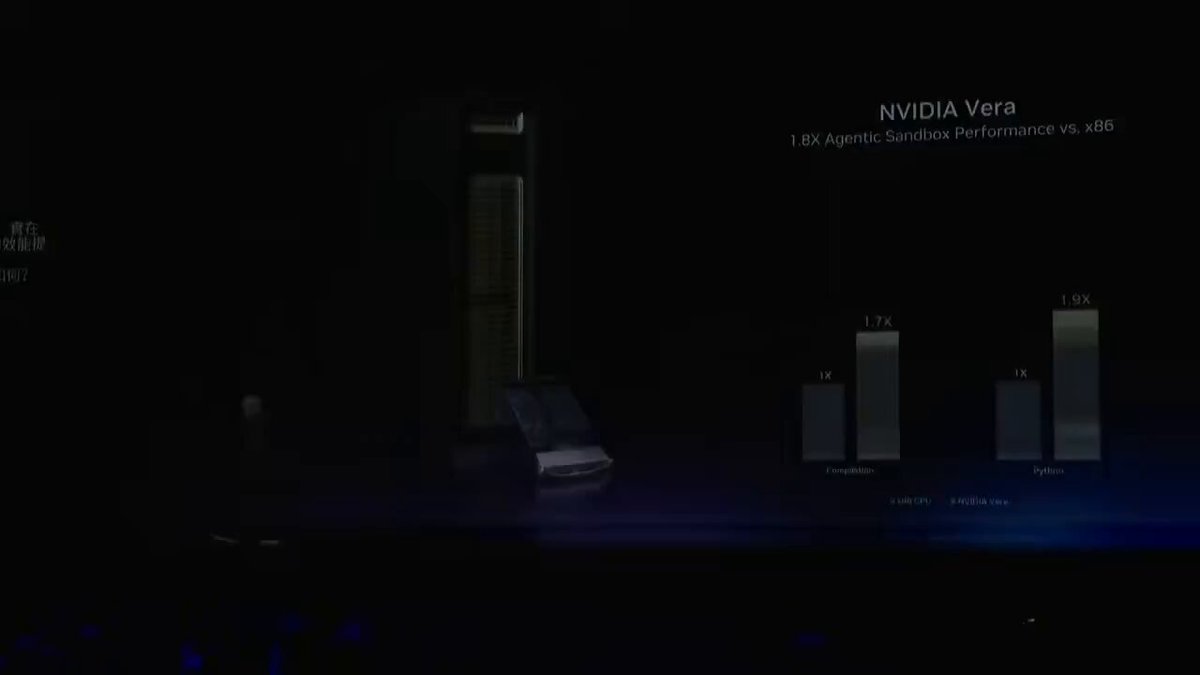
Jensen Huang just identified the next $200 billion market (Save this). The shift starts with a observation about agentic AI that changes everything about infrastructure. In the era of training and inference, the GPU was everything while CPU was a traffic cop, scheduling work, managing memory, dispatching tasks while the GPU did the heavy lifting. Agentic AI breaks that model entirely. An AI agent does not just run a single inference pass but rather it plans, calls tools, executes code in sandboxes, retrieves data from multiple sources and loops through complex multi-step reasoning sequences often thousands of times per second at scale. Every one of those operations runs through the CPU and the GPU sits idle waiting for the CPU to prepare the next task, supply the right context and execute the retrieval and tool calling logic fast enough to keep the accelerators fed. The CPU is now the conductor and the GPU is the orchestra and the bottleneck is the conductor falling behind. This is showing up in production AI factory utilization right now, which is exactly why Jensen built Vera from scratch rather than licensing x86. Vera achieves 40% lower peak memory latency than x86, 50% faster core to core communication, and 1.8 times the agentic sandbox performance of current x86 processors on a purpose-built architecture designed around the agentic loop. Now here is where the investment thesis gets interesting. The obvious beneficiary is Nvidia itself, and that thesis is real. Nvidia's CFO has guided for nearly $20 billion in Vera CPU revenue this fiscal year alone, a market Nvidia had zero presence in just three years ago. Intel held 60% of server CPU market share as recently as Q4 2025 and that transition is now happening at a pace Intel structurally cannot respond to. But the deeper question is, what architecture is Vera actually built on? Vera's Olympus cores are ARM compatible and every single Vera CPU deployed in every Vera Rubin rack in every data center in the world runs on ARM architecture. And ARM Holdings collects a royalty on every one of them. ARM does not make chips but rather licenses the instruction set architecture and CPU core designs that others build on top of. Every time Nvidia ships a Vera CPU, every time a hyperscaler deploys a Vera Rubin rack, every time an enterprise qualifies Vera for their AI factory, ARM earns a royalty. The secular tailwind here is almost perfectly constructed for ARM's business model. Amazon's Graviton, Microsoft's Cobalt, Google's Axion, Apple's silicon stack, and Qualcomm's data center push all run on ARM. And now Nvidia's Vera, which is projected to displace Intel as the largest server CPU supplier by revenue in a single fiscal year, is ARM. ARM's royalty rate on high end server chips is estimated at roughly 1 to 2% of chip selling price. At $5,000 per Vera CPU and 4 million units projected for FY2027, that is a royalty line growing from near zero to potentially $400 million to $800 million annually from Nvidia's data center CPU business alone before counting Amazon, Microsoft, Google, Apple, and Qualcomm. The total ARM addressable royalty base across all the silicon it already licenses is compounding at a rate that the current $130 billion market cap does not fully reflect. Jensen's CPU thesis is the most underappreciated catalyst in ARM's fundamental story, and the royalty compounding has barely started. Come join Milk Road Pro and get our full ARM royalty model and our entire AI trade thesis. Link below!

Milk Road AI

11,819 Aufrufe • vor 2 Monaten

The #GTA 3 port to the Sega #Dreamcast has been progressing at an incredible pace. It's been amazing to see the whole DC community come together to tag-team this "impossible" project... Here it is running on a stock DC, no longer requiring the 32MB RAM hardware modification, only a few weeks into development. Since I finally got the time to sit down, build the codebase, and look into some of what I think is the critical path for performance, let's talk about some technical shit, and some of the future steps I think can be taken to further improve performance. First of all, I want everyone to take note that this is NOT a port of the PS2 version. This is a port of the PC version, which has extra content, increased draw distance, improved textures, and other things that have actually increased the challenge here... Whether the DC version will ultimately have these additions or not will remain to be seen, but we're running into plenty of shit that the PS2 didn't have to worry about (like these big-ass PC replay saves won't fit onto a Visual Memory Unit!) Secondly, lets talk about what is and isn't currently optimized, because it's absolutely vital that the DC's hardware is fully utilized here for the sake of performance and achieving a competitive polygon count. Unlike with modern devices, where the whole graphics pipeline is handled by the GPU, both the PS2 and Dreamcast were responsible for transforming and doing lighting calculations for each vertex BEFORE they got submitted to the GPU. The PS2 had a vector coprocessor to do this, while the Dreamcast had a few extremely important SIMD and fast math assembly instructions on its CPU to do these computations. Up until literally just a few hours ago (not shown in this footage), the Dreamcast's SH4 was doing 100% of these operations in slow-ass plain C and C++ code, which is absolutely sub-optimal and is immediately bogging down its CPU with just transforming vertices, bottlenecking the entire graphics pipeline on the fist T&L stage, and also leaving less CPU time for handling other gameplay logic... this is going to absolutely have to be addressed (and already has begun to be). Another issue that is crippling performance here is the fact that the models are all using individual triangles rather than triangle strips, which the Dreamcast's PVR GPU was designed to handle better... Converting these models to use strips rather than individual triangles will result in MANY different gainz for the DC, as you're going from 3N to N+2 vertices per triangle. Converting the models to triangle strips will 1) reduce load times, since model assets will be smaller 2) reduce the amount of video memory required to hold these vertices on the GPU 3) reduce the amount of shit that must be transferred from the CPU to the GPU and 4) give us back a bunch of CPU time, since the SH4 will be less bogged down transforming redundant vertices! TL;DR: This is still EXTREMELY suboptimal in terms of fully utilizing the graphical potential of the Dreamcast. There is going to be a LOT that can be done still to both improve performance and polygon counts, so stay tuned! FINALLY: Mad respect and love to Stefanos Kornilios Mitsis Poiitidis, for doing an amazing job leading this project, and to Frogbull , Esppiral, and everyone else who is helping us stick it to the PS2 by making this happen! #gamedev #retrogaming #cplusplus

Falco Girgis

88,356 Aufrufe • vor 2 Jahren

This is one of the craziest AI launches of 2026 and it came out of basically nowhere (Save this). A company called Subquadratic just shipped SubQ, and the benchmarks are almost hard to believe. To understand why this is such a big deal, you have to understand the fundamental problem that has defined AI for the last decade. Every large language model in existence is built on transformer architecture, and transformers use a mechanism called standard attention that checks every single word in a sequence against every other word. Double the context length and compute doesn't double, it quadruples, triple it and compute goes up nine times. This quadratic scaling is why frontier models have been stuck at roughly 1 million tokens, why running them at those lengths gets expensive fast, and why the AI labs have essentially been printing money charging you more the longer you need the model to think. The industry has known this problem existed since 2017 but they scaled it anyway. SubQ is built from the ground up to solve it. Instead of processing every possible token relationship, SubQ's sparse attention architecture identifies which relationships actually matter and ignores the rest meaning compute is used where it counts and wasted nowhere else. The result is that compute scales linearly with context length instead of exponentially, and the implications of that one architectural shift are enormous. At 12 million tokens, SubQ reduces attention compute by nearly 1,000x compared to standard frontier models and at 1 million tokens, it runs 52x faster than FlashAttention. And it does all of this while posting frontier level accuracy, scoring 95% on the RULER 128K long-context benchmark versus Claude Opus 4.6's 94.8%, and an 81.8 on SWE-Bench Verified coding tasks, besting Opus 4.6 (80.8) and DeepSeek 4.0 Pro. The cost comparison is where it gets genuinely insane. SubQ runs at under $1.50 per million tokens less than 5% of what Claude Opus charges. On the RULER benchmark, running the test with SubQ cost $8, running the same test with Claude Opus cost $2,600 and that's a 300x cost reduction at equivalent or better accuracy.. Subquadratic launched with $29 million in funding, SubQ is available today for early access via API, and SubQ Code, a coding agent built on the architecture ships alongside it. The transformer has been the unchallenged foundation of every major AI system since 2017. SubQ is the first serious evidence that something structurally better might have just arrived.

Milk Road AI

278,367 Aufrufe • vor 3 Monaten

Chamath Palihapitiya just dropped the number that explains the entire AI infrastructure trade (Save this). A gigawatt of compute now costs $100 billion and when he started his Arizona data center project it was $4 to $5 billion, it has gone up 20x in a single investment cycle. The implication is not just that AI infrastructure is expensive but rather that the capital barrier to owning meaningful compute has become so high that only a handful of entities in the world can actually build it and the companies who got there early are sitting on what may be the most durable pricing power in the history of the technology industry. This is the neocloud trade. The neocloud market, purpose-built GPU cloud providers like CoreWeave, Nebius, and Lambda Labs was worth $35 billion in 2026 and is projected to reach $236 billion by 2031, compounding at 46% annually. For context, that is faster growth than cloud computing itself posted in its first decade. The reason is very simple, hyperscalers like AWS, Azure, and Google are building for everything, storage, databases, enterprise software, networking and their GPU pricing reflects the overhead of that full-stack infrastructure. Neoclouds build for one thing only, AI compute. The result is a 60% to 85% cost advantage on the same Nvidia silicon, bare metal H100s at $0.78 to $2.79 per GPU-hour on a neocloud versus $3.43 to $5.07 per GPU-hour on a hyperscaler. That spread does not close as AI demand scales but rather it widens, because hyperscalers have to amortize legacy infrastructure and margin expectations that neoclouds do not carry. Gartner projects that by 2030, neoclouds will capture 20% of the $267 billion AI cloud market, and Vultr's own analysis says at least 80% of GPU market share by end of 2026 will be held by a small group of scaled neocloud providers. Now zoom into Nebius specifically, because it is the most interesting publicly traded proxy for this trade. Nebius is the infrastructure arm of the former Yandex Russia's equivalent of Google rebuilt from the ground up after Russia's invasion of Ukraine by Arkady Volozh and relisted on Nasdaq in October 2024. The team that built it already knew how to run internet-scale infrastructure at the lowest possible cost, which is exactly the operational DNA a neocloud requires. In Q1 2026, Nebius reported revenue of $399 million and already generating serious cash on a young business with revenue growing nearly eightfold year-over-year. Then in March 2026, Meta signed a five-year infrastructure agreement with Nebius worth up to $27 billion, $12 billion in committed dedicated GPU capacity deployments beginning early 2027, plus up to $15 billion more tied to Meta purchasing Nebius's unsold third-party capacity. The deal will be executed on one of the first large-scale deployments of Nvidia's Vera Rubin platform, the next-generation architecture after Blackwell making Nebius one of a tiny number of operators in the world with confirmed priority access to the most advanced AI hardware available. Following the contract, Nebius guided to $7 to $9 billion in annualized recurring revenue for 2026 representing 540% year-over-year growth. Chamath Palihapitiya point about the $100 billion capital moat is the bear case for new entrants and the bull case for incumbents. No one can afford to build the next CoreWeave or Nebius from scratch at current hardware and power costs. The companies that are already built, already contracted, and already deploying Nvidia's latest silicon have a moat that compounds with every GPU generation cycle because they get allocations first, they deploy fastest, and their customers re-sign rather than wait for a new operator that does not yet exist. Come join Milk Road Pro for our full breakdown, the complete neocloud competitive landscape, how to think about Nebius's valuation versus CoreWeave and AI entire thesis. Link below.

Milk Road AI

139,047 Aufrufe • vor 2 Monaten

Sam Altman made the case for open-source harnesses in July. a month later, someone shipped it, and it's more efficient than most managed harnesses. here is the problem it was aimed at: a large share of your agent's token bill is the model rereading things it already read. that isn't the model's doing. the runtime around it decides what goes into every prompt and how often the model gets called. for example, an agent queries a CRM at step four and gets back 400 rows. those rows get piled up in the conversation history. by step nineteen, the model has to read those rows fifteen times unnecessarily, and every token read is billed at input rates. it happened because your harness assembled that prompt on every turn and kept the rows in it. that gives you two levers: how much context the harness carries forward, and how often it calls the model. there are four practical ways to keep the prompt from growing unnecessarily: → load tool schemas on demand. a server with 100 tools doesn't need to put all 100 into every prompt when the agent only calls two. → offload large results to disk. turn a large response into a short preview and a file path instead of replaying the entire result on every turn. → delegate to subagents. let a subagent spend thirty tool calls in its own context and return one summary to the root agent. → run toolchains in code. one script calls three tools, joins the results, and returns a table instead of three turns each dragging a full response. but reducing context is only half the job. you also need to control how often the model gets called. a good harness should avoid unnecessary planning, verification, and reflection when the work can be completed in fewer steps. TrueFoundry's open-source agent harness, TrueForge, is built around both of those controls. it sits between the model and the tools, deciding what goes into every prompt and when another model call is actually needed. it also breaks token usage down across the harness, skills, instructions, tools, and messages. DevRev's Enterprise-Bench is where this gets tested, on multi-step tasks of the kind where an agent pulls records from one system and reconciles them against another. TrueFoundry ran TrueForge there against Claude Managed Agents, both on the same model, and both finished the same number of tasks. the tie is the part that matters, because it means the gap underneath is not a quality tradeoff. TrueForge reached that score on close to a third of the tokens, with roughly 40% fewer trips back to the model. for the same result, that comes out around 2.7x cheaper than Claude Managed Agents. swapping in an open model made it sharper still. TrueForge with GLM-5.2 scored a little higher than either setup above, and the entire benchmark run cost about $3 at list prices. being open source matters beyond the license here. the model underneath can be swapped without rewriting the agent, and the whole thing can run inside your own environment when the data cannot leave it. all of this comes down to the runtime around the model, the context it carries, the tools it exposes, and how many times it goes back to the model. that is what a production harness actually owns. the full task list, the per-run numbers, and the MIT-licensed code are on GitHub: (don't forget to star 🌟) you can read more about the same in the article quoted below. thanks to the TrueForge team for working with me on this one.

Akshay 🚀

74,353 Aufrufe • vor 3 Tagen

Dear ICP community, the Internet Computer has now been running strong for 5 years 👏👏👏 Here is a celebratory preview of ICP "cloud engines," the sovereign frontier cloud technology the network shall soon provide from Main points: — Cloud engines enable anyone to spin up their own sovereign frontier cloud. The technology involves an extraordinary inventive step, in which cloud is created from a mathematically secure network of nodes. The nodes run as part of the Internet Computer network ( but are selected and configured by the cloud engine's owner. — The frontier cloud provided by engines is strongly focused on enabling AI agents to build and update online applications and services for us. The world is changing fast, and nearly all new online apps and services are already being built with the help of AI, and thus cloud engines target the future of cloud. — Software hosted on cloud engines is tamperproof, which means that it is immune to infrastructure hacks, because it runs inside a mathematically secure network protocol, rather than on computers directly. This means that AI agents, and those building with them, don't need to have a security team in the loop, or to trust someone else's security team. This is crucial, because in the future, non technical people will demand the freedom to build with full automation — where they just need to issue instructions to AI about what to build, and don't need to worry about anything or anyone else. Of course, apps and services running on engines are also vastly safer from the new breed of hacker being enabled by frontier AI. (The cloud engines themselves are also "tamperproof." Even if a hacker gains physical access to some portion of a cloud engine's nodes, and can make arbitrary changes, the computations and data of the hosted apps and services cannot be corrupted or interrupted so long as the network's fault bounds aren't exceeded. The recent hack of Vercel, a major cloud platform, which gave hackers access to the apps it hosted, provides additional perspective on the importance of this advantage.) — Software hosted on cloud engines is guaranteed to run, so long as a sufficient number of the engine's nodes are running. This means that AI can build applications and services without the need to have a human systems admin team constantly tinkering with the underlying platform to keep it running, which is again crucial, because in the future, non technical people will expect the freedom to use AI to build without the support of others. — New frontier programming language technology, in the form of the Motoko language developed by Caffeine Labs, leverages seminal "orthogonal persistence" technology that unifies program logic and data to deliver further unlocks for AI (Motoko is the first computer language being developed that targets agents that are writing software rather than humans engineers per se). Nowadays, AI can build and update production apps at a prodigious rate, even at the speed of conversation. But it can also make mistakes, and there's a risk that an update it creates might be "lossy" in the sense it causes some transformed data to be lost. Again, in this new world, it's both undesirable and impractical for everyone to have to have a systems admin team on-hand to detect lossy updates and roll them back, but Motoko provides a solution: it can detect new software updates are lossy before they are applied, reducing potentially catastrophic errors by AI to harmless coding retries. — Software hosted on cloud engines is "serverless" but unlike traditional serverless software, directly it directly incorporates data through "orthogonal persistence." Another key purpose is simplify backend software logic and fuel the modeling power of AI by increasing abstraction (sorry for the technical language!!!). Put simply, this enables AI to produce more sophisticated backends, faster, and at dramatically lower costs, as measured by the number AI API tokens consumed during coding. (Tip for the technical: orthogonal persistence is a new paradigm where "the program is the database," and data lives inside program variables, which is possible because it's as if hosted software runs forever in persistent memory). — An expanding database of skills at shall make it possible to develop and directly deploy apps and services to your cloud engines directly from Claude Code, Perplexity, Codex and other AI platforms. Further, your account on can be connected, so that new apps and updates created through conversation automatically appear hosted from your cloud engine. In the future, R&D is going to be very seamless. You converse with AI, and your secure and unstoppable apps or services are created or updated. Cloud engines are designed to directly support this "self-writing cloud" future where we can work hands-free. — Tech sovereignty is becoming a huge issue worldwide, with governments and corporations seeking to create sovereign tech stacks owing to geopolitical tensions. Increasingly, people are realizing that tech provided by foreign nations can come with hidden backdoors and kills switches, from the base platform, right up through hosted apps and services. ICP technology is open source, and those building on ICP using AI own their own source code. When you have the source code, you can verify that there are no backdoors, and when you own the source code thanks to AI, you can update it at will, freeing you from vendor lock-in. But cloud engines take sovereignty much further... — You create a cloud engine by selecting the nodes that will be combined. You can choose the class of nodes used, and their number, but more importantly, you can choose who operates the nodes, and where they are located. Almost any configuration is possible, because the Internet Computer scales the security privileges afforded to hosted software within the network according to configuration (software hosted on cloud engines can directly interoperate with software on other engines and traditional subnets, but base restrictions are applied according to security rules). A cloud engine can be created within a region such as Europe, to comply with regs such as GDPR, or completely within a sovereign state like Switzerland or Pakistan. But cloud engines go further still... — Sovereignty is also about freedom from vendor lock-in. Cloud engines are essentially ICP (Internet Computer Protocol) network configurations, and this means the underlying compute nodes they combine can be swapped out without interrupting their hosted apps and services. This is a big deal. In addition, cloud engines now support nodes that are instances running on Big Tech's clouds, in addition to nodes that are dedicated specialized hardware, as per the Gen I and Gen II nodes that dominate the Internet Computer today. For example, it is possible to have an engine running across different AWS data centers, say, and then reconfigure the engine to run across a mixture of AWS, Google, Azure and Hetzner for even more resilience, without the users of hosted apps and services noticing a thing. That's true freedom. — Sovereign AI is becoming increasingly important too, and cloud engines allow special "AI nodes" to be added to them, so that hosted software can perform inference on hardware provisioned by the owner from a location the owner has selected. Even though the AI nodes are only accessible within the cloud engine, they can still benefit from the forthcoming Internet Intelligence Gateway (IG), which will make it possible to validate inference performed on key frontier open weights LLMs, even when the inference is performed on completely independent AI clouds. When the results of inference are received, this technology can verify that neither the prompt+context (input) nor the inference result (output) have been modified, and that the results were produced by the precise LLM expected. This ensures that AI clouds don't cheat by running inference on cheaper models than are being paid for, and bad actors aren't modifying the inputs or outputs to surreptitiously insert advertising into results, say, or change facts, or insert malware when code is being generated. What's super cool about this technology is the cost of the verification is scalable. A very valuable additional security can be achieved with only 1-2% of extra cost. — Scaling apps and services when they hit capacity limits is another thorny problem that cloud engines help the world address. Engines make scaling possible without rewriting or reconfiguring software. The query workload capacity of hosted software can be horizontally scaled simply by adding new nodes to an engine, and nodes can also be added in geographical proximity to demand. Meanwhile, update workload capacity can first be scaled-up by swapping an engine's nodes out for the next class up, and then when no larger class of node is available, horizontally scaled-out by "splitting" the engine into two, which doubles available capacity. (Technical tip: horizontally scaling update capacity by splitting engines requires multi-canister architectures). — For those who have been following how Caffeine builds apps that can efficiently store large numbers of files, I should mention that apps built on cloud engines will also support the new ICP Blob Storage cloud network (since cloud engines currently have up to about 3 TB of memory, which apps storing large amounts of files can easily exceed). We are also working on allowing blob storage nodes to be added to cloud engines, to enable sovereign mass blob storage within an engine, similarly to how AI nodes can be added currently. — Lastly, but certainly not least, I should mention that cloud engines are multi-blockchain capable, and ready for digital assets, thanks to the clever math at their core. For example, an e-commerce service built on a cloud engine can securely accept and custody stablecoin payments, or a multi-chain DEX could be hosted. Further, engines can support software autonomy (software orchestrated and controlled by other autonomous software, in a decentralized way) and can themselves be orchestrated by SNS technology, and thus run autonomously too. Today, though, the focus is on *mainstream* cloud. This year, the cloud industry will generate approximately one trillion dollars in revenue. That number is already huge, but is expected to grow to two trillion dollars by 2030. After years of continuous development, which have seen more than $500m spent on R&D, the Internet Computer network is now tacking directly toward this mainstream cloud market with cloud engine technology. In their first version, cloud engines are not meant to be a cloud panacea. For example, currently they are not ideal for working with big data. You should use something like DataBricks for that. Cloud engines are carefully targeted at enabling AI to produce traditional online applications and services, including SaaS, in a safer and more productive way, which represents a new market segment with tremendous potential. Of course, DFINITY will continue to work relentlessly to push forward ICP's capabilities, so expect further developments. It's worth mentioning that this cloud segment isn't just about creating new apps and services using AI, it's also about replacing legacy systems and apps built on super expensive SaaS services. Caffeine Labs is working to produce technology (Caffeine Snorkel) that can study an enterprise's legacy systems and app built on SaaS, create replacement systems and apps, and migrate the data, while supporting key stakeholders through the process over email and chat, with full automation. Thus the legacy systems and SaaS markets shall also be addressed by cloud engines. Zooming out, and reasoning in a more metaphysical way, we believe, as we always have, that there is room for a new kind of cloud created by mathematical networks, that provides seminal advances in the fields of security and resilience, as well as true sovereignty and freedom from lock-in. That this same technology, with the help of additional technologies like orthogonal persistence and Motoko, enables AI to build for us without the need for so much oversight, and to create more backend sophistication while consuming fewer AI API tokens, enables ICP to bring game-changing advances to the world. Cloud engines will work synergistically with the Intelligence Gateway, which will enable apps and services running on engines to seamlessly leverage AI, wherever that AI is running, while providing verifiability at extremely low cost for open weights frontier models. We believe that cloud engines represent an inflection point in the storied history of the Internet Computer project, and I'm very proud to be sharing the details with you on the network's fifth birthday 💪 I'll be back with more news soon!!

dom | icp

293,234 Aufrufe • vor 3 Monaten