Video wird geladen...

Video konnte nicht geladen werden

Zur Startseite

Open models are how developers build AI they can own. Not just weights. Model families, post-training recipes, evaluation tools, and supporting data give teams the ability to inspect, adapt, and deploy AI for real applications. At GTC Berlin, Bryan Catanzaro, VP of Applied Deep Learning Research at NVIDIA, will...

12,309 Aufrufe • vor 1 Tag •via X (Twitter)

5 Kommentare

Profilbild von NVIDIA AI
NVIDIA AIvor 1 Tag

We'll be there!

Profilbild von NVIDIA GTC
NVIDIA GTCvor 22 Stunden

Join @ctnzr live in Berlin as he unpacks the data, weights, recipes and evaluation behind NVIDIA Nemotron models, and how to adapt them for domain-specific AI. 🤝 See session details & join us in person:

Profilbild von Sandro Agency
Sandro Agencyvor 1 Tag

golden ticket who

Profilbild von Raul Verdusco
Raul Verduscovor 1 Tag

Open models give developers much more than access to the underlying technology. The ability to inspect, customize, evaluate, and deploy models can accelerate innovation while giving teams greater control over real-world AI applications. 🧠⚙️

Profilbild von ゆり
ゆりvor 1 Tag

素敵です✨

Ähnliche Videos

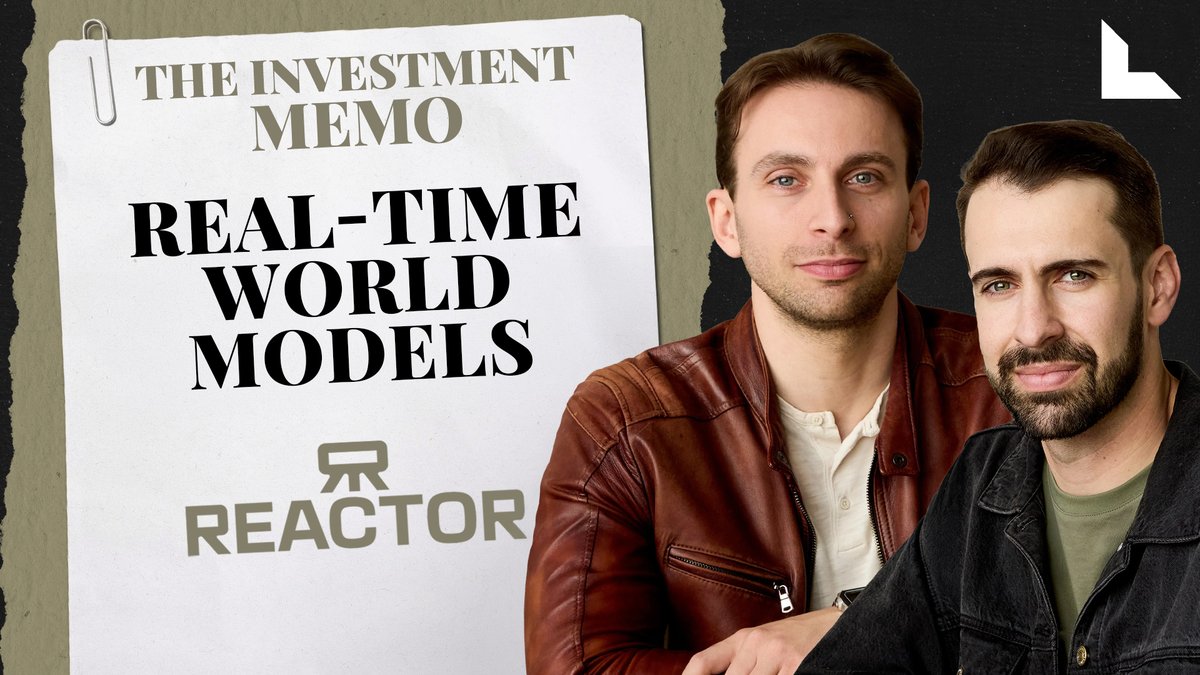
Real-time world models represent a fundamental shift in AI. reactor is building the platform for real-time generative video infrastructure, supporting developers who need the tech for use across entertainment, physical AI, and robotics. Co-founders Alberto and Bryce Schmidtchen joined us last week on The Investment Memo, hosted by Partners Bucky Moore and Amber Yang, to talk about the era of world models. The conversation centered around the infrastructure Reactor is building, why real-time models are the edge right now, and current use cases for the product. Alberto and Bryce agreed that world models are shaping the way simulations are created, and that developers need a streamlined platform that can support their ideas. We believe Reactor is positioned to be at the frontier of research into real-time generative models. We look forward to seeing how these models apply across industries. Chapters 00:00 Introduction & Overview of Reactor 01:08 Meet the Hosts & Founders 02:18 The Origin Story: From 3D Assets to World Models 05:07 Real-Time Video Applications Across Industries 06:55 The Open Source World Model Explosion 07:23 Why Infrastructure Is the Opportunity 08:42 Parallels to Past Technology Waves 09:51 Bridging the Research-to-Production Gap 13:13 What Developers Are Building with World Models 16:41 Lessons from Luma AI 18:23 What Apple Vision Pro Taught Bryce About Real-Time Systems 20:48 Company Values & Team Culture 22:40 Series A: What the Capital Unlocks 24:13 Reactor's Five-Year Vision 26:09 Closing Remarks

Lightspeed

144,942 Aufrufe • vor 3 Monaten

99% of AI applications are cool-looking demos. Impressive, but don't get fooled by the hype. It takes a lot to build enterprise-grade products that deliver real value. I have at least three weekly conversations with companies that want to use a Large Language Model with their data. The demand is huge! Here is one idea about what you can do to help. The use cases that most of these companies want to solve are similar: They have an extensive knowledge base and want to build a simple application that uses that information to answer questions. In other words, they need help building Retrieval Augmented Generation (RAG) applications they can use in many different scenarios: 1. To train new employees 2. To help their support team 3. To search old meetings and documents 4. To help with their research However, building these systems is not straightforward. Yes, there's a lot of information online, but there aren't enough people who know how to create solutions that work. Here is the idea: Today, you can build an enterprise-grade RAG application without writing code. A couple of MIT PhDs with 10+ years of experience building AI applications created . It's a no-code platform for building applications using Large Language Models. They are partnering with me on this post. You can use Stack AI to create, test, and deploy an end-to-end production-ready AI system. It's SOC-2, HIPAA, and GDPR compliant and offers SSO, role management, access control, and on-premise deployments. Of course, you can use the platform with any LLM on the market now. It's the whole nine yards for building AI applications. Check them out here: 2023 was about models. 2024 is about the tools using these models to build production-ready applications. That's where I'd start.

Santiago

197,702 Aufrufe • vor 2 Jahren