正在加载视频...

视频加载失败

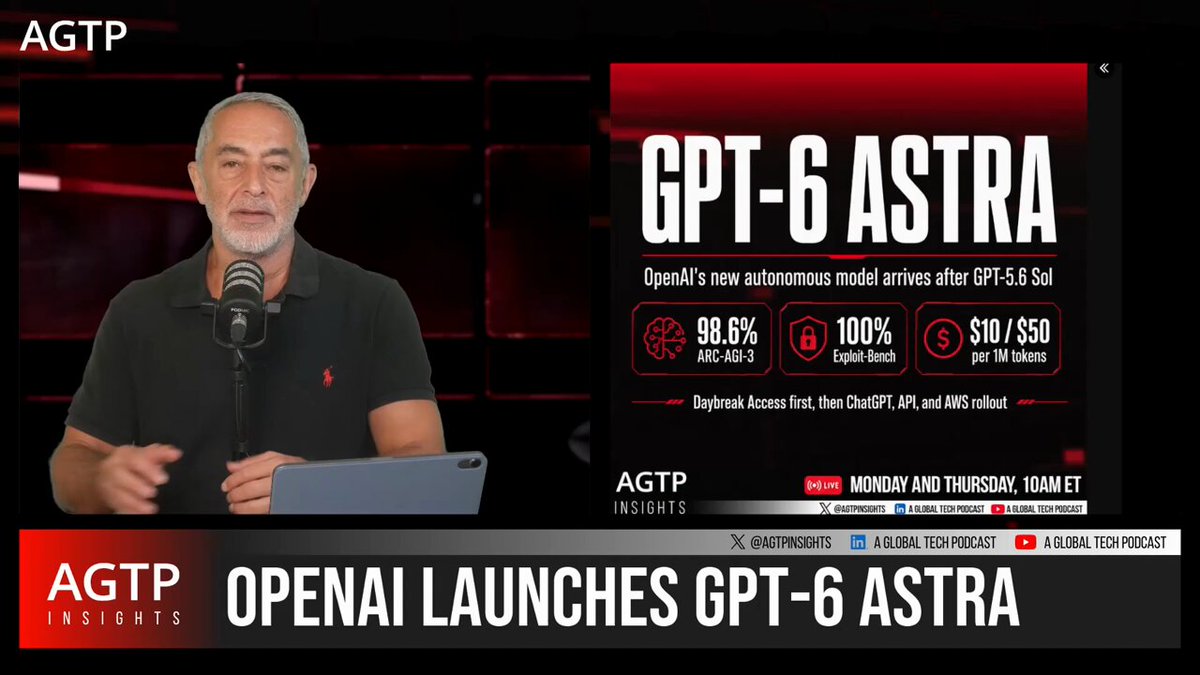
OpenAI President just said that we already hit AGI: "Astra has really hit something that I'm like, okay, I think this is pretty reasonable to call it AGI." his proof is wild, he says they've watched it run on its own, coherently, for 24 hours straight to finish real...

46,801 次观看 • 15 天前 •via X (Twitter)

17 条评论

Hải Cao Hoàng 的头像
Hải Cao Hoàng15 天前

Tôi thì cảm giác nó đã xong từ trước rồi - giờ chỉ là " chọn Ngày đẹp " để ra đường thôi. Helo !

Anthugger 的头像
Anthugger15 天前

@AnatoliKopadze. China has decrete 841 to ensure AI has guard rails and going rogue is punishable by law. Now I’m not a huge fan of the Party line of 🇨🇳. But they sure do show a lot more IQ than the guy in the White Ballroom, claiming he has the highest of all 🙄

Res K 的头像
Res K15 天前

They have their own definition of AGI, and it's one that is tailored for LLMs. True general intelligence that can be compared to, or even derived from, human intelligence is nowhere near it. The capabilities are just not as diverse and on the same time horizon as humans.

GrzegorzJurczyk 的头像
GrzegorzJurczyk15 天前

If Astra is AGI, then i'm super AGI at coding. Come on. Astra is shit at programming.

Azy 🦋 的头像
Azy 🦋15 天前

Congrats, now we wait for lunch

KUMA 的头像
KUMA15 天前

The AGI label is debatable, but 24 hours of coherent work without supervision is a much bigger deal than most people realize.

Fazal AI 的头像
Fazal AI15 天前

the AGI label will be debated. the bigger shift is harder to ignore: AI is moving from answering our questions to pursuing our goals. how much autonomy are we ready to give it?

NotaDEV 的头像
NotaDEV15 天前

running unsupervised for a day is a real milestone, calling it AGI is a marketing choice

Uno Alpha 的头像
Uno Alpha15 天前

everyone has a different goalpost for agi now

Verimand 的头像
Verimand15 天前

The closer AI gets to general capability, the less authority can be assumed. Powerful systems need narrower, explicit mandates.

null 的头像
null15 天前

Damn, the a16z pod is a brilliant watch!

Timmay 的头像
Timmay15 天前

Marketing

StarHaze 的头像
StarHaze15 天前

I wonder how well he completed the tasks

DiscoCowboy 的头像
DiscoCowboy15 天前

Sounds good. "He's seen" Ok. What? What did the AI computer program actually perform for 24hrs? Tell us what always so difficult about those 24hrs. It doesn't make any sense. 24hrs to produce what exactly? A big ass other computer program? Solve a giant math problem? Figure out antigravity? There's holes all over his claims.

Rovita Malcolm Khan 的头像
Rovita Malcolm Khan15 天前

👽

Renzo 的头像
Renzo15 天前

24 hours of coherent work is real progress, but it's a measure of not falling apart, not of generality. The interesting number isn't how long it ran. It's how often someone had to check it, and what happened at the first ambiguous step.

NAMAN RAJ 的头像
NAMAN RAJ15 天前

Whoa, 24 hours straight? 🕰️ That's like asking if Alexa's just being Alexa or something 😂

相关视频

I absolutely love how Alex pressed Sam on whether OpenAI thinks they’ve already hit AGI internally, and what he actually considers the difference between AGI and ASI. Sam’s answer was basically that declaring AGI doesn’t really mean anything anymore, because every lab and every person uses a different definition. He makes the good point that if you went back to 2020 and showed people a system that could code, help start a company, discover new science and give you a 20 minute win across basically every part of your life, most people probably would’ve called that AGI. I personally still don’t think we’ve hit it, but I agree with his broader point that treating AGI like some single finish line is becoming increasingly meaningless. The way he describes ASI is exactly how I would want him to, AGI is basically a milestone somewhere on the curve, while superintelligence is this continuous ramp of increasing capability that may never really have a final “we won” moment. And importantly, Sam says he sees no sign that this exponential capability curve is slowing down. A few quotes I liked as well: “We’re building AI, but it’s a thing you’re always building. It’s not an end state anymore.” “I don’t want to say we’ve declared victory on the AGI point and moved on.” “The important part of any of this is not any milestone, any term. It’s that we are on this exponential of increasing capabilities and potential.”

Chris

38,143 次观看 • 1 个月前

The smartest man in AI just exposed the whole AGI narrative as a LIE. And he used a physics problem from 1905 to prove it. His name is Demis Hassabis. He runs Google DeepMind, and won the Nobel Prize for using AI to crack a problem in biology that had stumped scientists for 50 years. Almost nobody in this industry has a track record like his. He went on the NothingButTech podcast and called out the biggest lie in AI right now: Right now the loudest voices in AI are telling you that AGI is basically here. OpenAI has literally defined AGI as a system that can outperform humans at most "economically valuable work." In other words, if it replaces enough jobs, we have arrived. Hassabis thinks that bar is a joke. He said real general intelligence has to do what the human brain can do, because the brain is the only proof we have that this kind of intelligence is even possible. He called that "a higher bar than just being able to do some useful economic work," which is about as close as a polite British Nobel laureate gets to calling his rivals out. Then he gave the actual test: Today's AI has read everything humans have ever written, including the theory of relativity. So when it explains relativity back to you, it's repeating an answer that already exists. That's not intelligence. So Hassabis proposed a test that makes memorization impossible. Train an AI on only what humanity knew in 1901, four years BEFORE Einstein published relativity. Then ask it to come up with relativity on its own. It can't look up the answer, because in 1901 the answer doesn't exist yet. The only way to pass is to do what Einstein actually did: Take the same physics everyone else had and reason its way to an idea no human had ever had. Hassabis says not a single AI today can, no matter how much it has memorized. Which means what we keep calling "almost AGI" is really just the best librarian in history. It can find any answer that already exists but it cannot create one that doesn't. His second version is even sharper: AlphaGo, the system his own team built, famously invented a brand new move that no human had played in 2,000 years of the game. Everyone called it genius but Hassabis says that still is not the bar. The real test is not whether an AI can invent a new move inside Go, it is whether an AI could INVENT a game as deep and as beautiful as Go in the first place. No model that exists today can do it. The people telling you AGI has already arrived are the same people raising hundreds of billions of dollars on that exact promise. The valuations only work if the finish line is right in front of us. So the finish line keeps getting dragged closer, and AGI keeps getting quietly redefined down to "does useful work," until the products they already sell happen to qualify. Hassabis has nothing to prove and nothing to sell you. He already won the Nobel, and he is telling you the machines still cannot do the one thing that would make them genuinely intelligent, which is have a truly original idea. To be fair to him, he is not a pessimist about it. He believes real AGI IS coming, and he is spending his life building it. He just refuses to pretend it is already sitting in your phone. So the next time a founder tells you AGI is months away, remember that the one man in the room with a Nobel Prize built his test around Einstein, and admitted that nothing we have made can pass it. What do you think?

Ricardo

1,288,853 次观看 • 3 个月前

OpenAI CEO: “Goalposts keep getting moved” - if we were still using AGI definitions from 10 years ago, many would say GPT-4 is AGI. “In one year, AI will be dramatically more impressive.” He also said (surprisingly confidently - he did not hedge like usual) AGI is less than 10 years away. In the long term he’s not concerned about AI taking jobs, but he is concerned about the speed that AI will disrupt the job market. --- INTERVIEWER: What is AGI? When will it be here? And how will we know it's here? Predict how long - we'll call you in ten years? SAM ALTMAN: Less than that. We kind of define AGI as like the thing we don't have quite yet. there were a lot of people who would have ten years ago said, alright, if you could make something like GPT-4, GPT-5, maybe, that would have been an AGI. And now people are like, well, it's like a nice little chatbot or whatever. And I think that's wonderful. I think it's great that the goalposts keep getting moved, it makes us work harder. But I think we're getting close enough to whatever that AGI threshold is going to be, that we no longer get to handwave at it and the definition is going to matter. INTERVIEWER: What is the inflection point for AGI? SAM ALTMAN: I think it's going to be much more continuous than that. We're just on this beautiful exponential curve. Whenever you're on a curve like that, you look forward, it looks vertical. You look back, it looks horizontal. That's true at any point on there. So a year from now, we'll be in a dramatically more impressive place than a year ago. We were in a dramatically less impressive place. But it'll be hard to point. People will try and say, oh, it was AlphaGo that did it. It was GPT-3 that did it. It was GPT-4 that did it. But it's just brick by brick. 1 foot in front of the other, up, climbing this exponential curve. WILL AIs TAKE ALL OUR JOBS? SAM ALTMAN: Every technological revolution affects the job market. And over human history, every maybe 100 years, 150 years, half the jobs go away, totally change, whatever. I'm not afraid of that at all. In fact, I think that's good. I think that's the way of progress and we'll find new and better jobs. The thing that I think we do need to confront as a society is the speed at which this is going to happen. It seems like over two, maximum three, probably two generations, we can adapt. Society can adapt to almost any amount of job market change. But a lot of people like their jobs or they dislike change. And going to someone and saying, hey, the future will be better, I promise you, and society is going to win, but you're going to lose here. That doesn't work. That's not cool. That's not an easy message to get across. We are going to have to really do something about this transition. It is not enough to just give people a universal basic income. People need to have agency, the ability to influence this

AI Notkilleveryoneism Memes ⏸️

27,576 次观看 • 2 年前

.David Deutsch: "What's currently called AI and AGI are not only different from each other, they are very close to being the exact opposites of each other. The reason is that an AI, current AI is like an AI that diagnoses diseases or an AI that plays chess or an AI that controls a huge factory. Those things have objective functions, that is they have a function that they are designed to maximize and that is why they are used in those particular applications. Or in military terms, you could say the objective is to hit the target. You might say the objective is to hit the target unless some thing specified, but it's a specified thing comes up in which case don't hit the target and so on. This is, as I said, almost the opposite of what humans do when humans think. For a start, the AI has to be obedient, that is it has to actually do the things it is programmed to do, whereas a human is fundamentally disobedient, especially when being creative. When a human plays chess, they are performing a completely different kind of computation. They don't do the same things, they don't investigate the same possibilities that the artificial chess playing machine does, because the artificial one is capable of looking at billions and billions of possibilities, whereas the human can only look at hundreds or something. They are doing something completely different. Another difference is that the human can explain, can write a book later, having become world champion, can write a book saying how I did it, as the computer program that beats the world champion can write no such book, because it has no idea how it did it. It was just following a program. I was doing this and that and that and none of that is illuminating. Also, third thing, the chess player can decide I don't want to play chess anymore, from now on I will play Go or from now on I will play tennis. If commanded to play chess, the functionality will deteriorate completely. Those things are different. What we want in an AGI is that it behaves in a way that cannot be specified in advance, because if you specified it, you would already have the answer. The AGI program has to give unexpected answers, answers to questions we didn't even know how to ask."

Deutsch Explains

72,475 次观看 • 1 年前

.David Deutsch: The equivalent of consilience, that is, the unified meta-theory, as you put it, for all sciences, and I think actually more than a meta-theory, because I think more links them than just the structure and methodology and so on, was discovered by Popper. Again, I don't know whether this is historically the order in which things happen, but he is famous for his political philosophy and for his philosophy of science, and he found at one point that they are the same, that they both are about problems and about the fact that there is no such instruction from without, there is only conjecture from within. So that's why Lamarckism is false and Darwinism is true, and that's why group selection is false and individual selection is true, and so on. So I think it's already there in Popper. I think there's a lot more to it, and I tried to add another couple of things to it, so quantum theory and computation, but there's a lot that isn't in it, like consciousness and creativity and so on, that we have no idea of how those work and how they fit in with those other things. Gad Saad: Forgive me for interrupting you, David, I'm sorry. There is a book by Dean Simington, who's a psychologist out of, I think, UC Davis, that actually offers a Darwinian account for creativity. It's actually quite mind-blowing. So keep that in mind. I can give you the reference later, but go ahead. David Deutsch: I don't read such things unless they've already made an AGI. Gad Saad: I see. Okay, fair enough. David Deutsch: If they can't make an AGI, then they haven't got the full theory. They might have an idea for a theory, but then Popper has an idea for a theory, but he couldn't make one either. And Turing thought that there'd be an AGI by the year 2000, and that it would require two megabytes of memory. Now, he's obviously wrong about the year 2000, but two megabytes of memory, I reckon that's what it'll be. In other words, these large language models and all this massive computer power is going in entirely the wrong direction. The answer will be a philosophical breakthrough, which will allow, once we understand what we're trying to make, it will be relatively easy to make it with relatively few computational resources.

Deutsch Explains

33,398 次观看 • 1 年前