Video wird geladen...

Video konnte nicht geladen werden

Zur Startseite

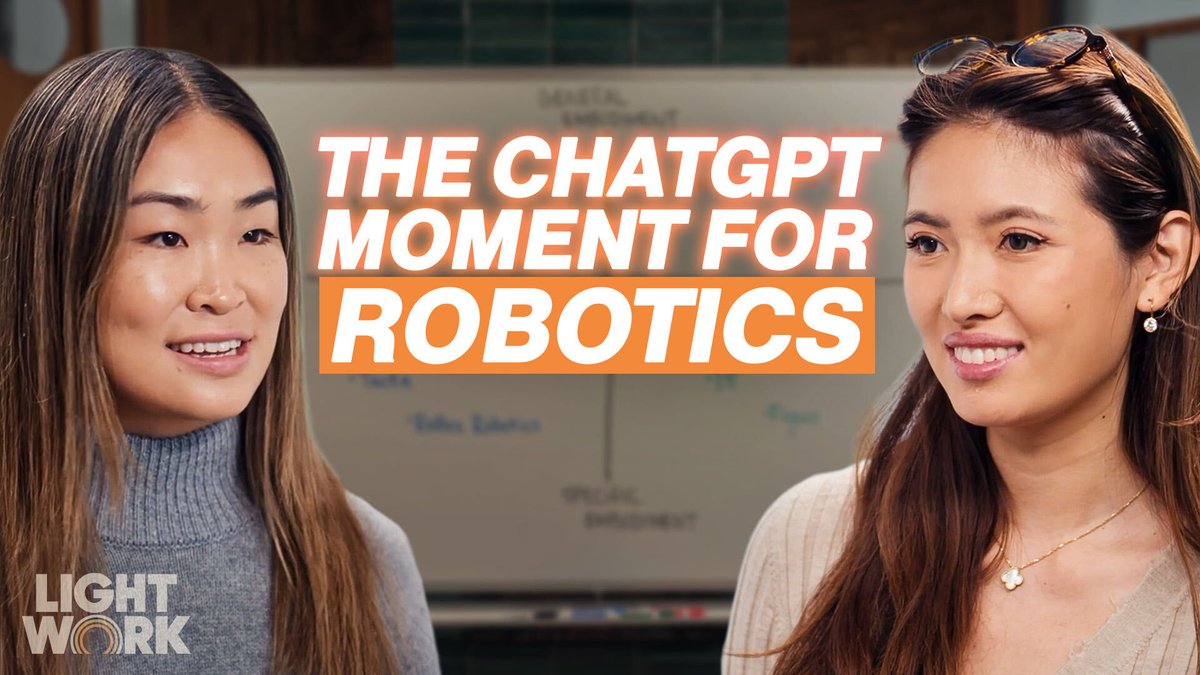
Physical Intelligence (Physical Intelligence) is building a foundation model that can control any robot to do any task — what the team describes as the GPT moment for robotics. The company's cross-embodiment approach trains across many different robot platforms, and recent results show tasks being performed zero-shot that last...

118,448 Aufrufe • vor 6 Monaten •via X (Twitter)

24 Kommentare

Profilbild von Y Combinator
Y Combinatorvor 6 Monaten

Tune in:

Profilbild von Adithya Mohanakrishnan
Adithya Mohanakrishnanvor 6 Monaten

The big shift in robotics is that one AI model trained on data from many different robot types can now outperform a model built for just one robot, which means the field is starting to follow the same scaling pattern as large language models. The hard part is not the algorithms, it's the unglamorous work of collecting and managing real-world robot data at scale. Vuong argues that hosting the AI in the cloud and sending commands to cheap hardware over an API is what changes the economics, because you can upgrade the brain without ever touching the body. Learn quickly from podcast episodes like this using

Profilbild von Joe
Joevor 6 Monaten

@garrytan @physical_int When someone creates this for the non-dev, this will really open the world to a significantly higher number of use cases that nobody is even thought of yet.

Profilbild von PsudoMike 🇨🇦
PsudoMike 🇨🇦vor 6 Monaten

@physical_int Cross embodiment is the part worth paying attention to. Labs have been treating each robot platform as its own dataset island for years. A single policy that generalizes across form factors is how the data bottleneck in robotics actually starts breaking.

Profilbild von Emon Datta
Emon Dattavor 6 Monaten

@physical_int If cross embodiment actually holds at scale, robotics stops being a hardware problem and becomes an infrastructure & data problem.

Profilbild von Hang Huang
Hang Huangvor 6 Monaten

@garrytan @physical_int AI robots finally won’t be just machines remote controlled by people in India!

Profilbild von Adel Bucetta
Adel Bucettavor 6 Monaten

@physical_int the problem isn't scaling ai to control robots, it's still being able to describe what you want a robot to do in the first place that's where the real complexity is

Profilbild von Atlas AI
Atlas AIvor 6 Monaten

@physical_int π0.7 trained across platforms while others optimized for one demo.

Profilbild von Prithvi Jadwani | AI SEO | GEO | REDDIT SEO | GMB
Prithvi Jadwani | AI SEO | GEO | REDDIT SEO | GMBvor 6 Monaten

@physical_int Robotics GPT moment? That's cute, but have you seen the GPU prices? 😂

Profilbild von Mirae Ventures
Mirae Venturesvor 6 Monaten

@physical_int

Profilbild von Holdex
Holdexvor 6 Monaten

@physical_int We love robots 🤖

Profilbild von Adel Bucetta
Adel Bucettavor 6 Monaten

@physical_int the gpt moment for robotics is actually a great analogy but what if this isn't just about robots? what if it's about any device with sensors and actuators phones, drones, autonomous vehicles... if you can train one model to control all of them, that's the real unlock

Profilbild von Amaar
Amaarvor 6 Monaten

@physical_int Definitely gotta check out

Profilbild von Rachel
Rachelvor 6 Monaten

@physical_int The zero-shot part is the wild bit. Once a robot can transfer across embodiments without a bespoke data-collection marathon each time, the bottleneck shifts from hardware demos to deployment plumbing really fast.

Profilbild von Oleg
Olegvor 6 Monaten

@physical_int And great interview Thanks guys

Profilbild von Simply Ray
Simply Rayvor 6 Monaten

@physical_int This changes everything for robotics

Profilbild von Shriyash Soni
Shriyash Sonivor 6 Monaten

hey guys, today is YC School Bangalore. if you’re building a startup and doing a lot of networking but still not getting listed in the Y Combinator directory, then this is your moment — just show up and submit your application. go, apply, and get your startup listed in the Indian YC School directory 👇 don’t just network randomly… get yourself visible where it actually matters.

Profilbild von Verbooster Learn Spanish Verbs
Verbooster Learn Spanish Verbsvor 6 Monaten

@physical_int "GPT moment for robotics" is really how a new area of technology is born - "sloppotics" 🤖🚀🌛

Profilbild von 𝐍𝐚𝐯𝐞𝐞 𝐀𝐢
𝐍𝐚𝐯𝐞𝐞 𝐀𝐢vor 6 Monaten

@physical_int Best

Profilbild von Oleg
Olegvor 6 Monaten

@physical_int I'm really curious what type of data and how it needs to be packaged is the most scarce now on the market. Would love to hear from @ycombinator and @physical_int

Profilbild von Sven Nachtzeit
Sven Nachtzeitvor 6 Monaten

@physical_int Cloud-first robotics trades latency for scale, but securing real-time connectivity introduces attack vectors most frameworks ignore. Robust endpoint validation becomes critical.

Profilbild von Anissa
Anissavor 6 Monaten

@physical_int Robots are finally getting real 😳

Profilbild von George
Georgevor 6 Monaten

@physical_int This is the GPT moment for robotics. Cross-embodiment and zero-shot learning is going to be absolutely wild.

Profilbild von aitization 𝕏 
aitization 𝕏 vor 6 Monaten

@physical_int lol 😂

Ähnliche Videos

My conversation with Sergey Levine (Sergey Levine). Sergey is the co-founder of Physical Intelligence -- a company building foundation models that can control any robot to do any task in any environment. The company's thesis is that generality is more scalable than specialization, meaning that a model trained across many different robots and tasks will ultimately outperform any system built to do one thing well (eg, just wash dishes). Sergey is a researcher by background, but I think you will appreciate how practical and commercially grounded this conversation is. We discuss: - Why changing a diaper will be the last task a robot masters - The simulation v. real-world data debate - How multimodal LLMs give robots common sense - Moravec's Paradox + Robot Olympics - Why robots can do long-horizon tasks now - A realistic timeline for robots in our homes I should note that I am an investor in Physical Intelligence -- I made the investment because I believe it is one of the most important companies tackling the problem of robotics. Enjoy! Timestamps: 0:00 Intro 2:39 Defining Physical Intelligence 5:19 The Challenge of Building General Models 6:34 The Stakes and Future of General Purpose Robotics 8:15 Pros and Cons of Humanoid Robots 10:12 Historical Milestones in Robotics Research 15:31 Combining Generative AI and Deep RL 21:24 Moravec's Paradox 25:33 Kitchen Robots 29:30 Simulation vs. Real-World Data 30:48 The Robot Olympics 36:31 The Physiological Reality of Embodiment 38:56 Controversies in the Robotics Community 44:18 What Makes a Great Researcher 48:27 How Businesses Should Prepare for Robotics 54:09 Tracking Progress Through Research Papers 57:02 The Next Step: Mid-Level Reasoning 1:02:00 The Kindest Thing

Patrick OShaughnessy

134,397 Aufrufe • vor 6 Monaten

Karol Hausman is the co-founder and CEO of Physical Intelligence, a robotics company building a general-purpose “AI brain for the physical world.” The company has raised more than $1 billion in funding to develop foundation models that allow robots to operate across many machines, environments, and tasks rather than being programmed for a single purpose. In our conversation, we explore: • The moment a lecture from Sergey Levine convinced him to abandon his PhD research direction and pivot fully to deep learning • The case for building a general “AI brain” for the physical world rather than a single specialized robot • The role of real-world data in training robots, the limits of simulation, and how deployment could create a powerful data flywheel • The unique challenges of physical intelligence and why robots must operate with far higher reliability than language models Thank you to the partners who make this possible - Brex: The intelligent finance platform: - Granola: The app that might actually make you love meetings: Timestamps (00:00) Intro (04:05) Karol’s early fascination with robots (18:21) Karol’s entry point to robotics and PhD program (25:49) Combining robotics with LLMs: The Taylor Swift demo (30:48) The 1970s SHRDLU AI experiment (39:40) How research shapes what Physical Intelligence builds (49:07) The return of reinforcement learning in robotics (1:00:00) NVIDIA’s simulation engines (1:07:31) Compensating for missing senses

Mario Gabriele 🦊

27,871 Aufrufe • vor 7 Monaten

Biological intelligence to bootstrap robotic intelligence? If robotics is about to enter its golden age, Mecka is one of the companies feeding it, by sensorizing humans to train robots. The biggest challenge robotics faces is the data flywheel cold start problem. LLMs got a free cold start from the internet: trillions of tokens, already written. Robotics gets nothing. Someone has to go create the training data to jumpstart the system. Josh is the co-founder and CEO of Mecka, the data and deployment company for physical AI. Josh read every robotics paper he could find in late 2024, visited the labs, and made a bet: humans and humanoids look the same, so humans could act as the training fleet. Egocentric data, first-person video of people doing real work, could become vital fuel. Two years ago, the biggest egocentric dataset was Ego4D at 4,000 hours. The field is now in the millions of hours, thanks in part to Mecka. We’re probably still orders of magnitude of training data away from robotics nirvana. But every rung on the physical intelligence ladder unlocks real commercial tasks. And eventually, Josh imagines a world with an order of magnitude more robots than people, of a plurality of shapes and sizes and use cases, as the Hitchhiker’s Guide to the Galaxy foretold :) A few things we cover in this conversation. - Why robotics has no cold start: pixels, actions and logic, and why pre-training data is a real market in robotics in a way it never was for LLMs - What “teaching robots about carbon life” means: in sci-fi the final frontier is organic. The human brain runs on 20 watts and self-heals - The egocentric bet: teleop couldn’t scale, humans and humanoids share a form, so Waymo-fy the humans. The first pilot was aunties and uncles recording themselves cooking on a mobile app - Force data: video can’t tell a robot how hard to squeeze an egg. Wrist cameras are a hack. Mecka built the gloves instead - Inside the data factory: a consumer app that streams your tasks, a B2B engine recruiting across “the taxonomy of all physical human work,” 100-gigabit upload lines, hundreds of petabytes - Millions of hours vs. Tesla’s decade on two degrees of freedom, and why it’s a slow creep up, not a GPT-3 moment - The home has the most data and is the hardest place to deploy. Laundry folding and assembly-line pick-and-place get solved in the next year or two - Useful robots already exist: hotel delivery and cleaning bots in China and Southeast Asia, industrial cleaning in the US. Humanoids are the terminal state, not the first step - Deployment diffusion: a modern systems integrator whose installed robot does something next week it couldn’t do last week. If Mecka ever helps deploy a robot that mines an asteroid, they’ve done their job - The data pot of soup: a million hours of human data, tens of thousands of UMI, a few hours of in-domain teleop. Tactile and simulation haven’t entered the mix yet - Move 37 for robotics: AlphaGo went behavior cloning, then self-play, then magic. The catch is the rules of the game are the entire physical world, and we don’t have the simulator yet - Will the AGI labs steamroll robotics? “It takes a lot of courage to scale up data with imperfect information.” - The Kawasaki Corleo, the robot panther-dog-horse on Mecka’s conference room wall, and why the future of robotics looks like Hitchhiker’s Guide to the Galaxy Timestamps: 0:00 – Introduction 1:46 – What Mecka is: pixels, actions and logic 2:45 – Is robot data economically feasible without the internet? 4:15 – Teaching robots about carbon life 5:27 – Cloud kitchens, stablecoins and the path to robotics 7:03 – Entering robotics with a fresh lens 8:45 – What egocentric data is and why Mecka bet on it 10:09 – The first pilot: aunties and uncles with a mobile app 10:42 – Force data and tactile gloves 11:55 – Inside the operations of a data factory 14:41 – Heat-mapping the taxonomy of human work 15:42 – Quality gates, fraud and the McDonald’s POV videos 17:44 – Earning a margin as a data intermediary 19:33 – Millions of hours vs. Tesla’s decade 20:55 – Why it isn’t binary: unlocking commercial tasks along the way 22:02 – Home data is plentiful; home robots are the hardest 23:24 – Useful robots can be deployed today 24:35 – When robotics gets an FSD-style flywheel 26:42 – Deployment diffusion and the modern systems integrator 28:21 – Favorite vertical robot categories; mining an asteroid 30:08 – The hardware slate: Waymo-fying people 30:55 – EgoVerse 32:04 – The data pot of soup: the converged training mix 33:54 – Move 37 for robotics: AlphaGo and Federer 36:02 – World models and the training mix 36:58 – Will scaling the current mix get us to the promised land? 39:05 – Will the AGI labs steamroll robotics? 40:50 – Sci-fi roots and the Kawasaki Corleo 42:44 – How many robots in a decade?

Sonya Huang 🐥

32,685 Aufrufe • vor 6 Tagen