Загрузка видео...

Не удалось загрузить видео

На главную

Pixar founder Ed Catmull explains why George Lucas invented technology for his “competitors” “George Lucas had a very strong sense of wanting to contribute to the entire field.” “He wanted to affect the entire industry.” “It was a really exciting place to work because you're developing technology, and the...

19,908 просмотров • 1 месяц назад •via X (Twitter)

Комментарии: 0

Нет доступных комментариев

Здесь появятся комментарии из оригинального поста

Похожие видео

Mark Zuckerberg on the importance of engineers if you’re building a technology company “We never thought about ourselves as a website or a social network or anything like that.” Mark believes many companies define themselves too narrowly: “It’s one of the things I observed as soon as I came out to [Silicon] Valley. All these companies that called themselves technology companies were not really set up that way. The CEO wasn’t technical. The board of directors had no one technical on it… And it’s like alright, if that’s your team, then you’re not a technology company.” He believes there’s a balance: “You don’t want everyone to be an engineer because there’s other things that matter too. But if you don’t have a high enough share of the company as engineers, then you’re not a technology company.” This makes sense when you view it in the context of Mark’s strategy for Meta: “I define our strategy as: If we can learn faster than every other company, we’re going to win. We’re going to build a better product than everyone else because we’re going to get it out first, we’re going to have a good feedback loop, and we’re going to learn what people like better than other people.” He concludes: “I think that’s basically the formula. Be a technology company. Build a good foundation. Learn from what other people are focused on in the world. And iterate as quickly as you can.” Video source: Acquired Podcast (2024)

Startup Archive

44,116 просмотров • 8 месяцев назад

Lawrence Kasdan on how George Lucas helped him to make "Body Heat" (1981) & the most important advice George Lucas gave Kasdan before his debut movie: "Interviewer: What was it like making the jump into directing? Kasdan: Part of it had to do with George, because Alan Ladd Jr. said "You have to get a sponsor," because that's what was happening then. So I went to George and he said "I can't put the Lucasfilm name on Body Heat because it's too dirty. But I will sponsor you." So he went to Laddie and said "I'll sponsor Larry to do 'Body Heat'. Here's a quarter of a million dollars, and if he goes over (budget), you can use that to cover his overages," which just astounding! George never came to the set, but when we were editing, George spent one day in the cutting room with me, which was very helpful. But making the jump was not hard, because I had been imagining directing for a long time (laughs). Every movie I had written, I had already directed in my head, so it turned out to be not that big a deal. I was so happy. People don't talk about that too much. We have a way of being cool about our careers. The truth is, I'm happy about it, that I get to (make movies). It was true 20 years ago, and it's true now. (...) Interviewer: Any advice for first-time directors? Kasdan: George Lucas said the most useful thing to me as I was about to do 'Body Heat'. I said "George, I don't know that much about the technical stuff." And keep in mind that George is Mr. Technology, right? He said "Making movies has nothing to do with the technical stuff. It has everything to do with what kind of person you are." It was the most important thing anyone ever said to me about directing. I had a lot of confidence in the sort of person I was. I knew the kind of stories I wanted to tell. I knew the kind of atmosphere I wanted to create on my set. I knew the kind of life I wanted to live and how I wanted my work to embody that life, so the fact that I didn't know anything technically didn't really matter. You can learn the technical stuff like that (snaps fingers). So the fact that it was George who told me this was very comforting. And it turned out to be absolutely true." (Lawrence Kasdan's interview with Alex Simon, Venice Magazine, 2001)

DepressedBergman

86,932 просмотров • 2 месяцев назад

Naval Ravikant: "The only true test of intelligence is if you get what you want out of life" "There are two parts to that. One is getting what you want, so you know how to get it. The second is wanting the right things, knowing what to want in the first place. I could want to be a 6'8" basketball player and I'm not going to get that. That's wanting something you can't get. But there's also wanting something that's a booby prize, prizes that are just not worth having, or that create their own problems." Naval explains how people end up in places they never meant to be: "If you're not careful, you can end up in a place in life not only that you don't want to be, but one you didn't even mean to get to. Usually people end up there because they're going on autopilot with societal expectations. Or out of guilt. Or out of mimetic desire, our desires are picked up from other people. Go to law school, go to med school, go to business school. Or it might be what your parents expect. Guilt is just society's voice speaking in your head so you'll be a good little monkey." He shares a problem most people have: "We run on these four-year cycles. You join a startup, you vest over four years. College is four years. High school is four years. You go to law school, that's a 5-year cycle. You become a lawyer, that's a 40-year cycle. These are very long cycles. But the amount of time we spend deciding what to do and who to do it with? Very short. We spend one month deciding on a job where we're going to be for 10 years." Naval's rule: "If you're making a four-year decision, spend a year thinking it through. Really thinking it through. 25% of the time." He explains the Secretary Theorem: "It turns out the optimal time to search is about a third. By a third of the way through, you've seen enough to know what the bar is. Then anybody who meets or exceeds that bar is good enough. But here's the key: it's not time-based. It's iteration-based. You need to take opportunities quickly and bail out quickly. If you look at failed relationships, the biggest regret is usually staying after you knew it was over." Naval reframes the 10,000 hour rule: "Malcolm Gladwell popularized 10,000 hours to mastery. I'd say it's actually 10,000 iterations to mastery. Iteration is not repetition. Repetition is doing the same thing over and over. Iteration is modifying it with learning and doing another version. That's error correction. If you get 10,000 error corrections in anything, you will be an expert." On pessimism vs. optimism: "You want to be skeptical about specific things, every specific opportunity is probably a fail. But you want to be optimistic in the general. Something in here is going to work out. If something fails, it was a learning experience. It was an iteration. As long as you learned something, it's a win. You don't want to jump into the first thing. But once you find the match, you have to be willing to go all in. Move your chips to the center of the table." He concludes: "Most people are stuck in this gray bit. 'I'm half in, but I don't really know.' That doesn't work. It's a barbell strategy, black or white. Explore quickly, cut losses fast. Then when you find the right thing, compound into it."

Jaynit

74,340 просмотров • 4 месяцев назад

Geno Auriemma shares how he explains success to his players and why showing up isn't enough. "If you go to class and you do average work, you're gonna get a C. That's why it's called average." "If you want a B, you have to do more work. If you want an A, you have to do even more work and you have to give up stuff." You get what you earn in life. "You have to sacrifice. Maybe you can't do all the things that everybody else does." It means if you want more then you have to be willing to do more. "If you're just happy getting Bs all your life, there's nothing wrong with that either. But you're never gonna get the satisfaction of what it feels like to get an A." Then he connected it to basketball: "If you just wanna be average, then you do average work. If you wanna be a little bit above average then you do a little more work." "If you wanna get As in basketball, then you gotta do stuff that other people aren't willing to do - especially if you have the talent like we do. We have talent." It means bring a mindset of excellence to everything that you do. Excellence isn't the goal - it's the standard you set. Then he called out the entitlement problem: "Some of these younger guys coming out of high school, man, they wanna show up and go, 'I'm here. Where's my 3.7?'" "Like my father used to say, 'I got your 3.7 right here.'" Showing up doesn't earn you anything. Doing the work does. You get the grade you earn - in school, in basketball, and in life. It's easy to be average...successful people look to compete in everything they do. (🎥UCTV Sports )

Coach AJ 🎯 Mental Fitness

150,327 просмотров • 3 месяцев назад

YOKO ONO: ONOCHORD, VENICE, 2004 Yoko: The world is divided in two industries. One is the War Industry and the other is the Peace Industry. The people in the War Industry are totally together. They don't have to talk to each other, even. They know exactly what they want to do. They want to go out there, kill and make money. But the people in the Peace Industry, which are us - we are so idealistic that each one of us criticises the other Peace Person in the Peace Industry. And we are always just arguing and we are wasting our energies doing that. So let's just forgive each other and see that we are in the Peace Industry and that's all that counts. Even if you are not marching for peace, just be yourself, being a florist, being a merchant, being a talior, anything. That way you're contributing to the Peace Industry. People are just concentrating on fear, confusion and anger. And therefore just for a moment, I'd like us to think about Love. In a very magical, straight way, John and I met in London and from then on we stood for Peace and Love. And when I do this kind of event. Well it is... I was inspired to do it, but I still think that I'm still with John in spirit. John and I created the country called Nutopia. Not Utopia, because there was Utopia as a concept already. And we wanted to create a new concept, so we just added N on it - Nutopia - and as a country. Well, that is the concept of a country. And we all are citizens of that country. And in my apartment in the Dakota Building, we put a little plaque on the back door, the kitchen door. It says 'Nutopian Embassy' and even now we have that. (laughs). Nutopia exists in our minds. And because of that, some people want to rebel against it. The reason some want to rebel against it is a good proof that it exists. I think that it was a terrible thing that happened in Chechnya. But we have to still keep our hopes up. And instead of giving up, we have to keep on sending the message of Love to each other. You say that I am the Ambassador of Peace. We are all Ambassadors of Peace. You are too. Everybody in this room are Ambassadors of Peace. Just the fact that we are not participating in War. The fact that we are here, and we are what we are, means that we are in the Peace Industry. All of us. John and I used to say that our apartment in the Dakota is a conceptual monastry, just for the two of us. And when we go out of the Dakota, we get so many people communicating with us, so it's very important that we had silence and quietness. And my apartment is a very small space compared to the world. And I need that for my peace of mind. You should be kind to each other. You should come together, hug each other, love each other, express our love to each other and we should make it work. We should finally create a world that is a totally an Earth for Us. So let's do it. Yoko Ono, OpenAsia Press Conference, whilst exhibiting Onochord, 2004 by Yoko Ono (Nutopia) at the Venice Biennale: OpenAsia 2004, Lido Di Venezia, Venice, Italy, 9 September 2004.

Yoko Ono

35,208 просмотров • 2 лет назад

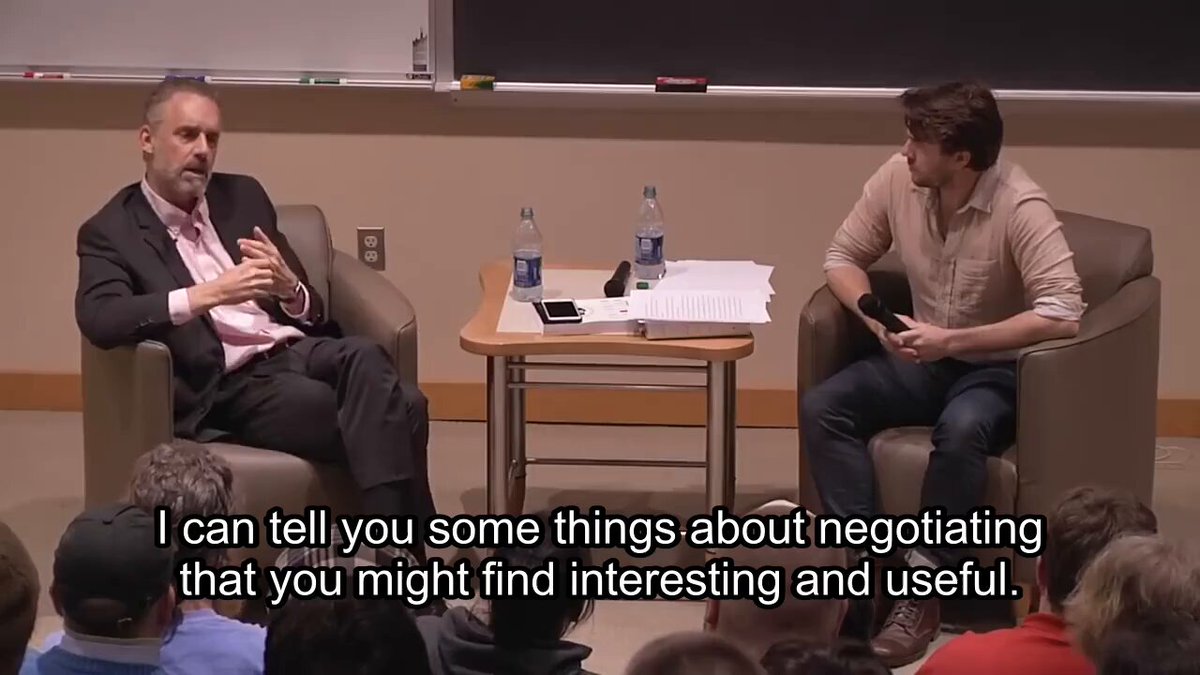
Jordan Peterson: "If you can't fix your room, you can't fix your life" "Why should you even bother improving yourself? The answer is something like: so you don't suffer anymore stupidly than you have to. And maybe so others don't have to either. It's not some casual self-help doctrine. If you don't organize yourself properly, you'll pay for it. In a big way. And so will the people around you." Peterson continues: "You can say, 'Well, I don't care about that.' But that's actually not true, you do care about it. Because if you're in pain, you will care about it. It's very rare that you can find someone in excruciating pain who would say, 'Well, it would be no better if I was out of this.' Pain brings the idea that it would be better if it didn't exist along with it. It's incontrovertible." On how to start: "Look around for something that bothers you and see if you can fix it. You can do this in a room. Sit in your bedroom and think: 'If I wanted to spend ten minutes making this room better, what would I have to do?' You have to ask yourself that, it's a genuine question. And things will pop out. There's a stack of papers bugging you. Some rubbish behind your computer monitor you haven't attended to for six months. Cables tangled up." He explains why this matters: "If you were coming to see me for psychotherapy, the easiest thing would be to get you to organize your room. You think, is that psychotherapy? It depends on how you conceive the limits of your being. Start where you can start. If something announces itself as in need of repair that you could repair, fix it. Fix a hundred things like that, your life will be a lot different." On fixing what you repeat every day: "People tend to think of their daily routines as trivial. You get up, brush your teeth, have breakfast. Those probably constitute 50% of your life. People think, they're mundane, I don't need to pay attention to them. No, that's exactly wrong. The things you do every day are the most important things you do. Hands down. Just do the arithmetic." On staying within your competence: "Sometimes you don't know how to fix something. Imagine you're walking down the street and there's a guy who's alcoholic and schizophrenic and has been homeless for ten years. That's a problem. It would be good if you could fix it, but you haven't got a clue. You walk around that and go find something you could fix. Just because something announces itself as in need of repair doesn't mean it's you, right then and there, who should repair it. You have to have some humility. You don't walk up to a helicopter that isn't working and just start tinkering away." Peterson shares the key insight: "As soon as you give your mind a genuine aim, it'll reconfigure the world in keeping with that aim. That's actually how you see to begin with. You've all seen the video where you watch basketballs being tossed back and forth, and while you're doing that, a gorilla walks into the middle of the video and you don't see it. If you thought about that experiment for five years, that would be about the right amount of time to spend thinking about it." He explains what it reveals: "What it shows you is that you see what you aim at. If you can get one thing through your head, that would be a good one. You see what you aim at. One inference you might draw from that is: be careful what you aim at. What you aim at determines the way the world manifests itself to you. So if the world is manifesting itself in a very negative way, one thing to ask is: are you aiming at the right thing?"

Jaynit

68,550 просмотров • 3 месяцев назад