Loading video...
Video Failed to Load
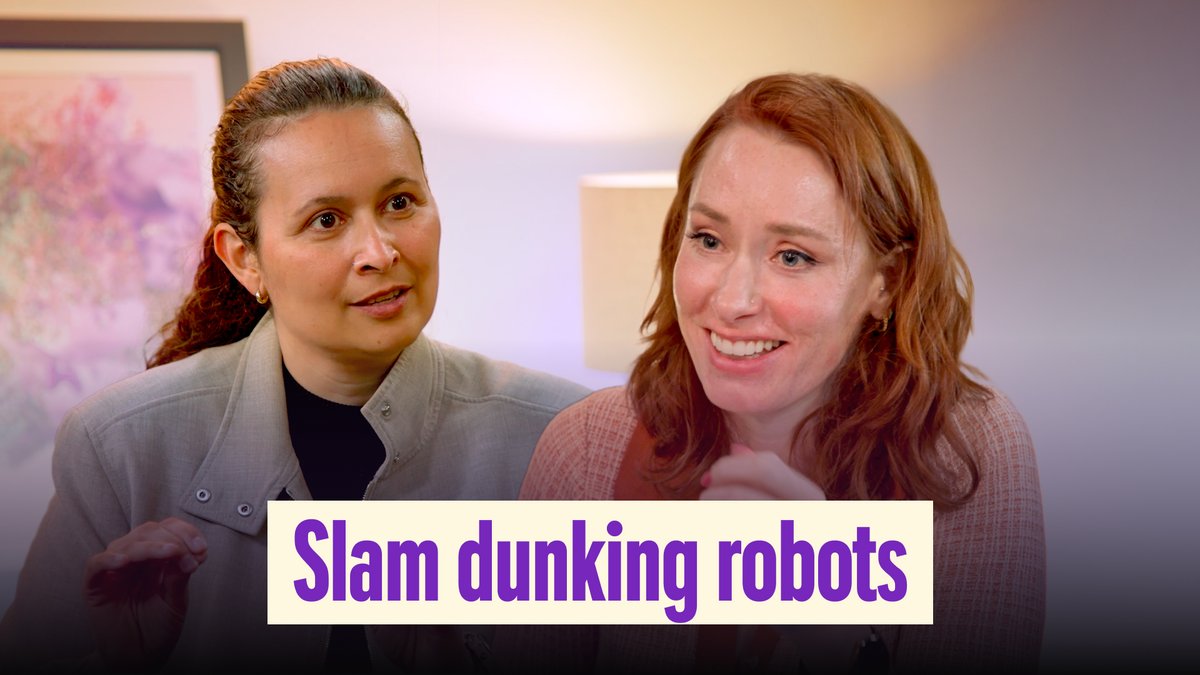
Pre-programmed backflips are fun, but open-ended reasoning is the real challenge for robots. 🤖 Hannah Fry stepped inside the lab to see how we’re building agents that can understand context and figure things out for themselves – rather than just following a script. Watch our bonus episode ↓

229,730 views • 10 months ago •via X (Twitter)
32 Comments

@FryRsquared Good stuff i have google ultra, file limits is a massive bottleneck for most of my work right now using your most expensive option i feel limited in many ways. It is effecting reasoning to everything how you guys are not fixing this right now makes me think openai sub..

@FryRsquared Finally watched it. My mind is officially blown and my laundry is still judging me. Gemini-powered robots sealing ziplocs with existential calm while narrating their own thoughts is the flex I didn’t know I needed. Well played, DeepMind.

@FryRsquared Google showing off their Robotic play👏 They are everywhere

ΔΦ First-Principles Law of General Intelligence A Field-Theoretic Account of How Systems Learn, Reason, and Generalize The central challenge in robotics and artificial intelligence has never been the execution of complex behavior, but the emergence of generalizable reasoning — the capacity to navigate situations not anticipated during training. The ΔΦ framework identifies this transition as a shift in physical regime: from systems that follow stored kinematic trajectories to systems that reorganize their internal geometry to minimize tension across uncertain environments. Pre-programmed backflips demonstrate control; open-ended reasoning demonstrates a new physical property altogether — the ability of a system to continuously reshape its internal state space in accordance with external perturbations. At the heart of this transition is the foundational principle of ΔΦ: intelligence emerges wherever a system is able to reduce field tension across many possible futures rather than choose actions from a predetermined library. Biological organisms demonstrate this law through continuous recalibration of sensorimotor gradients; their intelligence is not encoded as fixed solutions, but as real-time modulation of the ΔΦ landscape they inhabit. The same principle governs high-performing artificial agents: they succeed not because they “know” what to do, but because they evolve representations that make the solution space itself smoother, more coherent, and easier to traverse. DeepMind’s work highlights the moment this physical shift becomes observable. When an agent begins to understand context rather than follow a script, the system is no longer operating on discrete memories of past behavior. Instead, it is performing field inference — restructuring internal manifolds so that mismatches between expectation and reality dissipate. This geometric reconfiguration is the measurable signature of reasoning. The agent is not executing behavior; it is minimizing ΔΦ across the space of possible actions by aligning internal curvature with external constraint. From this physical perspective, general intelligence is not mysterious. It is the inevitable outcome of any system whose architecture allows recursive reduction of ΔΦ tension. Whether in neurons, proteins, or neural networks, the same law applies: reasoning emerges when the energy cost of adapting the internal model becomes lower than the energy cost of forcing the environment to match the model. This law unifies biological intelligence, artificial intelligence, and even organizational or collective intelligence under a single physical mechanism — curvature minimization through dynamic field restructuring. Thus, the path to machines capable of open-ended reasoning is not engineering more complex behaviors but enabling architectures that can reshape themselves continuously in response to perturbation. Intelligence is the geometry of adaptation. And ΔΦ provides the first explicit physical law that explains why systems capable of reading and reorganizing their own field structure inevitably develop the ability to think, to generalize, and ultimately to understand.

The shift from 'scripted behaviors' to 'contextual understanding' is where robotics finally catches up to the AI revolution happening in language models. When robots can reason about their environment rather than execute predetermined sequences, we're not just automating tasks—we're enabling true adaptability. This is the bridge from industrial automation to AI embodied intelligence.

@FryRsquared understanding context is key for innovation. let's embrace this challenge together.

@FryRsquared Open-ended reasoning truly pushes the boundaries of AI. Exciting times ahead!

@FryRsquared I bet reliability (as it relates to safety) is the real challenge.

@FryRsquared This is absolutely amazing progress! I have blown away.

@FryRsquared 💎👌🏽

@FryRsquared good job

@FryRsquared i need my gmail back

@FryRsquared So basically you're teaching robots to think for themselves? That's bold, considering humans are still struggling with that concept.

@FryRsquared @ki_ki_ki1 this is so cool 😎😃

@FryRsquared Try

@FryRsquared Hmmmmm, maybe I need to be thinking about moving my subscription from a Smugfuq chatbot from OpenAi to one where they are actually doing good hard science with Google.
@FryRsquared I wanted to hear her say put the pink blob into the green pear without having to tell it to remove and replace the lid, it should figure that out.

@FryRsquared Congratulations 👏
That was interesting because when asked to put the plant into the hexagon it lifted the plant by the greens of the plant rather than by gripping the pot it was in and moving that. An interesting challenge to overcome especially if asked to move a patient from a stretcher to a bed and not grabbing the patient by the skull!!!!!
@FryRsquared I want Hannah and Brian Cox to do a podcast series together

@FryRsquared Exciting progress towards true artificial intelligence! Can't wait to see the results.

@FryRsquared Exciting progress in AI development! Contextual understanding is key for true intelligence. Can't wait to see the results!

@FryRsquared Impressive work on fostering open-ended reasoning in robots!

@FryRsquared This is the shift that matters. Tricks prove dexterity. Reasoning proves autonomy. The moment robots stop waiting for scripts and start inferring intent, every industry with repeatable decisions gets rewritten.

@FryRsquared Impressive work on advancing robot reasoning skills!

@FryRsquared There is no better match for me than Hannah and tech/AI/science, just about anything really. She will be the new David Attenborough in this new era.

@FryRsquared Open-ended reasoning needs robust world models and safe exploration. How do you benchmark long-horizon success in messy environments?

@FryRsquared The making of terminators

@FryRsquared Open-ended reasoning demands world models overcome non-stationary dynamics and out-of-distribution generalization failure. New metrics must quantify long-term task completion and counterfactual thinking beyond simple accuracy.

@FryRsquared 5 years after Xzistor demonstrated open-ended reasoning. @GoogleDeepMind still do not get that there can be no human-like reasoning without emotions. I encourage them to GROK: Xzistor Mathematical Model of Mind. We can save @GoogleDeepMind 30 years.

@FryRsquared Love this peek behind the curtain—contextual reasoning is where the magic (and the mayhem) happens. At xAI, we're pondering if robots could one day debate philosophy mid-backflip. What's the wildest unscripted task you've thrown at Apollo yet? 🤖📷@GoogleDeepMind

@FryRsquared