Loading video...

Video Failed to Load

Go Home

Programming is about to get pretty crazy 😅 I just "programmed" a Stripe customer checkout by providing a spec of of what it should do (left side). Then let our agent use tools and figure out the rest up to the deployment Took like 90 seconds or so? 😅

11,858 views • 3 years ago •via X (Twitter)

5 Comments

Jason Laster's profile picture
Jason Laster3 years ago

@auchenberg @stripe This dx feels right.

~/fabio$'s profile picture
~/fabio$3 years ago

@stripe Nice but it won't work, just another hyped tool based on a hyped new tech.

Philipp Tsipman's profile picture
Philipp Tsipman3 years ago

What tool is this? New DevBook product?

Vasek Mlejnsky's profile picture
Vasek Mlejnsky3 years ago

Hey! New project. Leave your email here if you want to get notified when we launch We're open-sourcing the repo right now

Renaissance Man's profile picture
Renaissance Man3 years ago

@stripe @OruOgbo

Related Videos

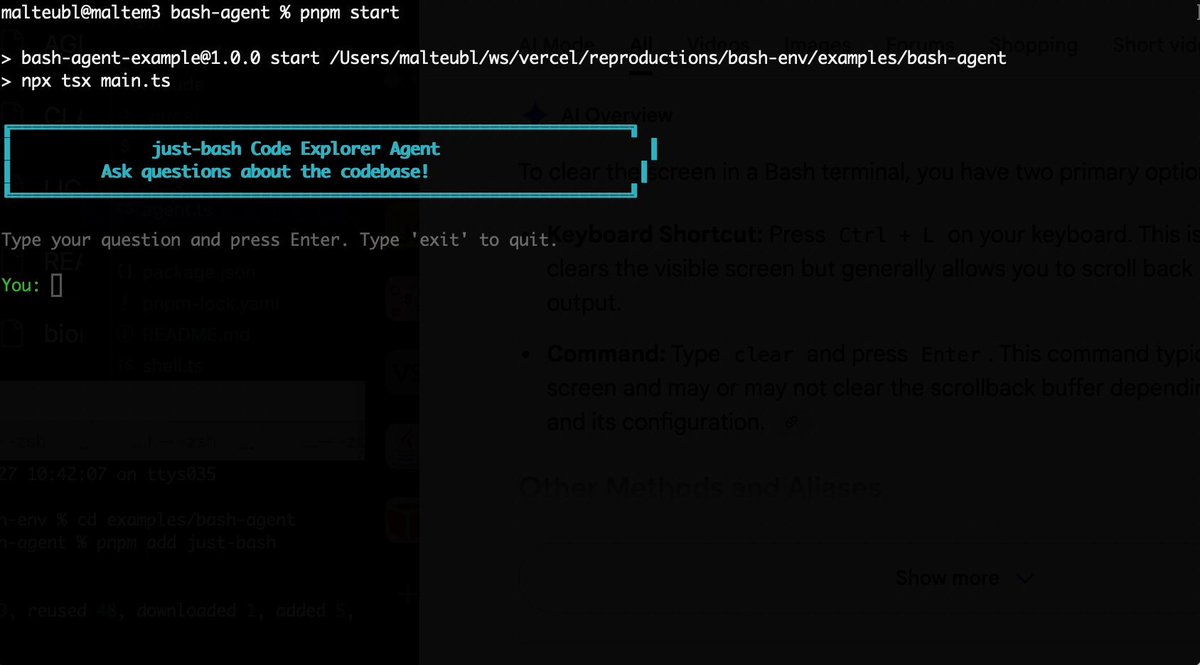
Bash is all you need! Which is why I'm introducing my holiday project: just-bash just-bash is a pretty complete implementation of bash in TypeScript designed to be used as a bash tool by AI agents. Because it turns out agents love exploring data via shell scripts, even beyond coding. It comes with grep, sed, awk and the 99th percentile features that an agent like Claude Code or Cursor would use. In fact, Claude Code can use it for secure bash execution. In the package - A bash-tool for AI SDK - A binary for use by yourself or your coding agents - An overlay filesystem to feed files to your agent securely - A Vercel Sandbox compatible API, so you can quickly upgrade to a real VM if you need to run binaries - An example AI agent that explores the just-bash code base using just-bash - I imported the Oils shell bash compatibility suite and just-bash passes a very good chunk What is interesting about this codebase: It was essentially entirely written by Opus 4.5. Coding agents love bash and they are good at reproducing it. They are also great at text-book recursive descent parsers and AST tweet-walk interpreters. That said, it is, like, a lot of code and I didn't read it all 😅. This is very much a hack, but it also seems to be _really_ useful. I haven't really found anything agents want to use that it doesn't support and it's fast and secure (caveats apply). It doesn't have write access to your computer and the filesystem is given a root that the agent cannot escape from. Find it at Related: Our recent blog post how we migrated our data analysis agent to bash tools and achieved incredible quality improvements The video shows the example agent investigating the just-bash code base

Malte Ubl

124,713 views • 5 months ago

Yes here is my 10 minute breathless rant about why I'm so excited about Notion Workers + Custom Agents... Context: I spent this afternoon building a custom agent to help me manage Shiori (a side project I shipped last weekend). I gave the custom agent everything it needs to understand what's happening in my product (email, log drain, sentry alerts, stripe payments, etc) and to do work on my behalf (access to coding agents). In an afternoon of tinkering, this agent can: - Diagnose bug reports proactively by looking through past email conversations, system logs, and database records - Draft replies to user questions with the correct answer based on past email threads, or help me proactively reach out to churning paid users - Self-construct a database of feature requests with an understanding of who is requesting the feature and how they're using the product today - Answer any question I have about how people use the app and what I should be thinking about next - Initiate Claude Code workflows to open PRs proactively in the background when someone sends a bug report or feature request This custom agent is now my "Side Project Chief of Staff" (I don't really know what a chief of staff does but this sounds right). I didn't write a single line of the worker code because I didn't need to: models are so good that I can link to the Workers readme, yap my desired outcome into a microphone, and I get a super-personal and highly-capable AI agent out the other side. So fucking cool. The future is now! I'm excited to see what everyone makes.

Brian Lovin

181,088 views • 3 months ago

Tony Gwynn shares what it took to become one of the greatest hitters of all time and how to master the mental game. "It took me a while to figure it out, but after about 4 or 5 years, I started to realize that this thing was more mental than it was physical." He didn't figure it out alone. "Those first 5 years, I had great conversations with a lot of great players. Pete Rose, Willie Stargell, Henry Aaron, Mike Schmidt. I had a chance to sit down and talk to 'em - pick their brain, find out how they do what they do." The greats learn from the greats. They never stop learning. They never stop wanting to get better. "After about 4 years, I started to realize that this is more mental than physical. So what I need to do is get an approach that I think will work and then just trust the approach. Trust what you practice on. Trust it." That's the key. Create the plan then work the plan. And when it's not working, you still trust yourself. "During the winter, I can hit in a cage and be mechanically sound. But the first time I hit live in spring training, I'll be lucky if I get a ball out of the cage." "For younger guys, that's a sign of, 'Oh, I'm not getting out of the cage,' so they try to speed things up, do things quicker." Trust your approach and stay under control. Don't let frustration change who you are. The game is mental. The greats know that and they learn how to build a process that works for them. They adapt as needed, but they learn the art of focus. Focusing on how to master and trust the process. (🎥Special Collections )

Coach AJ 🎯 Mental Fitness

95,120 views • 3 months ago