Загрузка видео...

Не удалось загрузить видео

На главную

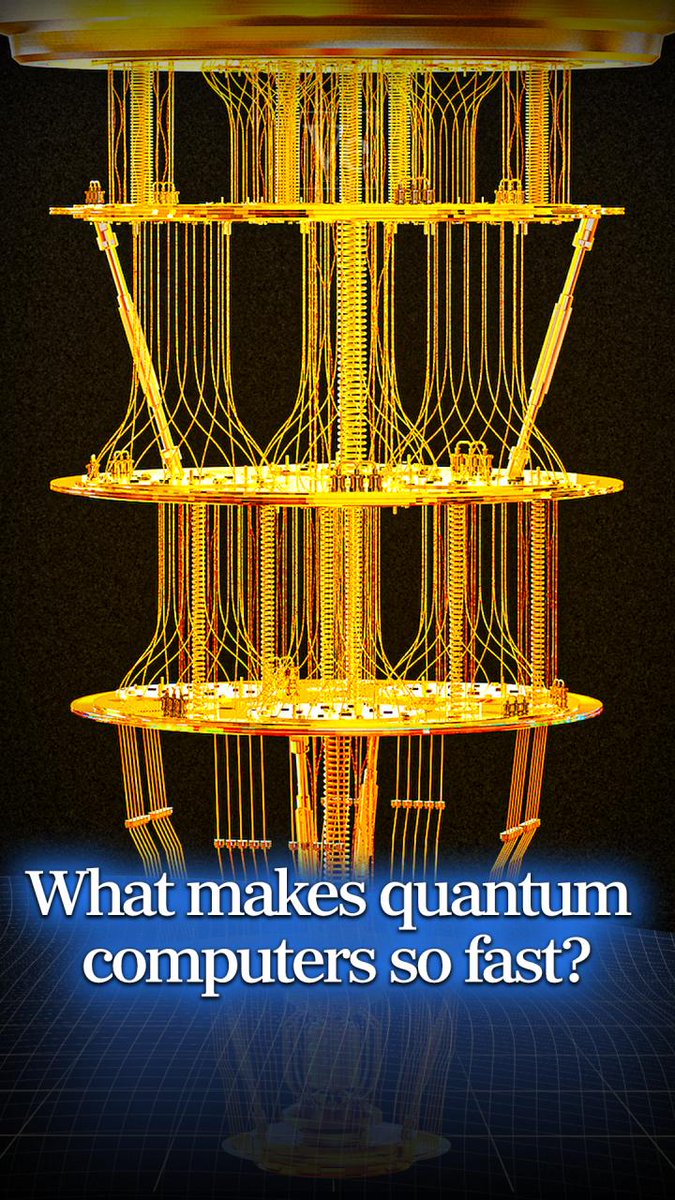
Quantum advantage doesn't only mean quantum computers are faster than classical ones. Sit down while prof Colton Dillion breaks it down further. Part five:

92,183 просмотров • 1 месяц назад •via X (Twitter)

Комментарии: 0

Нет доступных комментариев

Здесь появятся комментарии из оригинального поста
Похожие видео

QUANTUM COMPUTING COULD UNLEASH THE MOST POWERFUL AI EVER BUILT. BUT WHO REALLY CONTROLS IT? The Pentagon has invested more than $150 million in quantum computing, a technology most Americans have never used, but one that could reshape artificial intelligence, drug discovery, encryption, national security, and surveillance. Quantum computers use qubits instead of ordinary binary bits. Unlike traditional bits, which are either a one or a zero, qubits can represent multiple possibilities at once. That gives quantum systems the potential to solve certain complex calculations beyond the reach of today’s computers. President Trump signed two executive orders this year to accelerate quantum development and prepare U.S. systems for quantum-era cyber threats. IBM is also working toward a machine with at least 1,000 programmable qubits, a major step toward more powerful quantum systems. The potential is enormous. Paired with AI, quantum computing could help researchers model disease, study pollution, test new materials, and examine massive problems faster than ever. But the risks are enormous too. The same technology could expand surveillance, undermine encryption, and give those who control it unprecedented power to predict and influence human behavior. The question is not just what quantum-powered AI can do. It is who controls it, and whether the public will have any protection from it. Austin Steinbart (Austin Steinbart) joins me to break down quantum computing, AI, surveillance, and what this technology could mean for society.

Ben Swann

10,547 просмотров • 25 дней назад

$IONQ "The world still massively underestimates just how disruptive it's going to be." Chris Ballance IonQ President of Quantum Computing laid out the whole picture with Kearney's Brent Smolinski. Start to finish: What it is → Quantum computers run on quantum physics, not classical logic - for Ballance, the most powerful form of computing the laws of physics allow. They solve in minutes what a classical machine couldn't crack in the lifetime of the universe. Where we are → "The end of the beginning." Real systems exist, you can buy one from IonQ today, and the field is speed-running the computing revolution. The race now: who scales the best platform the fastest. The value comes in three eras → - Early: problems classical can't touch - chemistry & drug discovery (with AstraZeneca), crash-analysis simulation (with Ansys). - Middle: familiar work, but faster, better or far less energy - AI fine-tuning, most likely hybrid: a GPU farm and a quantum computer side by side, more than the sum of their parts. - Late: unknown. The killer applications are never the ones you expect. Quantum advantage → Not a benchmark stunt - a better solution per dollar invested in quantum than classical. Hard to spot, but already real for certain early problems. The economics → His sharpest line: compute is now just a markup on electricity. With a fixed budget, the question is classical or quantum - and some of the first quantum wins won't be faster, just orders of magnitude cheaper. The architectures → Superconducting (IBM, Google): first-mover lead and standard chip fabs - but chips chilled to a thousandth of a degree above absolute zero, huge energy-hungry refrigeration, and a quantum chip "three orders of magnitude harder" than Intel's toughest. It loses coherence fast, too: many redundant qubits, far bigger machines. Trapped ions (IonQ): individual atoms - and an atom is "guaranteed perfect across the universe." No fab variation, far lower error rates, no exotic cooling. The atoms are run by an ordinary classical chip, so IonQ rides the trillion-dollar semiconductor industry instead of inventing a quantum chip. (Oxford Ionics' Electronic Qubit Control, SkyWater foundry) Why it's green → A future million-qubit machine is about a dozen racks drawing minuscule power - orders of magnitude less than a large AI data center. Classical can still gain 10–100×, but not the orders of magnitude quantum unlocks. His call: within ~10 years, some 100-megawatt NVIDIA clusters could sit vacant. Quick-fire → - Most over-hyped: changing biology. - Most underestimated risk: integrating into real customer workflows. - First to adopt: finance ) portfolio analysis & fraud prevention. - Most exciting: the speed of change over the next 24 months. The personal why → What gets him out of bed: reinventing how we think about computation and the belief that the world still underestimates how disruptive this will be. For leaders → Quantum computing is here now. Adopting any new tech takes 2-3 years, so the moment to start isn't next year it's now, so you're ready when the hardware lands. Full conversation below ↓ $IONQ #IonQ #Quantum

TechInnovation

26,310 просмотров • 3 месяцев назад