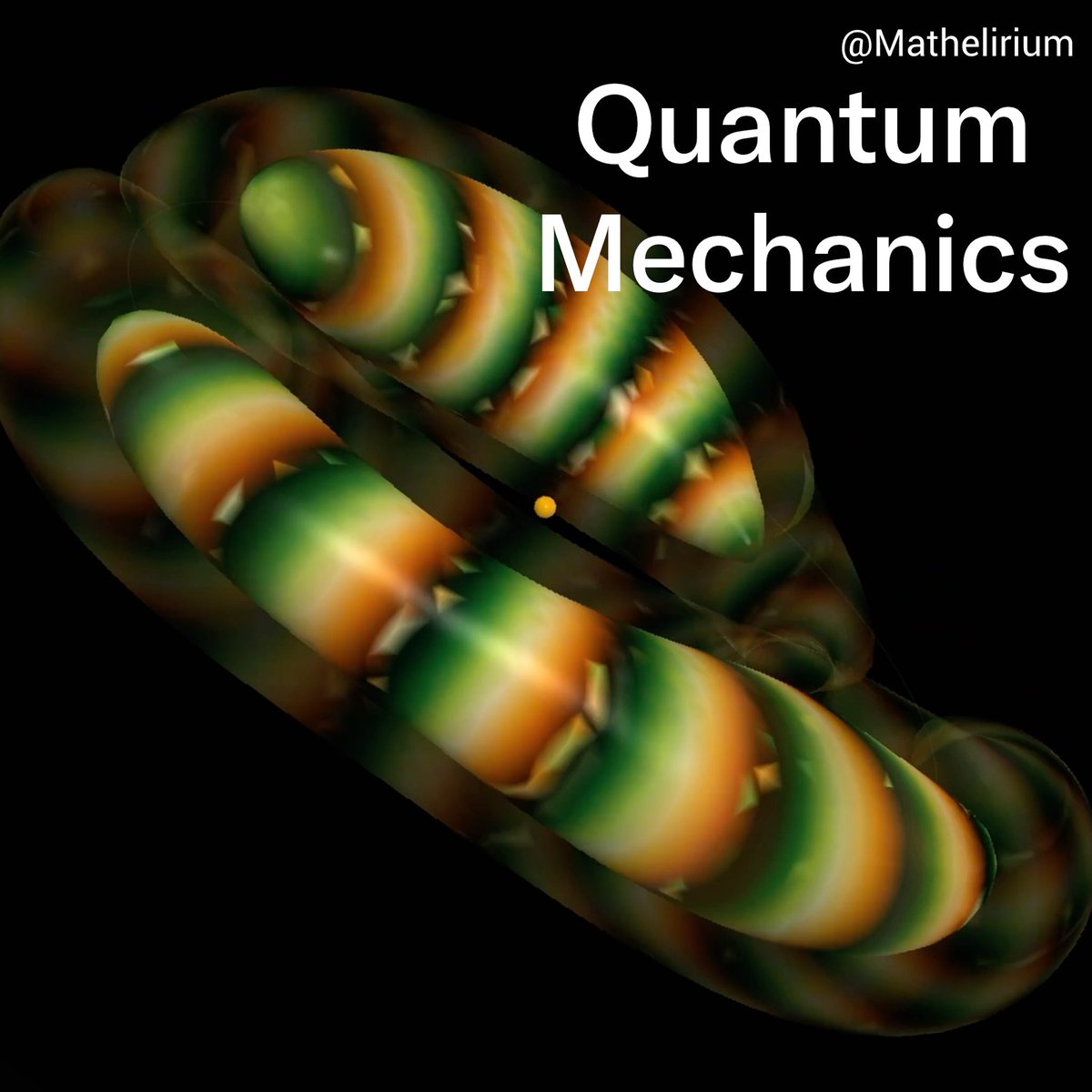
Quantum Mechanics How an Electron Moves Around an Atom Here, we modelled an electron in a Hydrogen…
82K followers
22,032 views
26 Comments
Comments from the original post on X (Twitter)

@AdaptiveAlph
Would be super cool if you could generate the Scalar Strong Interaction theory version of the proton
10 likes

@mathelirium
Added to my to-do list
5 likes
@AdaptiveAlph
Would be super cool to see

@smartserghash
another way to express probability current is following equation… remember, for classical fluid field, current=density•velocity, but for complex-valued quantum field it is rate of change of phase of its harmonics across space. if gradient of phase is zero, there is no current.
4 likes

@WhatMathMeans
Not exactly.
2 likes

@Ostatni_Podcast
So you make visualisation the Theory of prof. Jan Pajak from New Zealand. He found it in 1985. Yes, inside an atom electrons moving like donut, they travel around and they swirl around their own axis. He knew it first in the world.
2 likes

@HenningSittler
Looks like bait?
2 likes
@mathelirium
Lol, yeah it kinda does

@caseywriter
How is the "probability cloud" calculated, meaning is it based on physical measurements? And, sorry for a silly question, what is an electron and why it orbits the nucleus?
1 like

@LoganM78494
can you make it look less like a maggot
1 like

@Merdog
Actually… in Quantum Mechanics, per Quantum Field Theory, via Quantum Electrodynamics, of which, utilizes the Field Operator: ψ⁽ˣ⁾ Opposed to the standard Wave Function: ψ(x) To 3D model the probability density of finding the electron at a specific point around the nucleus, or localized probability clouds, via bound or fixed regions of space per electron energy. ***In Short & Simple: Electrons do not orbit the nucleus, as they are waves fixed within a specific localized probability density cloud region, relative to the nucleus, & based on an electron’s energy level. Electrons stay in a relatively fixed pocket/bubble/blob around the atom, and not in a ring of orbital probability revolving around the nucleus. 😉😉👉
1 like
@RPBachman
I had a bunch of these ruining my garden this year. Never occurred to me that it might be huge Texas-sized Hydrogen molecules. Thanks for the heads up.
1 like
@smartserghash
ideally, this probabilistic evolution of electron would never collapse periodically reviving its skewed shapes due to superposition of various energy eigenstates with different phases and angular momenta.
1 like

@Physixdude13
Would’ve been cool to visualize the d orbital on the dz^2 axis
1 like

@dopiewankenobi
Pretty sure this is a worm

@mattbroadstreet
Getting closer!

@Dave66426026582
This is bullshit Electron is a standing wave propagating 360 degrees

@aylin2012anvar
Враньё! В электрическом поле, так же как и магнитном есть силовые линии. Магнитные линии можно наглядно видеть. Электрон в атоме водорода размазан тонкой плёнкой по поверхности энергетической оболочки в виде шара. Размер этого шара можете узнать у Grok, я не помню точно.

@gimseongho47556
이론보다..그림이 그럴듯하게 잘나왔다, 확률이 구름으로 변해버렸다, 참고로.. 100년 넘은 자동차는 수리비가 새차를 사는것보다 많이 나온다, 버리는것을 권한다,

@Real_Cambria
Interesting


